Identity & taxonomy
- Scientific name
- Caladium bicolor (Aiton) Vent.
- Family
- Araceae
- Genus
- Caladium
- Order
- Alismatales
- IUCN status
- Least Concern (LC)
- Wikidata
- Q10296092
- Arum bicolor Aiton
- Caladium hortulanum Birdsey
- Caladiumen
- Angel wingsen
- Heart of Jesusen
- Elephant ear (small)en
- Kaladium / Änglavingarsv
- Kaladiumno
- Kaladiumda
- Kaladiumfi
- Buntblatt / Kaladiede
Tropical South America: Brazil (Amazon basin) · Guyana · Suriname · French Guiana · Venezuela
How to identify it
Growth habit. Underground tuber sends up a rosette of long-stemmed heart- or arrow-shaped leaves directly from the soil — there is no above-ground stem. In active growth (May–September) the plant produces 6–12 leaves per tuber. From late autumn through spring the entire visible plant disappears: leaves yellow, collapse, and dry, leaving only the tuber resting in the mix.
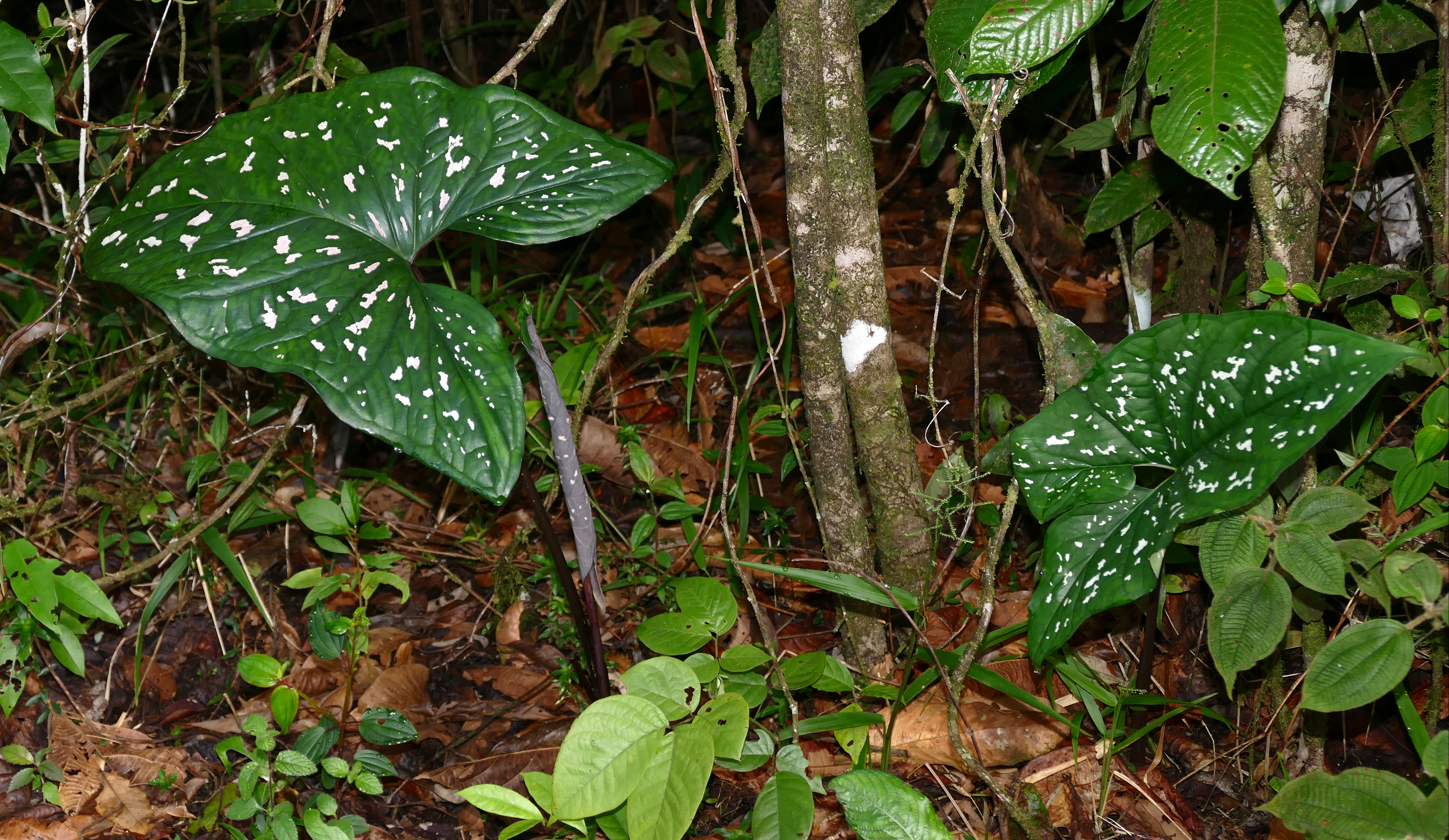
Leaves. Heart-shaped to arrow-shaped (sagittate or cordate) leaves 15–40 cm long on long succulent petioles. Paper-thin, slightly translucent, and patterned in dramatic combinations of white, pink, red, and green that vary by cultivar. The classic 'fancy-leaf' types have rounded leaves; 'strap-leaf' cultivars (Florida Sweetheart, Pink Symphony) have narrower lance-shaped leaves and tolerate brighter light.
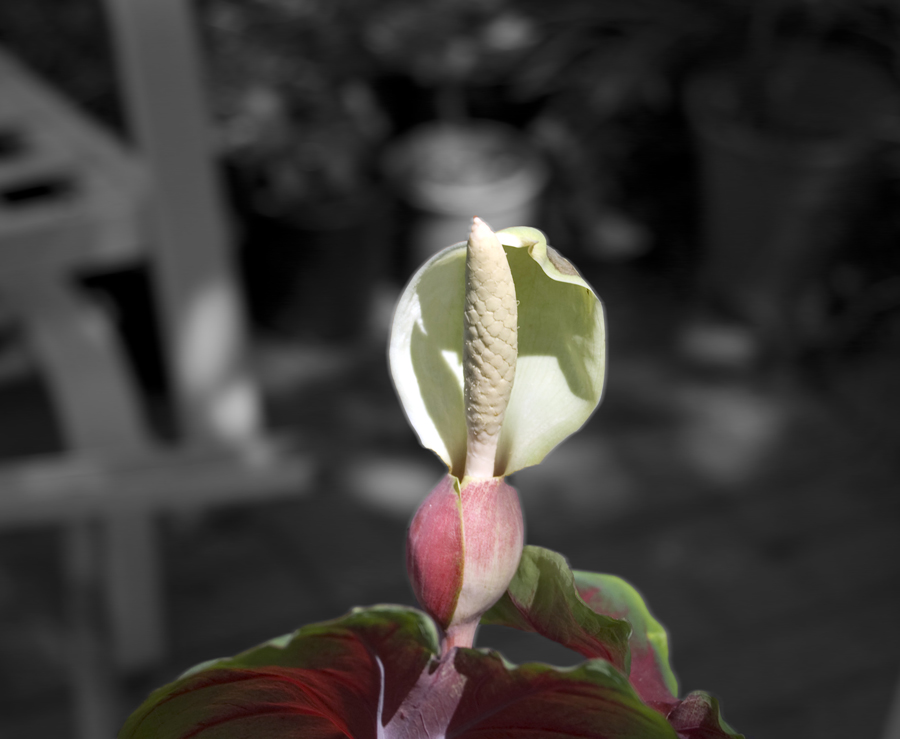
Flowers. Typical aroid spathe-and-spadix inflorescence with a pale green-white spathe, similar in form to a peace lily but smaller and easily missed under the foliage. Flowering is rare indoors and adds little ornamental value — most growers remove the flower spike to direct energy back to the leaves and tuber.
- Paper-thin, almost translucent leaves with sharp colour zones — different from the leathery thick leaves of most aroids.
- Whole plant emerges from the soil with no above-ground stem — leaves rise directly from the tuber.
- Leaves die back completely every autumn; the plant is gone for 4–5 months of the year.
- Many cultivars; classic colours are white-with-green ('Aaron'), pink-with-green ('Florida Sweetheart'), and red-pink-green tricolour ('Red Flash').
- Snaps easily — petioles are watery and brittle, especially compared to philodendron or alocasia.
Commonly confused with
Alocasia / Elephant ear
Alocasias have thick, leathery, often glossy leaves with strongly raised veins and stand on visible above-ground stems. Caladiums are paper-thin, soft, and emerge directly from the soil with no stem.
Taro / True elephant ear
Colocasia leaves are huge (often >50 cm), peltate (the petiole attaches to the centre of the leaf, not the edge), and held drooping or angled downward. Caladiums are smaller and held upright.
Yautía / Arrowleaf
Xanthosoma leaves are larger, thicker, plain green or only faintly variegated, and the petiole attaches at the leaf edge (sagittate). Caladium colour patterning is far more vivid.
Care
Light
Bright indirect; strap-leaf cultivars tolerate morning sun.
An east window or 30–60 cm back from a bright south or west window is ideal. Hot midday sun bleaches the colour out of fancy-leaf cultivars within days. Strap-leaf types ('Florida Sweetheart', 'Pink Symphony', 'Aaron') are noticeably more sun-tolerant and can take 2–3 hours of direct morning sun.
Seasonal: In Nordic apartments the summer (June–August) is the only window with bright enough light to push strong leaf growth — make the most of it.
Water
Evenly moist while in leaf; do not water during dormancy.
Caladiums are thirsty while actively growing. Water as soon as the top 1–2 cm of mix feels dry — typically every 3–5 days in summer. The tuber rots in soggy mix, so a free-draining mix in a pot with drainage is essential. As leaves yellow in autumn, taper watering off completely; the tuber should rest dry through winter.
Seasonal: Winter dormancy: stop watering once leaves yellow. The tuber rests dry from October through April; resume watering only when new shoots emerge.
Soil
Rich, well-drained, slightly acidic mix.
A mix of 2 parts peat-free potting soil, 1 part perlite, and 1 part composted bark holds the moisture caladiums want without going anaerobic. Fresh mix every spring when you replant the tuber keeps the substrate sweet — old wet mix is the most common cause of tuber rot.
Humidity
60 %+; collapses fast below 50 %.
Caladium leaves are paper-thin and lose water fast. Below 50 % humidity the edges go crispy within days. A pebble tray, room humidifier, or grouping with other tropical plants all work. Misting alone is not enough — it raises humidity for minutes.
Temperature
21–27 °C ideal; below 18 °C triggers dormancy.
Caladiums are warm-tropical and will not grow below 18 °C — sustained cool temperatures pull the plant into early dormancy. They tolerate up to 32 °C if humidity is high. During dormancy, store the dry tuber at 13–18 °C; below 13 °C the tuber risks chill damage.
Fertilizer
Half-strength balanced feed every 2 weeks during active growth.
Feed every 2 weeks at half strength from May through August. Stop entirely as leaves begin to yellow in autumn — feeding a dormant tuber rots it. Caladiums are heavy feeders relative to their size and respond well to consistent fertilising.
Pruning
Cut yellowed leaves at the base as they decline.
Trim yellowing or damaged leaves at the petiole base with clean scissors. In autumn allow the leaves to die down naturally — they translocate sugars back to the tuber as they yellow. Cutting them off green steals energy from the tuber and weakens next year's display.
Repotting
Lift and replant the tuber every spring in fresh mix.
In April or May, dig the dormant tuber out of last year's mix, brush it clean, inspect for soft spots (cut these out and dust with cinnamon), and replant 5 cm deep in fresh free-draining mix. Plant the tuber rounded-side-down with the small bumps (eyes) facing up. Water lightly and place somewhere warm (above 21 °C) — sprouts emerge in 2–4 weeks. Slow sprouting almost always means the soil is too cold.
Tuber division
easy~Sprouts emerge in 2–4 weeks at 21 °C+When repotting in spring, cut the tuber into pieces with a clean knife — each piece needs at least one eye (a small bump on the upper surface). Dust the cuts with cinnamon or fungicide and let them air-dry for 24 hours before planting. Each piece becomes an independent plant in 4–6 weeks.
Cultivars
'Aaron'
Pure white centres outlined with a clean dark green margin. The most popular white cultivar — tolerates morning sun better than most caladiums. A classic choice for shady patios.
'Florida Sweetheart'
Dwarf strap-leaved cultivar with hot pink centres bordered by ruffled green. Compact form — ideal for windowsills. One of the University of Florida's strap-leaf selections.
'Red Flash'
Large arrow-shaped leaves with a deep red central blotch, pink veining, and a dark green margin. The most dramatic of the common cultivars.
'White Queen'
White leaves with vivid pink-red veins. Striking when backlit by morning sun.
'Pink Symphony'
Strap-leaved selection with translucent pink leaves veined in green. Notably sun-tolerant for a caladium — bred at the University of Florida.
'Miss Muffet'
Compact dwarf form with chartreuse-green leaves spotted in deep raspberry pink. A polka-dot effect rather than a colour zone.
Common problems
All leaves yellow at once in autumn
Symptom
Healthy plant suddenly has every leaf yellowing in September or October.
Cause
Natural autumn dormancy — the plant is going to rest, not dying.
Fix
Stop watering, let the leaves dry completely, then move the pot somewhere dry at 13–18 °C. Replant the tuber in fresh mix in April or May; new shoots emerge within 2–4 weeks of warm soil.
Crispy leaf edges and faded colour
Symptom
Leaf margins go brown and brittle; colour zones look washed out.
Cause
Humidity below 50 % or too much direct sun.
Fix
Move out of direct afternoon sun. Add a pebble tray or run a humidifier. Caladiums need 60 %+ humidity to look their best.
Tuber doesn't sprout in spring
Symptom
Replanted tuber sits inert in the pot for weeks.
Cause
Soil too cold (below 21 °C) or tuber rotted during storage.
Fix
Move to a warm spot (a heat mat at 24–27 °C works perfectly). If still no shoots after 4 weeks, lift and inspect — a soft, hollow, or smelly tuber has rotted and must be discarded.
Leaves collapse limp despite moist soil
Symptom
Leaves go floppy and translucent overnight.
Cause
Either tuber rot in cold wet soil, or chill damage below 18 °C.
Fix
Check soil temperature; move somewhere warmer. If soil is sodden, lift the tuber and inspect for rot.
- Spider mites in dry indoor air
- Aphids on new growth
- Thrips on leaf undersides
- Tuber rot in soggy mix
- Bacterial leaf spot in stagnant humid conditions
- Pythium root rot
Toxicity & safety
Insoluble calcium oxalate raphides cause immediate burning of the lips, mouth, and tongue on chewing, with intense pain, drooling, and swelling. Severe cases can swell the airway. Wear gloves when dividing tubers — sap on broken skin causes an itchy rash.
Mechanism: Insoluble calcium oxalate raphides (microscopic needle-shaped crystals).
Caladium bicolor — North Carolina State Extension Toxic PlantsDrooling, oral pain, pawing at the mouth, vomiting, and difficulty swallowing. Airway swelling is rare but possible. Contact a veterinarian if a cat chews any part of a caladium.
Mechanism: Insoluble calcium oxalate raphides.
ASPCA Toxic and Non-Toxic Plants — CaladiumDrooling, oral pain, vomiting, and difficulty swallowing. Larger ingestions of the tuber can cause more severe GI signs. Contact a veterinarian.
Mechanism: Insoluble calcium oxalate raphides.
ASPCA Toxic and Non-Toxic Plants — CaladiumWhy your caladium 'died' in October — and how to bring it back next May
The single most common caladium experience: a beautiful tropical foliage plant from a garden centre, three months of dramatic colour, then in October every leaf yellows and the plant looks dead. Most owners throw it out. Almost all of those plants were not dead — they were entering the natural dormancy that is the species' defining lifecycle quirk.
Caladium bicolor is a tropical tuber that grows during the warm wet season and rests through the cool dry one. The yellowing leaves in autumn are the dormancy signal. The tuber under the soil is alive and resting — store it dry at 13–18 °C through winter, then replant in fresh mix in April or May. New shoots emerge within 2–4 weeks of warm soil, and by midsummer the plant is back in full leaf, often more vigorous than its first year.
Almost all the colourful caladium cultivars sold worldwide are descendants of selections bred by a single Florida nursery in Lake Placid, Florida — the self-styled 'Caladium Capital of the World'. Lake Placid still grows over 90 % of the world's caladium tubers; the entire annual supply for European garden centres is shipped from a 50-mile patch of central Florida farmland.
Frequently asked · 5
Are caladiums safe for cats and dogs?+
No — Caladium bicolor is toxic to cats and dogs. All parts contain insoluble calcium oxalate raphides, which cause immediate oral pain, drooling, vomiting, and difficulty swallowing on chewing. Contact a veterinarian if a pet chews any part of a caladium. Wear gloves when dividing tubers — the sap can also cause skin irritation in humans.
Why did all my caladium's leaves die?+
Almost certainly natural autumn dormancy, not death. Caladiums die back to the tuber every autumn and rest through winter. Stop watering, let leaves dry, lift the tuber and store dry at 13–18 °C, then replant in fresh mix in April or May. New shoots emerge within 2–4 weeks of warm soil.
How often should I water a caladium?+
While actively growing (May–September), keep the mix evenly moist — water when the top 1–2 cm feels dry, typically every 3–5 days. As leaves yellow in autumn, stop watering completely; the tuber rests dry through winter. Resume watering only when new shoots emerge in spring.
Why are my caladium's leaf edges turning brown?+
Almost always low humidity. Caladium leaves are paper-thin and need 60 %+ relative humidity to keep their edges. Indoor air below 50 % causes crispy margins within days. Add a pebble tray or run a humidifier; misting alone is not enough.
Can I keep my caladium evergreen?+
Not reliably — the dormancy is hardwired by photoperiod and temperature. Some growers can stretch the active season by keeping the plant above 21 °C and providing supplemental light, but most caladiums will go dormant whatever you do. Treat dormancy as a feature, not a bug: it lets you store the tuber compactly through winter.
- Are Houseplants Toxic to Cats and Dogs? A Quick-Scan Safety Guide
- My Cat or Dog Just Ate a Houseplant — What to Do Right Now
- Alocasia Varieties: Polly, Frydek, Zebrina, Silver Dragon, and the Rest of the Jewel Aroids
- Humidity for Houseplants: What Actually Matters (and What Doesn't)
- Indoor Humidity for Houseplants in Winter: What Actually Works