
Identity & taxonomy
- Scientific name
- Pteris cretica L.
- Family
- Pteridaceae
- Genus
- Pteris
- Order
- Polypodiales
- IUCN status
- Least Concern (LC)
- Wikidata
- Q161219
- Pycnodoria cretica (L.) Small
- Cretan brake fernen
- Ribbon fernen
- Table fernen
- Pteris fernen
- Krittornbunkesv
- Krittbregneno
- Kreta-bregneda
- Kreetansaniainenfi
- Kretischer Saumfarnde
Mediterranean basin · Africa (sub-Saharan and South Africa) · Tropical and subtropical Asia · Australia · Naturalised widely in temperate and tropical climates
How to identify it
Growth habit. Compact clumping evergreen fern with arching to nearly horizontal fronds emerging from a short underground rhizome. New fronds unfurl as fiddleheads (croziers) from the rhizome and elongate over weeks. The plant adds 4–6 new fronds per year indoors. Older fronds yellow and dry from the tip; trim them out at the rhizome to keep the clump tidy.
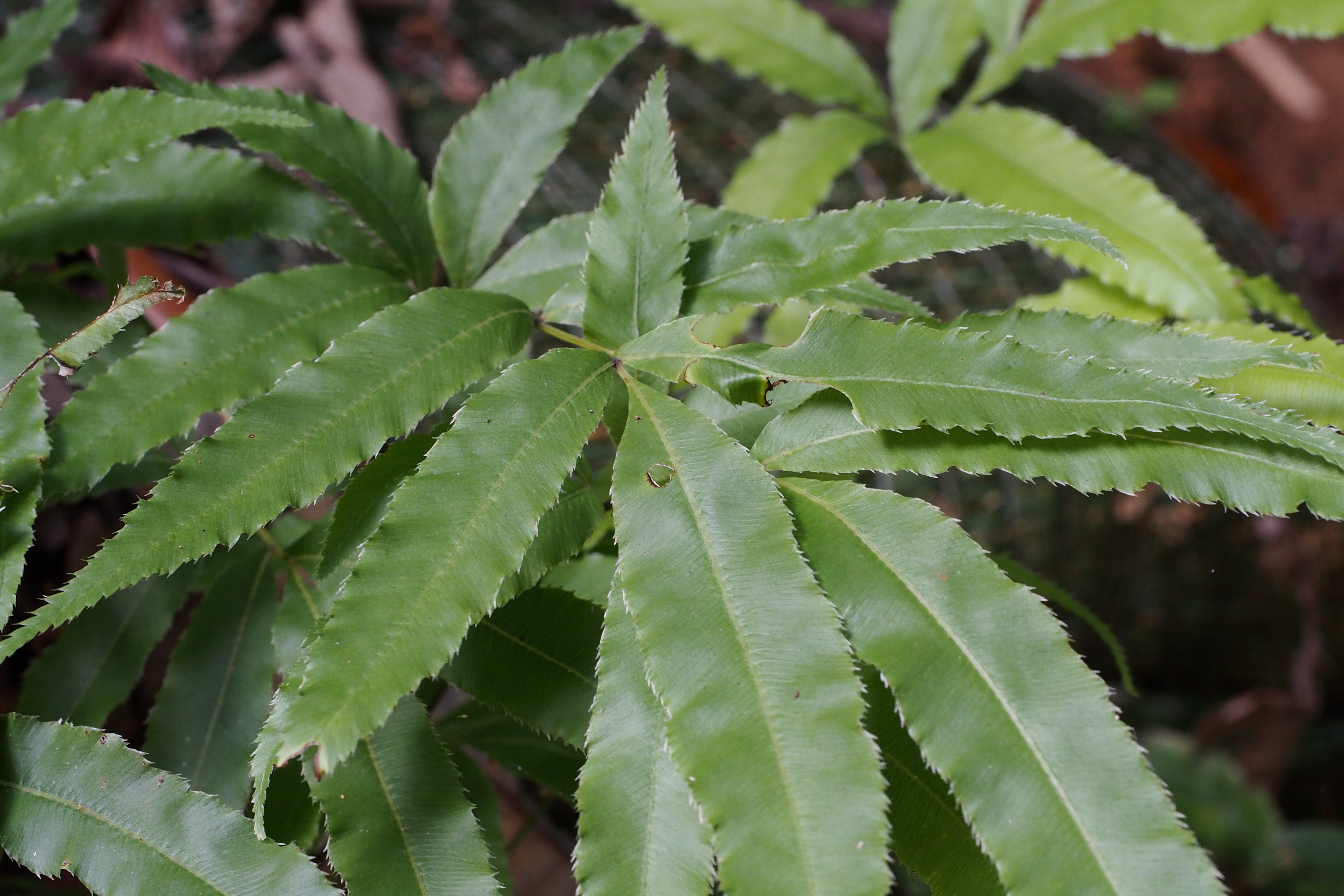
Leaves. Pinnate fronds 30–50 cm long with 3–5 (rarely up to 7) pairs of long ribbon-shaped pinnae arranged in opposite pairs along a central pale-green rachis (frond stem). Each pinna is 10–15 cm long and 0.5–2 cm wide, with serrated margins. In var. albolineata and most popular cultivars, each pinna has a broad cream-white central stripe with green margins. Texture is herbaceous, slightly leathery; surface is smooth and hairless. Fertile fronds carry sori (spore-bearing structures) along the underside margins of pinnae as continuous brown bands in late summer.
- Small number (3–5 pairs) of long ribbon-shaped pinnae per frond.
- Variegated cultivars have broad cream-white central stripe along each pinna.
- Pinnae 10–15 cm long, ribbon or strap-shaped — never lacy.
- Pale-green herbaceous texture with serrated pinna margins.
- Compact clumping habit; arching frond posture.
Commonly confused with
Boston fern
Long sword-shaped fronds with hundreds of finely divided narrow pinnae — classic 'lacy fern' silhouette. Demands much higher humidity. Drops dry leaflets prolifically. Pteris is much simpler in structure and drier-tolerant.
Button fern
Round button-like leathery pinnae 1–2 cm across on dark wiry stems. Pteris pinnae are long ribbons 10–15 cm. Both tolerate dry air, but visually distinct.
Bird's nest fern
Undivided strap-shaped fronds in a rosette — no separate pinnae. Pteris fronds are clearly subdivided into a few large pinnae. Different growth habit entirely.
Silver lace fern
Sister species in same genus; even narrower variegated pinnae and a more delicate appearance. Same care needs.
Care
Light
Medium to bright indirect light; avoids direct sun.
An east window, a north-bright window, or 1.5 m back from a south or west window with a sheer curtain. Pteris cretica handles a wider light range than most ferns and tolerates lower light, making it suitable for a desk corner or the dimmer end of a bookshelf. Direct unfiltered noon sun bleaches the variegation. The variegated cultivars need slightly MORE light than plain green forms to maintain pattern.
Seasonal: Nordic latitudes above 55°N: tolerates the dim winter without complaint. Variegation may fade slightly in mid-winter; new spring growth restores full pattern.
Water
Top 2 cm dries — every 5–7 days.
Pteris cretica needs more consistent moisture than button fern but less than Boston or maidenhair. Let the top 2 cm dry between waterings, then water thoroughly until runoff. Letting the rootball fully dry causes leaf-tip browning and fiddlehead failure; keeping it constantly soggy rots the rhizome. The species is forgiving of brief lapses in either direction — one of the qualities that makes it the easiest fern indoors.
Seasonal: Reduce frequency by about a third in winter when growth slows.
Soil
Free-draining peat-free houseplant mix with extra perlite.
Two parts peat-free houseplant mix, one part perlite, one part fine bark. Pteris cretica originated in Mediterranean limestone scrub and tolerates a wider pH range than most cultivated ferns — slightly alkaline conditions are fine, unlike most ferns which strictly need acid soil.
Humidity
40–60 %; tolerates 35 % grudgingly.
More tolerant of dry indoor air than Boston, maidenhair, or birds-nest ferns. 40 % humidity (typical heated apartment in winter) is workable; below 35 % the leaf-tips brown and the variegation may fade. A pebble tray or humidifier helps but is not strictly required for survival.
Temperature
13–22 °C; tolerates 10 °C briefly.
Cooler-tolerant than tropical ferns. Native habitat in Mediterranean and montane Africa includes cool winters, and the plant accepts a 13 °C bedroom or hallway without complaint. Avoid sustained heat above 25 °C combined with dry air.
Fertilizer
Half-strength balanced feed monthly in growing season.
Half-strength balanced NPK monthly April–September. Pteris is a light feeder; over-fertilising shows as crispy leaf tips and salt build-up. Skip feeding October–March.
Pruning
Trim spent yellow fronds at the rhizome.
Cut yellowed or browned fronds out at the base of the petiole, close to the rhizome, with sharp scissors. New fronds emerge from the rhizome through the year; trimming old material keeps the clump tidy and lets new fronds emerge cleanly.
Repotting
Every 2–3 years in spring; tolerant of pot-binding.
Move up by one pot size only. Pteris cretica grows steadily but doesn't sprawl, and a pot too large stays wet at the bottom and risks rhizome rot. Refresh top 3 cm of soil annually in non-repot years.
Division of the rhizome
easy~Immediate; recovery 4–8 weeksAt repotting time, lift the clump and tease apart into 2–3 sections, each with several fronds and a healthy share of rhizome and roots. Pot each into a fresh pot of free-draining mix. Water once well, keep slightly shaded for 2 weeks, and resume normal care once new fronds appear. The most reliable propagation route.
Spore propagation
moderate~9–15 months to a small plantPteris cretica is easier to grow from spores than most cultivated ferns. Collect ripe spores from brown sori bands on fertile pinnae; sprinkle on the surface of damp sterile peat-free mix in a covered container. Prothalli emerge within 4–8 weeks; sporophytes (small fern plants) appear over the following year. The species naturally self-sows in greenhouse conditions and seedlings can be lifted from neighbouring pots — sometimes the easiest way to acquire new plants.
Cultivars
var. albolineata
The most common cultivated form: each pinna has a broad cream-white longitudinal central stripe with green margins. The variegated 'standard' Cretan brake.
'Mayii'
Crested form with frilled tips on each pinna; variegation similar to var. albolineata.
'Wimsettii'
Highly divided, frilled, and crested fronds with pale variegation; 'lacy' look.
'Rivertoniana'
Forked finger-like pinnae with strong variegation; sculptural shape.
Common problems
Brown leaf tips
Symptom
Tips of pinnae go brown and crispy; rest of frond stays green.
Cause
Most often low humidity below 40 %; less often fluoride/salt build-up or underwatering.
Fix
Run a humidifier nearby aiming for 50 %+. Switch to rainwater or filtered water. Trim brown tips with scissors following natural pinna shape; new fronds emerge clean within 4–6 weeks once humidity stabilises.
Variegation fading on new fronds
Symptom
New fronds emerge mostly green with a thin or absent cream stripe.
Cause
Light too low — variegated forms need brighter conditions to develop full pattern.
Fix
Move to a brighter indirect spot. Variegation should return on new fronds within 6–10 weeks. Consider supplemental grow lighting in winter at high latitudes.
Fronds yellowing rapidly
Symptom
Multiple fronds go yellow within days.
Cause
Overwatering and root rot, or sudden cold draught.
Fix
Check soil moisture and temperature. If soil is wet, reduce watering frequency and consider repotting in fresh free-draining mix. If cold draught, move to a more sheltered spot above 13 °C.
White cottony tufts at frond bases
Symptom
Cottony white waxy tufts where fronds meet the rhizome or petiole.
Cause
Mealybugs sheltering at the rhizome — a favourite Pteris pest.
Fix
Dab each visible mealy with a cotton bud dipped in 70 % isopropyl alcohol. Repeat weekly for 4 weeks because eggs hatch in waves. Inspect new fronds as they emerge.
Small ferns appearing in neighbouring pots
Symptom
Tiny fern plantlets emerging in the soil of nearby houseplants.
Cause
Normal: Pteris cretica self-sows readily from windborne spores.
Fix
These are 'free' baby ferns. Lift gently and pot into their own small pots. The species' tendency to self-sow is one reason it's so popular — a single mature plant produces many offspring with no effort.
- Scale insects on fronds
- Mealybugs at rhizome and petiole bases
- Fungus gnats in damp soil
- Root rot from waterlogged soil
- Botrytis grey mould in stagnant high humidity
Toxicity & safety
No reported toxicity in humans. Some Pteris species accumulate arsenic from contaminated soil, but this is an environmental phenomenon, not intrinsic plant toxicity.
Pteris cretica — North Carolina Extension Gardener Plant ToolboxASPCA classifies Pteris (Cretan brake fern, table fern, ribbon fern) as non-toxic to cats. Safe for cat households.
Cretan Brake Fern (Pteris cretica) — ASPCA Toxic and Non-Toxic PlantsASPCA classifies Pteris cretica as non-toxic to dogs. Safe for dog households.
Cretan Brake Fern (Pteris cretica) — ASPCA Toxic and Non-Toxic PlantsWhy Cretan brake is the easiest fern indoors
Most popular indoor ferns come from genuinely high-humidity habitats — tropical cloud forest (maidenhair, birds-nest), swamp margins (Boston, sword fern), or deep wet shade (rabbit's foot, asparagus 'fern'). They struggle in dry centrally-heated apartments below 50 % humidity and need active humidity intervention to thrive. Pteris cretica is the practical exception: it's a Mediterranean and temperate African plant adapted to drier scrub habitats and tolerates ordinary indoor air without complaint.
Compare it to the alternatives. Boston fern in a heated Nordic flat in winter sheds dry leaflets continuously and looks ratty by February without a humidifier. Maidenhair fern collapses entirely if humidity drops below 50 % even briefly — it is essentially unkeepable in a typical apartment. Birds-nest fern survives but slows down dramatically. Pteris cretica chugs along, producing new fronds through the winter at a slow but steady pace, with no humidifier and no special attention.
The trade-off is aesthetic: Pteris cretica's frond architecture is simpler than the lacy elaboration of Boston or maidenhair fern. You get a few long ribbon-shaped pinnae rather than hundreds of finely divided ones. For some growers this is a feature (the variegated cultivars look striking and modern); for others the simpler look is less satisfying. If you want classic 'lacy fern' aesthetics and have the humidity to support them, Boston fern or maidenhair is the right choice. If you want a fern that looks like a fern and just grows quietly without constant intervention, Pteris cretica is the answer.
How to identify the popular Pteris cretica cultivars
Pteris cretica has been in cultivation for over 200 years and has produced dozens of named cultivars, most differing in pinna shape, frond divisioning, and intensity of variegation. The four most common in the trade are easy to tell apart at a glance once you know what to look for.
var. albolineata — the basic variegated form. Each pinna has a broad cream-white central stripe with green margins. Fronds are arching, simple-pinnate (3–5 pinna pairs). This is what 99 % of garden centres sell as 'Pteris fern' or 'Cretan brake'.
'Mayii' — same variegation as albolineata but each pinna has a small frilled or crested tip, like a tiny ruffle at the end of each ribbon. Tidy and sculptural.
'Wimsettii' — heavily divided fronds with each pinna further subdivided into multiple narrow lobes; ends are frilled and crested. The 'lacy' Pteris look.
'Rivertoniana' — pinnae forked into multiple finger-like projections with strong variegation. The most sculptural and unusual-looking cultivar.
All four cultivars have identical care needs and identical pet-safety status. Choice is purely aesthetic.
Pteris cretica has a remarkable ecological talent: certain populations are 'arsenic hyperaccumulators'. The closely-related Pteris vittata can accumulate arsenic in its fronds at concentrations 200 times the level in surrounding soil, and Pteris cretica shows similar (though less extreme) ability. Both species are now used in commercial phytoremediation projects to clean arsenic-contaminated soils — a 'living vacuum cleaner' approach where the ferns are grown on contaminated sites and the harvested fronds are disposed of safely. The mechanism involves specialised cellular pumps that move arsenic into vacuoles where it cannot interfere with metabolism.
Frequently asked · 5
Is Cretan brake fern safe for cats and dogs?+
Yes. ASPCA classifies Pteris cretica as non-toxic to both cats and dogs. It is one of the better fern options for pet households alongside Boston fern, button fern, and birds-nest fern. The species also self-sows readily so a single mature plant in a pet household produces baby ferns in neighbouring pots.
Why are the tips of my Cretan brake fern brown?+
Most often low humidity below 40 %, less often fluoride or salt build-up from tap water, occasionally underwatering. Run a humidifier nearby aiming for 50 %+, switch to rainwater or filtered water, and water consistently when the top 2 cm of soil dries. Trim brown tips with scissors following natural pinna shape; new fronds emerge clean within 4–6 weeks once conditions stabilise.
Why is the variegation fading on my Pteris cretica?+
Light too low. Variegated cultivars need brighter indirect light than plain green forms to maintain their cream stripes. Move to a brighter window. Variegation should return on new fronds within 6–10 weeks; existing faded fronds do not regain pattern. At Nordic latitudes in winter, supplemental grow lighting may be needed to prevent winter fading.
Can I propagate Pteris cretica from cuttings?+
No — like all ferns, Pteris cretica does not propagate from stem or leaf cuttings. The two methods that work are rhizome division (at repotting time, separate the clump into sections each with several fronds and roots) and spore propagation (collect ripe spores from brown sori bands on fertile fronds, sprinkle on damp sterile mix at high humidity). Self-sown seedlings often appear in neighbouring pots and can be transplanted easily.
How is Pteris cretica different from Boston fern?+
Two main differences. Boston fern (Nephrolepis) has long sword-shaped fronds with hundreds of small narrow pinnae — the classic 'lacy fern' look — and demands high humidity above 50 %. Pteris cretica has just 3–5 pairs of large ribbon-shaped pinnae per frond, often variegated cream-and-green, and tolerates dry indoor air down to 40 %. Both are non-toxic to pets, but Pteris is the easier choice for typical heated apartments.