
Identity & taxonomy
- Scientific name
- Streptocarpus ionanthus (H.Wendl.) Christenh.
- Family
- Gesneriaceae
- Genus
- Streptocarpus
- Order
- Lamiales
- IUCN status
- Endangered (EN)
- Wikidata
- Q156859
- Saintpaulia ionantha H.Wendl. (basionym)
- Saintpaulia kewensis B.L.Burtt
- African violeten
- Usambara violeten
- Saintpauliaen
- Afrikansk violsv
- Afrikafiolno
- Saintpauliada
- Saintpauliafi
- Afrikanisches Veilchende
Tanzania (Eastern Arc Mountains, Usambara range) · Kenya (Taita Hills)
How to identify it
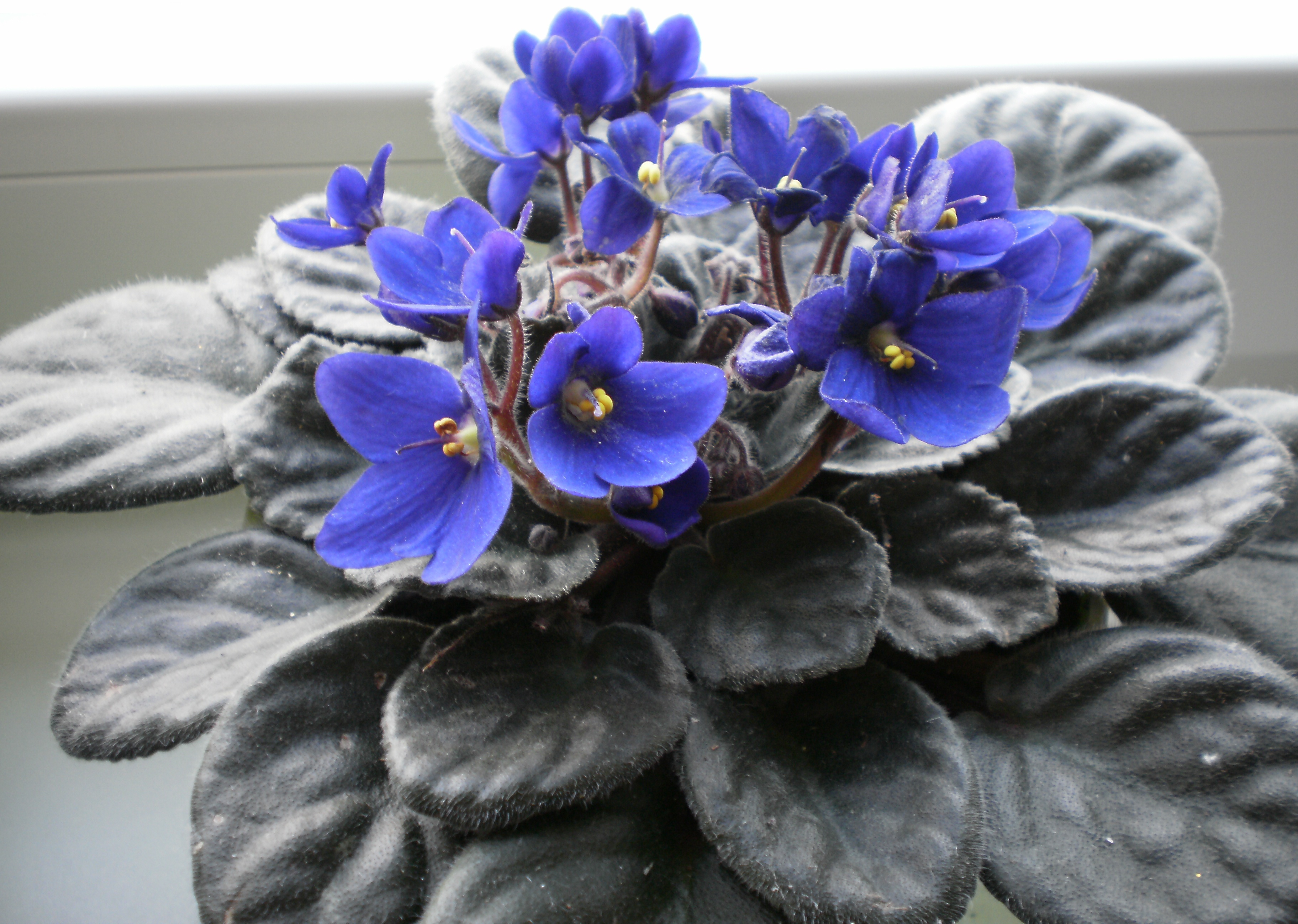
Growth habit. Compact herbaceous rosette from a short stem, with leaves arranged in a single plane like a dinner plate. Does not form a visible trunk; the leaves are the plant. Healthy plants produce a continuous succession of flower clusters from leaf axils near the centre of the rosette.
Leaves. Soft, velvety, dark green, ovate-to-rounded leaves 5–10 cm long on short hairy petioles. The upper surface is densely hairy (sericeous); undersides are often pale green to reddish-purple. Leaves are brittle — they snap off the petiole at a sharp bend, which is also what makes leaf-cutting propagation so easy.
Flowers. Clusters of 3–10 flowers on short stems above the rosette. Each flower is 2–5 cm across with five petals (two smaller upper, three larger lower), arranged bilaterally. Colour range in hybrids covers purple, violet-blue, pink, red, white, and nearly every bicolour combination. Single and double forms exist. A well-grown plant flowers 10–11 months of the year.
Fruit. Small elongated capsules 1–2 cm long that split lengthwise to release hundreds of fine, dust-like seeds. Rare in cultivation; hybrids are almost always propagated vegetatively.
- Compact rosette with all leaves in one plane — never climbs or trails (except trailing-type cultivars, which are clearly multi-crowned).
- Velvety hairy leaves — distinctive by touch as well as sight.
- Five-petalled flowers with two small upper petals and three larger lower ones (bilateral symmetry).
- Short fleshy petioles that snap cleanly — every broken leaf is a potential propagule.

Commonly confused with
Cape primrose
Now the same genus, but Cape primroses have elongated strap-shaped leaves (10–30 cm long) arranged in a loose rosette and trumpet-shaped flowers on tall stems. Entirely different silhouette.
Flame violet
Trailing habit with coppery-green hairy leaves and small tubular orange or red flowers. Same family (Gesneriaceae); not a rosette.
Sweet violet / true violet
Different family (Violaceae) — smooth leaves, flowers with a characteristic spur at the back. The 'African' in African violet is what distinguishes Streptocarpus ionanthus from garden violets; the two are unrelated.

Care
Light
Bright indirect light — no direct sun.
African violets evolved in the dappled light of East African cloud forest understory. Indoors, place directly in an east window or 0.5–1 m from a north window; south and west windows need a sheer curtain. Direct sun scorches the hairy leaves, producing pale patches that never recover. Under fluorescent/LED grow lights, 30–40 cm below the tube for 12–14 hours/day produces continuous flowering year-round.
Seasonal: In Nordic winters, a full-spectrum LED on a 12–14 hour timer is the difference between a plant that flowers year-round and one that stalls from November to March.
Water
Bottom water with room-temperature water; avoid wetting the leaves.
The classic African violet problem: cold water on the hairy leaves leaves permanent pale ring marks; overhead watering also promotes crown rot at the base of the rosette. Stand the pot in a saucer of room-temperature water for 20–30 minutes, then pour off excess. Water only when the top 1 cm of soil is dry; the rosette wilts visibly when thirsty, which is the surest signal. Self-watering African violet pots with a water reservoir and wicking inner pot are designed specifically around this constraint.
Seasonal: Cut frequency by roughly a third from November to February.
Soil
Light, humus-rich, slightly acidic African violet mix.
Commercial African violet soil works well; alternatively, blend 2 parts peat-free potting mix, 1 part perlite, 1 part vermiculite. The mix must drain fast but retain moisture evenly — a dense compacted mix leads to crown rot in weeks. Many growers refresh the top 2 cm of mix every year to prevent salt accumulation, without disturbing the root mass.
Humidity
50–60 % preferred; tolerant of 40 %.
Moderate humidity supports continuous flowering; very dry air (below 30 %) causes buds to fail to open. A nearby humidifier is ideal. Pebble trays provide a modest boost; never mist an African violet — water on the hairy leaves causes spotting and promotes Botrytis.
Temperature
18–24 °C.
Room temperature is ideal. Chill below 13 °C causes blackening of leaves and stunting; above 27 °C, flowering slows and leaves go pale. Avoid cold window glass in Nordic winters; the contact-chill kills leaf tissue within hours.
Fertilizer
Dilute African violet feed with every watering ('weakly, weekly').
A high-phosphorus African violet formula (e.g. 14-12-14 or 7-9-5) at quarter the label rate applied at every watering supports continuous flowering. This 'weakly, weekly' approach is standard practice among serious growers and produces dramatically better bloom than monthly full-strength feeding. Flush the soil with plain water every 2 months to prevent salt build-up.
Seasonal: Reduce to every second or third watering from November to February.
Pruning
Remove spent flowers and old bottom leaves; keep a clean single-rosette shape.
Pinch off each spent flower at the base of its stem with clean fingernails. Remove the bottom ring of old leaves as they yellow — a single-crown rosette of 3 leaf rings produces the most flowers per plant. Suckers (new rosettes emerging from the main one) should be removed unless you want a multi-crown plant; they divert energy from flowering.
Repotting
Annually — into the SAME pot size with fresh soil.
African violets flower best in a pot roughly one-third the diameter of the rosette. Each year, unpot, trim off the lower leaves and the old neck of stem (which will re-root), trim the root mass by a third, and repot in fresh mix in a same-size pot. Annual refresh prevents the soil from going stale and keeps the rosette flowering; oversized pots produce all leaves and no flowers.
Leaf cutting
easy~6–10 weeks to roots; 3–5 months to sellable plantletThe textbook easy propagation method. Detach a healthy mid-rosette leaf with 3–4 cm of petiole. Insert the petiole into damp African violet mix at a 45° angle, covering the bottom 2 cm. Cover loosely with clear plastic to hold humidity. Keep in bright indirect light at 21–24 °C. One or more plantlets emerge at the base of the leaf after 2–3 months; separate and pot individually when each has 3–4 leaves. Note: chimera cultivars do NOT reproduce true from leaves — propagate those from suckers only.
Leaf cutting in water
easy~4–6 weeks to roots; 3–5 months to plantletInsert a detached leaf's petiole through plastic wrap stretched over a jar, so the cut end touches the water but the leaf stays dry. Pot up when plantlets at the leaf base have 3–4 leaves. Slightly slower than soil rooting but easy to monitor.
Sucker / crown cutting
moderate~4–6 weeksDetach a sucker (a secondary rosette emerging from the main one) with a sharp knife, pot in African violet mix, and treat as a young plant. Essential for chimera cultivars and faster to a flowering plant than leaf cuttings.
Seed
difficult~Germinates in 3–4 weeks; reaches flowering size in 6–9 monthsSurface-sow fine seed on damp African violet mix; do not cover — seed needs light to germinate. Keep at 22–24 °C under cover. Seedlings are tiny and slow but produce genetic variation — useful for breeders, rarely practical for hobbyists.
Cultivars
Standard hybrids
Rosettes 20–30 cm across with single or double flowers in purple, blue, pink, white, or bicolour. Tens of thousands of named hybrids registered with the African Violet Society of America since the 1940s.
Miniature
Rosettes under 15 cm across. Ideal for windowsill collections; flowering at the same abundance as standards on a smaller scale.
Trailing
Multi-crowned plants that cascade over the pot rim rather than forming a single rosette. Require wider, shallower pots and pinching to encourage branching.
'Chimera' types
Flowers with distinct pinwheel striping produced by a chimeric meristem mutation. Only reproduce true from suckers (crown cuttings), not from leaf cuttings — the leaf propagates only the underlying green tissue.
Common problems
Pale rings or blotches on leaves
Symptom
Dull pale rings, blotches, or crescents appearing on leaves.
Cause
Cold water on the hairy leaf surface — the water droplet causes cell damage that shows as a pale mark once the water evaporates. Not a disease.
Fix
Always use room-temperature water, and water from the bottom. Existing ring marks are permanent; new leaves emerge clean with corrected watering.
Won't flower
Symptom
Healthy rosette with plenty of leaves but no blooms.
Cause
Insufficient light (most common), too-large pot (rosette is focused on root and leaf growth), low phosphorus, or too-short day length in winter.
Fix
Move to brighter indirect light or add a grow light on a 12–14 hour timer. Confirm pot is no wider than one-third the rosette diameter. Switch to a high-phosphorus African violet feed at quarter strength with every watering.
Crown rot
Symptom
The centre of the rosette goes soft and black; new leaves collapse.
Cause
Water sitting in the crown (from overhead watering), cold conditions, or overwatering combined with compacted old soil.
Fix
If the entire crown has rotted, the plant cannot be saved — salvage healthy outer leaves as cuttings. For early-stage rot (small discoloured patch), cut out the dark tissue with a sharp blade, dust the wound with cinnamon or charcoal powder, let dry, and move to a drier spot. Always water from the bottom and keep the crown dry.
Tight, twisted new growth
Symptom
New leaves in the centre of the rosette are small, twisted, densely clustered, and sometimes hairy or deformed.
Cause
Cyclamen mite infestation. Microscopic mites (invisible without magnification) attack the central growing point; damage is easier to diagnose than the mites themselves.
Fix
Cyclamen mites are persistent. Isolate the plant immediately. Treat with an acaricide (Avid, Pylon, or insecticidal soap for lighter cases) applied as a drench to the crown every 7 days for 3–4 weeks. If damage is severe or the plant is irreplaceable, propagate unaffected outer leaves as fresh clean stock and discard the original. Quarantine new African violets for 3–4 weeks before adding them to a collection.
- Cyclamen mites (Phytonemus pallidus) — main African violet pest
- Mealybugs
- Thrips
- Fungus gnats
- Crown rot (Phytophthora) from water in the crown
- Botrytis / grey mould (wet leaves, poor airflow)
- Powdery mildew
- Ring spot from cold water
Toxicity & safety
No documented toxicity. A traditional houseplant in European and American homes for over a century with no reported systemic toxicity in humans.
Streptocarpus ionanthus — Missouri Botanical Garden Plant FinderListed by ASPCA as non-toxic to cats. Ingestion of leaves may cause mild GI upset in sensitive animals but no systemic effects are recorded.
African Violet — ASPCA Toxic and Non-Toxic PlantsListed by ASPCA as non-toxic to dogs. Mild GI upset possible with any non-food plant ingestion but no systemic effects are recorded.
African Violet — ASPCA Toxic and Non-Toxic PlantsAfrican violets were reclassified in 2012 from the genus Saintpaulia into Streptocarpus on the basis of molecular phylogenies that showed Saintpaulia nested inside Streptocarpus — they are closer relatives to Cape primroses than to any other garden-commerce genus. The horticultural trade still uses the old name 'Saintpaulia ionantha' everywhere; the Kew database and IPNI accept both, with Streptocarpus ionanthus as the current accepted name.
Frequently asked · 5
Are African violets safe for cats and dogs?+
Yes — ASPCA lists African violet as non-toxic to cats, dogs, and horses. Ingestion of leaves may cause mild GI upset in sensitive pets, but no systemic toxicity is recorded. It's one of the safest flowering houseplants for a pet household.
How do I water an African violet?+
From the bottom, with room-temperature water. Stand the pot in a saucer of water for 20–30 minutes, then pour off what hasn't been absorbed. Never water overhead: cold water on the hairy leaves leaves permanent pale ring marks, and water sitting in the crown causes crown rot. Water only when the top 1 cm of soil is dry; the plant wilts visibly when truly thirsty.
Why won't my African violet bloom?+
Four main causes, in order of likelihood: insufficient light (add bright indirect light or a grow light on a 12–14 hour timer), an oversized pot (the pot should be about one-third the diameter of the rosette), low phosphorus (use an African violet feed weekly at quarter strength), or too-short winter day length (a timed grow light fixes this). A healthy properly-cared-for plant flowers 10–11 months of the year.
How do I propagate an African violet from a leaf?+
Detach a healthy mid-rosette leaf with 3–4 cm of petiole. Insert the petiole into damp African violet mix at a 45° angle, covering the bottom 2 cm of stem. Cover loosely with clear plastic to hold humidity and keep at 21–24 °C in bright indirect light. Plantlets emerge at the base of the leaf after 2–3 months; separate and pot individually when each has 3–4 leaves. Note: chimera cultivars with pinwheel-striped flowers do not reproduce true from leaves — propagate those from suckers only.
Why does my African violet have pale rings on the leaves?+
Cold water on the hairy leaf surface — every splash leaves a pale ring as the cells under the droplet die. The fix is to always water with room-temperature water from the bottom. Existing rings won't regreen; new leaves emerge clean with corrected watering.
Sources
- Streptocarpus ionanthus — Kew Plants of the World Online
- Streptocarpus ionanthus — Missouri Botanical Garden Plant Finder
- African Violet — ASPCA Toxic and Non-Toxic Plants
- Nishii et al., 'Streptocarpus redefined' (2015) — molecular basis of the Saintpaulia → Streptocarpus reclassification
- Saintpaulia ionantha — IUCN Red List (Endangered)