The 5-second decision: should I water today?
Push your finger 2–3 cm into the soil (first knuckle for small pots, second knuckle for anything over 20 cm wide). If it feels dry and cool, water thoroughly until water runs freely from the drainage hole. If it still feels damp, wait 1–3 days and check again.
This single check replaces every calendar-based rule you have ever read. A pot drying at a predictable rate under identical conditions is rare — even two plants of the same species in the same room will drift apart within a month. The finger test is one of five reliable methods — see how to tell if your plant needs water for the weight-lift, wooden skewer, and moisture meter alternatives that work better on big pots and chunky aroid mixes.
- 1Top 2–3 cm dry → water thoroughly.
- 2Top is damp but pot feels light when lifted → check again in 2 days.
- 3Soil is wet and pot feels heavy → do not water; check drainage.
- 4Leaves are limp and soil is bone dry → water now, then check humidity.
- 5Soil has pulled away from the pot edge → the root ball is hydrophobic — bottom water for 20 minutes to rehydrate.
Better than the finger test: the weight-lift method
Once you have watered a pot thoroughly and let it drain, lift it and memorise how heavy it feels when saturated. Lift again a few days later. A dry pot can weigh 30–50% less than a saturated one — the difference is obvious once you have felt both. Long-term, this is the fastest method for plants in deep or decorative pots where a finger cannot reach the root zone, and for chunky aroid mixes where the surface tells you very little about moisture three inches down.
A cheap kitchen scale formalises this: weigh each pot after watering, label the pot base with the saturated weight, and water again when it has dropped toward the lower end of its range. Growers use this trick for prized plants like fiddle leaf figs and calatheas precisely because it is more reliable than any surface test.
What changes how often you should water
Seven variables change watering frequency, and most of them matter more than the plant's species label. If you understand the list below, you no longer need care-tag schedules for every new plant.
- ·Light: Brighter light drives more photosynthesis and transpiration — water demand roughly doubles from medium to bright indirect.
- ·Pot material: Terracotta is porous and dries 2–3× faster than plastic or glazed ceramic. Self-watering pots slow it further.
- ·Pot size: Small pots (under 12 cm) can dry out in 3–5 days. Pots over 25 cm can hold moisture for 2+ weeks.
- ·Pot shape: Wide shallow pots dry faster than tall narrow pots with the same soil volume.
- ·Soil mix: Chunky aroid mixes drain in seconds. Peaty "universal" mixes hold moisture for days.
- ·Season: Most tropicals need 30–50% less water from late autumn to early spring, even indoors.
- ·Humidity and temperature: A warm room at 30% humidity dries a pot twice as fast as a cool room at 60%.
- ·Root-bound state: A fully root-bound pot holds almost no soil and dries out in a day or two — a signal to repot.
How much water to give per session
Watering is binary: you either water thoroughly or not at all. "A little splash every other day" is one of the most damaging habits for houseplants — it keeps the top layer wet and the bottom bone-dry, and roots grow only where the water is.
The benchmark: pour slowly and evenly across the entire soil surface until 10–20% of the volume drains from the hole at the bottom. For a 15 cm pot that is roughly 250 ml of run-off; for a 25 cm pot closer to 750 ml. The drain-through flushes accumulated salts, rehydrates the full root ball, and confirms water reached the bottom.
Empty the saucer after 10 minutes. Pots left standing in water reabsorb it slowly, drowning the lowest roots — the most common silent cause of yellow lower leaves in otherwise healthy plants.
Top watering vs bottom watering
Top watering (pouring over the soil surface) is faster and flushes salts. It is the default for most plants. Bottom watering (sitting the pot in a tray of water for 15–30 minutes, then draining) shines in three situations: hydrophobic bone-dry soil that repels surface water; fuzzy-leaved plants like African violets and gesneriads that mark — or rot at the crown — if water touches the leaves (see African violet crown rot); and seedlings, where top watering can dislodge them.
A practical rotation: bottom water once a month to ensure the bottom half of the root ball hydrates evenly, and top water the rest of the time to keep salts from building up in the lower soil. If your water is hard, top watering every 2–3 sessions prevents the crust of minerals that bottom-only watering leaves behind. The full bottom-watering routine covers when it backfires and how to combine the two methods.
- 1Fill a tray with 2–3 cm of room-temperature water.
- 2Set the pot in the tray and wait 15–30 minutes.
- 3Check the topsoil — it should feel cool and damp. If not, refill the tray.
- 4Lift the pot out, let it drain for 10 minutes, and return it to its spot.
Frequencies by plant category
These are starting ranges for a typical indoor environment (18–24°C, 40–60% humidity, bright indirect light). Adjust for the variables above. The table below covers the categories most houseplants fall into.
- ·Succulents and cacti: Every 14–28 days summer; every 4–8 weeks winter. Soak, then let soil dry completely.
- ·Snake plants and ZZ plants: Every 2–4 weeks summer; every 4–8 weeks winter. Let soil dry fully.
- ·Aroids (monstera, philodendron, pothos, anthurium): Every 7–10 days when top 2–3 cm is dry. See the Monstera care guide, or the Monstera deliciosa species profile for full identification, toxicity, and lookalikes.
- ·Ficus (fiddle leaf, rubber tree, weeping fig): Every 7–10 days; consistent schedule matters more than frequency.
- ·Peace lilies and spathiphyllums: Every 5–7 days — they wilt dramatically but recover fast.
- ·Ferns (Boston, maidenhair, bird's nest): Every 3–5 days; keep evenly moist, never fully dry.
- ·Calatheas, marantas, stromanthes: Every 4–7 days; prefer filtered water.
- ·Orchids (phalaenopsis): Every 7–14 days; ice-cube myth is wrong — soak bark fully once a week.
- ·Herbs (basil, mint, parsley): Every 2–4 days; thirsty compared to decorative houseplants.
Seasonal adjustments
Most indoor growers water too often in winter. Reduced daylight, cooler rooms, and dormancy mean even heated homes can cut watering in half from November through February. Watch the finger test, not the calendar — but expect intervals to stretch. For the full Nordic winter playbook, see the seasonal reset checklist.
Spring is the mirror: as daylight returns and new growth appears, water demand climbs within two weeks. Missing this transition is why plants that looked fine all winter suddenly droop or drop leaves in March — see the spring watering reset for how to ramp cadence back to summer levels without over-correcting. Summer is the heaviest draw, especially for plants near south or west windows, where soil can dry in 48 hours. Water is also the carrier for fertiliser in most routines — if you are on a schedule, tie fertilising to watering events rather than the calendar.
- ·Winter (Nov–Feb): Check every 10–14 days; water 30–50% less by volume.
- ·Spring (Mar–May): Increase frequency gradually as new growth appears.
- ·Summer (Jun–Aug): Peak demand; check every 3–5 days for most plants near windows.
- ·Autumn (Sep–Oct): Ease back as growth slows; watch for overwatering as conditions cool.
Water quality: tap, filtered, rainwater, distilled
For most houseplants, tap water left out overnight is fine — overnight rest allows chlorine (but not chloramine) to dissipate. The problems are hard water, chloramine, and high fluoride, which show up slowly as leaf-tip browning, crusty white mineral deposits on the soil surface, or stalled growth.
Sensitive species are the tell: calatheas, marantas, spider plants, dracaenas, and carnivorous plants all react within weeks to mineral-heavy water with brown leaf tips. If you are growing any of these, filtered or rainwater is not a luxury. Distilled water works but lacks trace minerals — mix it 50/50 with tap water, or water with distilled and fertilize with a weak liquid feed.
- ·Tap water: fine for the majority of plants; rest overnight if heavily chlorinated.
- ·Filtered water (activated carbon): removes chlorine but not mineral hardness.
- ·Reverse osmosis / distilled: mineral-free; ideal for sensitive species, mix with a pinch of fertilizer.
- ·Rainwater: the best option if you can collect it — slightly acidic, mineral-balanced.
- ·Avoid: softened water (high sodium), boiled-and-cooled tap water (concentrates minerals), fridge-dispenser cold water.
Water temperature matters more than you think
Cold water straight from the tap can shock tropical roots and cause leaf drop in fussy plants like fiddle leaf figs. The target is room temperature, 18–22°C — let a full watering can sit near the plants for an hour before you use it. In winter, this also gives chlorine time to dissipate.
Conversely, hot water from the same tap (mixer taps often start warm) is worse: it damages fine root hairs and can push stressed plants into immediate wilt. If in doubt, the back of your wrist is the right temperature check — the same one used for baby bottles.
Reading your plant's signals
Leaves are your most reliable gauge. Learn these signals and you can water confidently without testing the soil every time.
- ·Soft, drooping leaves + dry soil = thirsty. Water now; recovery is usually within 24 hours.
- ·Soft, drooping leaves + wet soil = overwatered / root rot. Do not water; unpot and inspect roots.
- ·Crispy brown leaf tips + dry soil = chronic underwatering or low humidity.
- ·Crispy brown leaf tips + healthy soil = mineral buildup from tap water or fertilizer; flush the pot.
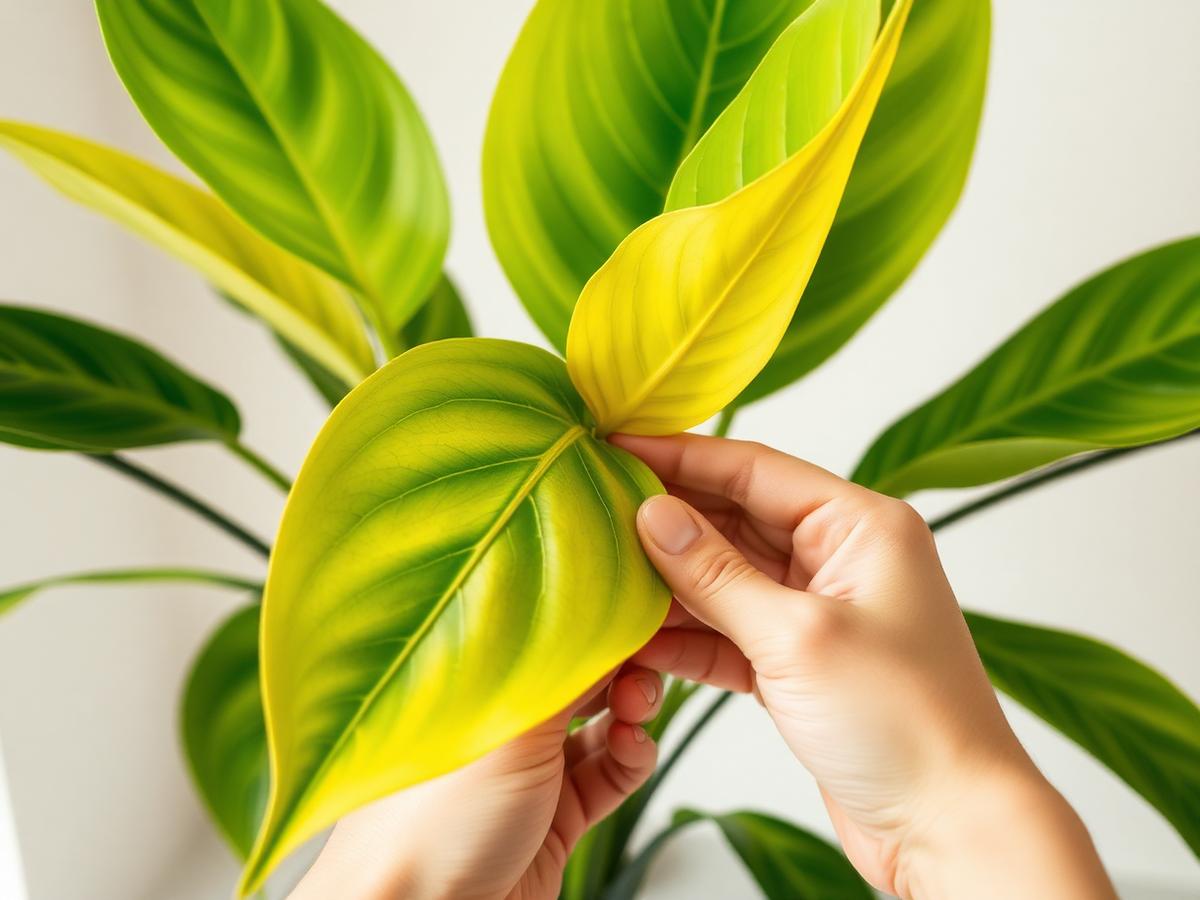
- ·Yellowing lower leaves on damp soil = classic overwatering.
- ·Leaf curl + dry soil = thirsty; curl is the plant reducing surface area.
- ·Edema (small raised bumps on leaf underside) = overwatering in cool conditions.
How to water: the complete technique
The motion matters. Pour slowly in a circle around the whole soil surface, not in one spot. If water pools and sits for more than 20 seconds without draining, the soil is either hydrophobic (needs bottom watering first) or the mix is too compacted (needs repotting). Stop when you see clear water coming through the drainage hole.
After 10 minutes, pour out any water left in the saucer or cover pot. The single habit of emptying the saucer separates growers who lose plants to root rot from those who do not.
Watering while on vacation
For trips under a week, water thoroughly the morning you leave, move plants out of direct sun, and they will be fine. For 7–21 day absences, the reliable options are: a capillary wick from a water reservoir to the soil; a drip-irrigation bulb (glass or terracotta spike) pushed into the soil; or a bathtub with 2 cm of water and pots sitting in it on a towel.
How long any given plant tolerates without water depends on the species — see how long houseplants can go without water for the species-by-species chart that turns trip length into a per-plant decision.
Avoid automatic misters and apps that don't actually water — they are theatre. Over three weeks, the only reliable unattended option is a neighbour briefed on the finger test.
When it is no longer a watering problem
If a plant wilts within a day of being watered thoroughly, or if leaves keep yellowing despite a dry-then-water cycle, the issue is likely not frequency but drainage, soil quality, or rotted roots. Unpot the plant and check: healthy roots are firm and pale; rotted roots are black, mushy, and smell sour. Trim rotted roots with clean scissors, repot in fresh dry mix, and hold water for a week. A repot into the right soil solves more "watering problems" than any schedule change.