
Identity & taxonomy
- Scientific name
- Aloe vera (L.) Burm.f.
- Family
- Asphodelaceae
- Genus
- Aloe
- Order
- Asparagales
- Wikidata
- Q392152
- Aloe barbadensis Mill.
- Aloe vulgaris Lam.
- Aloe indica Royle
- Aloe veraen
- True aloeen
- Medicinal aloeen
- Barbados aloeen
- Aloe verasv
- Ekte aloeno
- Ægte aloeda
- Aitoaaloefi
- Echte Aloede
Arabian Peninsula (Oman, Yemen) · Cultivated and naturalised worldwide in subtropical and Mediterranean climates
How to identify it
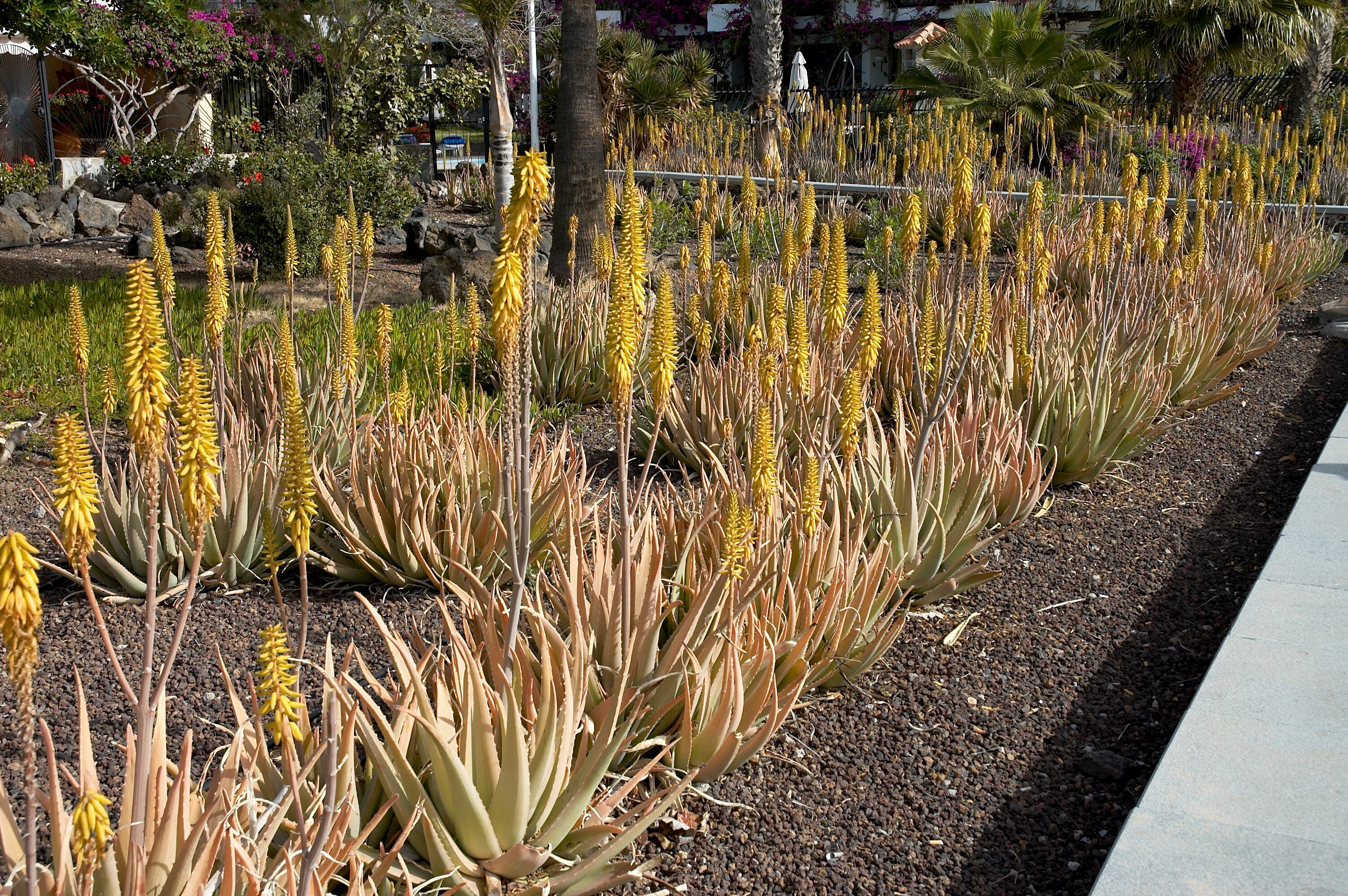
Growth habit. Stemless rosette of thick, erect-to-spreading succulent leaves emerging from a short underground rhizome. Produces numerous lateral offsets ('pups') from the base that can be separated to propagate. A mature rosette sends up a tall unbranched inflorescence in spring.
Leaves. Thick, fleshy, lanceolate leaves 30–50 cm long and 5–10 cm wide at the base, tapering to a pointed tip. Grey-green to glaucous blue-green; juvenile leaves often have soft white spots that fade with maturity. Margins bear small, harmless white-to-pale-yellow teeth. Cross-section shows a thin waxy skin, a yellow latex layer (aloin) beneath, and a clear interior gel (acemannan).
Flowers. Tall unbranched raceme 60–90 cm tall bearing pendulous tubular flowers 2–3 cm long, yellow to deep orange. Each flower lasts several days; the spike is pollinated by sunbirds in native range and by bees in cultivation. Rare indoors; requires strong sun and a cool winter rest.
Fruit. Triangular dry capsules 1–2 cm long, splitting to release small black seeds. Rarely produced in cultivation; indoor Aloe vera is overwhelmingly propagated by offsets.
- Stemless rosette — leaves emerge directly from soil level, no visible stem.
- Thick gel-filled leaves: a cut leaf oozes clear gel and a thin layer of yellow latex.
- Small white harmless teeth on the leaf margins (not sharp spines like Aloe aristata).
- Juvenile leaves are softly spotted; spots fade by the time the plant matures.
- Offsets emerge at the base of the clump, visible as miniature rosettes.

Commonly confused with
Century plant
Much larger, with stiff, fibrous, rigid leaves bearing long, sharp, dark terminal spines. Agaves flower once and die; aloes flower repeatedly.
Ox-tongue
Tongue-shaped leaves arranged in a flat fan rather than a rosette; leaves are thicker and have a slight groove on the upper surface.
Zebra plant / haworthia
Small, dark-green rosette with raised white bands across the outer leaf surface. Never exceeds ~15 cm across, and the gel is not used medicinally.
Soap aloe
Retains heavy white spotting into maturity and has a flatter rosette. Flowers are branched rather than borne on a single unbranched spike.
Care
Light
Direct sun to very bright indirect light.
Aloe vera is an outright sun plant. Indoors, give it the brightest possible spot — directly in a south-facing window, or unobstructed west sun with afternoon exposure. Insufficient light produces etiolated stretching (leaves flop outward, centre of rosette stretches upward) and pale grey-green colour. Bright light brings a warm pink-red blush to the leaf tips, which is normal and healthy.
Seasonal: Nordic winters above ~55°N: a full-spectrum LED at 15,000+ lux for 10–12 hours/day is nearly mandatory from October through March; otherwise the rosette flops open and fails to recover in spring.
Water
Deep soak every 2–3 weeks in summer; monthly in winter.
Water thoroughly until runoff, then do not water again until the top 5 cm of soil is bone dry. Aloe vera stores weeks of water in its leaves and punishes overwatering with rapid root rot. Never let the pot sit in standing water, and never water when the soil is cold (below ~15 °C), where rot risk climbs sharply.
Seasonal: From November to February, reduce to roughly one thorough watering per month. If the plant sits below 15 °C, reduce further to every 6–8 weeks.
Soil
Fast-draining gritty cactus or succulent mix.
A mix of 2 parts commercial cactus/succulent soil to 1 part coarse perlite or pumice and 1 part horticultural grit works well. Unamended potting compost holds too much water and accelerates rot. Use a terracotta pot for even faster drying.
Humidity
Any — low humidity is fine.
Indoor air at 20–60 % is well within Aloe vera's tolerance. Very high humidity (above 70 %) combined with poor airflow increases fungal leaf spot risk.
Temperature
13–27 °C.
Tolerates warmer (up to 35 °C) and cooler conditions briefly. Frost and even brief exposure below 4 °C causes water-soaked translucent patches that rot within days.
Fertilizer
Balanced liquid feed 2–3 times per year, at quarter strength.
Aloe vera is lightly fed in nature. A dilute balanced NPK (e.g. 10-10-10) at quarter the label rate once in spring, once in midsummer, and once in early autumn is ample. Over-fertilised plants grow leggy and weak.
Seasonal: Never feed during the winter rest.
Pruning
Cut whole leaves at the base for harvest; remove dying outer leaves.
To harvest gel, cut the thickest outermost leaves flush with the base using a clean sharp knife. Leave the younger central leaves to continue feeding the rosette. Let the cut surface dry before using — the yellow latex that oozes out is aloin, which is irritating to skin and laxative if ingested.
Repotting
Every 2–3 years, or when pups fill the pot.
Move up by one pot size. A shallow pot is better than a deep one — the root system is compact and a deep pot holds cold wet soil the roots never reach. Best time to repot is early spring, just as growth resumes.
Separating pups (offsets)
easy~Immediate — pups carry existing rootsOnce pups are 8–10 cm tall and have their own roots, unpot the parent, gently tease a pup away with its root mass, and pot it separately in cactus mix. Water lightly after a week to give the separation wound time to callus.
Leaf cutting
difficult~Often fails — 8–12 weeks when successfulUnlike some succulents, Aloe vera does not root reliably from leaves. Cut leaves tend to rot before roots form because of their high water content. Propagate from pups whenever possible.
Seed
moderate~Germinates in 2–4 weeks; reaches adult size in 3–5 yearsFresh seed sown on the surface of damp gritty mix, kept at 21–27 °C, germinates readily but seedlings are slow. Practical mainly for hybrids; cultivars and clones of Aloe vera are propagated by offsets.
Cultivars
'Chinensis'
Blue-green form with pronounced white spots on juvenile leaves, fading as the plant matures. Some botanists treat it as a separate species (Aloe chinensis).
'Variegata'
Uncommon cultivar with pale vertical stripes on the leaves. Note: the much more common 'variegated aloe' sold as Aloe variegata is a different species (Gonialoe variegata).
Common problems
Floppy, outward-leaning leaves
Symptom
Leaves that normally stand upright splay outward; rosette loses its compact shape.
Cause
Etiolation from insufficient light, usually compounded by overwatering during low-light months.
Fix
Move to a brighter location — direct sun through a window, or a grow light. Flopped leaves will not straighten, but new central growth will emerge upright under better light. Pups separated from a flopped parent regrow normally in good light.
Soft, mushy leaves
Symptom
Leaves go soft, translucent, and collapse; the rosette smells sour.
Cause
Root rot from overwatering, cold wet soil, or a container without drainage.
Fix
Unpot immediately; trim mushy roots and any leaves with soft translucent patches; let the remaining plant callus on dry paper for 2–3 days; repot in fresh gritty cactus mix. If the whole rosette is affected, detach any firm pups and treat them as the new plants.
Brown, crisp leaf tips
Symptom
Tips of older leaves go brown and crispy.
Cause
Underwatering or accumulated salts from tap water / over-fertilising.
Fix
Water thoroughly when the top 5 cm of soil is bone dry. If salt build-up is suspected, flush the soil with plain water (double the pot volume) to leach accumulated salts, then resume normal watering.
Red-pink leaf blush
Symptom
Leaves take on a warm pink-red tone, especially at the tips.
Cause
High light and/or cool nights — often mistaken for stress but usually a sign of excellent conditions.
Fix
None needed if the plant is otherwise firm and growing. Sustained deep red colour in combination with shrivelled leaves does indicate stress (usually drought); in that case, water thoroughly.
- Mealybugs
- Scale
- Aloe mite (Aceria aloinis)
- Root rot (Pythium, Phytophthora)
- Aloe rust (Uromyces aloes)
- Bacterial soft rot
Toxicity & safety
The clear interior gel is widely used in topical skin preparations and is generally considered safe for external use. The yellow latex layer (aloin) just under the leaf skin is a potent laxative and causes cramping, diarrhoea, and electrolyte imbalance if ingested in any quantity. Oral aloe latex preparations are banned from over-the-counter laxative products in the US and EU.
Mechanism: Anthraquinone glycosides (aloin, barbaloin) in the latex layer.
Aloe vera — NCCIH (National Center for Complementary and Integrative Health)Vomiting, diarrhoea, lethargy, and anorexia after ingestion. The saponins and anthraquinone compounds are responsible; the clear inner gel is much less irritating than the yellow latex, but pet ingestion of whole leaves exposes the cat to both.
Aloe — ASPCA Toxic and Non-Toxic PlantsVomiting, diarrhoea, lethargy, and occasionally tremors if large amounts are ingested.
Aloe — ASPCA Toxic and Non-Toxic PlantsAloe vera has been in continuous cultivation for at least 6,000 years — it appears on Mesopotamian clay tablets from the 3rd millennium BCE, in the Egyptian Ebers Papyrus (~1550 BCE), and in Dioscorides' De Materia Medica. The plant's native range has become almost impossible to pin down because humans have moved it everywhere they've settled in subtropical climates.
Frequently asked · 5
Is aloe vera safe for cats and dogs?+
No — ASPCA lists Aloe vera as toxic to cats, dogs, and horses. The yellow latex layer beneath the leaf skin contains anthraquinone compounds that cause vomiting, diarrhoea, and lethargy. The clear inner gel used in skincare is much less irritating, but pets that chew leaves get exposed to both layers.
How often should I water my aloe vera?+
Water deeply, then do not water again until the top 5 cm of soil is completely dry. In practice, that's roughly every 2–3 weeks in summer in a sunny window and once a month or less in winter. Overwatering is the number one cause of aloe vera death — the plant stores weeks of water in its leaves.
Why are my aloe vera leaves flopping outward?+
Floppy, outward-leaning leaves almost always mean insufficient light. Aloe vera is a sun plant — it wants a south-facing window or a full-spectrum grow light. Flopped leaves will not straighten, but new central growth emerges upright once light improves, and pups separated from a flopped parent regrow normally in good conditions.
Can I use gel straight from my aloe vera plant on my skin?+
Yes — the clear inner gel sliced fresh from a mature leaf is the most concentrated and chemically intact form of aloe vera, more so than bottled preparations. Cut the thickest outermost leaf at the base, let the yellow latex drain and dry for a few minutes (it's irritating), then scoop out the clear gel with a spoon. Test on a small patch of skin first in case of sensitivity.
How do I propagate aloe vera?+
The easiest and most reliable method is separating pups (baby rosettes that emerge at the base). Once a pup is 8–10 cm tall with its own roots, unpot the parent, gently work the pup free with its root mass, and pot it separately in gritty cactus mix. Water lightly a week later to let the wound callus over.