Identity & taxonomy
- Scientific name
- Pilea cadierei Gagnep. & Guillaumin
- Family
- Urticaceae
- Genus
- Pilea
- Order
- Rosales
- IUCN status
- Least Concern (LC)
- Wikidata
- Q138813
- Aluminum planten
- Aluminium planten
- Watermelon pileaen
- Silverleaf pileaen
- Aluminiumpileasv
- Aluminiumpileano
- Aluminium-pileada
- Hopealehtipileafi
- Aluminiumpflanzede
Vietnam (north) · China (Yunnan)
How to identify it
Growth habit. Soft-stemmed bushy perennial growing as a low mound. Stems become semi-woody at the base with age but remain flexible at the tips. Without regular pinching, plants quickly become single-stemmed and leggy with bare lower stems and a tuft of leaves at the top — the same growth pattern as Hypoestes phyllostachya. Adds 5–10 cm of growth per month in active conditions.
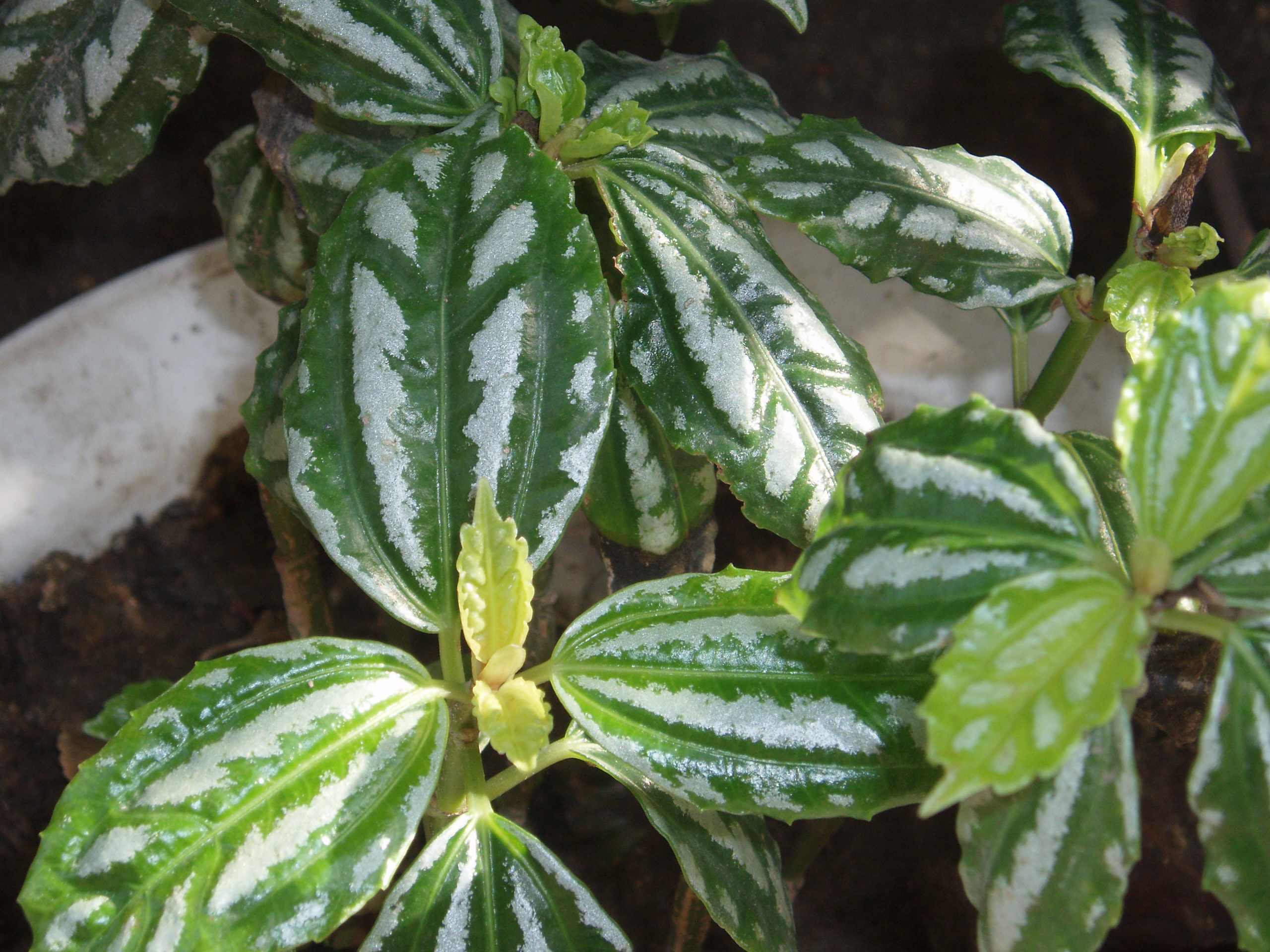
Leaves. Opposite ovate to elliptical leaves 5–8 cm long with pointed tips and finely toothed margins. The defining feature: three prominent longitudinal veins divide each leaf into four panels, each panel bearing a raised silver-white patch on a dark green ground. The silver effect is structural — air pockets immediately beneath the upper epidermis scatter light, the same mechanism that gives Begonia maculata its silver dotting. Underside is plain green with the veins clearly visible.
Flowers. Tiny pale green-pink flowers in compact clusters at leaf axils, individually only 2–3 mm across. Flowering signals the plant is shifting energy away from foliage and is a useful early-warning sign that the plant is approaching the end of its prime. Pinch off flower clusters as they appear; the floral display is unremarkable and sacrificing it keeps the foliage display longer.
- Dark green leaves with raised silver patches between three prominent longitudinal veins.
- Opposite leaf arrangement on soft semi-woody stems.
- Compact bushy habit when pinched; rapidly leggy when not.
- Tiny inconspicuous green-pink flowers in leaf axils.
- Member of the Urticaceae (nettle family) but with no stinging hairs.

Commonly confused with
Chinese money plant
Same genus, but leaves are perfectly round 'coin' shape on long petioles emerging from a single central stem — completely different leaf shape and arrangement. Both are pet-safe Pileas.
Silver tree pilea
Similar silver-and-green leaf pattern but with a prominent silver stripe down the leaf centre rather than four panels. Smaller leaves and more compact habit.
Polka dot begonia
Also silver markings on dark green, but pattern is uniform discrete dots rather than continuous patches, and leaf shape is asymmetric angel-wing rather than symmetrical ovate. Very different family (Begoniaceae vs Urticaceae).
Watermelon peperomia
Striking silver-and-dark-green stripe pattern on near-round succulent leaves. Different family (Piperaceae) and noticeably thicker, fleshier leaves.
Care
Light
Bright indirect light; some morning sun is fine.
An east window, or a south/west window 1 m back from the glass with a sheer curtain. The silver patches are most prominent in good light; in deep shade the leaves become uniformly darker green and the silver fades. Direct unfiltered noon sun bleaches and scorches the leaves.
Seasonal: Nordic latitudes above ~55°N: a south or west window is acceptable from October to March; move back from the glass when April light intensifies.
Water
Keep evenly moist; water when the top 1–2 cm of soil is dry.
Typically every 4–7 days in active growth. Pilea cadierei wilts dramatically when the soil dries — leaves go limp and the whole plant collapses within hours, similar to Hypoestes. It usually recovers after a thorough watering, but repeated wilt cycles cause leaf drop and stem dieback.
Seasonal: Reduce by about a third in winter when growth slows. Never let the rootball dry completely.
Soil
Standard peat-free houseplant mix with added perlite.
1 part houseplant mix to 1 part coir, plus a handful of perlite for drainage. The mix should hold moisture without staying waterlogged.
Humidity
50–70 % ideal; tolerates 40 %.
Tropical Vietnamese origin — prefers humid air. Brown crispy leaf edges signal humidity is too low. Group with other plants, use a humidifier, or sit on a pebble tray.
Temperature
18–27 °C year-round; damage below 13 °C.
Tropical lowland origin. Does not tolerate cold drafts or sustained cold below 13 °C — leaves blacken and drop. Keep away from cold window glass in winter.
Fertilizer
Half-strength balanced feed every 2–3 weeks in spring and summer.
Balanced NPK at half label rate. The plant grows fast and benefits from regular light feeding. Suspend feeding in winter when growth slows.
Pruning
Pinch growing tips every 2–3 weeks to keep the plant bushy.
Pinch off the topmost pair of leaves on each stem with thumb and forefinger. This forces two new stems from the leaf node below, doubling branch count over time. Without regular pinching the plant becomes single-stemmed and leggy within a few months. Cut hard back to 5–8 cm from the soil if the plant is already leggy — new shoots emerge within 2–3 weeks.
Repotting
Annually in spring; the plant is fast-growing and short-lived.
Move up by one pot size each spring. Most growers replace plants from cuttings every 18–24 months rather than chasing larger pot sizes — fresh young plants from cuttings always look better than old leggy ones.
Stem cutting in water
easy~1–2 weeksCut a 7–10 cm tip cutting just below a leaf node. Remove the lower pair of leaves and stand the cutting in a glass of water on a bright windowsill (not direct sun). Roots emerge from the node within 1–2 weeks; pot up into standard mix once roots reach 2–3 cm.
Stem cutting in soil
easy~2–3 weeksInsert a 7–10 cm cutting into moist propagation mix, optionally dipped in rooting hormone. Cover with a clear plastic bag to maintain humidity for the first week. Roots establish within 2–3 weeks; remove the bag once new growth appears.
Division
easyAt repotting time, gently tease the rootball apart into 2–3 sections, each with several stems and a healthy share of roots. Pot each section in fresh mix. The plant tolerates root disturbance well and division refreshes a tired old clump.
Cultivars
'Minima'
Compact dwarf form half the size of the species — leaves 2–4 cm rather than 5–8 cm. Better for small terrariums and bottle gardens; harder to find in the supermarket trade.
Common problems
Plant goes leggy with bare lower stems
Symptom
Stems lengthen and lose their lower leaves; the plant becomes a few tall thin stalks topped with foliage.
Cause
Either insufficient light (plant stretches toward the window) OR no pinching (apical dominance suppresses lateral branching).
Fix
Cut the plant back hard — to within 5–8 cm of the soil. Move to brighter indirect light. New shoots emerge within 2–3 weeks, and pinching them at the next growth flush keeps the plant compact.
Silver patches fade
Symptom
New leaves emerge with weaker silver patterning; older leaves lose contrast.
Cause
Insufficient light. The structural silver effect requires good light to develop fully on new growth.
Fix
Move to brighter indirect light. Existing leaves do not regain their silver, but new growth emerges with full pattern within a few weeks of better light.
Sudden total wilt
Symptom
Whole plant goes limp within hours; leaves and stems collapse.
Cause
Soil has dried out completely.
Fix
Soak the rootball thoroughly — bottom-water in a bowl for 30 minutes. The plant typically recovers within hours but loses its oldest leaves. Repeated wilt cycles cause permanent leaf drop, so set a more reliable watering reminder.
Brown crispy leaf edges
Symptom
Leaf margins go brown and dry; older leaves drop early.
Cause
Air too dry — humidity below 40 %.
Fix
Raise humidity with grouping or a humidifier. Existing brown edges remain; new growth emerges normal once humidity is corrected.
- Spider mites in dry conditions
- Aphids on new growth
- Mealybugs in leaf joints
- Fungus gnats in damp soil
- Stem rot at soil line in cool damp conditions
- Leaf spot from waterlogged soil
Toxicity & safety
No reported toxicity. The species has no documented poisoning cases.
Pilea cadierei — North Carolina State ExtensionNo toxic effects reported. ASPCA classifies aluminum plant as non-toxic to cats. Casual nibbling causes no symptoms.
Aluminum Plant — ASPCA Toxic and Non-Toxic PlantsNo toxic effects reported. Considered safe for dogs.
Aluminum Plant — ASPCA Toxic and Non-Toxic PlantsHow the silver 'aluminum' patches work
The silver effect on Pilea cadierei leaves is structural rather than chemical. Most variegated houseplants get their colour from pigment patterns — anthocyanin spots, chlorophyll-deficient stripes, or absent green pigment in white sections. Pilea cadierei does something completely different: it lifts the upper epidermis off the underlying mesophyll, creating thin air-filled pockets in regular zones between the leaf veins.
Light hitting these zones reflects from the air-tissue interface rather than penetrating to the chlorophyll layer below. The result is a metallic silver-white appearance that looks like the leaf has been hand-painted with aluminum paint — hence both the common name and the descriptive Latin papers from the 1930s. Crush or puncture a silver patch with a fingernail and it turns transparent green where the air pocket collapses; the chlorophyll underneath was there all along.
The same trick is used by Begonia maculata (silver dots), watermelon peperomia (silver stripes), and several other unrelated genera. It's an example of convergent evolution toward an effective camouflage and possibly photoprotection adaptation in dim understorey light.
Why aluminum plant always goes leggy
Pilea cadierei has strong apical dominance — the growing tip of each stem produces hormones that suppress the development of side branches further down the same stem. Without intervention, every stem grows as a single shaft until something cuts the tip off. The plant becomes a few tall bare stalks with a tuft of leaves at the top, looking nothing like the bushy supermarket plant.
The intervention is regular pinching: pluck the topmost pair of leaves off each stem every 2–3 weeks. This removes the apical hormone source and triggers the leaf node below to produce two new branches. Doing this from the moment the plant arrives keeps it dense and bushy for years. Skipping it for even a few months produces the leggy form, after which the only fix is to cut hard back and start over.
Most growers also propagate cuttings continuously and replace the parent plant every 18–24 months. The cuttings root in 1–2 weeks in water and the plant from cuttings always looks better than an old maintained one — the lower stems of even pinched plants accumulate scars and bare patches over time.
The silver patches on the leaves are not produced by pigment but by structural light scattering — air pockets immediately beneath the upper epidermis lift it slightly off the underlying mesophyll, and incoming light reflects from the air-tissue interface rather than penetrating to the chlorophyll-bearing cells. The same mechanism produces the silver dots on Begonia maculata and the silver stripes on watermelon peperomia. Disrupting the leaf surface with a sharp object turns the silver patch transparent green at the puncture point.
Frequently asked · 5
Is aluminum plant safe for cats and dogs?+
Yes. ASPCA lists Pilea cadierei as non-toxic to both cats and dogs. The whole genus Pilea is considered safe for pet households — casual nibbling causes no symptoms beyond mild GI upset that any plant material can cause if eaten in quantity.
Why is my aluminum plant leggy?+
Two reasons combine. First, you probably haven't been pinching the growing tips — without that, apical dominance keeps every stem growing as a single bare shaft. Second, the light may be too low, encouraging stretch toward the window. Pinch every 2–3 weeks and move to brighter indirect light. Cut back hard to 5–8 cm if the plant is already bare-stemmed.
Why are the silver patches fading?+
Insufficient light. The silver effect requires good light to develop fully on new growth. Move to a brighter indirect spot — east window or south/west window with a sheer curtain. Existing leaves don't regain silver, but new growth emerges with full pattern within a few weeks.
How do I tell aluminum plant from polka dot begonia?+
Pattern shape and leaf shape. Aluminum plant has continuous silver patches in regular four-panel zones between three prominent veins on a symmetrical ovate leaf. Polka dot begonia has discrete circular silver dots scattered across an asymmetric angel-wing leaf. Different families entirely (Urticaceae vs Begoniaceae).
How do I propagate aluminum plant?+
Stem cuttings in water. Cut a 7–10 cm tip below a leaf node, remove the lower leaves, and stand in a glass of water on a bright windowsill. Roots emerge from the node within 1–2 weeks; pot up once roots reach 2–3 cm. Easiest indoor propagation imaginable.