Identity & taxonomy
- Scientific name
- Anthurium andraeanum Linden ex André
- Family
- Araceae
- Genus
- Anthurium
- Order
- Alismatales
- Wikidata
- Q158993
- Anthurium andreanum Linden
- Anthuriumen
- Flamingo floweren
- Flamingo lilyen
- Painter's paletteen
- Tailfloweren
- Flamingoblommasv
- Flamingoblomstno
- Flamingoblomstda
- Flamingokukkafi
- Flamingoblumede
Colombia (Pacific coast) · Ecuador (Pacific coast)
How to identify it
Growth habit. Rosette-forming evergreen epiphyte with a short stem. Produces new leaves from the central growing point every 4–8 weeks; each leaf is subtended by a bract that may develop into a flower spathe. Sends out aerial roots from leaf bases — these anchor to tree bark in nature and can be trained onto a bark slab or moss pole indoors.
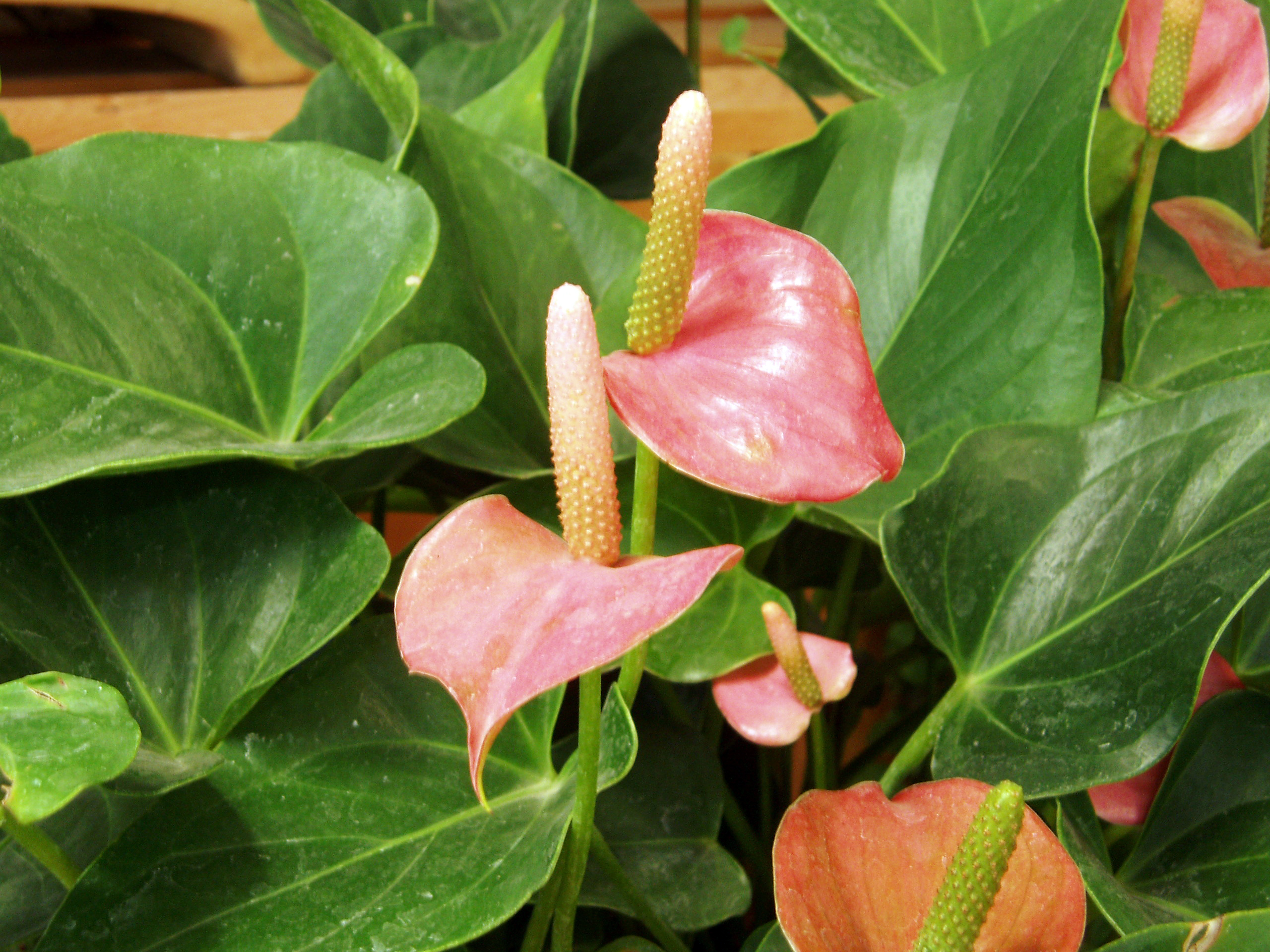
Leaves. Glossy, heart-shaped (cordate) dark green leaves 20–35 cm long on long petioles. Leaves are stiff and leathery with a pronounced midrib and visible lateral veins. New leaves emerge bronze-brown and mature to dark green over 2–3 weeks.
Flowers. An aroid inflorescence: a thick lacquered heart-shaped spathe (most commonly red, also white, pink, orange, green, or burgundy) 8–15 cm across, subtending a cylindrical straight-to-slightly-curved yellow-to-pink spadix 5–9 cm long. The spadix carries hundreds of tiny true flowers in a spiral. A single spathe stays colourful 6–8 weeks; a healthy mature plant produces 4–6 spathes per year in rotation.
Fruit. Small red berries 5–8 mm across, embedded in the spadix, each containing 1–2 seeds. Rarely produced indoors; commercial breeders hand-pollinate to produce new cultivars.
- Heart-shaped spathe with a lacquered, plastic-looking surface — diagnostic among common houseplants.
- Straight to slightly curved finger-like spadix (not enclosed by the spathe, unlike Monstera).
- Glossy heart-shaped leaves with a prominent midrib and cordate base.
- Short central stem — does not climb or vine.


Commonly confused with
Pigtail anthurium
Lance-shaped (not heart-shaped) leaves and a tightly coiled pigtail spadix rather than the straight spadix of A. andraeanum. Also sold as flamingo flower but a different species.
Peace lily
White spathe, not heart-shaped, and not lacquered. Longer, lance-shaped leaves. Flowers age from white to green; Anthurium retains spathe colour longer.
Velvet cardboard anthurium
Grown for foliage — thick velvety dark-green heart-shaped leaves with prominent silver veining. Rarely flowers indoors; a different horticultural use.
Care
Light
Bright indirect light.
Place within 1 m of a north-facing window, or 1.5–2 m from an east/south/west window with filtered light. Direct sun scorches the spathe and bleaches the leaves. Insufficient light is the number-one reason anthurium stops blooming — healthy foliage but no new spathes signals a light problem.
Seasonal: Nordic winters: a full-spectrum LED at 12,000–15,000 lux for 10–12 hours/day from October to March keeps the plant in flower year-round rather than stalling.
Water
When the top 2–3 cm of soil is dry.
Water thoroughly until runoff, then empty the saucer. Anthurium dislikes both drought and standing water — the root system rots quickly in soggy soil and dies back in bone-dry soil. Use lukewarm filtered water if possible; the plant is moderately fluoride-sensitive. Target consistently moist but not wet soil.
Seasonal: Reduce frequency by roughly a third from November to February; the plant is still semi-active but drinks less.
Soil
Chunky epiphytic aroid mix.
A blend of 2 parts orchid bark, 1 part peat-free potting soil, 1 part perlite, and a handful of sphagnum moss works well. Anthurium is epiphytic — its roots grow on tree trunks and in leaf litter, not in dense soil. A chunky airy mix provides the oxygen the roots need to avoid rot.
Humidity
60–80 %; tolerant down to 50 %.
High humidity accelerates leaf size, spathe production, and overall vigour. Below 50 %, leaf edges go brown and new spathes may emerge deformed. A nearby humidifier is the best solution — misting is brief and promotes leaf spot. A pebble tray under the pot is marginally helpful.
Temperature
18–27 °C.
A strictly tropical plant. Exposure below 13 °C causes yellowing and leaf drop within days; below 5 °C is lethal. Keep away from cold window glass in winter and from cold drafts under doors. No cool winter rest is required or beneficial.
Fertilizer
Dilute balanced liquid feed every 2 weeks in spring and summer.
A balanced NPK (e.g. 20-20-20) at quarter the label rate every 2 weeks during active growth supports continuous spathe production. A higher-phosphorus bloom feed (10-30-20) can be alternated in to push flowering. Over-fertilising causes crispy leaf margins and white salt crust on the soil.
Seasonal: Reduce to monthly at quarter strength from November through February.
Pruning
Remove spent spathes at the stem base; cut yellowing leaves.
Once a spathe ages (it goes green, then brown, over about 8–10 weeks), cut its stem flush with the base of the plant with clean sharp scissors — the plant will not continue to send energy to it. Remove any yellowing or browning leaves the same way. Aerial roots should NOT be cut; tuck them back into the pot or train onto a bark slab.
Repotting
Every 2–3 years, or when roots circle the pot and lift the plant.
Move up by only one pot size (2 cm wider). Too much extra soil holds water the small root system cannot use and accelerates rot. Best done in early spring just before the flush of new leaves. After repotting, skip the first watering for 5–7 days to let disturbed roots callus.
Division
moderate~Immediate — divisions carry existing rootsA mature plant produces offsets from the base over time. Unpot, tease an offset with its own root system away from the parent, and pot separately in fresh aroid mix. Best time is spring. Water lightly for the first 2 weeks while the division recovers.
Stem cutting
moderate~4–8 weeksIf the plant has formed a tall 'neck' from old leaf scars, cut below a node with aerial roots attached and pot the top as a new plant. The stump usually sends out new side growth. This is also the fix for plants that have lost their bottom leaves.
Seed
difficult~Germinates in 2–6 weeks; reaches flowering size in 3–4 yearsRequires hand-pollination of the spadix (flowers are protandrous, so pollen must come from a second plant or a spadix at a different stage). Fresh seed, surface-sown on damp sphagnum at 25–28 °C, germinates readily but seedlings are slow. Used primarily by commercial breeders.
Cultivars
'Red Hot'
Classic deep scarlet spathe with a yellow spadix. The most common commercial cultivar; long-lasting spathes (6–8 weeks each).
'White Heart' / 'Acropolis'
Pure white spathe with a yellow-to-pink spadix. Less common; more sensitive to water spotting on the spathe.
'Pink Champion'
Soft pink spathe, often with a green edge as the flower ages. Dutch breeder cultivar released in the 2000s.
'Black Queen'
Nearly black-burgundy spathe. Slower growing and more light-demanding than standard cultivars.
Common problems
Spathes turn green
Symptom
A new spathe opens fully coloured, then fades to green after 3–4 weeks.
Cause
Partly normal — spathes age to green as part of natural senescence (the plant is reabsorbing pigments). If new spathes ALSO emerge green, the cause is insufficient light or nutrient imbalance.
Fix
Move to brighter indirect light and add a bloom-boosting feed (10-30-20 at half strength) every 2 weeks. The current spathe will not revert, but the next one will emerge with full colour in better light.
No flowers / stopped blooming
Symptom
Healthy foliage but no new spathes for several months.
Cause
Insufficient light (most common), recent repotting, over-fertilising with nitrogen, or cool temperatures.
Fix
Move to brighter indirect light; keep temperatures above 18 °C; switch to a high-phosphorus bloom feed; stop repotting unless strictly necessary. A reset often takes 2–3 months to show a new spathe.
Brown leaf tips and edges
Symptom
Leaf tips and edges go brown and crispy.
Cause
Low humidity, fluoride or chloramine in tap water, or over-fertilising.
Fix
Raise humidity above 50 %; switch to filtered, rain, or distilled water; halve the fertiliser rate and flush the soil with plain water every 3–4 months to leach accumulated salts.
Yellowing leaves from the bottom up
Symptom
Lower older leaves yellow and drop; upper leaves look fine.
Cause
Overwatering and/or compacted old soil starving roots of oxygen.
Fix
Unpot and inspect: black mushy roots mean rot — trim them, replace all soil with fresh chunky aroid mix, and water less frequently. Occasional yellowing of the oldest leaf is normal; multiple leaves yellowing at once is a drainage problem.
- Mealybugs
- Scale
- Thrips
- Spider mites (dry air)
- Root rot (Pythium, Phytophthora)
- Bacterial blight (Xanthomonas)
- Anthracnose leaf spot
Toxicity & safety
Intense immediate oral burning on chewing, followed by lip and tongue swelling, drooling, hoarseness, and difficulty swallowing. The pain is typically severe enough that large ingestions are rare; symptoms resolve with rinsing and supportive care. Sap on skin can cause contact dermatitis.
Mechanism: Insoluble calcium oxalate raphides — microscopic needle-shaped crystals that penetrate soft tissue on chewing and release irritant proteins.
Anthurium andraeanum — Missouri Botanical Garden Plant FinderOral irritation, intense burning of lips, mouth, and tongue, excessive drooling, vomiting, and difficulty swallowing after chewing any part of the plant.
Mechanism: Insoluble calcium oxalate raphides.
Flamingo Lily — ASPCA Toxic and Non-Toxic PlantsOral irritation, burning, drooling, pawing at the mouth, vomiting, and difficulty swallowing after chewing any part of the plant.
Mechanism: Insoluble calcium oxalate raphides.
Flamingo Lily — ASPCA Toxic and Non-Toxic PlantsThe 'flower' most people point to on an anthurium is not a flower at all — it's a modified leaf (the spathe) surrounding a real flower spike (the spadix). The lacquered, waxy appearance that makes the spathe look almost plastic is a layer of cuticle thick enough to protect the underlying cells from intense rainforest understory dew; it's also what lets a single spathe remain colourful for 6–8 weeks where most flowers last days.
Frequently asked · 5
Are anthuriums toxic to cats and dogs?+
Yes — ASPCA lists flamingo lily (Anthurium) as toxic to cats and dogs. All parts contain insoluble calcium oxalate raphides, microscopic needle-shaped crystals that cause intense oral burning, drooling, vomiting, and difficulty swallowing when chewed. The severe pain usually prevents large ingestions; if a pet chews a leaf, rinse the mouth with water and contact a vet if symptoms persist beyond an hour.
Why are my anthurium flowers turning green?+
Partly normal — anthurium spathes age to green over 6–10 weeks as the plant re-absorbs pigments from the old flower. It becomes a problem only if new spathes emerge green rather than the cultivar's natural colour. The fix is more bright indirect light plus a high-phosphorus bloom feed (10-30-20 at half strength) every 2 weeks. Existing spathes won't recolour, but the next wave will.
How do I get my anthurium to rebloom?+
Three levers: more bright indirect light (the number-one cause of a stalled bloomer), warmer steady temperatures (18–27 °C), and a phosphorus-heavy bloom feed every 2 weeks. Stop repotting unless strictly necessary — anthurium flowers more when the roots are slightly restricted. Under good conditions a mature plant produces 4–6 spathes per year in rotation, each lasting 6–8 weeks.
How often should I water an anthurium?+
When the top 2–3 cm of soil is dry — typically every 5–7 days in summer and every 10–14 days in winter, depending on pot size and light. Use lukewarm filtered water; tap water fluoride causes brown tip burn. Anthurium dislikes both drought and soggy soil equally — consistently moist but never wet is the target.
Why are my anthurium leaves brown on the tips?+
Three common causes: low humidity (below 50 %), tap water fluoride/chloramine, or over-fertilising. Raise humidity with a nearby humidifier, switch to filtered or rainwater, and halve the fertiliser rate. Flush the soil with plain water every few months to wash out accumulated salts. Existing brown tips won't regreen, but new leaves will emerge clean under corrected conditions.