Identity & taxonomy
- Scientific name
- Asparagus setaceus (Kunth) Jessop
- Family
- Asparagaceae
- Genus
- Asparagus
- Order
- Asparagales
- IUCN status
- Least Concern (LC)
- Wikidata
- Q16204205
- Asparagus plumosus Baker
- Protasparagus setaceus (Kunth) Oberm.
- Asparagus fernen
- Lace fernen
- Common asparagus fernen
- Climbing asparagus fernen
- Aspargusormbunke / Plymsparrissv
- Aspargusbregneno
- Aspargesbregneda
- Koristepartafi
- Federspargel / Zierspargelde
Eastern and southern Africa (Kenya, Tanzania, Mozambique, eSwatini, South Africa)
How to identify it
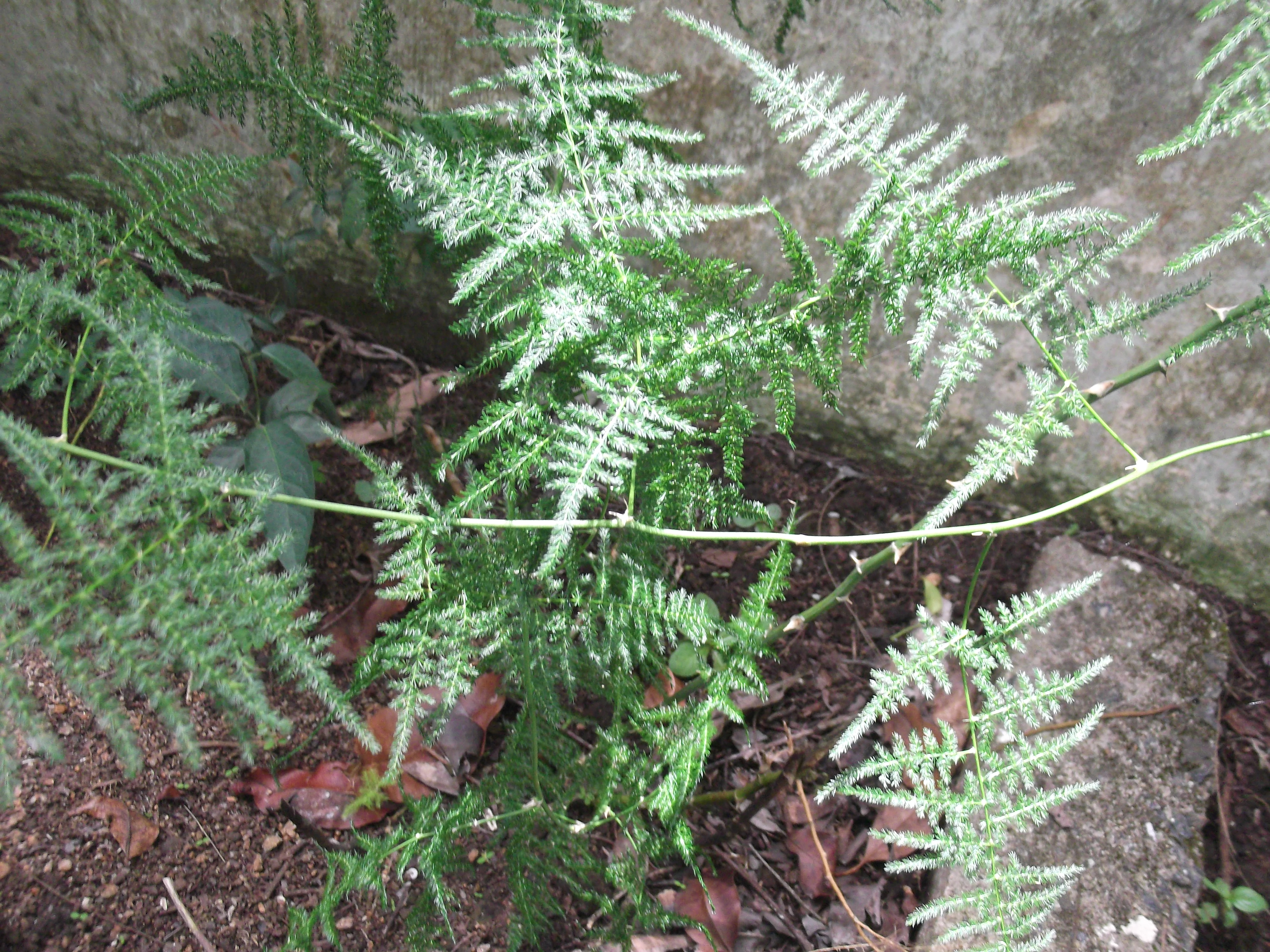
Growth habit. Climbing or scrambling perennial with thin wiry green stems. Young plants form low feathery mounds; mature plants send up long arching or climbing shoots that twine around any support. The 'leaves' are not leaves at all — they are flattened needle-like stem branches called cladodes, arranged in horizontal sprays that mimic fern fronds. True leaves are reduced to tiny papery scales at the base of each cladode cluster.
Leaves. Cladodes (modified stems) 4–10 mm long, arranged in dense horizontal sprays at intervals along the wiry stems. Bright fresh green when young, fading to yellow and dropping with age. The visual texture is extremely fine — far softer-looking than a true fern at the same scale. Stems carry small backward-curved thorns that catch on clothing and fingers.
Flowers. Tiny greenish-white bell-shaped flowers ~3 mm across, borne singly or in pairs along the stems in summer. Easy to miss without looking closely. Followed in autumn by small (~5 mm) red-purple berries, each containing 1–3 black seeds. Flowering and fruiting are uncommon on indoor specimens but routine on outdoor plants in warm climates.
- Horizontal fern-like sprays of fine bright-green needle-like cladodes (not true leaves).
- Wiry stems carry small backward-curved thorns — the plant is not as soft as it looks.
- Plant climbs given any vertical support; trails downward without one.
- Old cladodes turn straw-yellow and drop at the slightest stress (drought, cold, root disturbance).
- Roots include cluster of small fleshy water-storage tubers — visible when repotting.
Commonly confused with
Sprenger's asparagus / foxtail fern (loose form)
Same genus, but cladodes are stiffer, longer (1.5–3 cm), and arranged radially around the stem (not in flat horizontal sprays). Stems are longer and more arching. Bigger and tougher overall; easier to keep alive than A. setaceus.
Foxtail fern (compact form)
Same species as 'Sprengeri' but with dense upright cylindrical foxtail-shaped fronds 30–60 cm long. Looks nothing like A. setaceus at maturity.
Boston fern
An actual fern. Fronds are larger (30–90 cm), with clearly visible pinnate leaflets rather than fine cladodes, and reproduce by spores on the underside. Different family entirely (Nephrolepidaceae).
Maidenhair fern
Another true fern with delicate-looking fronds. Leaflets are fan-shaped (not needle-like) and emerge on black wiry stems. Much higher humidity demands than asparagus fern.
Care
Light
Bright indirect; tolerates medium light.
Place near an east window or 1–2 m from a south or west window with sheer-curtain filtering. Direct midday sun bleaches the cladodes and accelerates yellowing. The plant tolerates lower light than true ferns and can hold its own at office distances from a window, but new growth becomes sparse and the plant looks thin.
Seasonal: Nordic latitudes above ~55°N: a south window without curtains is fine in winter; in summer pull back from direct sun.
Water
Keep evenly moist; never bone-dry.
Water as soon as the top 1–2 cm of soil feels just dry — typically every 5–7 days in active growth. Asparagus setaceus is more drought-sensitive than most houseplants of its size: a single week of completely dry soil can trigger massive cladode yellowing and drop. The water-storage tubers in the root mass help the plant recover from brief drought, but recovery growth is sparse and slow.
Seasonal: Reduce watering by a third from November through February but do not let the soil dry out completely. Dry indoor air in winter combined with infrequent watering is the most common cause of mid-winter leaf drop.
Soil
Standard peat-free potting mix with extra perlite (3:1).
A free-draining but moisture-retentive mix. Avoid mixes high in bark or coir alone — they dry out too quickly between waterings and trigger leaf drop. Adding a thin top layer of moss or fine bark slows surface evaporation.
Humidity
40–60 % adequate; ≥50 % prevents leaf drop.
Asparagus setaceus tolerates ordinary indoor humidity better than true ferns, but 50 %+ keeps the cladodes green and reduces yellowing. A nearby humidifier is more effective than misting; misting wets the wiry stems and can mark them with hard-water spots.
Temperature
16–24 °C; damage below 10 °C.
Tropical/subtropical African origin. Below 10 °C the plant drops most of its cladodes; below 5 °C the stems die back to the rootstock, though tubers usually survive and resprout. Keep away from cold window glass in winter and from radiators that produce dry hot air.
Fertilizer
Half-strength balanced liquid feed monthly in spring and summer.
A balanced NPK at half label rate, applied to already-moist soil. Heavy feeding produces soft pale growth that yellows even faster. Skip feeding from November through February.
Pruning
Cut yellow stems at soil level; trim climbing shoots to control size.
Yellow stems do not regreen — cut them off at soil level with sharp scissors. New shoots emerge from the rootstock to replace them. Climbing shoots can be cut back hard at any time of year; the rootstock readily produces replacements.
Repotting
Every 2–3 years in spring; the tubers fill the pot fast.
Move up by one pot size when the fleshy white tubers visibly bulge against the pot wall. Asparagus tubers are vigorous and will crack thin plastic pots. Best time is early spring just before active growth resumes.
Division
easy~Establishes within 2–3 weeksTip the plant out of its pot, wash off enough soil to see the tubers, and cut through the rootstock with a sharp knife to make 2–4 sections, each with several stems and a healthy cluster of tubers. Pot each section into fresh moist mix and keep slightly shaded for 2–3 weeks while it establishes. The most reliable method.
Seed
moderate~Germination in 4–6 weeksSoak the small black seeds in warm water overnight, then sow on damp seed mix and cover with 5 mm of mix. Keep at 20–24 °C in bright indirect light. Germination is slow and uneven; division is faster and more reliable.
Cultivars
'Pyramidalis'
Compact upright form with vertical fan-like sprays of foliage; less inclined to climb than the species.
'Nanus'
Dwarf form to 30–40 cm; popular for terrariums and small dish gardens.
Common problems
Cladodes turn yellow and drop in showers
Symptom
Whole stretches of foliage turn straw-yellow and fall off at a touch.
Cause
Most often the soil dried out completely for several days; less often, a sudden cold draught, a move to a darker spot, or root disturbance.
Fix
Resume even watering, move back to a stable bright spot, and cut the worst yellowed stems off at soil level. The rootstock readily produces fresh shoots within 4–8 weeks. Cladodes that have already yellowed will not regreen.
Plant looks thin and pale in winter
Symptom
Few new shoots, existing growth pale, gradual cladode loss.
Cause
Combination of low light and dry indoor air during the heating season.
Fix
Move closer to the brightest window (or supplement with a grow light), raise humidity to 50 %+ with a humidifier, and pull the plant away from radiators.
Fine webbing under the foliage
Symptom
Stippled yellow flecks on cladodes, fine silk webbing throughout the plant.
Cause
Spider mite infestation favoured by dry indoor air.
Fix
Take the plant to a shower and rinse the entire foliage in lukewarm water; treat with insecticidal soap every 5–7 days for three cycles. Raise ambient humidity above 50 %.
Full guide: Spider Mites on Houseplants: Identify Webbing, Damage, and How to Kill ThemHard-to-spot scrapes on hands and forearms
Symptom
Fine bleeding scratches after handling the plant.
Cause
The wiry stems carry small backward-curved thorns that catch on skin — the plant is genuinely not as soft as it looks.
Fix
Wear long sleeves and gloves when pruning or repotting. The thorns do not produce any chemical reaction; they are a purely mechanical hazard.
- Spider mites in dry air
- Mealybugs in dense foliage
- Scale on stems
- Root rot from waterlogged soil
- Fungal stem rot at base in cold damp conditions
Toxicity & safety
Berries cause stomach upset, vomiting, and diarrhoea if eaten in quantity. Sap can cause contact dermatitis in sensitive individuals; the small thorns add a mechanical injury risk.
Mechanism: Steroidal sapogenins in the berries.
Asparagus setaceus — North Carolina State ExtensionVomiting, diarrhoea, and abdominal pain after eating berries. Allergic dermatitis from repeated skin contact with the foliage. Listed by ASPCA as toxic.
Mechanism: Steroidal sapogenins.
Asparagus Fern — ASPCA Toxic and Non-Toxic PlantsVomiting, diarrhoea, and abdominal pain after eating berries. Allergic dermatitis from repeated skin contact. Listed by ASPCA as toxic.
Mechanism: Steroidal sapogenins.
Asparagus Fern — ASPCA Toxic and Non-Toxic PlantsWhy asparagus fern is not actually a fern
True ferns are an ancient lineage of vascular plants that reproduce by spores, lack flowers and seeds, and have a complex two-stage life cycle alternating between sporophyte and gametophyte generations. They predate flowering plants by about 200 million years.
Asparagus setaceus does none of those things. It is a flowering plant, produces seeds in red berries, and belongs to the family Asparagaceae alongside onions, hyacinths, dragon trees, and the edible asparagus. The 'fern' in its common name is purely visual — the soft horizontal sprays of fine green branchlets happen to look like fern fronds at a glance, even though the underlying plant biology is completely different.
Practical consequence: care should follow houseplant logic, not fern logic. Asparagus setaceus tolerates lower humidity than true ferns, takes brighter light, and recovers more readily from drought because of its water-storage tubers. The classic mistake is treating it like a Boston fern and keeping it in deep shade and a humid bathroom — it survives, but never thrives.
Asparagus setaceus is the same genus as the asparagus you eat. The 'spears' of edible asparagus (Asparagus officinalis) are young shoots emerging from a similar tuberous rootstock, and would unfurl into similar feathery cladodes if left to grow. Cut a tender new shoot of A. setaceus at the base and it looks remarkably like a thin asparagus tip — though it is bitter and not edible.
Frequently asked · 5
Is asparagus fern safe for cats and dogs?+
No. ASPCA lists Asparagus setaceus as toxic to both cats and dogs. The red berries are the main hazard — sapogenins cause vomiting, diarrhoea, and abdominal pain. Repeated skin contact with the foliage can also produce allergic dermatitis. Keep the plant out of reach.
Why is my asparagus fern shedding yellow needles all over the floor?+
The soil dried out too completely for too long, or a cold draught hit the plant, or it was recently moved or repotted. Asparagus setaceus drops cladodes en masse at any sudden stress. Resume even watering, cut the yellow stems off at soil level, and the rootstock will produce fresh shoots within 4–8 weeks. Yellowed cladodes do not regreen.
Is asparagus fern a real fern?+
No. Despite the common name, Asparagus setaceus is a flowering plant in the asparagus family — closely related to edible asparagus, onions, and dragon trees. It produces flowers, seeds, and red berries, none of which are features of true ferns. The 'fern' name is purely visual.
What's the difference between asparagus fern and Sprengeri?+
Both are Asparagus species. Asparagus setaceus has fine soft horizontal sprays of cladodes 4–10 mm long arranged in flat fern-like fronds. Asparagus densiflorus 'Sprengeri' has stiffer longer cladodes (1.5–3 cm) arranged radially around longer arching stems, and is generally tougher and easier to keep alive.
How do I propagate asparagus fern?+
Division at repotting time. Tip the plant out, wash off enough soil to see the white tubers, and cut through the rootstock with a sharp knife to make 2–4 sections, each with several stems and a healthy cluster of tubers. Pot each section in fresh moist mix; new growth resumes within 2–3 weeks.