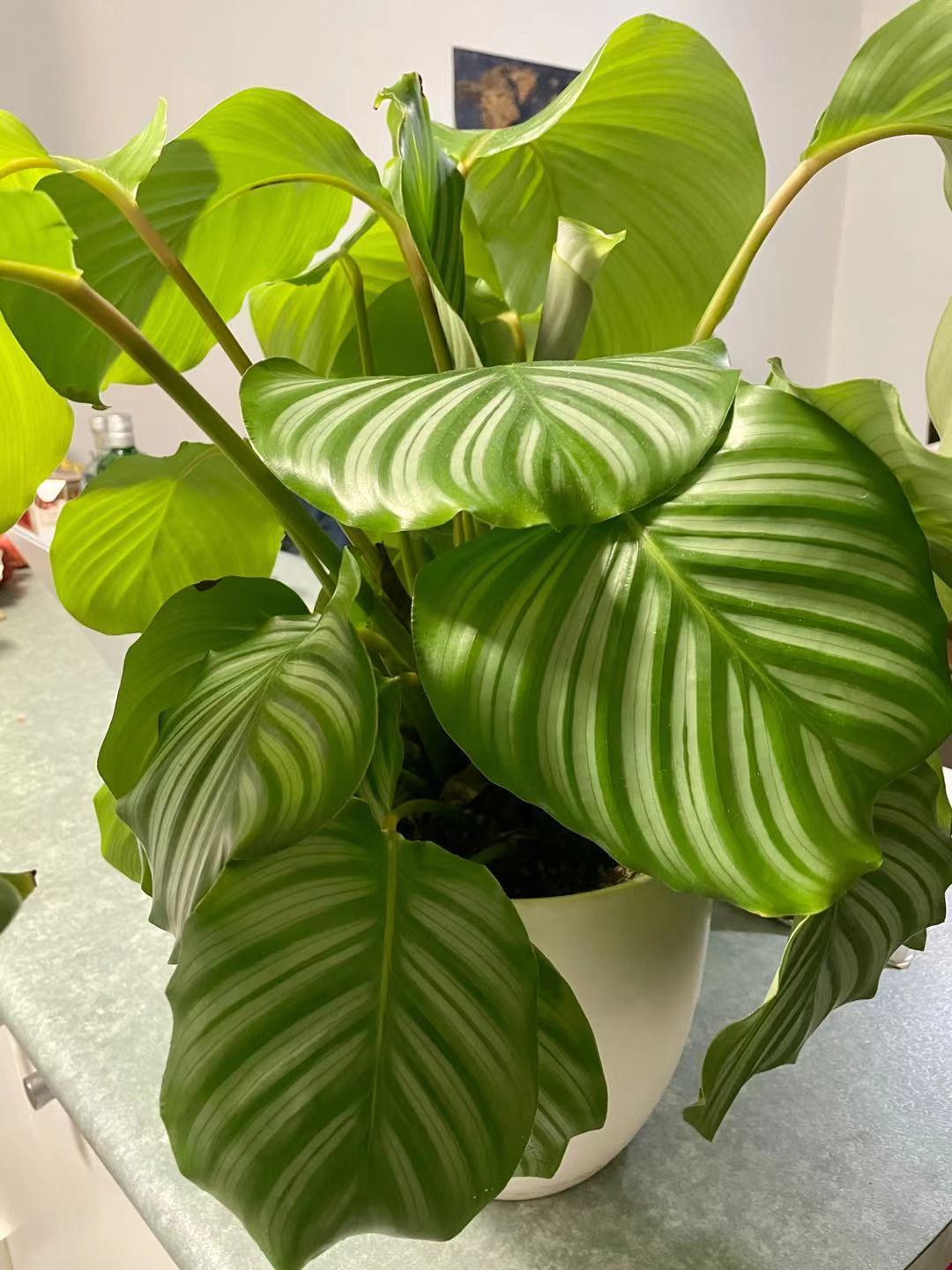
Identity & taxonomy
- Scientific name
- Goeppertia orbifolia (Linden) Borchs. & S.Suárez
- Family
- Marantaceae
- Genus
- Goeppertia
- Order
- Zingiberales
- Wikidata
- Q17302145
- Calathea orbifolia (Linden) H.Kenn.
- Phrynium orbifolium Linden (basionym)
- Maranta orbifolia (Linden) Regel
- Calathea orbifoliaen
- Round-leaf calatheaen
- Prayer planten
- Round-leaf prayer planten
- Kalatea orbifoliasv
- Kalatea orbifoliano
- Kalatea orbifoliada
- Kalateafi
- Rundblättrige Korbmarantede
Bolivia
How to identify it
Growth habit. Clumping evergreen perennial spreading from a short underground rhizome. Leaves emerge one at a time, rolled tightly from the rhizome on long petioles. Daily circadian movements raise the leaves upward at night (the 'prayer' posture — audible as a faint rustle in still rooms) and lower them horizontally during the day.
Leaves. Nearly circular to broadly elliptical leaves 25–40 cm across on petioles 40–60 cm long. Upper surface is patterned with concentric silver-to-pale-green stripes radiating outward from the midrib; underside is pale grey-green. Texture is paper-thin and soft compared to most foliage houseplants.
Flowers. Small inconspicuous white flowers in a short inflorescence at the base, only occasionally produced in cultivation. Not ornamentally significant.
- Leaves are much more circular than other calatheas — nearly as wide as they are long.
- Concentric silver-pale-green striping radiates outward from the midrib like tree rings.
- Long, slender, flexible petioles that raise the leaves high above the rhizome.
- Leaves fold upward at night in the classic Marantaceae prayer posture.
- Underside of the leaf is a soft silver-grey, not purple (unlike Goeppertia roseopicta or makoyana).

Commonly confused with
Rose-painted calathea
Elongated oval leaves (not circular) with pink-and-silver striping, and a deep burgundy underside. Much smaller leaves than orbifolia.
Cigar calathea
Large banana-like leaves on upright stems — plain green, no silver striping. Grows considerably taller (1.5–2 m).
Triostar stromanthe
Long lance-shaped leaves with pink-cream-green variegation and red undersides. Shares the Marantaceae prayer-plant movement but has none of orbifolia's leaf shape.
Peacock plant
Oval leaves with a feathered silver pattern on green, and a distinct purple underside. Smaller and more heavily patterned than orbifolia.
Care
Light
Medium indirect light — no direct sun.
Calathea orbifolia is a cloud-forest understory species that evolved beneath a closed canopy. Direct sun of any intensity bleaches and scorches the silver stripes within days. A north-facing window or 1–2 m back from an east window is ideal. Supplemental grow lights in dim Nordic winters should be diffused, not direct.
Seasonal: Nordic winters: a gentle LED grow light (3,000–5,000 lux at leaf level) for 10 hours/day helps maintain growth from October through March.
Water
When the top 1–2 cm of soil feels dry; use filtered or rainwater.
Calathea orbifolia punishes both under- and over-watering. Water thoroughly until runoff, then empty the saucer promptly — standing water in the saucer triggers root rot within days. Fluoride, chlorine, and salts in tap water cause brown leaf edges; use filtered, distilled, or collected rainwater exclusively. This is not optional.
Seasonal: Cut frequency by roughly a third from November to February.
Soil
Airy, moisture-retentive, peat-free mix.
A mix of 2 parts quality peat-free potting soil, 1 part perlite, and 1 part fine orchid bark or coir works well. The goal is a mix that holds moisture without going soggy — the fine roots suffocate in dense wet compost but crisp up in mixes that drain too fast.
Humidity
60 % or higher preferred.
Humidity is the single most important care factor for Calathea orbifolia. Below 50 %, leaves crisp at the edges and curl inward. A humidifier nearby (not misting) is effectively required; pebble trays are largely cosmetic and not enough on their own. A glass cabinet or enclosed grow tent is the most reliable long-term setup in very dry homes.
Temperature
18–27 °C.
Calathea orbifolia is intolerant of cold. Below 15 °C, leaves stop moving at night and new leaves come in deformed; below 10 °C, existing foliage develops irreversible dark blotches. Keep well away from cold window glass and draughts in Nordic winters.
Fertilizer
Balanced liquid feed monthly in spring and summer, at quarter strength.
Calathea is a light feeder. A balanced NPK (3-1-2 or 20-20-20) at quarter the label rate is ample; anything stronger contributes to leaf-edge burn, compounding the water-quality problem. Flush the soil with plain filtered water every 2–3 months to leach accumulated salts.
Seasonal: Stop feeding from October through February.
Repotting
Every 2–3 years, in early spring as new growth resumes.
Move up by one pot size. The rhizome prefers a snug pot — an oversized container holds too much wet soil around the small root mass and invites rot. Disturb the roots as little as possible.
Rhizome division
moderate~Immediate — divisions carry existing rootsThe only reliable method. Unpot a mature clump in early spring, gently tease apart natural rhizome sections (each with several leaves and its own roots), and pot each section into fresh aroid-style mix. Expect 2–4 weeks of stalled growth while the divisions recover. Leaf cuttings do not produce new plants.
Common problems
Crispy brown leaf edges
Symptom
Leaf margins go brown and crispy; damage is irreversible once it appears.
Cause
Low humidity, salts and fluoride in tap water, and/or over-fertilising — almost always a combination rather than a single cause.
Fix
Switch to filtered, distilled, or rainwater exclusively. Raise humidity above 55 % with a dedicated humidifier near the plant. Flush the soil every 2–3 months. Trim the brown edges with scissors following the natural curve of the leaf. New leaves should emerge clean once the three problems are resolved.
Leaves curling inward
Symptom
Leaves roll longitudinally toward the midrib, often during the day.
Cause
Either under-watering or low humidity — sometimes both at once.
Fix
Check the top 1–2 cm of soil. If dry, water thoroughly. If moist, raise humidity. Leaves usually relax within a day if the cause is addressed promptly; chronic curling indicates a sustained problem.
Spider mite infestation
Symptom
Fine white speckling and dull yellowing on the upper leaf surface; faint webbing between veins in bad cases.
Cause
Dry air — spider mites thrive below 40 % humidity and find Calathea a preferred host.
Fix
Rinse the plant thoroughly in the shower, including leaf undersides. Repeat weekly for 3 weeks. Apply horticultural oil or insecticidal soap between rinses. Maintaining humidity above 55 % is the single most important prevention.
Yellowing lower leaves
Symptom
Older, lower leaves turn yellow and drop.
Cause
Overwatering, cold soil, or a pot too large for the root mass.
Fix
Check soil moisture and drainage. Reduce watering frequency; move the plant away from cold windows or floors; consider downsizing the pot. Trim off yellowed leaves once new growth resumes.
- Spider mites
- Thrips
- Fungus gnats
- Mealybugs
- Root rot (Pythium)
- Leaf spot (Alternaria, Helminthosporium)
Toxicity & safety
No known toxic effect from handling or ingestion.
Calathea — Missouri Botanical Garden Plant FinderASPCA lists Calathea / prayer plants as non-toxic to cats. Cats chewing large amounts of any leafy material can develop mild GI upset from volume, not from toxicity.
Prayer Plant — ASPCA Toxic and Non-Toxic PlantsASPCA lists Calathea / prayer plants as non-toxic to dogs.
Prayer Plant — ASPCA Toxic and Non-Toxic PlantsMost of the plants sold as 'Calathea' today are technically in the genus Goeppertia — a 2012 molecular phylogenetic study (Borchsenius et al.) split Calathea into multiple genera. Horticultural trade has largely ignored the change because 'Goeppertia' is hard to market and everyone already knows the plants as calatheas. Both names refer to the same plants.
Frequently asked · 5
Is Calathea orbifolia safe for cats and dogs?+
Yes — ASPCA lists Calathea / prayer plants as non-toxic to cats and dogs. It is one of the safer ornamental foliage houseplants for pet households. Cats that chew a large amount of any leafy material may get mild GI upset from volume, but there is no toxic compound.
Why are the edges of my Calathea orbifolia leaves going brown?+
Almost always a combination of low humidity, salts or fluoride in tap water, and over-fertilising. Switch to filtered, distilled, or rainwater exclusively, raise humidity above 55 % with a humidifier (pebble trays alone aren't enough), and halve or quarter the fertiliser rate. Brown damage is irreversible on a given leaf, but new leaves will emerge clean.
Why is my Calathea orbifolia called 'Goeppertia'?+
A 2012 phylogenetic study split the old genus Calathea — most of the popular houseplant species, including orbifolia, were moved to Goeppertia. The plant is the same; only the botanical genus changed. Both 'Calathea orbifolia' and 'Goeppertia orbifolia' refer to exactly the same species, and both names are still widely used in horticulture.
What water should I use for a Calathea orbifolia?+
Filtered, distilled, or collected rainwater. Tap water containing fluoride, chlorine, and dissolved salts is the single most common cause of the classic brown-edge problem on calatheas — and plain stock-standard tap water is enough to cause it over weeks. This isn't a luxury choice; it's part of the baseline care for the species.
How often should I water Calathea orbifolia?+
When the top 1–2 cm of soil feels dry — typically every 5–7 days in a bright room in summer and every 10–14 days in winter. Water thoroughly until runoff, then empty the saucer immediately. Both under- and over-watering show up as crispy or curled leaves, so a steady rhythm based on checking the soil beats any fixed schedule.