Identity & taxonomy
- Scientific name
- Aglaonema commutatum Schott
- Family
- Araceae
- Genus
- Aglaonema
- Order
- Alismatales
- Wikidata
- Q147720
- Aglaonema marantifolium var. commutatum (Schott) Engl.
- Chinese evergreenen
- Philippine evergreenen
- Poison dart planten
- Silverlövliljasv
- Aglaonemano
- Aglaonemada
- Aglaonemafi
- Kolbenfadende
Philippines · Northeastern Celebes (Sulawesi)
How to identify it
Growth habit. Clumping evergreen herb with a short upright stem that eventually becomes visible as lower leaves drop, making older specimens look mildly 'palm-like'. Offsets from the base thicken the clump over years. Leaves emerge one at a time from the stem apex on long petioles.
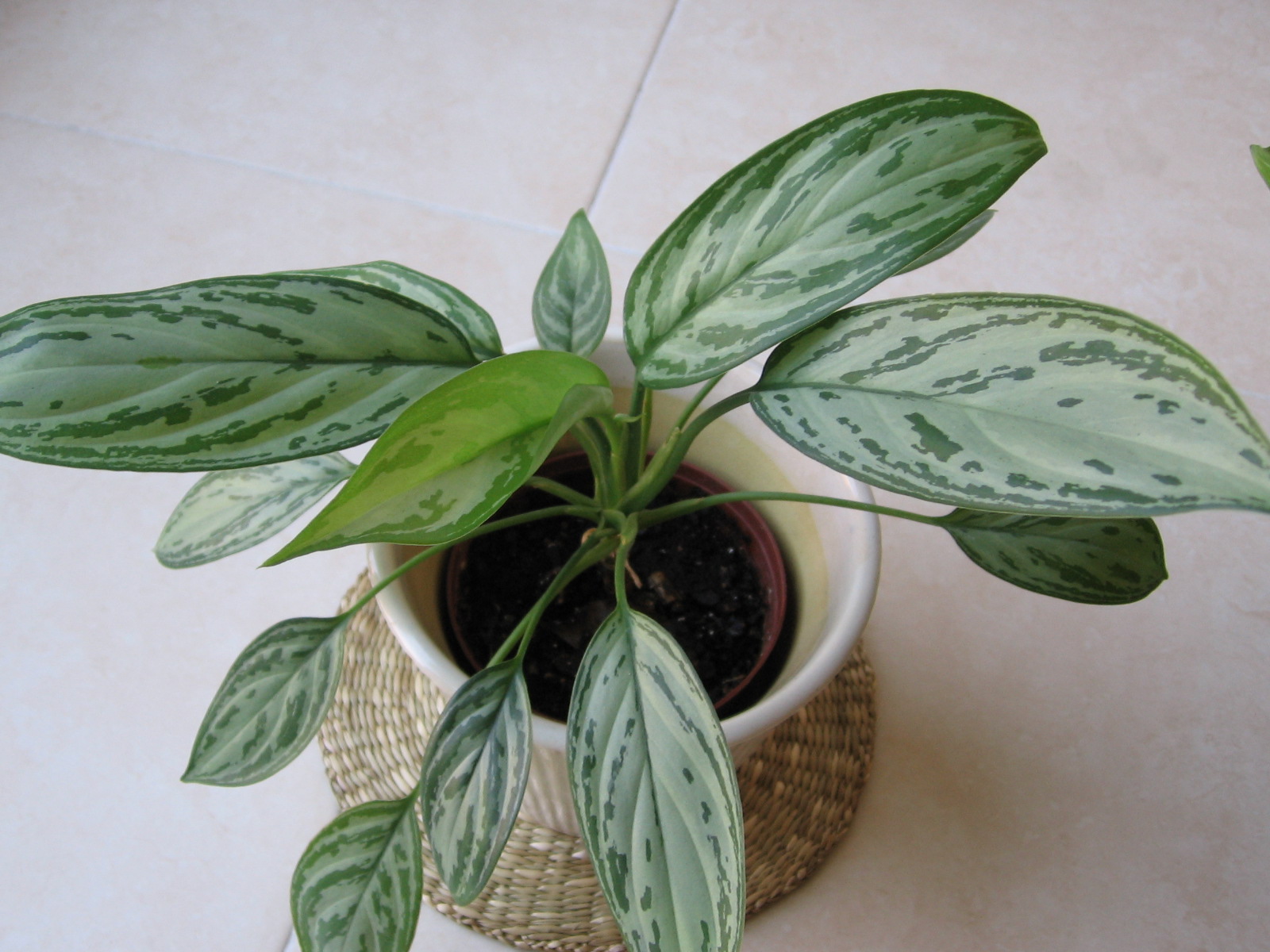
Leaves. Lanceolate to oblong leaves 15–30 cm long and 5–10 cm wide, with a pointed tip and smooth margin. The species form is dark green with silver central marbling along the main veins. Cultivars radically extend the colour palette — cream, silver, red, pink — but share the characteristic pinnate variegation pattern aligned with lateral veins.
Flowers. Typical aroid inflorescence: a short creamy-white to pale-green spathe partly enclosing a pale greenish spadix, emerging from the leaf axils. Flowering is uncommon indoors; when it occurs, the flowers are inconspicuous.
Fruit. Small red-to-orange berries 1 cm across when produced on the spadix after pollination. Rare in cultivation.
- Silver, cream, or red pinnate variegation patterns aligned with the lateral leaf veins — the pattern mirrors the leaf's underlying vascular structure.
- Clumping, upright, short-stemmed habit; no vining or climbing.
- Leaves emerge one at a time from the stem apex on long petioles, not from a basal rosette.
- Mature lower stems are visible, smooth, and cane-like.
Commonly confused with
Dumb cane
Larger, broader leaves with random creamy splotches rather than pinnate variegation. Dieffenbachia grows taller, with thicker canes, and its variegation pattern is not organised along the veins.
Song of India
Narrower strap-like leaves arranged in dense whorls around woody stems; leaves are striped yellow-green rather than pinnately marbled.
Rose-painted calathea
Thinner, softer leaves that move on a daily circadian rhythm; pinkish-silver central stripes rather than silver marbling, and the plant demands far higher humidity.
Care
Light
Medium indirect light; tolerates low light.
Aglaonema is one of the most low-light-tolerant houseplants in common cultivation. Silver-leaved cultivars handle shade better than most plants on earth. However, red and pink cultivars ('Red Siam', 'Lipstick') need at least medium light to hold their colour — in deep shade they revert to mostly green. Direct sun scorches any cultivar.
Seasonal: Nordic winters: supplemental lighting is optional for silver cultivars but beneficial for the red/pink forms.
Water
When the top 3 cm of soil feels dry.
Water thoroughly until runoff, then empty the saucer. Aglaonema is moderately drought-tolerant — the thick petioles and fleshy rhizome buffer several weeks of dry conditions — but punishes sustained wet soil with root rot. Let the top few centimetres dry out between waterings.
Seasonal: Cut frequency by roughly a third from November to February.
Soil
Standard peat-free potting mix with added perlite.
A mix of 3 parts quality peat-free potting soil to 1 part perlite works well. Avoid heavy garden soil and dense compacted mixes that stay wet. A layer of LECA or coarse grit at the bottom of the pot is optional but can help drainage.
Humidity
40–60 %; tolerates 30 %.
Aglaonema is forgiving of ordinary indoor humidity but appreciates a slight boost. In very dry rooms (below 30 %), leaf tips may brown; a pebble tray or nearby humidifier corrects it. Misting is not effective and can trigger bacterial leaf spot.
Temperature
18–27 °C.
Cold-sensitive for an indoor plant — sustained exposure below 13 °C produces greyish cold-stress patches that never recover. Keep away from cold window glass and draughts from doors.
Fertilizer
Balanced liquid feed monthly in spring and summer, at half strength.
A balanced NPK (3-1-2 or 20-20-20) at half the label rate, applied to already-moist soil, is plenty. Over-feeding produces crispy brown leaf edges and salt crust on the soil.
Seasonal: Skip feeding from late October through February.
Pruning
Remove yellowed lower leaves; trim browned edges with scissors.
Aglaonema does not require structural pruning. Simply pull off yellowed lower leaves at the stem (they detach with a gentle twist), and trim brown leaf edges following the natural curve of the blade. Tall or leggy specimens can be cut back to 10–15 cm above soil level; new growth emerges from dormant nodes below the cut.
Repotting
Every 2–3 years — Aglaonema prefers slightly pot-bound roots.
Move up by one pot size. Aglaonema grows best when slightly root-restricted and does not enjoy oversized pots, which hold too much wet soil around the small root system. Spring is the ideal time.
Division of rhizome clumps
easy~Immediate — divisions carry existing rootsUnpot a mature clump in spring and slice the rhizome mass into 2–4 sections with a clean knife, each carrying at least one stem and healthy roots. Repot each division into its own container. The least disruptive propagation method.
Stem cutting in water
easy~3–6 weeksCut a 10–15 cm stem section that includes at least two nodes. Place in tepid water in bright indirect light, change weekly. Pot up once roots reach 3–5 cm.
Stem cutting directly in soil
easy~4–8 weeksInsert a cutting 3–5 cm deep into moist cutting mix. Keep at 21–24 °C in bright indirect light with cover or bag to retain humidity. Remove cover once new growth is visible.
Cultivars
'Silver Queen'
The archetypal Chinese evergreen — leaves marbled silver over dark green, with the silver coverage often exceeding 60 %. Compact, very tolerant of low light.
'Silver Bay'
Broader, more pointed leaves with heavy silver central zones and narrow dark green margins. Larger than 'Silver Queen'.
'Red Siam' / 'Siam Aurora'
Pink-to-red suffusion along leaf margins and midrib on a green base. Needs brighter light than the silver cultivars to hold the red colour.
'Pink Dalmatian'
Green leaves spattered with pink speckles and patches. Relatively compact.

'Lipstick'
Narrower leaves edged with a vivid pink to red margin (hence the name). One of the more light-demanding cultivars.
Common problems
Yellowing lower leaves
Symptom
Oldest leaves at the base yellow and drop, one at a time.
Cause
Normal senescence up to a point — Aglaonema sheds its oldest leaves as new ones emerge. If many leaves yellow at once, the usual cause is overwatering.
Fix
If a single old leaf is yellow at a time, do nothing. If multiple leaves yellow together and the soil is wet, let the soil dry out thoroughly and check for mushy roots.
Brown leaf tips and edges
Symptom
Crispy brown at the very tip or along the leaf edge.
Cause
Most often low humidity or fluoride/chlorine in tap water; secondarily over-fertilising (salt build-up).
Fix
Switch to filtered or rainwater, or leave tap water standing overnight to dissipate chlorine. Halve fertiliser rate and flush the soil with plain water every 3–4 months. Raising humidity above 40 % also helps.
Loss of red or pink colour
Symptom
Cultivars like 'Red Siam' or 'Lipstick' lose their coloured margins and go mostly green.
Cause
Insufficient light for the cultivar's colour-producing anthocyanins.
Fix
Move to brighter indirect light (near an east or north-east window is usually enough), or add a grow light for 8–10 hours/day. New leaves should come in with restored colour within 2–3 growth cycles.
Cold damage
Symptom
Greyish translucent patches on leaves after exposure to cold window glass or a draught.
Cause
Temperature below 13 °C.
Fix
Move the plant away from the cold source. Damaged leaves will not recover and can be pruned off once new growth stabilises; the rhizome usually survives even severe cold damage if warmed promptly.
- Spider mites
- Mealybugs
- Scale
- Aphids
- Root rot (Pythium)
- Bacterial leaf spot (Erwinia)
- Fusarium stem rot
Toxicity & safety
Sap contains insoluble calcium oxalate raphides. Contact causes skin irritation; ingestion causes intense oral burning, drooling, and swelling of the lips, tongue, and throat. Rarely life-threatening but genuinely painful.
Mechanism: Insoluble calcium oxalate raphides (needle-shaped crystals) that mechanically injure mucous membranes.
Aglaonema commutatum — Missouri Botanical Garden Plant FinderIntense oral irritation, drooling, pawing at the face, vomiting, and difficulty swallowing. Severe cases can include upper airway swelling.
Chinese Evergreen — ASPCA Toxic and Non-Toxic PlantsOral irritation, drooling, vomiting, and difficulty swallowing. Same mechanism as in cats.
Chinese Evergreen — ASPCA Toxic and Non-Toxic PlantsChinese evergreen has been bred and selected in Southeast Asia for at least 1,000 years — the Chinese and Thai ornamental horticulture industries produced most of the modern cultivars that Western markets rediscovered in the 20th century. The red and pink forms so popular in Europe today are largely the work of Thai breeder Nat DeLeon, whose hybrids from the 1990s–2000s reshaped the genus.
Frequently asked · 5
Is Chinese evergreen safe for cats and dogs?+
No — ASPCA lists Aglaonema as toxic to cats and dogs. The sap contains insoluble calcium oxalate crystals that cause intense oral burning, drooling, vomiting, and difficulty swallowing. Keep it away from pets that chew plants.
How much light does a Chinese evergreen need?+
Medium indirect light is ideal, but silver-leaved cultivars like 'Silver Queen' are among the most shade-tolerant houseplants available and can handle genuinely dim corners. Red and pink cultivars need brighter light to hold their colour — if they revert to green, move them closer to a window.
Why are the bottom leaves of my Chinese evergreen turning yellow?+
A single old leaf yellowing at a time is normal — Aglaonema sheds oldest leaves as new ones emerge. If multiple leaves yellow at once and the soil is wet, the cause is overwatering. Let the top 3 cm of soil dry between waterings and check the roots for mushy dark sections.
How do I propagate Chinese evergreen?+
The easiest method is division: unpot a mature clump in spring and slice the rhizome into 2–4 sections, each with roots and at least one stem, then pot each up separately. Stem cuttings rooted in water or moist cutting mix also work reliably, typically taking 3–6 weeks to root.
Why does my Chinese evergreen have brown leaf tips?+
Usually one of three things: low humidity (raise to 40–50 %), fluoride or chlorine in tap water (switch to filtered or rainwater), or over-fertilising (halve the rate and flush the soil with plain water every few months to leach salts). Trim the browned tips with scissors following the natural leaf shape.