
Identity & taxonomy
- Scientific name
- Dracaena marginata hort. ex Bos
- Family
- Asparagaceae
- Genus
- Dracaena
- Order
- Asparagales
- Wikidata
- Q7761
- Dracaena reflexa var. angustifolia Baker
- Pleomele marginata (hort. ex Bos) N.E.Br.
- Dragon treeen
- Madagascar dragon treeen
- Red-edged dracaenaen
- Drakträdsv
- Drakontreno
- Dragontræda
- Lohikäärmepuufi
- Drachenbaumde
Madagascar · Mauritius
How to identify it
Growth habit. Slow-growing tree with slender, upright, sparsely branched grey canes. Each cane terminates in a tuft of leaves; as lower leaves drop, the cane lengthens and the leaf tuft migrates up. Plants are commonly sold as multi-cane specimens with canes of staggered heights, giving a layered palm-like silhouette.
Leaves. Narrow, lance-shaped to strap-shaped leaves 30–60 cm long and 1–2 cm wide, spirally arranged in dense tufts at cane tips. Leaves are deep glossy green with a thin red-to-purple margin; cultivars vary in variegation. Older leaves yellow and drop from the base of the tuft as the cane grows.
Flowers. Panicles of small, fragrant, creamy-white flowers on a mature plant; each flower about 0.5 cm across. Flowering is rare indoors; requires a mature plant (5+ years) in strong light and happens mostly in plants summered outdoors.
Fruit. Small orange-red berries 1–1.5 cm across, each containing a single seed. Rare in cultivation.
- Slender grey, visibly ringed canes with leaf tufts only at the tip — palm-like silhouette.
- Narrow (1–2 cm wide) strap-shaped leaves with a thin red or purple margin.
- Leaves spirally arranged and arching outward from the cane top.
- Bare cane below the tuft shows old leaf-scar rings like bamboo.

Commonly confused with
Corn plant
Broader strap-shaped leaves (5–10 cm wide) with a yellow-green central stripe, and thicker canes. Does not have the red leaf margin of D. marginata.
Snake plant / mother-in-law's tongue
Stiff upright sword-shaped succulent leaves emerging directly from a rhizome at soil level — no cane, no leaf tuft, completely different silhouette. Same genus.
Ti plant / Hawaiian good luck plant
Wider leaves (4–10 cm) with stronger pink, red, or purple variegation across the whole leaf rather than just the margin. Different genus in Asparagaceae.
Spineless yucca
Stiffer, blade-like leaves with a sharp (but non-spiny) point. Much thicker woody trunk. Often sold in the same shape but requires direct sun.

Care
Light
Bright indirect; tolerates medium light.
Dracaena marginata tolerates lower light than most houseplants of its size — a position 2–3 m from a bright window is fine. Full direct sun bleaches the leaves and often burns 'Tricolor' and 'Colorama' cultivars. The best compromise for variegated forms is filtered bright indirect; solid-green forms accept deeper shade.
Seasonal: In Nordic winters, solid-green plants cope with the low light; variegated cultivars benefit from supplementary lighting to hold colour.
Water
When top 3–4 cm of soil is dry.
Water thoroughly until runoff, then let the top 3–4 cm dry. Dracaena is drought-tolerant — a week of forgotten watering rarely shows. Overwatering shows as soft wilting, yellow lower leaves, and root rot. Use filtered, rain, or distilled water if possible: fluoride, chlorine, and chloramine in tap water are the leading cause of brown leaf tips.
Seasonal: Cut frequency by roughly half from November to February.
Soil
Well-draining peat-free potting mix.
A blend of 3 parts peat-free potting soil to 1 part perlite works well. Dracaena isn't fussy about soil composition, but it is fussy about drainage — a dense compacted mix is the direct cause of most root rot cases. Alkaline tap water can push soil pH above the preferred range over time; flush with filtered water yearly.
Humidity
40–60 %; tolerates dry indoor air down to 30 %.
One of the more forgiving tropical foliage plants for dry Nordic winter indoor air. Very low humidity (below 30 %) accelerates brown leaf tips. A nearby humidifier is more effective than misting.
Temperature
16–27 °C.
Avoid cold drafts and window glass below 10 °C in winter — leaves show pale grey water-soaked patches within days of cold exposure. Does well in normal heated indoor air year-round.
Fertilizer
Balanced liquid feed monthly in spring and summer at half strength.
A balanced NPK at half the label rate during active growth is ample. Dracaena is a low feeder and especially sensitive to fertiliser salts — brown tips can as easily come from over-fertilising as from tap water. Flush the soil with plain water every 3–4 months to leach accumulated salts.
Seasonal: Skip feeding from late October through February.
Pruning
Cut canes at any height; the plant branches from the cut.
Dracaena tolerates hard pruning. Cut a cane at any height with a clean sharp blade; the cut cane sprouts 1–3 new shoots just below the cut within 4–8 weeks, and the cut piece can be propagated. This is also the standard fix for a plant that has outgrown its ceiling.
Repotting
Every 3–4 years; prefers to be slightly pot-bound.
Repot only when roots fill the pot or when the plant becomes top-heavy. Move up by 2–5 cm in pot diameter; larger jumps hold too much water. Best done in early spring. Many multi-cane specimens are sold root-packed by design — the crowded rooting is part of what keeps the canes the correct relative heights.
Cane cutting (top cutting)
easy~3–6 weeks in water; 4–8 weeks in soilCut the top of a cane (8–15 cm with at least one leaf tuft) just below a ring-like leaf scar with a clean sharp knife. Let the cut callus for a day, then place in a jar of room-temperature water or insert into damp potting mix. Rooting hormone speeds the process but isn't required.
Cane cutting (stem segment)
easy~6–10 weeksA leafless middle section of cane 10–15 cm long will root on its own if you keep it right-way-up (note the original orientation — it will not grow if inserted upside down). Push the bottom 2–3 cm into damp mix and keep in bright indirect light. New leaf tufts emerge from dormant buds along the cane.
Air layering
moderate~6–10 weeksFor an overgrown specimen, girdle a cane below a leaf tuft, wrap the wound in damp sphagnum, and cover with clear plastic. Roots form inside the moss over 6–10 weeks; sever below the new root mass and pot separately. The stump re-sprouts and you end up with two plants.
Cultivars
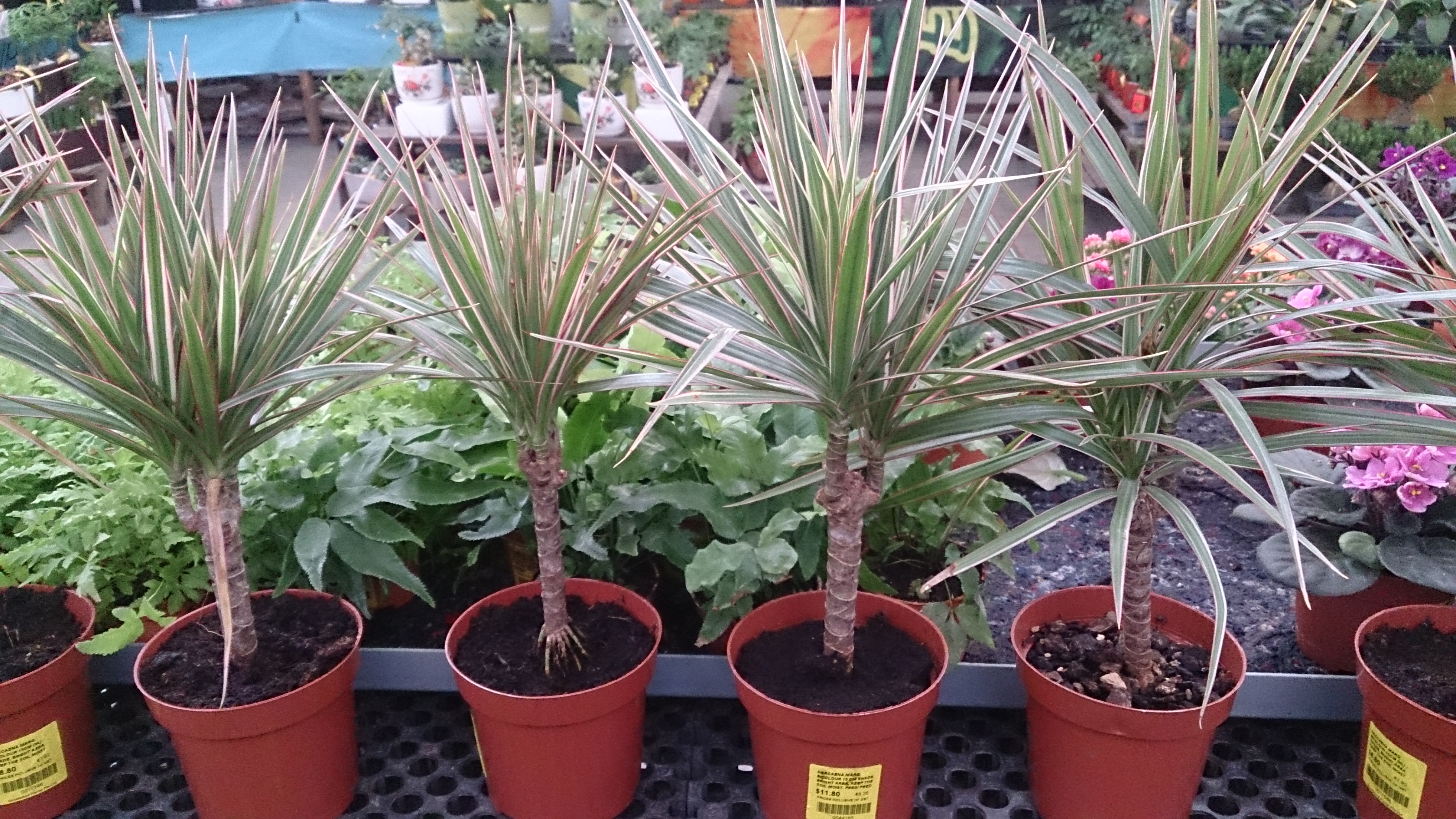
'Tricolor'
Leaves with cream-yellow, pink, and green longitudinal stripes. Slightly slower-growing than the species and slightly more light-demanding.
'Colorama'
Intense pink-to-red variegation with narrower green stripes. The most colourful cultivar; needs the most light to hold colour without reverting.
'Bicolor'
Green leaves with a broad cream stripe along the margin. Less common than 'Tricolor' and 'Colorama' in the Nordic trade.
Common problems
Brown leaf tips
Symptom
The outermost 1–3 cm of each leaf tip goes brown and papery.
Cause
Fluoride, chlorine, or chloramine in tap water — Dracaena is one of the most fluoride-sensitive houseplants. Less commonly, over-fertilising or very dry air.
Fix
Switch to filtered, distilled, or rainwater. Halve the fertiliser rate. Raise humidity above 40 %. Brown tips will not regreen but can be trimmed at an angle with sharp scissors to restore the leaf shape. New leaves will emerge tip-clean under corrected water.
Yellow older leaves dropping
Symptom
Lower leaves on the tuft yellow and fall; tuft slowly migrates up the cane.
Cause
Usually natural — Dracaena continuously sheds its oldest leaves as new ones emerge at the tuft centre. Excessive yellowing (multiple leaves at once) indicates overwatering or root rot.
Fix
If only 1–2 old leaves yellow at a time, no action needed. If a whole cane yellows at once, unpot and inspect — black mushy roots mean rot, and the cane needs fresh dry mix plus a long watering break.
Soft, mushy leaf bases
Symptom
Leaves collapse from the base; the tuft falls off the cane.
Cause
Severe root rot, or cold damage from winter exposure below 10 °C.
Fix
Remove the affected cane at the soil line. If the plant has other canes and they are still firm, repot in fresh dry mix and reduce watering. If the whole root system has rotted, salvage any firm cane tips as top cuttings and start over — the rotted root mass is not recoverable.
Fine webbing between leaves
Symptom
Fine silk-like webbing between leaf bases; leaves develop a stippled, dusty look.
Cause
Spider mite infestation, strongly correlated with very dry winter indoor air.
Fix
Rinse the plant in the shower with lukewarm water to dislodge mites. Treat weekly for 3 weeks with insecticidal soap or 1:1 isopropyl alcohol + water. Raise ambient humidity above 40 % to slow re-infestation. Spider mites are a dry-air problem as much as a pest problem.
- Spider mites (dry indoor air)
- Mealybugs
- Scale
- Thrips
- Root rot (Pythium, Phytophthora)
- Fusarium leaf spot
- Leaf tip fluoride burn (abiotic)
Toxicity & safety
Not listed as toxic to humans; Missouri Botanical Garden does not flag it. Large ingestion may cause mild GI upset.
Dracaena marginata — Missouri Botanical Garden Plant FinderVomiting (occasionally with blood), anorexia, depression, hypersalivation, and dilated pupils after ingestion. The dilated-pupil sign is especially characteristic of Dracaena toxicity in cats.
Mechanism: Saponins.
Dragon Tree — ASPCA Toxic and Non-Toxic PlantsVomiting (occasionally with blood), anorexia, depression, and hypersalivation after ingestion. Dogs generally do not show the pupil dilation seen in cats.
Mechanism: Saponins.
Dragon Tree — ASPCA Toxic and Non-Toxic PlantsDracaena marginata was tested in NASA's 1989 Clean Air Study and consistently ranked among the best indoor plants for passive removal of formaldehyde, xylene, and trichloroethylene. Later research has shown that the effect is far too small at normal room scale to meaningfully clean indoor air — you would need hundreds of plants per room for measurable impact — but the original study cemented Dracaena's place in office-plant catalogues for decades.
Frequently asked · 5
Is a dragon tree toxic to cats and dogs?+
Yes — ASPCA lists Dracaena marginata as toxic to cats and dogs. Ingestion causes vomiting (sometimes with blood), depression, hypersalivation, and anorexia, and in cats also causes distinctively dilated pupils. The toxin is saponins. Symptoms usually resolve with supportive care within 24 hours; keep the plant out of reach of chewing pets.
Why are my dragon tree leaves brown at the tips?+
Almost always tap water. Dracaena is one of the most fluoride- and chlorine-sensitive houseplants — fluoride accumulates in leaf tips and kills the tissue. Switch to filtered, distilled, or rainwater and the problem stops for new growth. Existing brown tips don't regreen but can be trimmed at an angle. Over-fertilising and very dry air are secondary causes.
How often should I water a dragon tree?+
When the top 3–4 cm of soil is dry — typically every 10–14 days in summer and every 3–4 weeks in winter. Dracaena tolerates drought far better than soggy soil; a week of forgotten watering rarely shows. Use filtered or rainwater whenever possible to prevent fluoride tip burn.
How do I prune a dragon tree that has grown too tall?+
Cut any cane at any height with a clean sharp blade — the plant will branch from dormant buds below the cut within 4–8 weeks, producing 1–3 new leaf tufts per cut cane. The cut piece can itself be propagated as a top cutting: callus for a day, then place in water or damp potting mix. Prune in spring for fastest recovery.
Can a dragon tree survive in low light?+
Yes — better than most large houseplants. Solid-green forms tolerate positions 2–3 m from a window, which is why Dracaena is a fixture of office lobbies and hallways. Variegated cultivars ('Tricolor', 'Colorama') need brighter light to hold their colour and will slowly revert to green-dominant leaves in deep shade.