
Identity & taxonomy
- Scientific name
- Monstera deliciosa Liebm.
- Family
- Araceae
- Genus
- Monstera
- Order
- Alismatales
- Wikidata
- Q161077
- Philodendron pertusum Kunth & Bouché
- Swiss cheese planten
- Mexican breadfruiten
- Fruit salad planten
- Split-leaf philodendronen
- Monsterasv
- Monstera deliciosano
- Fingerfilodendronda
- Jättipeikonlehtifi
- Köstliches Fensterblattde
Southern Mexico · Belize · Guatemala · Honduras · Nicaragua · Costa Rica · Panama
How to identify it
Growth habit. Hemiepiphytic climber: germinates on the forest floor, scrambles toward a host tree, then climbs using thick aerial adventitious roots. Older stems can become self-supporting indoors with a moss pole.
Leaves. Juvenile leaves are entire, heart-shaped, and 10–25 cm long. Adult leaves reach 30–90 cm, become pinnately lobed from the margin, and develop characteristic elliptical perforations (fenestrations) between the midrib and margin. Dark glossy green, leathery, with a prominent midrib.
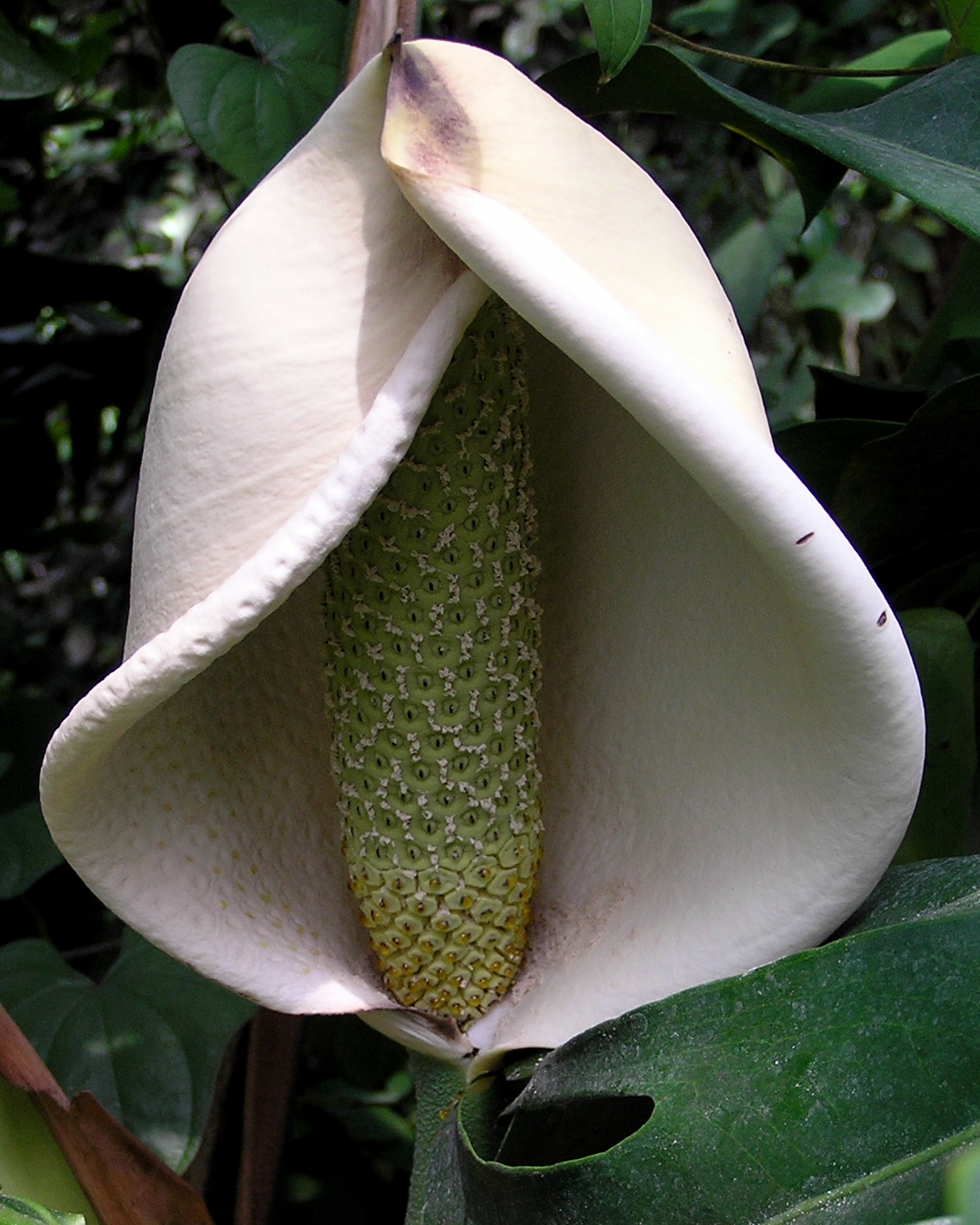
Flowers. Inflorescence is a typical aroid spadix — a cream-coloured spike up to 25 cm, partially enclosed by a thick, cream-to-yellow spathe. Rare in cultivation; requires a mature plant with plenty of light.
Fruit. A spike 20–30 cm long composed of hexagonal scales that fall away as each segment ripens from the base upward over roughly a year. Ripe flesh smells of pineapple and banana; unripe flesh contains painful oxalate raphides.
- Adult leaves have BOTH interior holes AND edge-splits — the combination is diagnostic.
- Leaves can exceed 60 cm at maturity.
- Thick, rope-like aerial roots emerge from every node.
- Petiole is grooved on the upper surface and sheathes the stem at the base.


Commonly confused with
Swiss cheese vine
Smaller leaves (up to 25 cm) with enclosed oval holes but NO edge-splits; more vining, less self-supporting.
Split-leaf philodendron (tree philodendron)
Leaves have edge-splits but NO interior holes; forms a short, thick, self-supporting trunk rather than climbing with aerial roots.
Mini monstera / Monstera 'Ginny'
Fenestrated leaves that stay under 25 cm; different genus. Vines more tightly and outgrows a small pole within months.
Dragon-tail plant
Mature leaves develop pinnate splits but lack the circular interior fenestrations typical of Monstera.

Care
Light
Bright indirect light.
Place within 1–2 m of a south or west window, or directly beside an east window. Direct midday sun bleaches and scorches the leaves; deep shade produces small entire leaves with no fenestrations. If new leaves emerge without splits, the plant is asking for more light — move it closer to the window or add a full-spectrum LED for 10–12 hours/day in winter.
Seasonal: In Nordic latitudes above ~55°N, supplementary grow lights from October to March prevent the classic winter stall and leggy growth.
Water
When the top 2–3 cm of soil feels dry.
Water thoroughly until it runs from the drainage hole, then empty the saucer. Do not water on a fixed schedule — a large pot in low light may only need watering every 10–14 days, while a small pot in a bright room may need it twice a week. Overwatering is by far the most common cause of Monstera decline.
Seasonal: Cut frequency by roughly a third from November to February.
Soil
Chunky, fast-draining aroid mix.
A mix of ~2 parts peat-free potting soil, 1 part perlite or pumice, 1 part orchid bark, and a small handful of horticultural charcoal works well. The air pockets between bark chunks mimic the loose forest-floor litter where Monstera roots naturally grow.
Humidity
50–60 % preferred; tolerant down to 40 %.
Higher humidity accelerates leaf size and fenestration development, but Monstera deliciosa is genuinely forgiving — it does not require a terrarium. A nearby humidifier is more effective than misting.
Temperature
18–27 °C.
Keep away from cold window glass in winter and from radiators and forced-air vents year-round. Exposure to temperatures below 10 °C produces dark water-soaked patches within days.
Fertilizer
Balanced liquid feed monthly in spring and summer, at half strength.
A balanced NPK (e.g. 3-1-2 or 20-20-20) at half the label rate, applied to already-moist soil, is ample. Over-fertilising shows up as crispy brown leaf margins and white salt crust on the soil surface.
Seasonal: Skip feeding from late October through February.
Pruning
Trim as needed to control size; cut just above a node.
Monstera tolerates hard pruning. Cut 0.5–1 cm above a node (the swollen ring where a leaf and aerial root emerge) with a clean, sharp blade. Use the cut piece for propagation. Tuck aerial roots back toward the pot or train them onto a moss pole — do not cut them off, as they are the plant's main anchoring system.
Repotting
Every 2–3 years, or when roots circle the pot bottom.
Move up by one pot size (2–5 cm wider in diameter). Larger jumps hold too much water around young roots and invite rot. Best time to repot is early spring, just as new growth resumes.
Stem cutting in water
easy~2–4 weeksCut a section containing at least one node and one aerial root. Place in a jar of room-temperature water, change weekly, and keep in bright indirect light. Pot up once the new roots reach 5–8 cm.
Stem cutting directly in soil
easy~3–6 weeksSkip the water step and plant a node-containing cutting directly in a small pot of chunky aroid mix. Keep the mix lightly moist and cover loosely with a clear bag for the first two weeks to raise humidity.
Air layering
moderate~4–8 weeksWrap damp sphagnum moss around a node on the mother plant, enclose in clingfilm, and wait for roots to fill the moss before cutting below. Higher success rate for variegated cultivars where losing a cutting would be costly.
Cultivars

'Thai Constellation'
Cream-to-yellow sectoral and speckled variegation, tissue-cultured and genetically stable — does not revert to green.
'Albo Variegata'
Pure white sectoral variegation produced by a chimeric mutation. Propagates only from cuttings that carry the variegated tissue; sections can and do revert.
'Aurea' / 'Marmorata'
Yellow variegation, chimeric and less common in cultivation.
Common problems
Yellowing leaves
Symptom
Lower leaves turn uniformly yellow, sometimes soft to the touch.
Cause
Almost always overwatering — roots can't take up nutrients in saturated soil. Less often: nitrogen deficiency in a plant that hasn't been fed in 6+ months.
Fix
Check soil 5 cm down. If wet, let dry fully and reduce frequency; if bone dry after weeks without water, resume normal watering and feed at half strength.
Brown, crispy leaf edges
Symptom
Dry brown margins on otherwise healthy leaves.
Cause
Low humidity, fluoride or chlorine in tap water, or over-fertilising.
Fix
Add a humidifier, switch to filtered or rainwater, and flush the soil with plain water every 2–3 months.
New leaves lack holes or splits
Symptom
Each new leaf emerges entire (no fenestrations).
Cause
Insufficient light. Monstera only develops fenestrations once light levels are consistently high enough and the plant is mature enough (~3 years from seed).
Fix
Move closer to a bright window or add a grow light. New fenestrated leaves should appear within 2–3 growth cycles.
Fine webbing under leaves
Symptom
Stippled yellow speckling on upper leaf surface, fine silk webbing beneath.
Cause
Spider mite infestation, favoured by dry indoor air.
Fix
Rinse the plant in a lukewarm shower, then treat with insecticidal soap or diluted neem oil every 5–7 days for three cycles to break the life cycle. Raise ambient humidity.
Full guide: Spider Mites on Houseplants: Identify Webbing, Damage, and How to Kill Them- Spider mites
- Thrips
- Mealybugs
- Scale
- Root rot (Pythium, Phytophthora)
- Leaf spot (Erwinia)
Toxicity & safety
Immediate burning of the lips, tongue, and throat if chewed; excessive drooling. Skin contact with sap can cause irritation in sensitive individuals. The fully ripe fruit is edible and a traditional food in its native range.
Mechanism: Insoluble calcium oxalate raphides
Monstera deliciosa — Missouri Botanical Garden Plant FinderOral irritation, intense burning and swelling of the mouth, tongue, and lips; drooling; vomiting; difficulty swallowing.
Mechanism: Insoluble calcium oxalate raphides
Cutleaf Philodendron — ASPCA Toxic and Non-Toxic PlantsSame oral-irritation syndrome as cats — pawing at the mouth, drooling, vomiting. Rarely systemic but uncomfortable.
Mechanism: Insoluble calcium oxalate raphides
Cutleaf Philodendron — ASPCA Toxic and Non-Toxic PlantsWhy the leaves have holes
Fenestrations are not decorative; they are an adaptation. In the dense forest understory of Central America, sunlight reaches the forest floor in shifting dappled flecks rather than steady beams. A large, unbroken leaf would waste most of its surface area on shaded tissue. Holes and splits let sunflecks pass through to lower leaves on the same plant, let wind pass without tearing the leaf, and reduce the hydraulic cost of maintaining a large surface.
The practical takeaway for indoor growers: fenestrations are a light signal. A Monstera producing entire, unsplit leaves is telling you the light is too low for it to bother investing in a more efficient shape — not that there is anything wrong with the plant.
Moss poles and aerial roots
A mature Monstera in the wild climbs a host tree; its aerial roots both anchor the stem and collect water and nutrients from debris and epiphytes. Indoors, giving the plant a moss pole to climb mimics this habit and typically results in larger, more heavily fenestrated leaves over time.
Never cut aerial roots off — they are the plant's main support structure. If they are in the way, tuck them gently into the top of the pot or train them onto the pole.
The species epithet *deliciosa* refers to the fruit, which tastes like a cross between pineapple and banana when fully ripe — but takes almost a year to ripen and will chemically burn the mouth if eaten even a week early.
Frequently asked · 5
Why doesn't my Monstera have holes in its leaves?+
Your plant needs more light, is still too young, or both. Fenestrations only develop once light is consistently bright-indirect-or-better AND the plant is mature enough — usually 2–3 years from seed. Move it closer to a bright window or add a grow light, and new leaves should start showing splits within 2–3 growth cycles.
Is Monstera deliciosa safe for cats and dogs?+
No. All parts contain insoluble calcium oxalate crystals (raphides). ASPCA lists it as toxic to cats, dogs, and horses. A pet that chews a leaf will experience immediate burning and swelling of the mouth, drooling, and sometimes vomiting. Keep it physically out of reach or pick a pet-safe alternative like Calathea or Boston fern.
How often should I water a Monstera deliciosa?+
Water when the top 2–3 cm of soil feels dry — typically every 7–10 days in summer and every 14–21 days in winter. Pot size, light level, and temperature all change the interval, so check with your finger rather than following a schedule.
What's the difference between Monstera deliciosa and split-leaf philodendron?+
"Split-leaf philodendron" is a common misnomer often applied to Monstera deliciosa in North American nurseries. The true split-leaf philodendron is Thaumatophyllum bipinnatifidum, which has only edge-splits in its leaves — no interior holes — and grows a short, thick trunk rather than climbing on aerial roots.
Can I eat the fruit of Monstera deliciosa?+
Only when it is fully ripe — which takes about twelve months from flowering. The ripe fruit smells strongly of pineapple and banana and the hexagonal scales fall away cleanly from the base. Eating the fruit even a week early causes painful oral burning from oxalate raphides, so patience is non-negotiable.