Identity & taxonomy
- Scientific name
- Philodendron hederaceum (Jacq.) Schott
- Family
- Araceae
- Genus
- Philodendron
- Order
- Alismatales
- Wikidata
- Q1767054
- Philodendron scandens K.Koch & Sello
- Philodendron oxycardium Schott
- Philodendron micans K.Koch
- Heartleaf philodendronen
- Sweetheart planten
- Vilevineen
- Philodendron Brasilen
- Hjärtfilodendronsv
- Hjerteblad-philodendronno
- Hjerteblad-philodendronda
- Köynnöspeikonlehtifi
- Herzblatt-Philodendronde
Mexico · Central America · Colombia · Venezuela · Brazil · Bolivia · Caribbean islands
How to identify it
Growth habit. Trailing epiphytic vine in juvenile form indoors; in native range it climbs tree trunks by clinging with short aerial roots at every node, and leaves become dramatically larger and more elongated on the mature climbing form. Indoor specimens almost always stay in juvenile form unless given a tall moss pole.
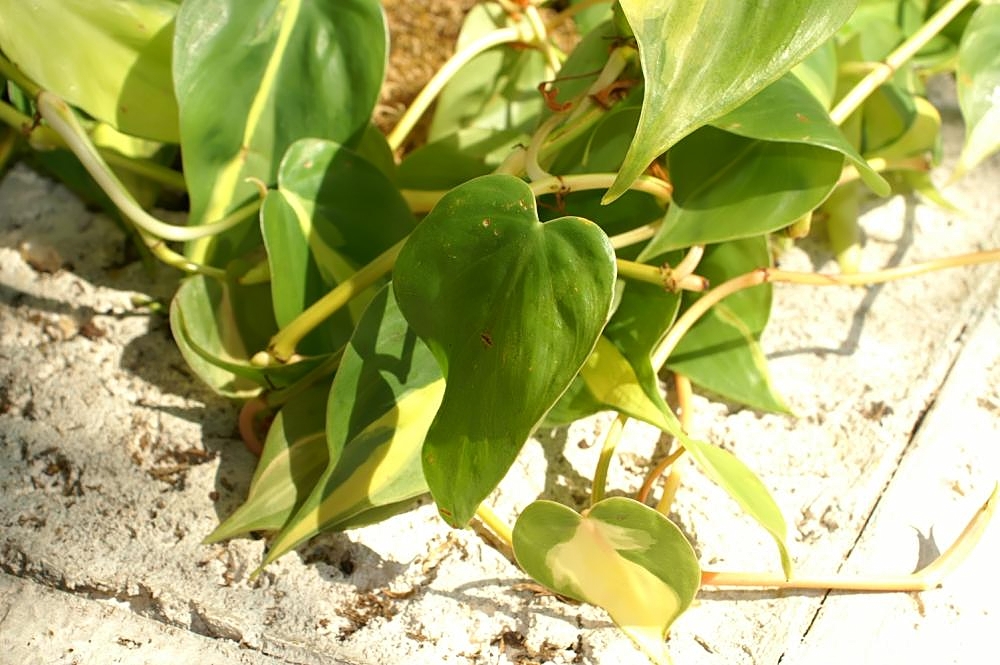
Leaves. Heart-shaped, glossy, thin-textured leaves 5–10 cm long and 4–8 cm wide on short petioles, arranged alternately along flexible vining stems. Species form is a uniform deep green; 'Brasil' shows a lime-yellow central stripe or sector; 'Micans' has a matte velvet finish with bronze undertones.
Flowers. Typical aroid spadix and spathe, rare in cultivation. Mature climbing specimens in tropical gardens occasionally bloom with a greenish spathe; indoor plants virtually never flower.
- Heart-shaped leaves with a distinct pointed tip and a smooth edge — no lobing or splitting.
- Short petiole (leaf stalk is shorter than the leaf itself), which keeps leaves close to the stem.
- Aerial roots at each node, visible as small pale nubs on the underside of the stem.
- Flexible vining stems that trail or climb rather than self-support.
- 'Brasil' cultivar: lime-yellow central stripe — the variegation pattern varies leaf by leaf.

Commonly confused with
Golden pothos
Larger, thicker, slightly asymmetric leaves with an off-centre midrib and a longer petiole. Pothos variegation is speckled/splashed, not a clean central stripe. Pothos leaves are stiffer and less heart-shaped than philodendron's.
Velvet-leaf philodendron
Same species as hederaceum, but the 'Micans' cultivar has a matte velvety surface and bronze-purple undertones. Leaves are smaller and more pointed.
Satin pothos
Silvery-splashed, slightly thicker and stiffer leaves on a vine. Not actually a pothos or philodendron — different genus with a matte silver-flecked leaf surface.
Care
Light
Medium to bright indirect light.
Medium indirect is ideal. The species form tolerates genuinely low light (a north window, a dim corner) but slows dramatically. 'Brasil' and other variegated cultivars need more light to keep their yellow/cream stripes — in deep shade they push plain-green new leaves and the variegation gradually disappears. Direct afternoon sun scorches the thin leaves.
Seasonal: Nordic winters: a simple desk-level grow light for 8–10 hours/day keeps variegated cultivars colouring well from October through March.
Water
When the top 2–3 cm of soil feels dry.
Water thoroughly until runoff, then empty the saucer. Philodendron hederaceum is drought-tolerant for an aroid and recovers well even from a significant wilt, but dislikes standing water. Leaves go limp when it needs water — a quick rebound within a few hours of watering is typical.
Seasonal: Cut frequency by roughly a third from November to February.
Soil
Chunky aroid mix.
A mix of 2 parts peat-free potting soil, 1 part perlite, and 1 part orchid bark holds the right balance of moisture and air around the fine epiphytic roots. A plain potting-compost mix works but increases rot risk. Top-dress with a little fresh bark every spring.
Humidity
40–60 %; tolerates 30 %.
Ordinary indoor humidity is fine. Very dry air (below 30 %) can cause slightly crispier leaf edges but rarely kills the plant. 'Micans' is the most humidity-appreciative cultivar because of its thinner velvet leaves.
Temperature
18–27 °C.
Keep away from cold window glass in winter. Exposure below 10 °C produces dark water-soaked patches that rot within days; the thin leaves are more cold-sensitive than heavier-leaved aroids like Monstera.
Fertilizer
Balanced liquid feed monthly in spring and summer, at half strength.
A balanced NPK (3-1-2 or 20-20-20) at half the label rate, applied to already-moist soil, is ample. Variegated cultivars benefit slightly from a feed higher in micronutrients — yellowing-not-just-variegation on new leaves can signal a magnesium deficiency corrected by Epsom salts (1 tbsp in 4 L water, once).
Seasonal: Skip feeding from late October through February.
Pruning
Pinch or cut vines just above a node to bush up the plant and keep it full.
Philodendron 'Brasil' tends to go leggy as vines lengthen, with fewer leaves per metre. Snip vines back by a third each spring, just above a node; new branches emerge from the cut node within 2–4 weeks. Use the cuttings for propagation. Prune off all-green reversions on 'Brasil' back to the last variegated leaf, or the plain-green shoots will out-compete the variegation.
Repotting
Every 2 years, or when roots circle the pot bottom.
Move up by one pot size. Philodendron hederaceum tolerates root-bound conditions well and does not require urgent repotting. Spring is the best time.
Stem cutting in water
easy~1–2 weeksThe classic — snip a vine into 10–15 cm sections, each containing at least one node and ideally one leaf. Place nodes in water, keep in bright indirect light, change water weekly. Roots appear in 7–14 days. Pot up once roots reach 3–5 cm.
Stem cutting directly in soil
easy~3–5 weeksInsert a node cutting 2–3 cm deep in moist aroid mix. Keep warm (21–24 °C) and lightly moist. Cover with a clear bag or propagation dome to retain humidity for the first 2 weeks, then uncover.
Sphagnum / perlite propagation box
easy~2–4 weeksPlace cuttings on a bed of damp sphagnum or perlite inside a covered box or zip-top bag. The 90 %+ humidity inside the box produces fast, strong roots. The most reliable method for variegated cuttings, which are more prone to rot in plain water.
Cultivars
'Brasil'
Chimeric cultivar with a lime-yellow central stripe or sector on dark green heart-shaped leaves. Natural sport discovered in Brazil; the variegation is unstable, with plain-green and solid-yellow branches appearing on the same plant. The single most popular philodendron in trade.
'Lemon Lime' / 'Neon'
Whole-leaf chartreuse to lime-green cultivar with no dark green. Grows fast but burns in direct sun. Essentially a stable mutation of the same species in a single colour.
'Micans'
Formerly classified as a separate species. Leaves have a velvet matte finish and bronze-to-purple undertones, especially in good light. Slower-growing than green or 'Brasil' forms.
'Rio'
Silver-to-cream central variegation on green heart-shaped leaves — narrower stripes than 'Brasil' and significantly rarer in cultivation. A patented cultivar.
'Cream Splash'
Leaves sectoral-variegated with cream-white patches on a green base. More visually dramatic than 'Brasil' but also slower-growing and noticeably more light-demanding.
Common problems
'Brasil' reverting to green
Symptom
New leaves on 'Brasil' come out mostly or fully plain green, or whole green vines dominate the plant.
Cause
Insufficient light, or plain-green branches out-competing the slower-growing variegated ones.
Fix
Move to brighter indirect light. Prune plain-green vines back to the last leaf that carries variegation — if left, green shoots photosynthesise faster and eventually take over. New growth should come in with restored variegation within 2–3 leaves.
Leggy vines with small, widely-spaced leaves
Symptom
Long bare stem between leaves; leaves smaller than expected.
Cause
Insufficient light and/or missing fertiliser.
Fix
Increase light and resume a half-strength feed monthly in spring and summer. Cut back leggy vines in spring to force new, denser growth from lower nodes. Use the cuttings to fill in the pot.
Yellowing leaves
Symptom
Whole leaves turn yellow — typically the oldest, lowest leaves.
Cause
Overwatering is the most common cause; a single old yellow leaf at a time is normal senescence.
Fix
Check soil moisture. If wet, let it dry out further and review watering rhythm. Trim any mushy roots if you unpot and find rot. A single yellowing old leaf per month is normal and can be left to detach on its own.
Limp vine after a missed watering
Symptom
All leaves droop and soil is dry.
Cause
Drought — the plant is using its reserves.
Fix
Water thoroughly and wait a few hours. Philodendron hederaceum usually rebounds overnight from a drought wilt. Repeated or severe wilts cause brown leaf-edge scars that do not heal, so don't lean on the plant's tolerance.
- Spider mites
- Mealybugs
- Scale
- Thrips
- Root rot (Pythium)
- Bacterial leaf spot (Erwinia)
Toxicity & safety
Sap contains insoluble calcium oxalate raphides. Contact irritates skin in some people; ingestion causes intense oral burning, drooling, and mouth swelling. Rarely dangerous but genuinely painful.
Mechanism: Insoluble calcium oxalate raphides (needle-shaped crystals) and proteolytic enzymes.
Philodendron — Missouri Botanical Garden Plant FinderOral irritation, intense burning of mouth, drooling, vomiting, and difficulty swallowing. Rarely life-threatening, but consistently listed among the most common cat-poisoning houseplant calls to animal helplines.
Heartleaf Philodendron — ASPCA Toxic and Non-Toxic PlantsOral irritation, drooling, vomiting, and difficulty swallowing. Same mechanism as in cats.
Heartleaf Philodendron — ASPCA Toxic and Non-Toxic Plants'Brasil' was found as a single spontaneous yellow-striped sport of Philodendron hederaceum in a Brazilian nursery in the 1990s and propagated purely by cuttings — every 'Brasil' plant in the world today is a clone descended from that single mutation. Unlike tissue-cultured variegated cultivars, 'Brasil' is chimeric and unstable, which is why its leaves show wildly different amounts of yellow even on the same vine.
Frequently asked · 5
Is Philodendron 'Brasil' toxic to cats and dogs?+
Yes — ASPCA lists all Philodendron species including 'Brasil' as toxic to cats and dogs. The sap contains insoluble calcium oxalate crystals that cause intense oral burning, drooling, vomiting, and swallowing difficulty. Keep it out of reach of pets that chew plants, and use kitchen gloves when handling the cut stems.
Why is my Philodendron 'Brasil' reverting to green?+
'Brasil' is chimeric and naturally unstable — plain-green reversions are part of how it grows. Insufficient light accelerates the problem because green shoots photosynthesise faster and dominate the plant. Move to brighter light and prune green vines back to the last variegated leaf, which forces new growth from a variegated node.
What's the difference between Philodendron Brasil and pothos?+
Philodendron 'Brasil' leaves are thinner, symmetrically heart-shaped with a clean pointed tip, and have a shorter petiole than pothos — they sit close to the vine. Pothos leaves are thicker, slightly asymmetric with an off-centre midrib, and variegated with irregular splashes rather than a clean central stripe. Both are easy beginner vines; philodendron is faster and more tolerant of low light.
How often should I water a Philodendron Brasil?+
Water when the top 2–3 cm of soil feels dry — typically about once a week in a bright room in summer and every 10–14 days in winter. Thin leaves wilt visibly when it needs water; a thorough soak usually reverses the droop overnight.
How do I propagate Philodendron 'Brasil'?+
The easiest method is a stem cutting in water: snip a 10–15 cm vine section with at least one node, place the node in water in bright indirect light, and change the water weekly. Roots appear in 1–2 weeks. For variegated cuttings (which rot more easily in plain water), use a sphagnum or perlite propagation box — the high humidity produces faster, stronger roots.