Identity & taxonomy
- Scientific name
- Maranta leuconeura E.Morren
- Family
- Marantaceae
- Genus
- Maranta
- Order
- Zingiberales
- Wikidata
- Q161205
- Maranta kerchoviana E.Morren
- Maranta massangeana E.Morren
- Prayer planten
- Rabbit's footen
- Red-veined prayer planten
- Bönplantasv
- Bønneplanteno
- Bedeblomstda
- Rukouskasvifi
- Pfeilwurz / Korbmarantede
Brazil (Atlantic Forest, lowland and submontane)
How to identify it
Growth habit. Low-growing, spreading herbaceous perennial arising from shallow fleshy rhizomes. Stems are short and creeping, producing alternate leaves on short petioles. Plants spread sideways rather than upward and are commonly grown in shallow wide pots or hanging baskets as the outer leaves arch downward with age.
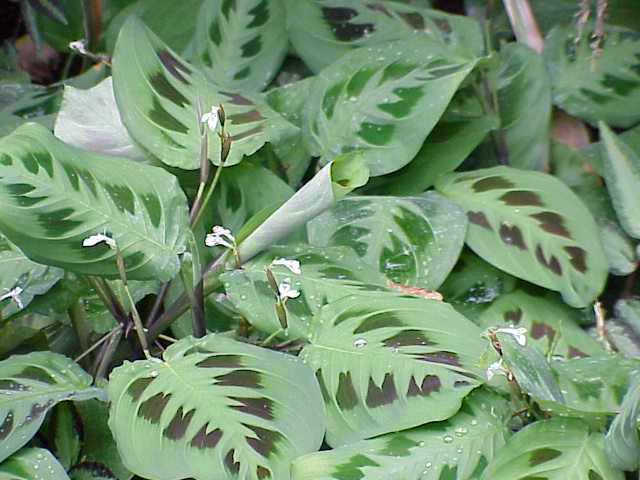
Leaves. Oval to elliptic leaves 10–15 cm long and 5–8 cm wide, held horizontally by day and folded upright by night. Upper surface is boldly patterned with contrasting veins, midrib bands, or dark blotches (depending on variety); undersides are green to purple. Each leaf has a thickened 'joint' at the petiole-blade junction (the pulvinus) that drives the nyctinastic folding.
Flowers. Small, two-lipped white-to-pale-purple flowers 1 cm across, borne in sparse spikes on slender stems above the foliage. Flowers open one at a time and last a single day. Inconspicuous relative to the foliage; indoor plants rarely flower.
- Leaves fold upright at night and relax horizontally by day — the 'prayer' movement is diagnostic among common houseplants (shared with Calathea / Goeppertia and Stromanthe in the same family).
- Visible thickened pulvinus (joint) at the petiole-blade junction — the mechanism behind the movement.
- Low spreading habit — never climbs, rarely exceeds 30 cm tall.
- Bold symmetric leaf patterning (red veins, rabbit-foot blotches, or silvery bands depending on variety).

Commonly confused with
Calathea
Same family (Marantaceae), same prayer-folding behaviour, but typically much larger (leaves 15–40 cm), more upright habit, and with a stiffer, more leathery leaf. Maranta is the lower, spreading cousin.
Fishbone prayer plant / never-never plant
Pale silvery-green leaves with dark green fishbone-like crossbars. Also Marantaceae, also prayer-folding, but leaves are narrower and lance-shaped.
Stromanthe triostar
Pink, cream, and green variegation with bright pink undersides. Grows much taller (60–90 cm) and clumping rather than spreading.

Care
Light
Bright indirect light — no direct sun.
Maranta evolved in the dim Atlantic Forest understory and scorches in direct sun within an afternoon. Place 1–2 m from a bright window, or directly beside a north window. Too little light weakens leaf colour and stops the night-folding; too much sun bleaches the bold markings to pale green. East exposure with filtered morning light is ideal.
Seasonal: Nordic winters: a full-spectrum LED at 10,000 lux for 10–12 hours/day from October to March keeps colour and fold rhythm going.
Water
Keep consistently moist — never wet, never bone-dry.
Water thoroughly until runoff, then empty the saucer. Let only the top 1–2 cm dry between waterings — Maranta is far less drought-tolerant than most houseplants and collapses visibly if the pot dries fully. Use lukewarm filtered, rain, or distilled water; Maranta is highly fluoride-sensitive and tap water causes brown crispy leaf edges within weeks.
Seasonal: Reduce slightly from November to February but never let the pot dry out completely.
Soil
Humus-rich, consistently moist but well-draining mix.
A blend of 2 parts peat-free potting mix, 1 part coco coir, 1 part perlite, and a handful of sphagnum moss works well. The mix should hold moisture for several days but drain freely — a dense waterlogged mix is the direct cause of root rot. Refresh the top 2 cm of mix yearly to prevent salt accumulation.
Humidity
60–80 % preferred; browns at below 50 %.
The single most important non-negotiable for a good-looking Maranta. Below 50 %, leaf edges go brown and crispy within weeks; below 30 % the plant cannot hold its leaves flat during the day. A nearby humidifier is essential for most Nordic indoor winters. Grouping with other tropicals helps marginally. Misting is not effective (brief moisture spike, no sustained effect).
Temperature
18–27 °C.
Exposure below 13 °C stunts growth and causes yellowing within days. Avoid cold window glass in Nordic winters. Does well in normal heated indoor air year-round as long as humidity is addressed.
Fertilizer
Dilute balanced feed every 2 weeks in spring and summer at quarter strength.
A balanced NPK (e.g. 20-20-20) at quarter the label rate every 2 weeks during active growth. Maranta is a light feeder; over-fertilising causes crispy leaf margins that are easy to mistake for fluoride burn. Flush the soil with filtered water every 3 months to prevent salt build-up.
Seasonal: Skip feeding from November through February.
Pruning
Remove yellowed or crispy leaves at the base; cut back leggy stems.
Cut dead or damaged leaves off at the base with clean scissors. If the plant becomes leggy or loses its bottom leaves, cut the whole plant back to 5–8 cm above the soil in spring — it will re-sprout densely from the rhizome within 4–6 weeks. Dispose of damaged leaves rather than composting if disease was involved.
Repotting
Every 2–3 years; prefers wide, shallow pots.
Move to a pot only 2 cm wider. Wide shallow pots match the spreading rhizome growth habit better than deep narrow ones. Best done in early spring. This is also the moment to divide the rhizome for propagation.
Rhizome division
easy~Immediate — divisions carry existing roots and leavesAt spring repotting, unpot and gently tease the rhizome apart with your hands into 2–3 sections, each with leaves and roots attached. Pot each section separately in fresh mix. Water lightly for the first week while divisions recover. The most reliable and fastest method for home growers.
Stem cutting
moderate~3–5 weeks in water or damp sphagnumCut a 10–15 cm stem with at least one node and 2–3 leaves, just below a node. Root in a jar of room-temperature filtered water or in damp sphagnum moss in bright indirect light at 24–27 °C. Pot up once roots reach 3–5 cm. Humidity dome or loose plastic bag over the cutting helps rooting rate.
Seed
difficult~Germinates in 3–6 weeks; impractical for home growersViable seed is rare indoors because flowers are inconspicuous and self-incompatible. Commercial production is overwhelmingly by division; seed is used almost exclusively by breeders.
Cultivars
var. erythroneura ('Red-Veined Prayer Plant' / 'Fascinator')
Dark green leaves with bright red lateral veins and a yellow-green midrib band. The most commonly sold form and the most dramatic at night when leaves fold upright.
var. kerchoveana ('Rabbit's Foot' / 'Rabbit's Tracks')
Pale grey-green leaves with two rows of dark green blotches along the midrib, resembling rabbit footprints. The oldest prayer plant variety in cultivation.
var. massangeana ('Black Prayer Plant')
Very dark almost-black-green leaves with silvery midrib markings and purple undersides. Slower-growing and harder to find than the other two varieties.
Common problems
Brown, crispy leaf edges
Symptom
Leaf edges and tips go brown and papery while the leaf body stays green.
Cause
Low humidity (most common), fluoride / chlorine in tap water, or over-fertilising. Maranta is one of the most sensitive houseplants on all three axes.
Fix
Raise humidity above 50 % with a nearby humidifier — the single biggest lever. Switch to filtered, rain, or distilled water. Halve the fertiliser rate and flush the soil every 3 months. Existing brown edges won't regreen; new leaves emerge clean under corrected conditions.
Leaves no longer fold at night
Symptom
Leaves stay flat at night or fold incompletely.
Cause
Insufficient light (most common), irregular day/night light cycle, or general stress from under/overwatering or pest damage. The folding mechanism responds to light and water balance.
Fix
Confirm the plant gets a clear day/night cycle with bright indirect light during the day and darkness at night (keep away from always-on lamps). Verify watering consistency and check for pests. The fold usually returns within 2 weeks of correction.
Yellowing leaves
Symptom
Older leaves yellow and drop; newer leaves look fine.
Cause
Occasional old-leaf yellowing is normal. Widespread yellowing indicates overwatering, waterlogged soil, or fertiliser salt build-up.
Fix
Check root health — black mushy roots mean rot. Repot in fresh humus-rich mix with better drainage, reduce watering frequency, and flush the soil. Ensure the pot has drainage holes and is not sitting in water.
Curled, inward-rolled leaves during the day
Symptom
Leaves that should be flat and horizontal stay rolled inward and curled.
Cause
Underwatering or very dry air — the leaves roll as the pulvinus loses turgor.
Fix
Water thoroughly; leaves typically unfurl within 24 hours. If curl persists after watering, raise humidity above 50 % and check for root rot (rotted roots cannot deliver water even to wet soil).
- Spider mites (dry air)
- Mealybugs
- Thrips
- Fungus gnats
- Root rot (Pythium, Phytophthora)
- Helminthosporium leaf spot
- Fluoride burn (abiotic)
- Cucumber mosaic virus (rare in home collections)
Toxicity & safety
No documented toxicity. Maranta is in the arrowroot family (Marantaceae); the rhizomes of Maranta arundinacea are the source of commercial arrowroot starch and are edible.
Maranta leuconeura — Missouri Botanical Garden Plant FinderListed by ASPCA as non-toxic to cats. Ingestion of leaves may cause mild GI upset in sensitive animals but no systemic effects are recorded.
Prayer Plant — ASPCA Toxic and Non-Toxic PlantsListed by ASPCA as non-toxic to dogs. Mild GI upset possible with any non-food plant ingestion but no systemic effects are recorded.
Prayer Plant — ASPCA Toxic and Non-Toxic PlantsThe prayer-like leaf fold at night is a form of circadian nyctinasty driven by reversible turgor changes in a thickened joint (the pulvinus) at the base of each leaf. Water is actively pumped between pulvinus cells at dusk and dawn, causing the leaf to fold upright or relax flat. The same mechanism folds Mimosa pudica (sensitive plant) leaves on touch — but in Maranta the trigger is the daily light cycle, not physical contact. Plants kept under 24-hour artificial light eventually stop folding.
Frequently asked · 5
Are prayer plants safe for cats and dogs?+
Yes — ASPCA lists prayer plant (Maranta leuconeura) as non-toxic to cats, dogs, and horses. The Maranta family is the same family as arrowroot, which is used as food. Ingestion of leaves may cause mild GI upset in sensitive pets, but no systemic toxicity is recorded.
Why does my prayer plant fold its leaves at night?+
It's nyctinasty — a form of circadian leaf movement driven by reversible turgor changes in a thickened joint (the pulvinus) at the base of each leaf. At dusk, water is actively pumped between cells at the pulvinus, causing the leaf to fold upright; at dawn, the reverse pumping relaxes it flat again. The trigger is the daily light cycle, so plants kept under 24-hour artificial light eventually stop folding.
Why are my prayer plant leaves brown on the edges?+
Almost always low humidity, tap water fluoride, or over-fertilising — Maranta is uniquely sensitive on all three axes. Raise humidity above 50 % with a nearby humidifier (the biggest single lever), switch to filtered or rainwater, halve the fertiliser rate, and flush the soil every 3 months. Existing brown edges won't regreen, but new leaves emerge clean.
How often should I water a prayer plant?+
Roughly every 5–7 days — enough to keep the soil consistently moist but never wet. Let only the top 1–2 cm dry between waterings. Maranta is much less drought-tolerant than most houseplants and collapses if the pot dries fully. Always use filtered or rainwater; tap water fluoride causes brown crispy leaf edges within weeks.
How do I propagate a prayer plant?+
The easiest method is rhizome division at spring repotting. Unpot the plant, gently tease the rhizome apart with your hands into 2–3 sections (each with leaves and roots attached), and pot each section separately in fresh humus-rich mix. Water lightly for the first week. Stem cuttings with a node also root in 3–5 weeks in filtered water or damp sphagnum.