Identity & taxonomy
- Scientific name
- Chlorophytum comosum (Thunb.) Jacques
- Family
- Asparagaceae
- Genus
- Chlorophytum
- Order
- Asparagales
- Wikidata
- Q157447
- Anthericum comosum Thunb. (basionym)
- Chlorophytum elatum R.Br.
- Spider planten
- Airplane planten
- Ribbon planten
- St. Bernard's lilyen
- Hen and chickensen
- Ampelliljasv
- Grønnrennerno
- Edderkopplanteda
- Viherliljafi
- Grünliliede
South Africa · Tropical and southern Africa
How to identify it
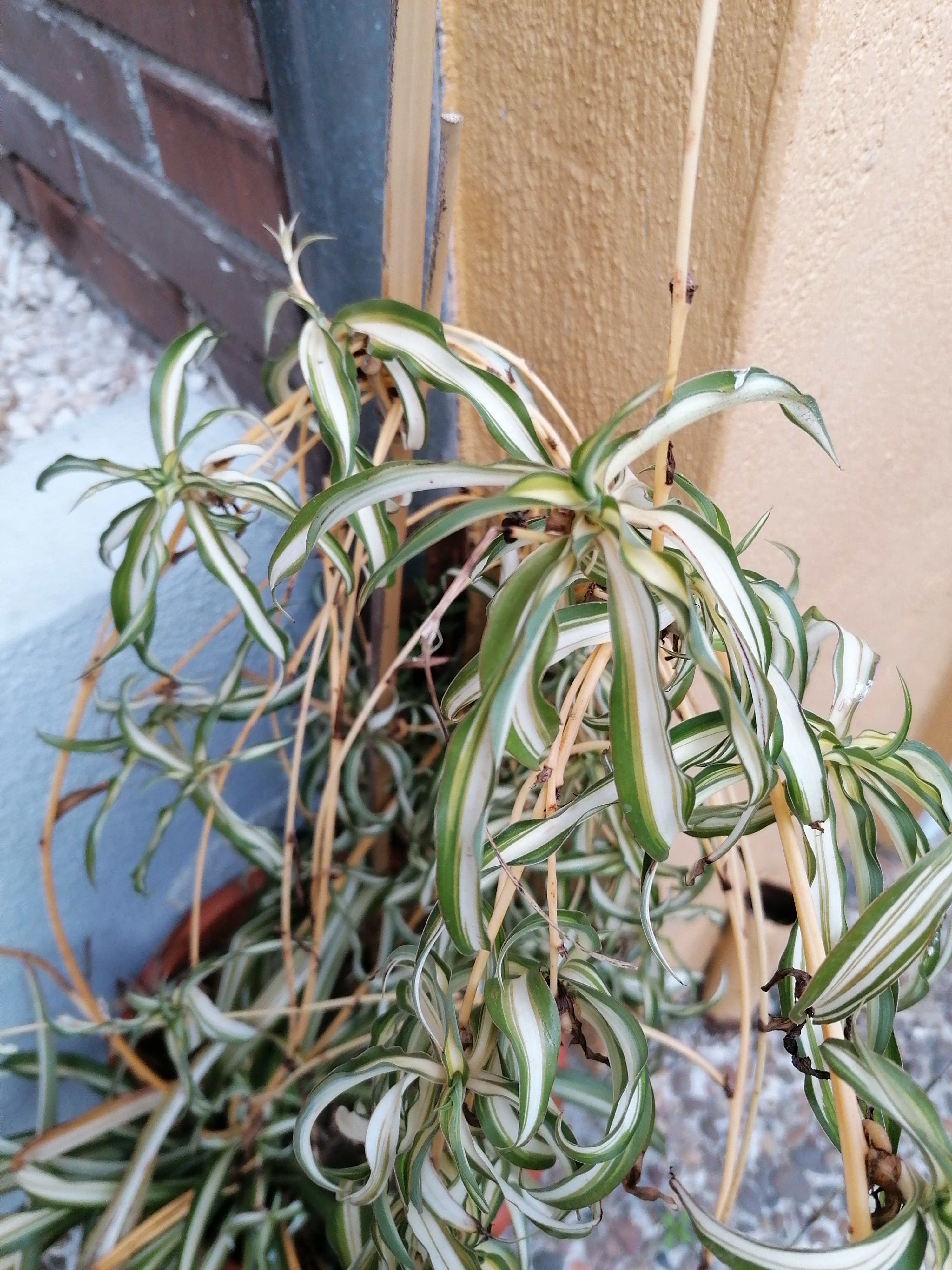
Growth habit. Evergreen rosette-forming perennial with thick, fleshy tuberous roots. Produces long, arching, wiry stolons bearing small flowers that develop into miniature rooted plantlets ('spiderettes'), which bend the stolons under their weight into the characteristic cascading display. The rhizome offsets laterally over time.
Leaves. Linear, grass-like, 15–45 cm long and 0.5–2 cm wide, arching outward from a central basal crown. Species form is solid bright green; cultivated forms are variegated with cream-to-white longitudinal stripes. Leaf surface is slightly ribbed lengthwise and mildly succulent.
Flowers. Small white six-tepalled flowers, 1–2 cm across, borne along the length of the stolon. Each flower has a short-lived individual display (1–2 days) but flowering continues in waves across weeks. Pollinated flowers rarely set seed indoors; each stolon node instead produces a vegetative plantlet.
- Long wiry stolons bearing rooted plantlets — no other common houseplant reproduces this way indoors.
- Thick, white, slightly translucent tuberous roots visible at the soil surface of rootbound plants.
- Leaves emerge from a single central crown in a loose fountain shape.
- Variegated cultivars show stripes running the full length of the leaf parallel to the midrib.


Commonly confused with
Mondo grass
Also produces grass-like clumps, but leaves are dark green (not variegated in the common form), stiffer, and the plant does not produce stolons or plantlets. Often sold as an outdoor ground cover.
Lilyturf
Similar grass-like rosettes, but with purple flower spikes rather than small white flowers on stolons, and no plantlets.
Fire flash / mandarin plant
Same genus but with wider, broader, solid-green leaves and bright orange petioles — does not produce stolons or plantlets.
Care
Light
Bright indirect light; tolerates medium light and gentle morning sun.
Spider plant grows well in a wide range of light. Variegated cultivars hold their stripes best in bright indirect light — in dim conditions the cream stripes narrow and new leaves come out greener. Direct afternoon sun bleaches the foliage; morning sun is fine. An east window is close to perfect.
Seasonal: Nordic winters: variegated cultivars benefit from supplemental light from October to February to keep the stripes wide.
Water
When the top 2 cm of soil feels dry.
Water thoroughly until runoff, then empty the saucer. Spider plant stores water in its tuberous roots and tolerates missed waterings well — weekly in summer and every 10–14 days in winter works for most homes. The plant is sensitive to fluoride and chlorine in tap water, which produce brown leaf tips.
Seasonal: Cut frequency by roughly a third from November to February.
Soil
Any quality potting mix with added perlite.
Spider plant is undemanding about soil. A mix of 3 parts peat-free potting soil to 1 part perlite works well and prevents the dense root system from suffocating. Avoid mixes heavy in bark — the fine roots do not need chunkiness.
Humidity
Any normal indoor level.
Spider plant tolerates humidity from 30 % upward without complaint. Brown leaf tips are almost always a water-quality or fertiliser issue, not a humidity issue.
Temperature
15–27 °C.
Handles cooler rooms than most tropical houseplants. Brief exposure to 5 °C causes water-soaked patches on the leaves; prolonged cold or any frost kills the above-ground parts, though thick roots sometimes re-sprout if the rhizome stays warm.
Fertilizer
Balanced liquid feed monthly in spring and summer, at half strength.
Over-fertilising is the single most common cause of brown leaf tips in spider plant. A balanced NPK at half the label rate is ample. Flush the soil with plain water every 2–3 months to leach accumulated salts.
Seasonal: Skip feeding from late October through February.
Pruning
Snip off browned leaf tips and remove spent stolons at the base.
Trim brown tips with sharp scissors following the original leaf shape to keep the plant looking tidy. Entire yellowed or damaged leaves can be pulled out at the base. Spent stolons that have finished producing plantlets can be cut away flush with the rosette.
Repotting
Every 1–2 years, or when roots push the soil surface upward.
Spider plant's tuberous roots will eventually crack plastic pots and lift the soil out of the top of the container. When that happens, pot up by one size in spring. Root-bound spider plants flower and produce plantlets more readily, so do not rush the move.
Rooting plantlets in water
easy~1–2 weeksChoose a plantlet at least 5 cm across with visible root nubs. Either cut it from the stolon and suspend in a small glass of water until roots reach 3–4 cm, then pot up; or leave attached to the parent and rest the plantlet in water or soil while still connected, cutting the stolon only once new roots establish.
Rooting plantlets directly in soil
easy~2–3 weeksPin a healthy plantlet onto the surface of a small pot of moist potting mix using a bent paperclip or piece of wire, keep the soil lightly moist, and the plantlet roots in while still drawing resources from the mother. Cut the stolon once the plantlet resists a gentle tug.
Division of the rhizome
easy~Immediate — divisions carry existing rootsFor mature, very pot-bound plants, unpot and slice the root mass into 2–4 sections with a clean knife. Pot each division into its own container. Spring is the best time.
Cultivars
'Variegatum'
Leaves edged with white, centre green — the reverse of 'Vittatum'. Older and less common in commerce than 'Vittatum' but cleaner-looking.
'Vittatum'
The ubiquitous cultivar: leaves with a broad central white-to-cream stripe and green margins. This is the plant most people mean when they say 'spider plant'.
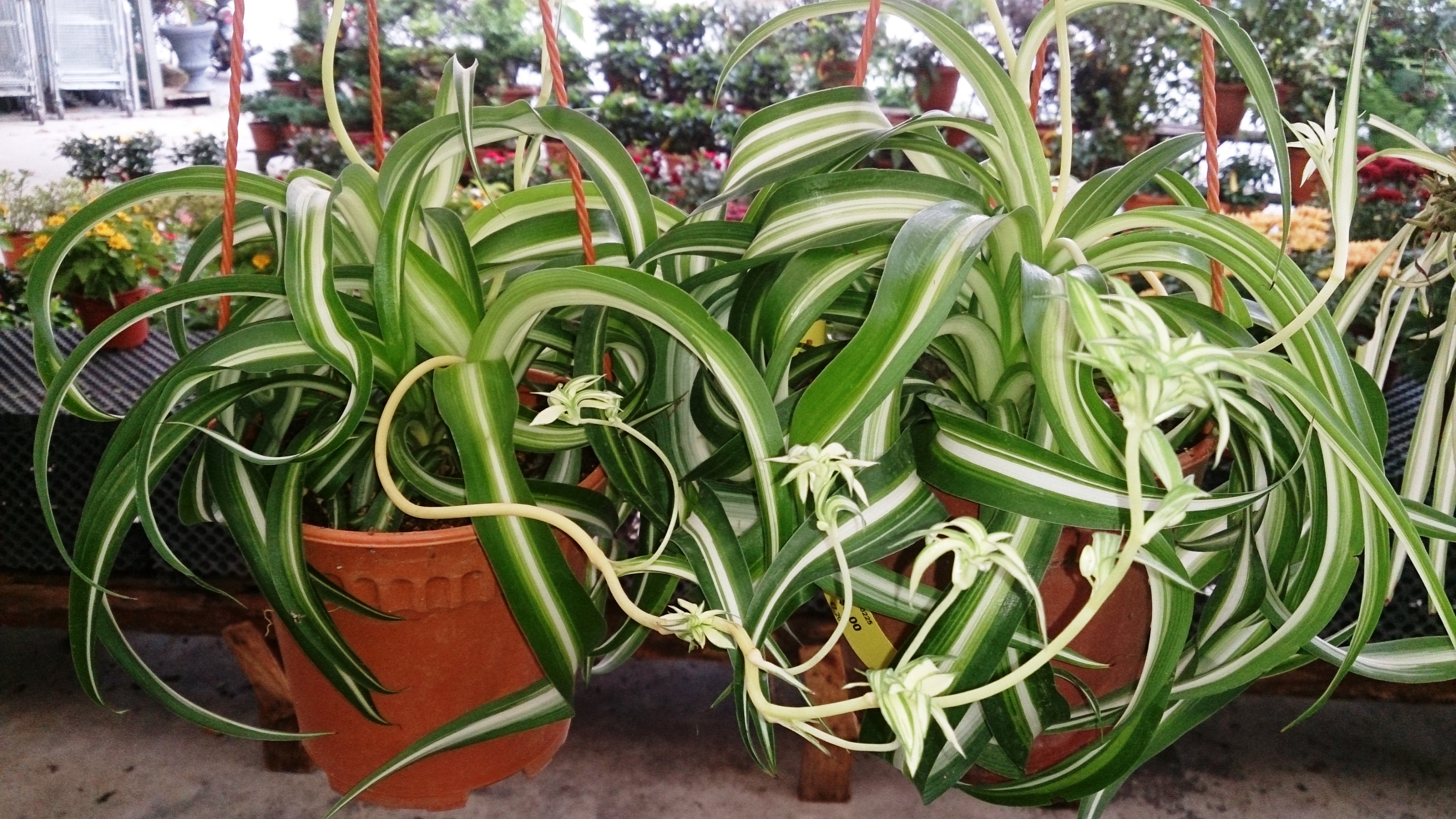
'Bonnie'
Curly-leafed sport of 'Vittatum' — the same variegation but with leaves that curl and twist in loose spirals. Keeps a more compact rosette.
'Ocean'
Shorter, more arching habit with broader cream margins — often sold as a hanging-basket cultivar.
Common problems
Brown leaf tips
Symptom
Leaf tips turn brown and crispy, sometimes progressing 1–2 cm down the blade.
Cause
Most often a reaction to fluoride or chlorine in tap water; also caused by over-fertilising and less often by low humidity or intermittent water stress.
Fix
Switch to filtered or rainwater (or leave tap water standing overnight to let chlorine dissipate). Halve the fertiliser rate and flush the soil with plain water every 2–3 months to leach accumulated salts. Trim damaged tips with scissors, following the natural leaf shape.
Pale or washed-out variegation
Symptom
New leaves emerge with narrower white stripes or mostly green.
Cause
Insufficient light — variegated cultivars need good light to produce full stripes.
Fix
Move to a brighter spot (bright indirect, not direct sun), or add a grow light for 10 hours/day in winter. New leaves should regain their variegation within a growth cycle.
No plantlets forming
Symptom
Healthy-looking rosette but no stolons or spiderettes.
Cause
Typically a young plant, a too-large pot, or insufficient light. Spider plant produces plantlets most readily when it is mature and slightly root-bound.
Fix
Give the plant time (2+ years from propagation) and leave it in a snug pot; move into bright indirect light. Short winter day length also pauses plantlet production; stolons often resume in spring.
Yellowing leaves with soft base
Symptom
Older leaves turn yellow and the base of the plant feels mushy.
Cause
Overwatering, usually compounded by a pot without drainage.
Fix
Unpot, remove mushy roots, let the root mass dry for a few hours, and repot in fresh mix. Only water once the top 2 cm of soil dries out going forward.
- Spider mites
- Mealybugs
- Scale
- Aphids
- Root rot (Pythium)
- Bacterial leaf spot
Toxicity & safety
No known toxic effect on humans.
Chlorophytum comosum — Missouri Botanical Garden Plant FinderASPCA lists spider plant as non-toxic to cats. That said, spider plant contains mild natural compounds (opioid-related saponins in trace amounts) that many cats find attractive, and cats that eat large amounts can develop mild GI upset (vomiting, diarrhoea) from the sheer volume of leafy material — not from toxicity.
Spider Plant — ASPCA Toxic and Non-Toxic PlantsASPCA lists spider plant as non-toxic to dogs.
Spider Plant — ASPCA Toxic and Non-Toxic PlantsWhy cats eat spider plant
Cats are famously drawn to spider plant — many owners find shredded leaves within days of bringing one home. The conventional wisdom that the plant is 'hallucinogenic' for cats is overstated: laboratory assays have detected trace saponin compounds with some structural similarity to opioids, but the levels are far below what would produce psychoactive effects, and no peer-reviewed study has demonstrated altered behaviour in cats from spider plant consumption.
What is well established: cats like chewing long, grass-like leaves (which behave similarly to the grass they seek out outdoors), and spider plant is conveniently located, soft, and within reach. The ASPCA lists it as non-toxic — the risk is limited to mild GI upset from overindulgence.
Thick roots, dry soil, live plants
Unpot a mature spider plant and the surprise is how much of the container is taken up by fleshy white roots. Each is slightly tuberous: in cross-section, pea-sized swellings store water and carbohydrates. These let the plant ride out several weeks of drought and are the main reason it tolerates erratic watering.
The same trait is the reason spider plants commonly crack their plastic pots: the tuberous roots keep expanding even when space runs out. A cracked pot or soil being lifted upward is a reliable cue to pot up.
The 'Vittatum' cultivar — the variegated form sold everywhere — is almost always grown from plantlets, not seed. Seed grown from variegated parents mostly reverts to the solid-green wild form, so every variegated spider plant in circulation is, genetically, a clone of a clone of a clone.
Frequently asked · 5
Is spider plant safe for cats and dogs?+
Yes — ASPCA lists spider plant as non-toxic to both cats and dogs. Cats often chew the leaves (they are drawn to long, grass-like foliage and, in trace amounts, mild saponins), which can cause mild stomach upset from overindulgence but not poisoning. Spider plant is one of the safest popular houseplants for multi-pet households.
Why does my spider plant have brown tips?+
The usual cause is fluoride or chlorine in tap water; switch to filtered or rainwater, or leave tap water standing overnight to let chlorine dissipate. Over-fertilising is the next most common culprit — feed monthly at half strength at most, and flush the soil with plain water every 2–3 months to leach accumulated salts.
How do I propagate plantlets from a spider plant?+
Pick a plantlet at least 5 cm across with visible root nubs. The easiest method is to pin it onto the surface of a small pot of moist potting mix (use a bent paperclip) while it is still attached to the mother plant; roots establish within 2–3 weeks, and you can cut the stolon once the plantlet resists a gentle tug. Alternatively, snip it off and root in water — new roots appear in 1–2 weeks.
Why isn't my spider plant making plantlets?+
Plantlets appear most readily on mature (2+ years), slightly root-bound plants receiving bright indirect light. If your plant is young, in too large a pot, or in dim conditions, it will focus on foliage and skip plantlet production. Short winter days also pause stolon production; it typically resumes in spring.
Does spider plant need sun?+
It prefers bright indirect light but tolerates medium light and gentle morning sun. Harsh afternoon sun bleaches the leaves. In low light, variegated cultivars lose stripe width and the plant slows dramatically — a grow light for 10 hours/day fixes both in Nordic winters.