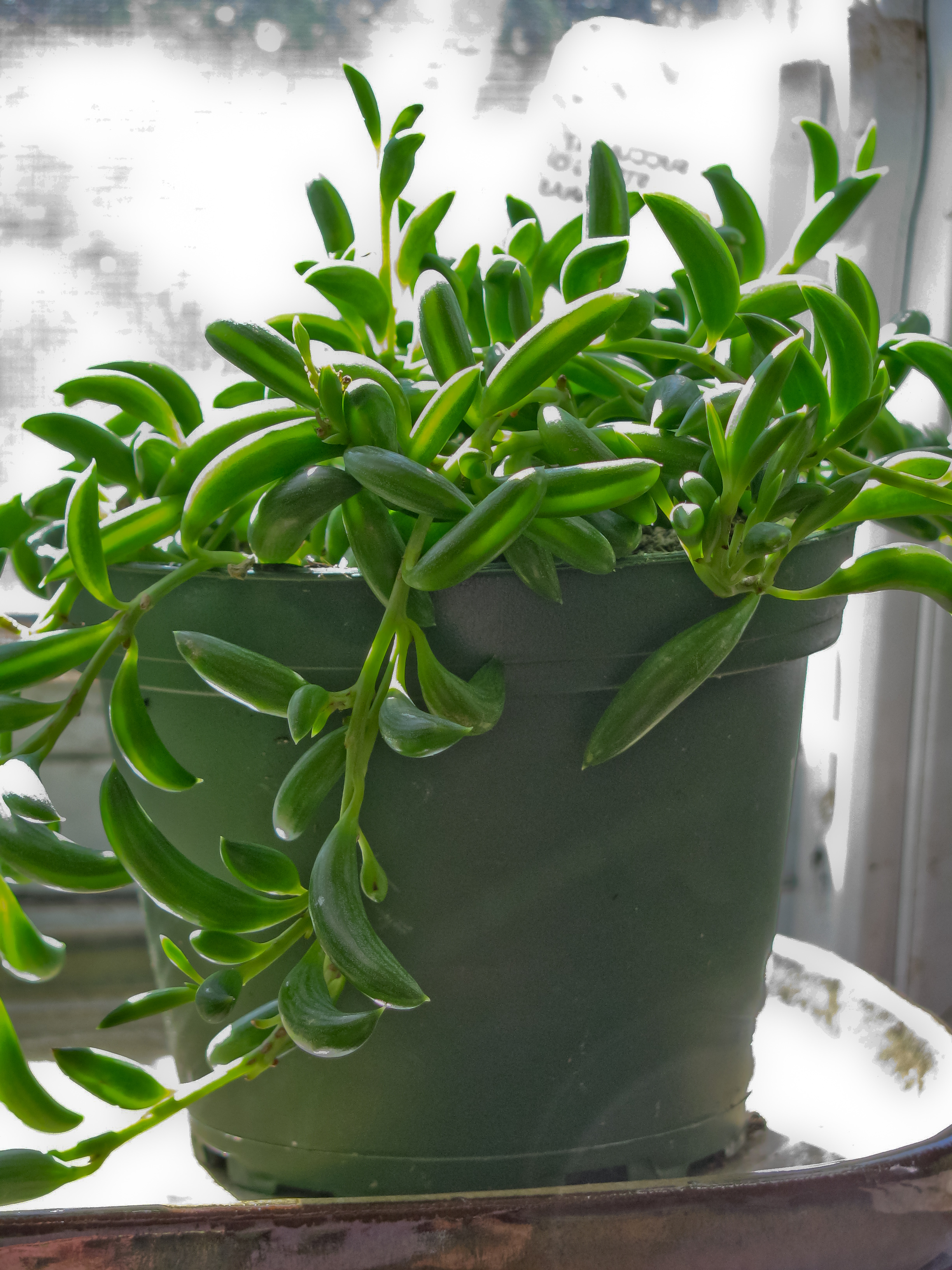
Identity & taxonomy
- Scientific name
- Curio radicans (L.f.) P.V.Heath
- Family
- Asteraceae
- Genus
- Curio
- Order
- Asterales
- IUCN status
- Least Concern (LC)
- Wikidata
- Q3469857
- Senecio radicans (L.f.) Sch.Bip.
- Cacalia radicans L.f.
- Kleinia radicans (L.f.) Haw.
- String of bananasen
- String of fishhooksen
- Banana vineen
- Creeping berryen
- Bananhängaresv
- Bananplanteno
- Bananrankeda
- Banaaniköynnösfi
- Bananen-Greiskrautde
South Africa (Eastern Cape — semi-arid scrub)
How to identify it
Growth habit. Sprawling trailing succulent. Stems are thin, soft, and segmented, with curved banana-shaped leaves spaced regularly along their length. In habitat the species creeps along the ground rooting at every node; in cultivation it is almost always grown in a hanging pot to display the long trailing strands. Adds 15–30 cm of stem per growing season — far faster than string of pearls.
Leaves. Elongated curved leaves 2–3 cm long shaped like miniature green bananas, sometimes described as 'fishhooks' for the same reason. Each leaf has a translucent 'window' along the upper curve — a clear epidermal stripe that admits diffuse light to interior photosynthetic tissue. Leaves are firm and turgid when well-hydrated; they shrivel and wrinkle when the plant is underwatered.
Flowers. Small white-to-cream daisy-like flowers in compact heads on short stalks, with a strong cinnamon-vanilla fragrance. Flowering is rare indoors but can be triggered by a cool dry winter rest (10–13 °C, no water for 6–8 weeks). The flowers last 2–3 weeks and are unmistakably Asteraceae in form despite the succulent foliage.
- Curved banana-shaped leaves 2–3 cm long, spaced regularly along thin stems.
- Translucent leaf window along the upper curve of each leaf.
- Long trailing strands that root readily at every node touching soil.
- White cinnamon-scented daisy flowers when forced into bloom.
- Faster-growing and hardier than its cousin string of pearls (Curio rowleyanus).

Commonly confused with
String of pearls
Same genus and similar care, but leaves are perfectly spherical 'pearls' rather than curved bananas. String of pearls is more drought-sensitive and prone to collapse; string of bananas is the easier of the two.
String of dolphins
A garden hybrid (C. rowleyanus × C. articulatus) with leaves shaped like leaping dolphins. Rarer and slower-growing than either parent.
String of beads / string of watermelons
Stouter near-spherical leaves with longitudinal stripes. Same family, similar trailing habit, intermediate care difficulty.
Care
Light
Bright indirect light with 1–2 hours of gentle direct sun.
An east window is ideal, or a south/west window with a sheer curtain. The translucent leaf windows let the plant tolerate brighter light than most houseplants without scorching, but unfiltered midday sun in summer can still bleach the leaves to a pale yellow-green. In dim conditions stems stretch and leaves are spaced further apart.
Seasonal: Nordic latitudes above ~55°N: a south or west window from October to March is fine; move back from the glass when spring sun intensifies in April.
Water
Soak deeply only when the soil is bone-dry; every 2–3 weeks in summer, monthly in winter.
Curio radicans is genuinely succulent and stores water in its banana leaves. Wait until the leaves themselves start to look slightly less plump — the soil should be completely dry before watering. Then soak deeply, let the pot drain, and don't water again until dry. Overwatering is the only common cause of death.
Seasonal: Reduce to once a month from November through February. A dry winter rest at 10–15 °C is what triggers spring flowering — keep the plant cooler and dryer than its summer regime.
Soil
Cactus and succulent mix or any free-draining soil.
1 part standard mix to 1 part perlite, pumice, or coarse sand. The mix should drain within 5–10 seconds. Heavy moisture-retentive mixes rot the trailing stems within a season.
Humidity
30–50 %; tolerates dry indoor air well.
No humidity demands. The species evolved in semi-arid Eastern Cape and copes with the dry indoor air that browns the tips of tropical foliage plants.
Temperature
15–27 °C in growth; tolerates a cool dry winter at 10–13 °C.
More cold-tolerant than most succulents. Brief dips to 7 °C are survivable if the plant is dry. A cool winter rest at 10–13 °C with little water triggers spring flowering — though most growers don't bother, since the foliage is the show.
Fertilizer
Half-strength cactus feed monthly in spring and summer.
Low-nitrogen cactus fertiliser at half label rate, monthly during active growth. Heavy feeding produces soft floppy stems with spaced-out leaves. No feeding from October through March.
Pruning
Trim long strands at any node; the cuttings root readily.
Cut bare or leggy strands back to a leaf node — new growth emerges from the node within a few weeks. Lay the cut strands on top of the parent's soil and they often re-root in place, filling out the pot. A few minutes of pruning per month keeps a hanging plant looking lush rather than thin.
Repotting
Every 2–3 years in spring; the plant prefers being slightly rootbound.
Move up by one pot size only. A shallow wide pot works better than a deep narrow one — the roots are shallow and the trailing habit looks best when the rim is at eye level or above.
Stem cutting (lay on soil)
easy~2–3 weeksCut a 10–15 cm strand. Lay it on top of moist cactus mix with a few of the leaf nodes pressed lightly into the surface. Roots emerge from each contact node within 2–3 weeks. No rooting hormone needed; no callusing period required for short cuttings.
Stem cutting (water root)
easy~1–2 weeksStrip the leaves off the lower 2–3 cm of a cutting and stand it in a glass of water. Roots emerge from the nodes within 1–2 weeks. Pot up once roots are 2–3 cm long, but the transition can be rough — soil-rooted cuttings establish more reliably.
Cultivars
'Glauca'
Standard cultivated form — bluer-grey 'bananas' on slightly thicker stems than the wild species. Most plants sold under just 'string of bananas' are this form.
'Variegata'
Cream-streaked variegation on the bananas; rare and slow-growing. Reverts readily to plain green if the variegated tissue is lost.
Common problems
Bananas shrivel and go soft
Symptom
Leaves wrinkle, lose firmness, and turn translucent.
Cause
Either underwatering (leaves shrivel but stems stay firm) OR root rot from overwatering (leaves shrivel AND stems go mushy).
Fix
Squeeze a stem near the soil line. Firm = thirsty: water deeply. Mushy = rot: cut all healthy strands above the rot, root them as cuttings, discard the parent. Sniff the soil — sour smell confirms rot.
Full guide: Root Rot in Houseplants: How to Identify, Save, and Prevent ItStrands go bare with leaves only at the tips
Symptom
Long strands with sparse or missing leaves on older sections.
Cause
Insufficient light, often combined with no pruning. Plant stretches toward the light source and old leaves drop.
Fix
Cut long bare strands back to a node — new growth emerges from below the cut, filling out the pot. Move to a brighter spot. New strands grow with closely-spaced leaves when light is adequate.
White cottony fluff in leaf joints
Symptom
Cottony patches where each leaf joins the stem.
Cause
Mealybug infestation — the leaf joints are favoured hiding spots.
Fix
Dab each colony with a cotton swab dipped in 70 % isopropyl alcohol. Repeat weekly for 4 weeks. For heavy infestations, take cuttings from clean strand sections and start over.
Full guide: Mealybugs on Houseplants: Identification and TreatmentLeaves bleach to pale yellow-green
Symptom
Leaves lose their healthy mid-green and become pale and translucent across whole strands.
Cause
Too much direct sun, especially in summer.
Fix
Move back from the window or add a sheer curtain. The bleached leaves do not recover green colour, but new growth emerges normally once light is moderated.
- Mealybugs (in leaf joints)
- Aphids on flower stalks
- Scale on older stems
- Root rot from overwatering
- Stem rot at soil line in cool damp conditions
Toxicity & safety
Sap is mildly irritant — direct skin contact can cause redness in sensitive individuals. Ingestion of significant quantities causes mouth irritation, drooling, and vomiting. The Senecio genus (now split — Curio is the modern placement) historically contained pyrrolizidine alkaloid traces, and the toxicity classification carries over to Curio radicans.
Mechanism: Pyrrolizidine alkaloid traces (legacy Senecio classification).
Senecio radicans — North Carolina State ExtensionDrooling, vomiting, lethargy. The closely-related Curio rowleyanus (string of pearls) is classified by ASPCA as toxic to cats, and the same precaution applies to Curio radicans. Most reports involve mild GI upset rather than serious illness, but cats are particularly sensitive to pyrrolizidine alkaloids and exposure is best avoided.
String of Pearls — ASPCA Toxic and Non-Toxic PlantsDrooling, vomiting, diarrhoea, lethargy. Same toxic profile as for cats. Dogs typically nibble the trailing strands when bored — keep the plant in a hanging position they cannot reach.
String of Pearls — ASPCA Toxic and Non-Toxic PlantsWhy string of bananas is easier than string of pearls
String of pearls (Curio rowleyanus) is famous and notoriously difficult — it collapses on the first wrong watering, browns out in dry indoor air, and takes years to recover from a serious mistake. String of bananas (Curio radicans) is the same genus and the same care regime in principle, but is genuinely much more forgiving in practice.
Three structural reasons. First, the banana leaves are larger and store more water than the small spherical pearls, so the plant tolerates longer between waterings without shrivelling. Second, the stems are stouter and root more readily at every node, so a damaged plant rebuilds faster from scattered surviving sections. Third, the leaf window structure is more developed, giving better tolerance of bright light and lower humidity than its cousin.
Practical takeaway: if you've killed a string of pearls (most growers have at least once), try string of bananas next. Same look, same trailing habit, same fast growth — much less drama. Many succulent collectors describe it as 'the string-of-pearls plant for people who don't actually want to baby a plant'.
The translucent stripe along the upper curve of each banana leaf is a 'leaf window' — a clear epidermal section that admits diffuse light to the chlorophyll-bearing tissue inside the leaf. This adaptation lets the plant survive the harsh sun of South African scrub by photosynthesising in the leaf interior rather than the exposed surface, which is buffered by water-storing tissue. The same trick is used by the famously sun-tolerant 'window plants' of the genus Fenestraria.
Frequently asked · 5
Is string of bananas safe for cats and dogs?+
No. The closely-related Curio rowleyanus (string of pearls) is classified by ASPCA as toxic, and the same precaution applies to Curio radicans. Cats and dogs that chew the strands experience drooling, vomiting, and GI upset. Hang the plant well out of reach.
How do I tell string of bananas from string of pearls?+
Leaf shape. String of bananas (Curio radicans) has elongated curved banana or fishhook-shaped leaves 2–3 cm long. String of pearls (Curio rowleyanus) has perfectly spherical pea-sized leaves. Both are the same genus and trail similarly, but string of bananas is the easier of the two.
Why are the bananas going soft and shrivelled?+
Squeeze a stem near the soil to diagnose. Firm stem with shrivelled leaves means underwatering — soak the pot. Mushy stem means root rot from overwatering — cut and re-root the healthy strands and discard the parent. Both look similar from above; the stem test is decisive.
How often should I water string of bananas?+
Roughly every 2–3 weeks in summer, monthly in winter — but always check the soil first. Wait until the soil is completely bone-dry, then soak deeply and let the pot drain. The plant survives weeks of forgotten watering far better than a single overwatering.
How do I propagate string of bananas?+
Lay a 10–15 cm cutting on top of moist cactus mix with several leaf nodes pressed into the surface. Roots emerge from each contact node within 2–3 weeks. No callusing or rooting hormone needed. The cuttings can also be water-rooted in a glass — both methods work; soil-rooting transitions more reliably to permanent potting.