Identity & taxonomy
- Scientific name
- Nepenthes alata Blanco
- Family
- Nepenthaceae
- Genus
- Nepenthes
- Order
- Caryophyllales
- IUCN status
- Least Concern (LC)
- Wikidata
- Q146944
- Nepenthes blancoi Blume
- Nepenthes graciliflora Elmer
- Nepenthes philippinensis Macfarl.
- Tropical pitcher planten
- Winged pitcher planten
- Monkey cupen
- Kannplante / kannrankesv
- Kannebærer / apekoppenno
- Abekop / kandebærerda
- Kannukasvi / apinanmaljafi
- Tropische Kannenpflanze / Affenbecherde
Philippines (Luzon, Mindanao, Mindoro, Samar, Sibuyan)
How to identify it
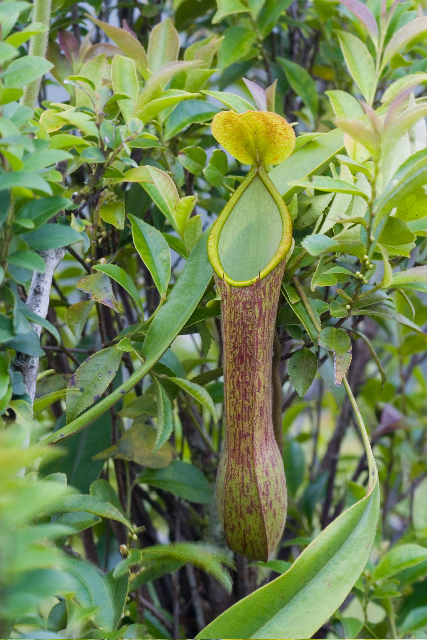
Growth habit. Climbing or scrambling carnivorous vine. The plant produces alternate strap-shaped leaves; each leaf has an extended midrib that ends in a tendril, and the tendril swells into a fluid-filled pitcher. Young plants sit at ground level with squat 'lower' pitchers; as the plant ages and stems lengthen, it produces narrower 'upper' pitchers that dangle from climbing tendrils. The two pitcher forms look distinct enough to be confused for two species.
Leaves. Strap-shaped lance-leaves up to 30 cm long, light to medium green, with a leathery texture. Each leaf ends in a tendril that produces a pitcher at its tip. The tendrils on lower (juvenile) leaves are short and the pitchers rest on the ground; on upper leaves they are long and the pitchers dangle.
Flowers. Small reddish-brown flowers borne on a long erect inflorescence 30–60 cm tall, emerging from older stems. Plants are dioecious (male and female on separate individuals). Indoor flowering is rare but does happen on mature climbing specimens.
- Pitchers — fluid-filled, vase-shaped traps at the tips of leaf tendrils. The species' defining feature.
- Two prominent wings ('alae' — the species name) running down the front of each lower pitcher.
- Pitcher dimorphism — squat ground-dwelling lower pitchers vs narrow dangling upper pitchers on the same plant.
- Light green to yellow-green pitcher exterior with reddish blotches; interior often pale green to yellow.
- Lid (operculum) above the pitcher mouth that produces nectar to attract prey.
Commonly confused with
Hourglass pitcher plant
Closely related Philippine highland species. Pitchers are constricted in the middle (hourglass-shaped) rather than tapering smoothly. Often crossed with alata to make the popular hybrid × ventrata sold as 'beginner Nepenthes'.
Beginner Nepenthes
Hybrid of N. alata × N. ventricosa. Most plants sold in shops as 'Nepenthes alata' are actually × ventrata. Hardier, more tolerant of typical apartment conditions, and indistinguishable to non-experts.
American pitcher plant
Different family (Sarraceniaceae) and continent. Sarracenia produces a single tall upright pitcher directly from the rhizome with no climbing stem and no tendrils. Temperate; needs winter dormancy. Nepenthes is tropical and grows year-round.
Albany pitcher plant
Tiny Australian carnivore with squat 5 cm pitchers at ground level only. No climbing habit. Different family. Often confused at a distance with juvenile Nepenthes lower pitchers but a fully different plant.
Venus flytrap
Different family, different mechanism — snap-traps rather than pitfall traps. Compact rosette 10 cm wide; no climbing habit; no fluid-filled pitchers. The classic 'first carnivorous plant' for most growers, alongside Nepenthes.
Care
Light
Bright indirect; some morning sun encourages pitcher colour.
An east-facing window with bright filtered light and a few hours of gentle morning sun is ideal. South-facing with a sheer curtain works. Insufficient light is the #1 reason indoor Nepenthes stop producing pitchers — leaves emerge but the tendrils never swell. Direct unfiltered midday sun scorches the leaves of plants not acclimated to it.
Seasonal: Nordic apartments above ~55°N: a full-spectrum LED at 30 cm distance for 12 hours/day from October through March is recommended. Without supplementation, expect winter pitcher-stop and slow growth.
Water
Rainwater or distilled water only — never tap water.
Carnivorous plants evolved on nutrient-poor soils and have no salt-tolerance mechanism. Dissolved minerals in tap water (calcium, magnesium, fluoride, chlorine) accumulate in the soil and kill the plant within weeks to months. Use rainwater, distilled water, or RO water exclusively. Keep the mix evenly moist — never bone-dry, never waterlogged. The classic 'tray method' for North American carnivores (sitting in 1–2 cm of water) works for Nepenthes too but is less critical than for Sarracenia.
Seasonal: Reduce water frequency slightly in winter but do not let the mix dry out completely.
Soil
Inert peat-perlite mix; never standard potting soil.
A mix of 1 part long-fibre sphagnum moss : 1 part perlite, or 2 parts peat (peat-free coco coir works as substitute) : 1 part perlite : 1 part orchid bark. Critical: no fertiliser, no compost, no garden soil. Standard potting mix contains fertilisers that burn the carnivore's roots. Many growers use pure long-fibre sphagnum moss for Nepenthes — the most epiphytic carnivore mix.
Humidity
50–70 %; below 50 % pitchers stop forming.
The single most controllable factor for keeping a Nepenthes pitchering indoors. Below 50 % humidity, leaves continue to emerge but the tendrils dry out before the pitcher swells, leaving wires of empty leaf-ends. A humidifier near the plant, a kitchen or bathroom location, or a glass terrarium all help. The hybrid N. × ventrata tolerates lower humidity (40 %) than most pure species.
Temperature
18–29 °C day, 15–20 °C night ('intermediate' Nepenthes).
Nepenthes alata is an 'intermediate' species — it tolerates a range of temperatures including the typical heated apartment. A 5 °C drop between day and night supports flowering and good pitcher formation. Brief exposure below 13 °C survives but stresses the plant; below 5 °C is usually fatal. Avoid placing on a windowsill where pitchers contact cold winter glass.
Fertilizer
Do not fertilise the soil. Feed prey directly into the pitchers (optional).
Standard plant fertilisers burn the roots. The plant feeds itself by capturing insects in its pitchers — fruit flies, mosquitoes, the occasional ant. If kept in a sterile indoor environment with no insects, you can drop a small dead insect (no larger than a quarter of a pitcher) into a few pitchers monthly. Pellet fish food or a quarter-strength orchid foliar feed sprayed lightly onto the leaves once a month is also acceptable. Do not feed mammal meat — it rots inside the pitcher.
Pruning
Cut back leggy stems to 30 cm to reset; dead pitchers cleaned off.
Old pitchers wither after 2–4 months and can be trimmed off cosmetically. Stems that have climbed too long can be cut back to 30 cm in spring; the plant resprouts from lower nodes and produces fresh juvenile (lower) pitchers. Cuttings root readily — see propagation.
Repotting
Every 2–3 years in spring with fresh peat-perlite mix.
Repot in spring as the mix breaks down (peat-based mixes degrade in 2–3 years) or when the plant becomes pot-bound. Move up only one pot size. Hanging baskets are excellent for mature plants — the climbing stems and dangling upper pitchers display well. Use plastic pots, not terracotta — terracotta leaches lime that raises pH and harms the plant.
Stem cuttings
moderate~8–12 weeksIn spring, take a 15–20 cm length of healthy stem with 3–4 leaves. Cut just below a node. Remove the lower 1–2 leaves, dip the cut end in rooting hormone, and insert into pure long-fibre sphagnum moss kept just damp. Cover with a clear plastic bag to maintain very high humidity (90 %+) during rooting. Roots emerge in 8–12 weeks; new growth follows. The original cut stem also resprouts from a node below the cut.
Air layering
moderate~10–14 weeksUseful for stubborn cuttings or to produce a larger immediate plant. Wound a node midway up a stem, wrap in damp sphagnum moss inside a plastic bag, and let roots form in place over 10–14 weeks before cutting and potting up.
Seed
difficult~6–10 weeks germination; 4–6 years to first pitchersFresh seed only — Nepenthes seed loses viability within months. Sown on damp sphagnum at high humidity in bright indirect light. Slow and used mainly by collectors and breeders.
Cultivars
Nepenthes × ventrata
A natural and cultivated hybrid of N. alata × N. ventricosa, sold widely as the standard 'beginner Nepenthes'. More vigorous and more tolerant of typical apartment conditions than either pure parent. Most plants sold as 'Nepenthes alata' in garden centres are actually × ventrata.
'Boschiana Mini'
Compact selection with smaller, more abundantly-produced pitchers. Good for limited windowsill space.
Common problems
Plant stops producing pitchers
Symptom
New leaves emerge but the tendrils never swell into pitchers; just a wire-like end on each leaf.
Cause
Most often low humidity (below 50 %), or insufficient light, or very recent transplant.
Fix
Raise humidity above 55 % using a humidifier or moving to a kitchen/bathroom. Provide brighter indirect light. After repotting, expect a 4–8 week pitcher-stop while roots re-establish — normal recovery. Pitchers should resume forming within 4–8 weeks once conditions stabilise.
Pitchers dry up and wither
Symptom
Healthy-looking pitchers turn brown and dry without obvious cause.
Cause
Normal — individual pitchers live 2–4 months, then wither while new ones form. Or low humidity if widespread.
Fix
If only the older pitchers wither while new ones continue to form, this is the natural lifecycle. Trim withered pitchers off cosmetically. If all pitchers wither at once or new ones never form, raise humidity and check light levels.
Leaf burn and yellow patches
Symptom
Leaves develop yellow patches or brown crisp areas, often on margins.
Cause
Tap water minerals, fertiliser burn, or sudden direct sun on an unacclimatised plant.
Fix
Switch immediately to rainwater or distilled water. Flush the pot with several volumes of pure water to leach accumulated minerals. Stop any fertiliser. If sun is the cause, move to bright indirect light and acclimatise gradually over 2–3 weeks before any direct sun. Damaged leaves will not recover; new leaves should emerge clean.
Black mushy stem at the base
Symptom
Lower stem turns black and soft; the entire plant collapses.
Cause
Crown rot from waterlogged mix, especially in cool conditions.
Fix
Rare a salvage operation. Cut the stem 5–10 cm above the rotted section, treat as a stem cutting (root in pure sphagnum at high humidity). Discard the rotted base and old mix. Repot survivors in fresh peat-perlite mix, water more carefully going forward, and improve drainage.
Full guide: Mushy Black Stems on Houseplants: Stem Rot vs Cold Damage vs SunburnPitcher fluid disappears or smells
Symptom
The fluid inside pitchers dries out, or smells foul.
Cause
Fluid evaporates over time as the pitcher ages; smell can come from too-large prey rotting inside.
Fix
Top up dried-out pitchers with rainwater (1–2 cm). Do not add tap water. Empty pitchers with foul-smelling rot, rinse with rainwater, and discard the prey. Feed only insect-sized prey, never larger than a quarter of the pitcher's volume.
- Aphids on new leaves
- Scale (rare)
- Mealybugs in leaf axils
- Botrytis (grey mould) on pitchers in still cold air
- Crown rot from waterlogged mix combined with low light
Toxicity & safety
No reported toxicity. Pitcher fluid contains digestive enzymes (proteases, chitinases) that could cause mild irritation if ingested, but no systemic toxicity.
Nepenthes — International Carnivorous Plant Society safety informationASPCA does not list Nepenthes among toxic plants. Cats occasionally drink the pitcher fluid (which contains digestive enzymes) without harm, though it can cause mild stomach upset.
ASPCA Toxic and Non-Toxic PlantsASPCA does not list Nepenthes among toxic plants. Considered non-toxic to dogs.
ASPCA Toxic and Non-Toxic PlantsWhy your Nepenthes isn't making pitchers — and what's actually going wrong
The single most common Nepenthes complaint is 'my plant grows leaves but never makes pitchers'. The cause is almost always one of three things, in this order of frequency: (1) humidity below 50 %, (2) insufficient light, (3) recent transplant or environmental change. Each new leaf in Nepenthes emerges with a tendril at its tip; under good conditions the tendril swells over 4–6 weeks into a pitcher. Under stress the tendril dries up before swelling, leaving a wire-like dead end on the leaf.
The fix is almost always to raise humidity. Below 50 % the tendril dries faster than it can develop into a pitcher; above 60 % the process is reliable. A humidifier in the room is the most consistent solution; a kitchen or bathroom location often works without one. Light comes second — bright indirect with a few hours of morning sun, or 12 h/day under a full-spectrum LED. Recent transplants need 4–8 weeks before resuming pitcher production while roots re-establish. Once the conditions are right, expect new pitchers within 4–8 weeks.
Lower pitchers vs upper pitchers — same plant, two completely different traps
Nepenthes alata produces two distinctly different pitcher forms on the same plant, depending on the plant's age and stem position. Juvenile rosette plants produce 'lower pitchers' — squat, broad, ground-resting traps with two prominent wings down the front. As the stem lengthens and begins to climb, it switches to producing 'upper pitchers' — narrower, more cylindrical, dangling at the ends of long climbing tendrils, often without wings. The two forms look so different that early botanists frequently described them as separate species before discovering they came from the same plant.
The two forms reflect different ecological roles. Lower pitchers are oriented toward catching ground-walking prey (ants, beetles, occasional small frogs), while upper pitchers are oriented toward flying or canopy-walking prey (mosquitoes, small flies, occasional small geckos). Indoor Nepenthes that stay in their juvenile rosette form indefinitely never produce upper pitchers — only the climbing mature form does. To trigger the switch, grow the plant on long enough for the stem to start climbing (1–2 m), provide vertical support, and give bright light. The first upper pitchers usually appear 2–4 years after a plant first starts climbing.
The pitchers of Nepenthes are not flowers and not fruit — they are highly modified leaf tips. The trap mechanism works by a combination of slippery wax on the inner walls (which detaches in flakes when an insect grips it), a digestive fluid pool at the base containing proteases and chitinases produced by the plant, and (in some species) a viscoelastic 'mucilage' that traps prey like flypaper. Some Nepenthes species in Borneo are too large to be primarily insectivorous — N. rajah and N. attenboroughii both catch and digest small mammals, including shrews and rats, that fall into their pitchers seeking nectar.
Frequently asked · 5
Why isn't my Nepenthes producing pitchers?+
Almost always low humidity (below 50 %) or insufficient light. Each new leaf emerges with a tendril at its tip that swells into a pitcher over 4–6 weeks; under stress the tendril dries before forming a pitcher. Raise humidity above 55 % using a humidifier, provide bright indirect light with some morning sun, and expect new pitchers within 4–8 weeks once conditions stabilise.
Can I use tap water on a Nepenthes?+
No. Carnivorous plants evolved on mineral-poor soils and have no salt-tolerance mechanism — dissolved minerals in tap water (calcium, magnesium, fluoride, chlorine) accumulate in the soil and kill the plant within weeks to months. Use rainwater, distilled water, or RO water exclusively. The water rule is the single most important difference between carnivorous and standard houseplant care.
Are tropical pitcher plants safe for cats and dogs?+
Yes — Nepenthes is not on the ASPCA toxic plant list and is considered non-toxic to cats and dogs. The pitcher fluid contains digestive enzymes (proteases, chitinases) and could cause mild stomach upset if drunk in quantity, but there is no systemic toxicity. Cats sometimes drink from the pitchers without ill effect.
Should I feed insects to my Nepenthes?+
Optional but not necessary. The plant photosynthesises and grows fine without prey if humidity and light are adequate. If you want to feed it, drop one small dead insect (size: less than one quarter of the pitcher's volume) into a few pitchers per month. Do not use mammal meat — it rots and stinks. Standard plant fertiliser is harmful and burns the roots.
What's the difference between Nepenthes alata and Nepenthes × ventrata?+
Most plants sold in shops as 'Nepenthes alata' are actually × ventrata, a hybrid of alata × ventricosa. The hybrid is hardier, more tolerant of typical apartment conditions (lower humidity, less consistent water), and easier for beginners. Pure N. alata pitchers are smoother and more uniformly cylindrical; × ventrata pitchers are slightly constricted in the middle from the ventricosa parent. Most owners cannot tell them apart, and care is identical.
- Carnivorous Plants for Beginners: Venus Flytrap, Sundew & Butterwort (Nordic Indoor Edition)
- Tap Water for Houseplants: Is It Really Safe?
- Hard Water and Houseplants: What It Actually Does
- Humidity for Houseplants: What Actually Matters (and What Doesn't)
- Pet-Safe Houseplants: A Non-Toxic Guide for Cats and Dogs