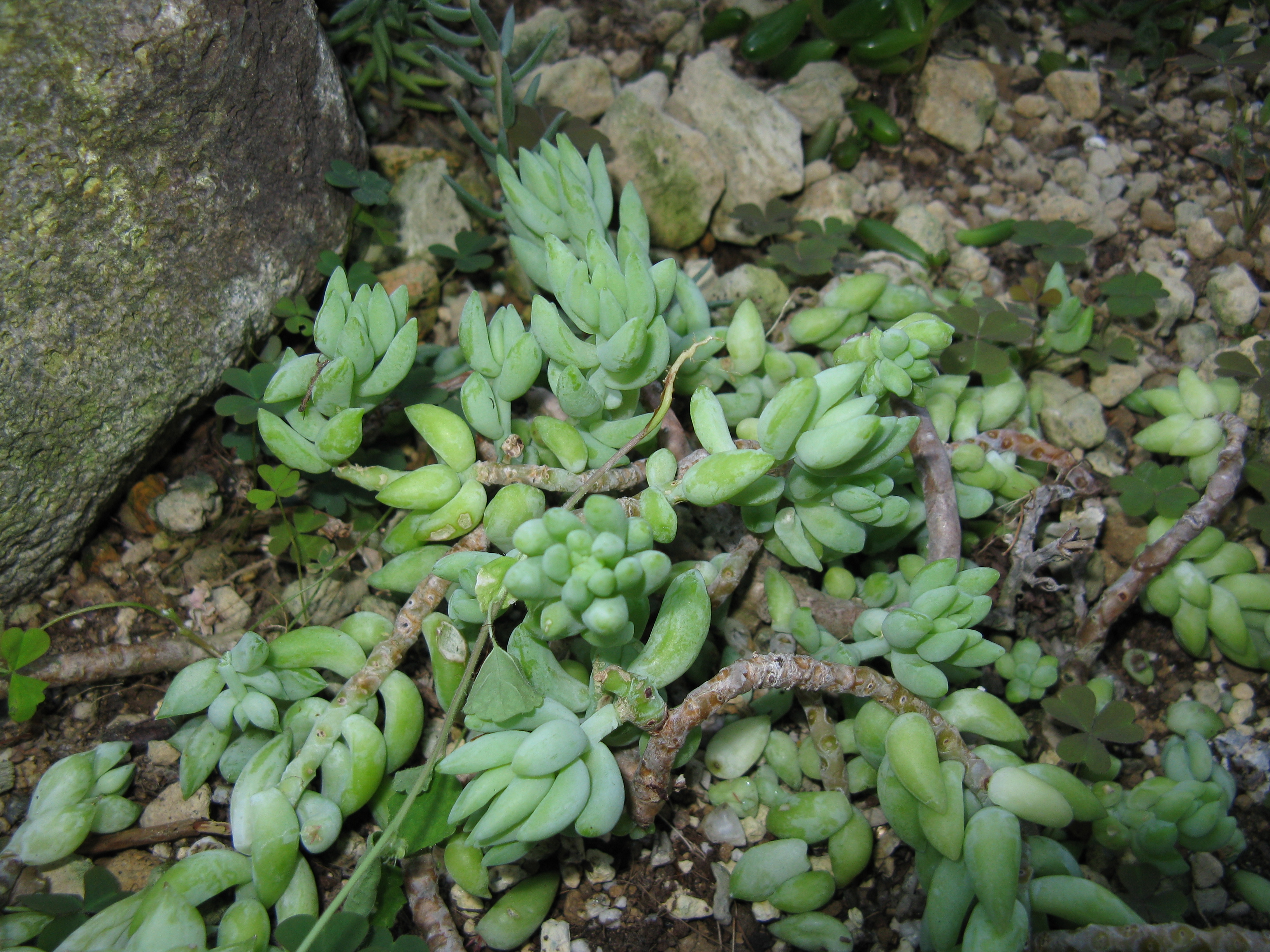
Identity & taxonomy
- Scientific name
- Sedum morganianum E.Walther
- Family
- Crassulaceae
- Genus
- Sedum
- Order
- Saxifragales
- IUCN status
- Vulnerable (VU)
- Wikidata
- Q140926
- Sedum burrito hort. (in part — see Identification)
- Burro's tailen
- Donkey's tailen
- Horse's tailen
- Lamb's tailen
- Åsnesvanssv
- Eselsschwanzno
- Æselhaleda
- Aasinhäntäfi
- Schlangen-Sedum / Eselsschwanzde
Mexico (Veracruz state — endemic, restricted to a few river canyons)
How to identify it
Growth habit. Pendulous succulent. Stems are weak, fleshy, and trail or hang from rocky cliffs in the wild — and from hanging baskets indoors. Each stem is densely covered in overlapping cylindrical leaves arranged in a tight spiral that resembles a braided rope. Stems can reach a metre or more on a healthy plant after 5–10 years; growth rate is around 10–15 cm per year.
Leaves. Cylindrical, plump, lance-shaped leaves 2–3 cm long and ~7 mm wide on Sedum morganianum (slightly smaller and rounder on S. burrito). Blue-green to grey-green colour from a powdery wax coating ('farina' or epicuticular wax) that reflects sunlight and reduces water loss. The wax rubs off on handling and does not regrow on the same leaf. Leaves are extremely loosely attached and drop at the lightest brush — they then root readily into nearby soil to form new plants.
Flowers. Small, star-shaped, 5-petalled pink-to-red flowers ~1 cm across, borne in clusters at the very tips of mature stems in late winter to early spring. Rarely produced indoors — most owners never see flowers. The flower colour is a useful ID confirmation versus other trailing sedums.
- Cylindrical, plump, blue-green leaves arranged in a tight rope-like spiral down the stem.
- Powdery wax coating that gives the leaves their bluish-grey colour and rubs off on contact.
- Extreme leaf shedding — leaves fall off at the lightest brush, more than almost any other succulent.
- Pink star-shaped flowers at stem tips (rare indoors).
- Pendant growth habit — never climbs, always trails.

Commonly confused with
Baby burro's tail
Sold under the same 'burro's tail' name and routinely confused. S. burrito has shorter (1–1.5 cm), rounder, more tightly packed leaves that hold on much better when handled. Often the safer choice for households with cats or children. Some authorities consider S. burrito a cultivar of S. morganianum rather than a distinct species.
Jelly bean plant
Upright rather than trailing, with shorter (1–2 cm) jelly-bean-shaped leaves that flush red in sun. Same family but a completely different growth habit.
String of pearls
Trailing succulent like burro's tail, but the leaves are spherical (true pea-shape) and arranged singly along thin wiry stems — not packed densely on a thick rope. Different family (Asteraceae); toxic to pets.
String of bananas
Trailing with curved banana-shaped leaves on thin stems. Faster-growing and more drought-tolerant than burro's tail. Toxic to pets, unlike Sedum.
Care
Light
Bright direct sun — at least 4 hours/day.
Sedum morganianum is a cliff-dwelling succulent and wants serious light. A south or west window with several hours of direct sun is ideal. In low light, stems stretch and grow apart with widely spaced leaves ('etiolation') — a sign to move it brighter. The wax coating protects against sunburn, so it tolerates more direct sun than most houseplants once acclimated. Sudden moves from low to high light can still scorch leaves; transition over 1–2 weeks.
Seasonal: Nordic apartments above ~55°N: a full-spectrum grow light at 30 cm distance for 12 hours/day from October through March prevents winter etiolation. South-facing windows alone are usually not enough through Nordic winters.
Water
Soak when leaves visibly soften — every 2–3 weeks in summer, monthly in winter.
Burro's tail stores water in its plump leaves and tolerates deep drought far better than overwatering. Water only when the leaves on the lowest pendant stems start to feel slightly soft when squeezed gently — a clear visual signal. Pour water through the pot until it runs from the drainage hole, then let it dry completely. Watering on a fixed schedule causes more failures than any other mistake — it varies from every 10 days in summer sun to every 4–6 weeks in winter. Overwatering causes the entire stem to rot from the base outward and is the #1 killer.
Seasonal: Reduce dramatically from November to February — wait for visible leaf softening even if it takes 6 weeks.
Soil
Gritty, fast-draining cactus or succulent mix.
Use a commercial cactus/succulent mix amended with extra perlite or pumice (50:50 by volume), or mix your own from 1 part peat-free potting soil, 1 part coarse perlite, and 1 part horticultural grit or pumice. Standard houseplant mix retains too much water and rots the stems. The pot should drain freely; water should never sit at the base.
Humidity
30–50 % preferred; tolerates very dry indoor air.
One of the few houseplants that actually thrives in dry indoor air — a benefit during Nordic winter heating. Higher humidity (above 60 %) combined with cool temperatures encourages stem rot and is harmful, not helpful. Do not mist.
Temperature
16–27 °C; tolerates 10 °C in winter dormancy.
Comfortable in normal heated room temperatures. A cool winter rest at 10–13 °C with reduced watering encourages flowering and tighter, more compact growth. Brief exposure to 5 °C survives; below 0 °C kills the plant. Avoid placing on a windowsill where leaves touch cold winter glass.
Fertilizer
Quarter-strength balanced or cactus feed every 6–8 weeks during growth.
Sedum is a slow grower with low nutrient needs. A quarter-strength balanced (e.g. 10-10-10) or cactus-specific liquid fertiliser every 6–8 weeks from April through September is enough. Over-fertilising produces weak stretched growth that flops and breaks. Stop entirely from October through March.
Pruning
Trim stems to control length; broken stems root readily.
Cut stems back to any length with clean scissors — the plant tolerates hard pruning. Trimmings root easily as cuttings (see propagation). Fallen leaves often root themselves around the parent plant, producing volunteer babies. The wax coating does not regrow on damaged sections, so handle as little as possible.
Repotting
Every 3–5 years, only when truly pot-bound.
Sedum prefers tight quarters. Repot only when the pot is completely full of roots or the mix has broken down, typically every 3–5 years. Choose a pot only one size larger and use fresh gritty mix. Plan to lose many leaves during repotting — the wax coating and loose attachment make it inevitable. A hanging basket lined with coco fibre is the classic display.
Stem cuttings
easy~2–4 weeks to root, 6–12 months to fill outCut a 10–15 cm length of healthy stem with clean scissors. Strip the bottom 2–3 cm of leaves (set them aside for leaf propagation). Let the cut callus over for 3–5 days in a dry shaded place. Insert the calloused end 2–3 cm into gritty cactus mix, and water sparingly only after roots have formed (about 2 weeks). Keep in bright indirect light during rooting.
Leaf propagation
easy~4–8 weeks to root; 6–18 months to a recognisable plantLay individual fallen leaves on the surface of slightly moist gritty mix in bright indirect light. Each leaf grows tiny roots, then a tiny rosette of new leaves at its base over 4–8 weeks. The original leaf eventually shrivels and falls away, leaving a baby plant. Burro's tail is one of the most reliable succulents for leaf propagation — a well-handled plant can produce dozens of offspring per year.
Cultivars
'Burrito'
Often sold as Sedum burrito and treated by some authorities as a separate species (Reid Moran, 1977) and by others as a cultivar of S. morganianum. Leaves are noticeably shorter (1–1.5 cm), rounder, and pack more tightly along the stem — and they drop less readily when the plant is handled. Both are commonly sold under the same trade name 'burro's tail'.
Common problems
Leaves falling off at the slightest touch
Symptom
Leaves drop in handfuls when the plant is watered, moved, or brushed past.
Cause
Normal — this is the species' natural behaviour. Sedum morganianum has the most fragile leaf attachment of any common houseplant.
Fix
Place the plant where it will not be touched or brushed past. Use a hanging basket suspended above head height. Water with a long-spouted can rather than lifting and tilting the pot. Do not rotate. Each fallen leaf can be propagated — lay them on dry mix to start new plants.
Stems stretched with widely-spaced leaves
Symptom
Stems look thin, leaves are spaced out rather than densely packed, growth is pale green.
Cause
Insufficient light (etiolation).
Fix
Move to a brighter spot — direct sun for at least 4 hours/day or a strong full-spectrum grow light. Existing stretched stems will not tighten back up; they need to be cut back, with new growth coming in at proper spacing in the brighter location.
Mushy black sections at the base of stems
Symptom
Lower part of stem turns black and soft; entire stem may collapse.
Cause
Overwatering, often combined with poorly-draining soil.
Fix
Rare a salvage operation. Cut all healthy green stem sections well above any blackening. Discard infected mix and the rotted base. Let cuttings callus 3–5 days, then root in fresh gritty mix. Switch to a much grittier soil mix and water far less frequently going forward.
Full guide: Root Rot in Houseplants: How to Identify, Save, and Prevent ItPowdery white patches on leaves
Symptom
Distinct white dots or patches on leaves where they have been touched.
Cause
Wax coating ('farina') has rubbed off where handled. Cosmetic only.
Fix
The wax does not regrow on the same leaf. Handle the plant as little as possible. New growth will come in with fresh wax. If the patches are fluffy and look like cotton wool, suspect mealybugs and treat with rubbing alcohol on a cotton swab.
Plant rarely or never flowers
Symptom
Healthy plant grows for years but never produces the pink star-shaped flowers.
Cause
Insufficient light, lack of cool winter rest, or simply immaturity.
Fix
Burro's tail flowers only on mature stems (3+ years old) given a cool dry winter rest at 10–13 °C with minimal water from November through February, followed by a return to bright direct light in spring. Most indoor specimens in heated apartments never receive enough seasonal cue and never flower.
- Mealybugs (in leaf axils — hard to spot)
- Aphids on flower stalks
- Scale (rare)
- Stem rot from overwatering
- Fungal leaf spot in cool damp conditions
Toxicity & safety
No reported toxicity. Sap is not irritating to skin.
Sedum morganianum — Missouri Botanical Garden Plant FinderASPCA lists Sedum morganianum (Burro's Tail) as non-toxic to cats. No mechanical or chemical hazard reported.
ASPCA Toxic and Non-Toxic Plants — Burro's TailASPCA lists Sedum morganianum (Burro's Tail) as non-toxic to dogs.
ASPCA Toxic and Non-Toxic Plants — Burro's TailWhy every burro's tail looks half-naked at the back — and how to live with it
Sedum morganianum is the most leaf-droppy of any common houseplant. Its leaves are attached only loosely so they can fall, root, and start new plants on the cliff faces it lives on in the wild — a survival strategy that makes perfect sense in Veracruz canyons and absolutely no sense in a furnished living room. Every move, every watering, and every brush past leaves a small pile of fallen leaves on the floor.
The practical answer is to stop fighting it. Hang the plant where it cannot be brushed past — above head height, away from doorways, away from where pets jump. Use a long-spouted watering can rather than lifting the pot. Do not rotate the plant. Accept that the side facing the wall (or any side that must occasionally be touched) will end up sparser than the visible side. The fallen leaves are not waste — laid on dry mix in bright light, each one will produce a new baby plant in 4–8 weeks. A patient owner can multiply a single plant tenfold per year just from the leaf-rain.
Sedum morganianum vs Sedum burrito — and why both are sold as 'burro's tail'
Two closely-related plants are sold interchangeably as 'burro's tail' in nurseries, garden centres, and online: Sedum morganianum (the original 1938 species) and Sedum burrito (described separately in 1977 by Reid Moran). They look very similar but differ in important ways. S. morganianum has longer (2–3 cm), more lance-shaped leaves with pointed tips, and the leaves drop at the slightest touch. S. burrito has shorter (1–1.5 cm), rounder leaves with blunt tips packed more tightly along the stem, and the leaves hold on much better when handled.
Some botanists treat S. burrito as a distinct species; others consider it a cultivar of S. morganianum or even a hybrid of S. morganianum × S. clavatum. For an owner with a cat or a busy household, S. burrito is usually the easier plant — fewer leaves on the floor and a more compact silhouette. Both have identical care requirements and identical pet safety. To tell them apart at the nursery, gently squeeze a single leaf: if it's plump and rounded with a blunt tip, it's likely S. burrito; if it's longer and pointed, it's likely S. morganianum.
Sedum morganianum is endemic to a tiny range in Veracruz, Mexico — possibly only a single river canyon — and was first scientifically described as recently as 1938 by Eric Walther. The species is considered Vulnerable in the wild owing to habitat loss and over-collection, but is one of the most widely cultivated succulents in the world thanks to the ease of propagating from fallen leaves. Almost every burro's tail in cultivation today is descended from a small number of original wild collections.
Frequently asked · 5
How often should I water a burro's tail?+
Water only when the leaves on the lowest stems feel soft when gently squeezed. In bright summer light this is typically every 2–3 weeks; in winter it can stretch to monthly or longer. Soak the pot until water runs from the drainage hole, then let it dry completely. Overwatering — far more than underwatering — is the #1 killer of this species.
Why are my Sedum morganianum leaves falling off?+
Most often it is normal handling — burro's tail leaves attach more loosely than almost any other succulent and drop at the slightest brush. If leaves are also turning yellow or mushy, the cause is overwatering. If leaves drop and the stems look pale and stretched, it's etiolation from low light. Place the plant where nothing can brush past it, water less frequently, and move it brighter.
Is burro's tail safe for cats and dogs?+
Yes — ASPCA lists Sedum morganianum as non-toxic to cats and dogs. No saponins, no alkaloids, no mechanical irritants. One of the few trailing succulents that is genuinely pet-safe (string of pearls, string of bananas, and string of dolphins are all toxic). The bigger pet hazard is the fragile leaf attachment — curious pets dislodge leaves easily.
What is the difference between Sedum morganianum and Sedum burrito?+
S. morganianum has longer (2–3 cm), pointed leaves that drop at the slightest touch. S. burrito has shorter (1–1.5 cm), rounder, blunt-tipped leaves that hold on much better. Both are sold as 'burro's tail' or 'donkey's tail' interchangeably. Identical care; choose S. burrito if you have pets or children — fewer fallen leaves to deal with.
How do I propagate burro's tail from a fallen leaf?+
Lay the fallen leaf on the surface of slightly moist gritty cactus mix in bright indirect light. Do not bury or water the leaf directly. After 4–8 weeks tiny roots emerge from the leaf base, followed by a small rosette of new leaves. The original leaf eventually shrivels. After 6–18 months you have a recognisable mini-plant. One mature parent can produce dozens of offspring per year through leaf propagation — they don't need any cutting on your part, just patience.