What a cutting needs to root
A cutting roots when a dormant growth point below the leaf — called a node — gets the right conditions to push out adventitious roots. The node is the critical part. A leaf with no node will never produce a new plant (though pothos and philodendron leaves will survive in water for months looking hopeful). The node appears as a small bump or ring on the stem, usually where a leaf meets the stem.
The four conditions a node needs: moisture (so the tissue does not desiccate), oxygen (so new roots can respire), warmth (21–27°C is ideal — most houseplants stall below 18°C), and indirect light (direct sun cooks unrooted cuttings; darkness slows photosynthesis and slows rooting). Every propagation method is a different way of delivering those four things.
How to take a cutting (any method)
This is the same regardless of whether you are rooting in water, soil, or moss. Get this step right and the rest is largely waiting.
- 1Identify a node on the parent plant. On a vining plant like pothos or philodendron, the node is the bump where a leaf and an aerial root originate. For pothos specifically, the pothos water propagation guide walks the exact node-finding and the typical 7–14 day root timeline.
- 2Sterilise scissors or a clean blade with rubbing alcohol or a brief flame pass. Dirty cuts are the single biggest cause of cutting failure.
- 3Cut 1–2 cm below the node on a diagonal, leaving at least one leaf above the node. More than 2–3 leaves and the cutting will struggle to support them without roots — strip the excess.
- 4If the plant has sticky sap (figs, rubber tree, some euphorbias), rinse the cut end under cool water for a few seconds to stop the sap flow — the sap will otherwise seal the cut and block rooting.
- 5Let cacti, succulents, and heavy-sap plants callus for 1–7 days before planting. All other cuttings can go into water or soil immediately.
Water propagation: the beginner default
Drop the cutting into a clear jar of room-temperature water with the node submerged and at least one leaf above the waterline. Change the water every 3–5 days, or when it looks cloudy. Keep the jar in bright indirect light. That is the entire method.
Why it works so well: clear glass gives you continuous visibility — you see when roots start, track their growth, and know when to pot. Failures are obvious early (black nodes, mushy stems) and you can try again without a dead pot to clean up. Most aroids, tradescantias, hoyas, begonias, and peperomias root in water within 3–6 weeks.
The limitation: water roots are structurally different from soil roots — thinner, more fragile, less branched. When you transfer a water-rooted cutting to soil, some roots die off and the plant has to grow new 'soil-adapted' roots. The transition usually goes fine with careful watering, but a few cuttings sulk for a month before resuming growth. Moving the cutting when roots are 3–5 cm long (not 10+ cm) reduces this shock — younger roots adapt better.
Soil propagation: less feedback, smoother transition
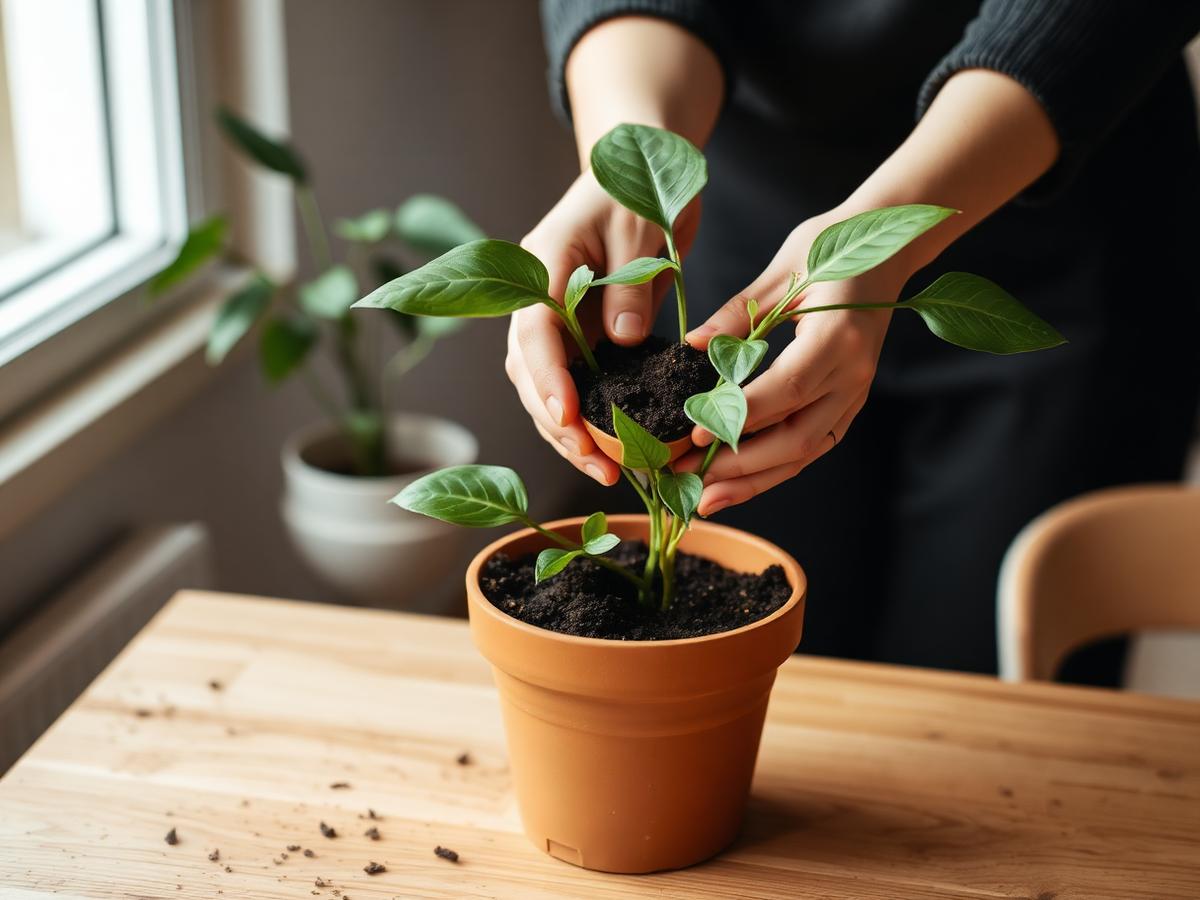
Plant the cutting directly into lightly damp propagation mix (a 50/50 blend of peat or coir with perlite works well; a chunky aroid mix is fine for aroids). Keep the soil moist but not waterlogged. Most growers cover the pot with a clear bag or bottle for the first 2–3 weeks to keep humidity at 80%+, then vent daily to avoid mould.
Why choose soil over water: the cutting develops soil-adapted roots from the start, so there is no transfer shock. Once the cutting takes, you already have a potted plant — no repotting step. The trade-off is that you cannot see what is happening. Tugging the cutting weekly to check for resistance (a sign of roots) is the only feedback, and most people under-tug and over-water out of anxiety.
Soil propagation is the method of choice for snake plants, ZZ plants, and any cutting where water is unreliable (fiddle leaf fig, some rubber trees). It is also the better method when you plan to keep the propagation in place — windowsill seedlings, herb starts, or ornamentals you do not want to handle twice.
Sphagnum and perlite: the hybrid methods
Both methods combine soil's root structure with water's visibility, and both are noticeably faster than pure water propagation for tricky species.
Sphagnum moss: soak long-strand sphagnum in water, wring it out so it is damp but not dripping, and wrap the node tightly. Put the wrapped cutting in a clear container and keep it in bright indirect light. Roots form in 2–3 weeks for most aroids — often faster than water — and transplant to soil with almost no shock because sphagnum-grown roots are structurally similar to soil roots. This is the go-to method for rare or expensive aroids (Anthurium, variegated Monstera) where failure is costly.
Perlite: fill a clear cup with perlite, wet it thoroughly, and push the cutting in so the node is buried. Keep the perlite damp. Same speed as sphagnum, same low-shock transplant, cheaper and more widely available. The downside is visibility — perlite is semi-opaque and you cannot see roots unless you lift the cutting out.
LECA and semi-hydro
LECA (expanded clay pellets) is sometimes pitched as a propagation medium, but it is really a long-term growing system. A cutting placed in LECA with a small water reservoir below will root in 3–4 weeks; the advantage is that the rooted cutting can stay in LECA permanently without a further transplant. The disadvantage is that LECA requires hydroponic fertiliser (the pellets themselves carry no nutrients), so it is a higher-maintenance system than soil once the plant is established.
For most home growers, LECA propagation is overkill unless you are already running a LECA setup. If you just want a new pothos, stay with water.
Method by species
Not every plant propagates by every method. The list below reflects what actually works, not what could theoretically be tried.
- ·Pothos: water (easiest) or sphagnum. Nearly 100% success. 3–4 weeks to transplant.
- ·Philodendron (climbing): water or sphagnum. Similar to pothos. Use sphagnum for Pink Princess or variegated cultivars.
- ·Monstera deliciosa: water or sphagnum. Include a node with an aerial root for fastest results.
- ·Tradescantia: water — practically guaranteed. Roots in 7–10 days.
- ·Hoya: sphagnum or perlite preferred. Water works but is slower and more rot-prone.
- ·Snake plant (Sansevieria): soil only, or division. Water-rooted snake plants do not transition to soil well.
- ·ZZ plant: soil or water (very slow — 3+ months).
- ·African violets and begonias: single-leaf cuttings in water or soil.
- ·Spider plants: detach the plantlets ('spiderettes') and root in water or directly in soil.
- ·Pilea peperomioides: detach the already-rooted pups — no cutting needed.
- ·Calathea and maranta: rhizome division at repot time — these do not propagate from cuttings.
- ·Fiddle leaf fig and rubber tree: air layering or sphagnum. Water propagation often fails.
When it's not working
Cuttings fail in predictable ways. If the stem below the waterline turns black and mushy within a week, the cut was contaminated or the water is too warm — start again with a clean blade and fresh water. If the cutting sits in water for 6+ weeks with no root activity, the node was damaged or the light level is too low — move it somewhere brighter. If the cutting looks fine but the leaves yellow, remove the yellowing leaf and reduce how many leaves the cutting is trying to support.
The single most common mistake is missing the node. A leaf-only cutting from a pothos will survive for months in water, looking like it's 'about to root', and never will. If you are 4 weeks in with no sign of roots, double-check that there is a node below the waterline.