Identity & taxonomy
- Scientific name
- Sempervivum tectorum L.
- Family
- Crassulaceae
- Genus
- Sempervivum
- Order
- Saxifragales
- IUCN status
- Least Concern (LC)
- Wikidata
- Q161084
- Sedum tectorum (L.) Scop.
- Hens and chicksen
- Common houseleeken
- Roof houseleeken
- Live-foreveren
- St. Patrick's cabbageen
- Taklöksv
- Takløkno
- Tagrød / Husløgda
- Mehikukka / Kattokrassifi
- Dachwurz / Hauswurzde
Mountains of central and southern Europe — Pyrenees, Alps, Apennines, Carpathians, Balkans
How to identify it
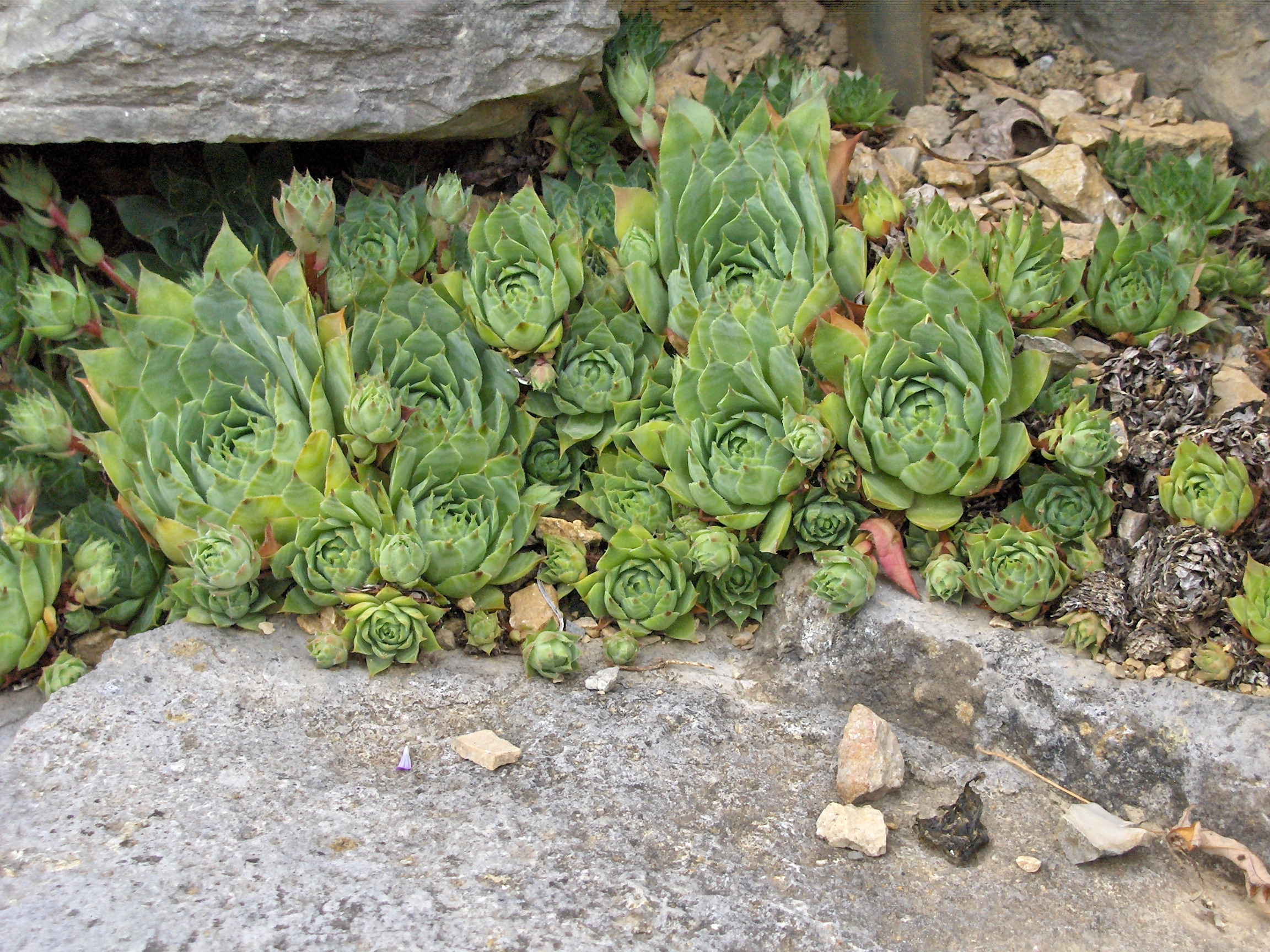
Growth habit. Mat-forming alpine succulent. Each individual is a tight low rosette of overlapping fleshy leaves. The parent rosette ('hen') produces multiple daughter offsets ('chicks') on short stolons that radiate around it; chicks root where they touch soil and become independent rosettes. A single planted rosette colonises a 30 cm circle within 2–3 years. After 3–5 years the parent rosette flowers, sets seed, and dies — but the surrounding chicks live on, which is why a mature mat looks immortal.
Leaves. Fleshy obovate leaves 2–4 cm long arranged in a tight ground-hugging spiral. Mid-green or grey-green, with a sharply pointed tip that is usually reddish-brown — the depth of the red varies with cold and sun exposure. Leaf surface is sparsely covered in fine hairs along the margins (more hairy in subsp. arvernense, almost smooth in subsp. tectorum).
Flowers. A tall stout flower stalk 20–40 cm high emerges from the centre of a mature rosette in mid-summer, bearing a many-flowered cyme of 12-petalled pink to red-purple star-shaped flowers ~2 cm across. Flowering exhausts the rosette — once the seed is set, the rosette dies and dries to a brown husk. The surrounding chicks continue.
- Tight ground-hugging rosette of fleshy leaves with reddish-pointed tips.
- Daughter offsets ('chicks') ringing the parent rosette on short stolons — diagnostic at a glance.
- Stays evergreen through winter, even under snow at −20 °C.
- Each rosette flowers once on a tall stalk and then dies (monocarpic).
- Native habitat is on rocks and old tile roofs — drought adaptation visible in the thick leaves.
Commonly confused with
Mexican snowball / Echeveria
Similar rosette form but Echeveria is a Mexican genus that dies at −5 °C — never use them outdoors in Nordic winter. Echeveria leaves are usually thicker and more cupped, and they do not produce stoloniferous chicks; offsets emerge from the leaf base instead.
Rollers / hen-and-chicks
Closely related (now lumped into Sempervivum by some authorities). Differs by producing chicks that detach and roll away rather than staying attached to the parent.
Aeonium
Mediterranean rosette succulent that grows on tall woody stems rather than ground-hugging mats. Not cold-hardy.
Cobweb houseleek
Same genus, smaller rosettes (1–3 cm) with white silk-like cobwebs between the leaf tips. Often grown alongside S. tectorum in the same trough.
Care
Light
Full direct sun outdoors; brightest spot indoors.
Sempervivum is an alpine plant adapted to extreme sun exposure on bare rock. Outdoors it wants 6+ hours of direct sun and develops the deepest red tips and tightest rosettes in full sun. Indoors it is genuinely difficult to keep happy — most apartments are not bright enough, and the rosettes elongate (etiolate) and lose their red colour within weeks. If you live in an apartment without a balcony, treat it as a temporary indoor plant and put it outdoors permanently in spring.
Seasonal: In Nordic gardens, Sempervivum's only competitive advantage over true succulents is winter survival — leave it outside year-round on a sunny rock garden, balcony pot, or green roof.
Water
Sparingly — let the soil dry completely between waterings.
Outdoors in a well-draining location, summer rainfall is usually sufficient and supplemental watering is rarely needed. Indoors, water only when the leaves visibly soften and the soil is bone-dry; typically every 3–6 weeks. The classic killing mistake is overwatering — Sempervivum rots fast in damp soil, especially in winter.
Seasonal: Stop watering entirely from late October through March. The plant will appear flat and wrinkled by spring; this is normal winter dormancy and full turgor returns within days of warmer weather.
Soil
Gritty, sharply draining mineral mix.
1 part standard potting mix to 2 parts coarse grit, gravel, or pumice. The plant grows on bare rock in the wild and needs a mix that drains within seconds. Heavy garden soils kill it. A 1–2 cm top layer of pea gravel keeps the rosette dry and prevents rot at the leaf bases.
Humidity
Tolerates 20–80 %; prefers dry air.
Sempervivum is one of the few houseplants that genuinely prefers dry indoor air. Damp humid conditions encourage rot and fungal spotting on the leaves. No misting, ever.
Temperature
−20 °C to +35 °C — fully hardy through Nordic winter.
The defining feature of Sempervivum: it is bone-hardy to USDA zone 4 (−30 °C with snow cover, −20 °C without). It survives Nordic winters outdoors with no protection beyond good drainage. Sustained heat above 35 °C with high humidity is harder on the plant than any cold spell.
Fertilizer
None or very little — Sempervivum thrives on neglect.
Native to nutrient-poor mountain rock. Heavy feeding produces soft pale rosettes that lose their characteristic colour and rot easily. A single half-strength feed in spring is sufficient for container plants; outdoor specimens need none.
Pruning
Remove dead flowering rosettes; pull spent leaves with tweezers.
After a rosette flowers and dries, lift it out with tweezers and replant a chick from the surrounding cluster in the gap. Yellowed outer leaves can be teased off the rosette base in spring to keep the planting tidy.
Repotting
Every 3–4 years if container-grown; outdoor plants need none.
Container-grown Sempervivum builds up a dense mat of intermingled rosettes that eventually exhausts the soil. Lift the entire mat, separate into individual chicks, refresh the gritty mix, and replant the strongest rosettes 5–10 cm apart.
Offsets ('chicks')
easy~1–3 weeksPull a chick away from the parent rosette with its short stolon attached. Let the cut surface callus over for a day, then press into gritty mix. New roots emerge within 1–3 weeks. The standard and overwhelmingly easiest method.
Seed
moderate~Germination 2–4 weeks; flowering 3–4 yearsUseful only for breeders. Seedlings are small and grow slowly; named cultivars do not come true from seed. Sow on damp gritty mix and barely cover; keep at 15–20 °C until germination, then move to bright cool conditions.
Cultivars
'Royanum'
Mid-green rosette with sharp dark-red tips. The classic landscape selection.
'Atropurpureum'
Rich burgundy rosettes that deepen in cold weather.
'Limelight'
Chartreuse-yellow rosettes with pink leaf tips in cool weather.
Common problems
Centre of rosette turns black and collapses
Symptom
Heart of the rosette darkens, leaves separate from the base, plant smells sour.
Cause
Crown rot from water sitting in the rosette centre, almost always after winter rain or overhead watering.
Fix
Affected rosettes are unrecoverable; pull them out and dispose of them. Surrounding chicks are usually fine. Switch to a drier site, top-dress with gravel, and water at the soil only — never into the rosette centre.
Rosettes elongate and pale (etiolation)
Symptom
Leaves lengthen and stand upright instead of forming a flat ground-hugging rosette; colour fades to pale green.
Cause
Insufficient light — typically indoors or under a tree canopy.
Fix
Move outdoors to full sun. New growth restores the tight rosette form within 4–8 weeks. Old elongated leaves do not return to the rosette shape but get hidden by new growth.
Tall flower stalk emerges from a rosette
Symptom
Centre of a healthy-looking rosette suddenly stretches into a thick stalk with buds.
Cause
Natural monocarpic flowering — that rosette will set seed and die after blooming.
Fix
Either let it flower (the display is striking and the seed can be collected) or cut the stalk early to extend the rosette's life by a year or two. Surrounding chicks are unaffected and replace the parent rosette over the following season.
Orange spots on leaves
Symptom
Bright orange or rust-coloured pustules on the leaves, sometimes with leaf distortion.
Cause
Rust fungus (Endophyllum sempervivi) — rare but specific to Sempervivum.
Fix
Remove and dispose of all affected leaves and the rosettes carrying them; do not compost. Improve airflow and avoid overhead watering. Severe infections may require disposing of an entire mat.
- Vine weevil (outdoor)
- Aphids on flower stalks
- Mealybugs in plug trays
- Crown rot in damp conditions
- Endophyllum sempervivi (rust)
- Botrytis grey mould in winter
Toxicity & safety
Considered non-toxic. The species has a long traditional folk-medicine history (Charlemagne ordered it planted on every roof to ward off lightning, and the leaf juice has been applied to insect stings and burns for centuries).
Sempervivum tectorum — North Carolina State ExtensionNot listed by ASPCA as toxic. No reported cases of feline poisoning.
ASPCA Toxic and Non-Toxic Plants — Hens and Chicks (Sempervivum)Not listed by ASPCA as toxic. No reported cases of canine poisoning.
ASPCA Toxic and Non-Toxic Plants — Hens and Chicks (Sempervivum)Why a single rosette dies but the plant lives forever
Each individual Sempervivum rosette is monocarpic — it flowers once, sets seed, and dies. The flowering takes 3–5 years to trigger, and the trigger is usually a combination of rosette age and seasonal cues (long winter cold followed by long summer light). When it happens, the centre of the rosette stretches into a tall stout flower stalk in mid-summer, blooms with dozens of pink-purple star flowers for about a month, sets seed, and the entire parent rosette dries to a brown husk by autumn.
What survives is the surrounding circle of chicks. By the time a rosette flowers, it has typically produced 5–15 daughter offsets at its base, and each is already an independent rosette with its own roots. The parent dies; the chicks fill the gap; the cycle repeats. A mature mat in a rock garden looks unchanged year-on-year because the turnover is happening rosette-by-rosette inside it.
If you want a particular rosette to live longer, cut the flower stalk as soon as it emerges. The plant will usually divert energy back to the rosette and survive another year or two — but it will eventually flower and die regardless.
Why hens and chicks is the only succulent that survives Nordic winter
Most ornamental succulents — Echeveria, Sedum morganianum, Crassula, Aeonium, Senecio, Haworthia — are tropical or Mediterranean species that die at −5 °C or below. Sempervivum tectorum is genuinely different: it is an alpine European native adapted to high mountains in the Pyrenees, Alps, and Carpathians, where temperatures of −20 °C with no snow cover are routine.
The cold tolerance comes from cellular antifreeze compounds (sugars and proline) that prevent ice crystals forming in the leaves. The leaves do shrivel and discolour through winter, looking flat, wrinkled, and reddish-brown — full turgor returns within days of warmer weather in spring. Snow cover actually helps; under 30 cm of snow, the temperature at ground level rarely drops below −5 °C even during severe arctic cold snaps.
Practical consequence: a Sempervivum trough on a Nordic balcony needs no winter protection beyond good drainage. The killing mistake is to bring it indoors for winter — warm dry indoor conditions in low light are far harder on the plant than freezing outdoors.
The Latin name Sempervivum means 'live forever', and the species name tectorum means 'of roofs'. In medieval Europe the plant was deliberately propagated onto thatched and tiled roofs — Emperor Charlemagne ordered it planted on every roof in his realm, in the belief that it warded off lightning strikes. The thick fleshy leaves did genuinely help with roof maintenance: they bound moss and reduced fire risk by keeping the surface damp.
Frequently asked · 5
Is hens and chicks safe for cats and dogs?+
Yes. Sempervivum tectorum is not listed by ASPCA as toxic, and there are no reported cases of feline or canine poisoning. The species has been used in folk medicine for centuries — the leaf juice is traditionally applied to insect stings and burns. A pet that nibbles a leaf will not be harmed.
Can I grow hens and chicks indoors?+
Reluctantly. Sempervivum is an alpine plant that needs full direct sun and cold winter dormancy. Indoors it elongates, loses its red colour, and becomes prone to rot. If you have only an indoor environment, a south-facing windowsill is the minimum, and the plant will still look mediocre. The species is best grown outdoors year-round, even in Nordic climates.
Why did the centre of my hens and chicks suddenly grow tall and flower?+
That rosette has reached the end of its life. Each Sempervivum rosette flowers once after 3–5 years, sets seed, and dies — this is called monocarpic flowering. The surrounding 'chicks' are unaffected and will fill the gap over the following season. You can either let it bloom and collect the seed, or cut the flower stalk early to extend the rosette's life by a year or two.
How cold can hens and chicks survive?+
Down to −20 °C without snow cover and below −30 °C under snow — Sempervivum tectorum is fully hardy to USDA zone 4. It is the only common ornamental succulent that genuinely survives Nordic winters outdoors with no protection beyond good drainage.
How do I propagate hens and chicks?+
Pull off a 'chick' offset with its short stolon attached, let the cut surface callus over for a day, and press it into gritty soil. New roots emerge within 1–3 weeks. Hundreds of chicks are produced over a few seasons, so this is the easiest succulent to multiply for free.