
Identity & taxonomy
- Scientific name
- Spathiphyllum wallisii Regel
- Family
- Araceae
- Genus
- Spathiphyllum
- Order
- Alismatales
- Wikidata
- Q2298537
- Spathiphyllum 'Mauna Loa' (hybrid, often sold as peace lily)
- Peace lilyen
- White sail planten
- Spathe floweren
- Closet planten
- Fredsliljasv
- Fredsliljeno
- Fredsliljeda
- Toukoliljafi
- Einblattde
Colombia · Venezuela · Tropical Central and South America
How to identify it
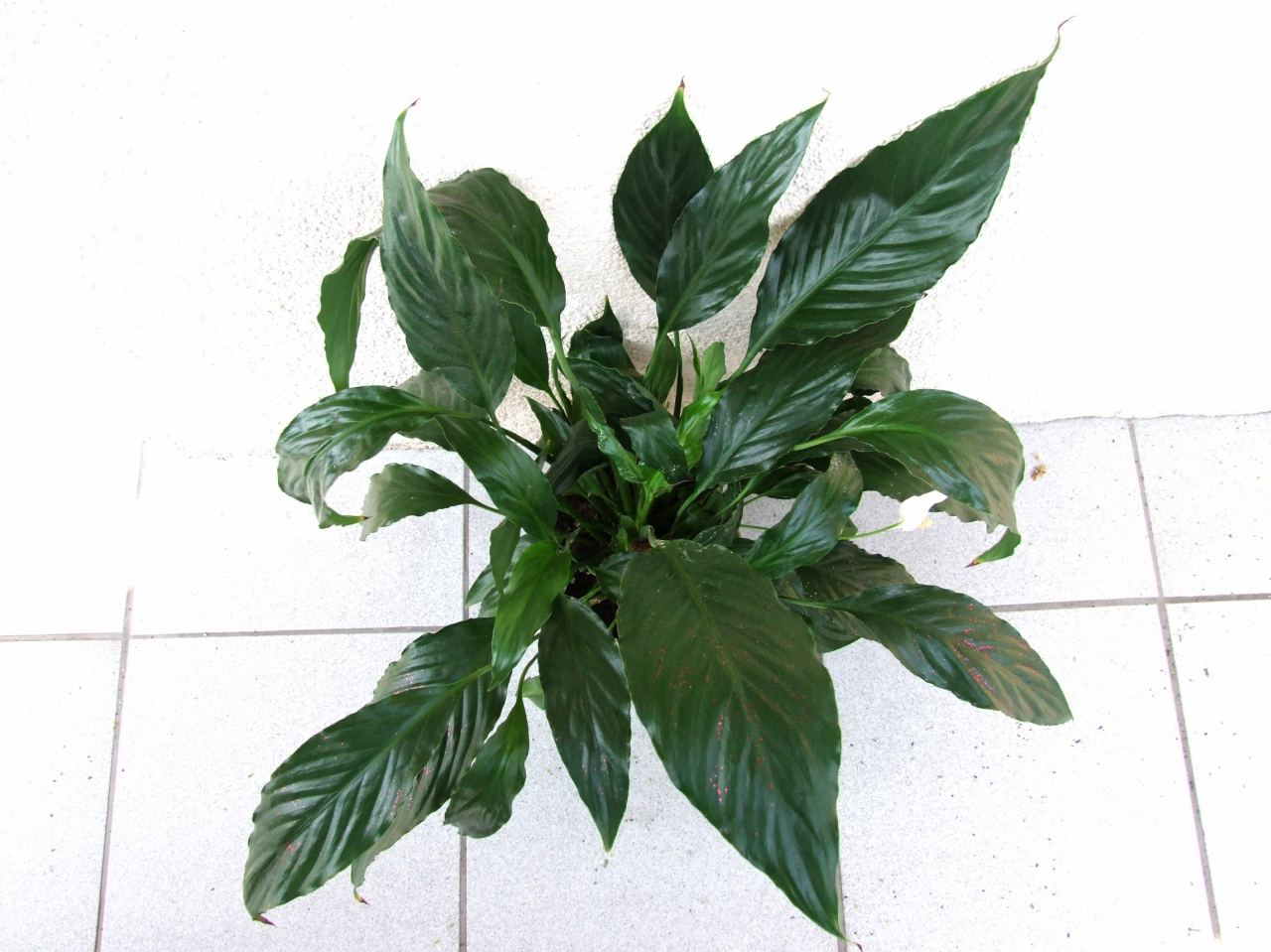
Growth habit. Stemless, clump-forming herbaceous perennial with leaves emerging directly from a short rhizome. Produces multiple fans of foliage as the rhizome spreads laterally; can be divided every few years.
Leaves. Lanceolate (narrowly oval, tapering to a point), 20–40 cm long and 5–12 cm wide, on long slender petioles emerging from the base. Dark glossy green above, paler beneath, with a prominent midrib and regularly spaced lateral veins. Leaves point slightly upward when hydrated and collapse dramatically when soil water is depleted.
Flowers. A typical aroid inflorescence: a pure white, oval spathe (often described as hood- or sail-shaped) 8–15 cm long, wrapped partly around a creamy white to pale green spadix 4–8 cm long studded with tiny true flowers. Spathes open white, fade through pale green, and eventually brown — deadhead at the base of the stalk when they dull. Most healthy plants flower at least twice a year in bright rooms.
- No above-ground stem — all leaves emerge directly from the soil.
- Pure white single spathe (not a cluster of petals) around a creamy spadix.
- Leaves collapse within hours of soil drying out — a near-unmistakable thirst signal.
- Leaf surface is distinctly glossy, not matte, and noticeably darker than most aroids.

Commonly confused with
Flamingo flower
Also an aroid with a spathe-and-spadix inflorescence, but the spathe is typically shiny red, pink, or orange — never pure white in species form. Leaves are more heart-shaped than lanceolate.
Chinese evergreen
Similar clumping aroid form, but leaves show silvery-grey or pink patterning along the midrib; inflorescences are smaller, greener, and much less ornamental.
Dumb cane
Upright thick green stem with mottled leaves — peace lily has no visible above-ground stem and solid green foliage (except variegated cultivars).
Care
Light
Medium to bright indirect light.
Peace lily is one of the few flowering houseplants that tolerates genuinely low light — it stays alive in a dim hallway — but it only flowers reliably with bright indirect light. Place 1–3 m from an east, north, or diffused south-facing window. Direct sun scorches and bleaches the leaves within days; very low light produces healthy foliage but no spathes.
Seasonal: Nordic winters: move closer to the window or add supplemental light from late October to February to keep leaf production steady.
Water
Water when the top 1–2 cm of soil feels dry — the plant itself will signal thirst.
Peace lily is unusually honest about its water needs. When soil water drops below a threshold, the leaves collapse dramatically — a wilting display that recovers within hours of thorough watering. Using this signal works, but repeated severe wilting damages lower leaves over time. Aim to water a day or two before the droop. Water thoroughly until it runs from drainage, then empty the saucer.
Seasonal: Cut frequency by roughly a third from November to February.
Soil
Rich, well-draining aroid mix.
A mix of ~2 parts peat-free potting soil, 1 part perlite or pumice, and 0.5 part orchid bark works well. Peace lily is less picky about coarseness than Monstera — it tolerates denser mixes — but still resents waterlogged conditions.
Humidity
50 %+ preferred; tolerates 40 %.
Higher humidity reduces brown leaf tips and improves spathe longevity. A bathroom with a frosted window is an ideal location. Grouping plants or running a humidifier is more effective than misting.
Temperature
18–27 °C.
Keep away from cold draughts and radiators. Sustained exposure below 10 °C produces brown patches and can kill the plant.
Fertilizer
Balanced liquid feed every 4–6 weeks in spring and summer, at half strength.
Peace lily is a light feeder. Over-fertilising produces crispy brown leaf tips and suppresses flowering. Apply to already-moist soil.
Seasonal: Skip feeding from late October through February.
Pruning
Deadhead spent spathes and remove yellowed leaves at the base.
Cut flower stalks all the way down to the rhizome with clean scissors — not partway down the stalk. Yellow lower leaves are normal as the plant matures and can be pulled or cut away at soil level.
Repotting
Every 2–3 years, or when the rhizome fills the pot.
Peace lily actually flowers more willingly when slightly pot-bound, so do not rush to pot up. When repotting, divide the rhizome if you want more plants — each division needs at least 3–4 healthy leaves. Spring is the best time.
Division
easy~Immediate — divisions carry existing rootsUnpot a mature plant in spring, gently tease the rhizome apart into sections each carrying 3–4 leaves and plenty of roots, and pot each into its own container. Water in and keep out of direct sun for a fortnight while roots settle. This is the only reliable way to propagate peace lily at home — stem cuttings do not work because there is no stem.
Cultivars
'Mauna Loa'
The most widely grown peace lily — a mid-20th-century hybrid reaching 60–90 cm with consistently large, long-lasting white spathes. Effectively the default 'peace lily' sold at scale.

'Domino'
Leaves carry creamy-white marbled variegation. Needs a little more light than the plain-green form to hold the variegation; slightly slower to flower.
'Sensation'
The giant of the genus: strap-shaped leaves to 60 cm on a plant that can reach 1.5 m tall. Flowers are correspondingly large and few per stalk.
'Picasso'
Sectoral white variegation on otherwise standard green foliage — strikingly irregular, chimeric, and propagates reliably only from marginal divisions.
Common problems
Leaves drooping dramatically
Symptom
Leaves collapse almost flat within hours; plant looks as if it has died.
Cause
The plant is thirsty. Peace lily is unusually dramatic about water stress — a visible, reversible wilt is its thirst signal.
Fix
Water thoroughly until runoff and empty the saucer. The plant typically recovers turgor within 2–4 hours. If leaves do not recover after watering, check for root rot — saturated soil with dead roots cannot deliver water to foliage.
Full guide: Why Is My Plant Drooping? A Quick Diagnostic GuideBrown, crispy leaf tips
Symptom
Leaf tips turn brown and crispy while the rest of the leaf stays green.
Cause
Dry air, fluoride or chlorine in tap water, or over-fertilising. Peace lily is unusually sensitive to water-quality issues.
Fix
Switch to filtered or rainwater (or leave tap water uncovered overnight to let chlorine dissipate). Raise humidity to 50%+. Flush the soil with plain water every 2–3 months to leach accumulated salts.
No flowers
Symptom
Healthy-looking foliage but no spathes for months.
Cause
Insufficient light — peace lily stays alive in dim conditions but needs bright indirect light to flower. Also common in overfed or freshly repotted plants.
Fix
Move to a brighter location (not direct sun). Skip nitrogen-heavy feed; a phosphorus-leaning bloom feed once or twice in spring can help trigger spathe production.
Green, not white, spathes
Symptom
New spathes emerge pale green rather than white and stay that way.
Cause
Usually just ageing — spathes fade from white to green to brown as they mature. If every newly-emerged spathe comes out green, the plant is getting too much light or has been over-fertilised.
Fix
Move out of bright light to a medium-light spot; stop feeding for two months and flush the soil.
- Mealybugs
- Spider mites
- Scale
- Fungus gnats
- Root rot (Pythium, Phytophthora)
- Cylindrocladium leaf spot
Toxicity & safety
Immediate burning of the lips, tongue, and throat if chewed; excessive drooling and hoarseness. Skin contact with sap can cause irritation in sensitive individuals. Severe swelling is rare but possible in children who chew leaves.
Mechanism: Insoluble calcium oxalate raphides
Spathiphyllum — Missouri Botanical Garden Plant FinderOral irritation with intense burning and swelling of the mouth, tongue, and lips; drooling; vomiting; difficulty swallowing. Note: peace lily is often confused with true lilies (Lilium, Hemerocallis), which cause fatal kidney failure in cats — peace lily is NOT in that family and does not cause kidney damage.
Mechanism: Insoluble calcium oxalate raphides
Peace Lily — ASPCA Toxic and Non-Toxic PlantsSame oral-irritation syndrome as cats — pawing at the mouth, drooling, vomiting. Uncomfortable but rarely systemically dangerous.
Mechanism: Insoluble calcium oxalate raphides
Peace Lily — ASPCA Toxic and Non-Toxic PlantsWhy peace lily leaves droop so dramatically
Unlike most aroids, peace lily lacks a thickened rhizome or pseudobulb to buffer water loss. Its leaves are held aloft by turgor pressure — the outward push of water against the inside of each cell — alone. When soil moisture drops below roughly 30% of field capacity, turgor collapses and the leaves fall limp within hours. Re-water the plant and turgor returns almost as quickly.
The feature is genuinely useful as a watering cue, but there is a cost: each severe wilt damages lower leaves, and repeated cycles produce yellowed and brown-tipped foliage at the base. Aim to water a day or two ahead of the droop, not at it.
The NASA clean-air study, honestly
NASA's 1989 Wolverton study tested peace lily and eight other species in sealed 0.88 m³ chambers against single volatile organic compounds. Peace lily removed a measurable fraction of formaldehyde, benzene, and trichloroethylene from those chambers over 24 hours — and that is where the widely-repeated 'peace lily cleans the air' claim comes from.
Subsequent work (notably Cummings & Waring, 2020) recalculated the implied removal rates against realistic room sizes and air-exchange rates and concluded that a typical home would need hundreds to thousands of plants per room to rival even a modestly leaky window. Peace lily is a lovely plant; it is not, by itself, an air purifier.
Despite the name, the peace lily is not a lily at all — it belongs to the arum family (Araceae), the same family as Monstera and Anthurium. This distinction is clinically important: true lilies (Lilium, Hemerocallis) cause acute kidney failure in cats, while peace lily causes only oral irritation.
Frequently asked · 5
Why is my peace lily drooping even though I watered it?+
If watering does not revive a drooping peace lily within 4–6 hours, the roots are likely damaged. Unpot the plant and check: healthy roots are firm and white; rotted roots are brown, soft, and smell sour. Trim away rotten material, repot in fresh well-draining mix, and water sparingly until new growth returns.
Is peace lily safe for cats and dogs?+
No — peace lily contains insoluble calcium oxalate crystals and ASPCA lists it as toxic to both cats and dogs. Pets that chew a leaf will experience oral burning, drooling, and sometimes vomiting. Crucially, peace lily is NOT the same family as true lilies (Lilium, Hemerocallis); true lilies cause fatal kidney failure in cats, while peace lily causes only oral irritation.
Why isn't my peace lily flowering?+
The most common cause is insufficient light. Peace lily survives in low light but flowers only with consistent bright indirect light. Move it closer to a bright window (not direct sun), stop any nitrogen-heavy feed, and try a phosphorus-leaning bloom feed once in spring. Healthy well-lit plants typically flower at least twice a year.
Why do my peace lily flowers turn green?+
Spathes naturally fade from white through pale green to brown as they age — this is not a problem. If every newly-opened spathe emerges green rather than white, the plant is getting too much light or has been over-fertilised with nitrogen. Move to a medium-light spot and pause feeding for two months.
How often should I water a peace lily?+
Typically every 5–10 days in summer and every 10–14 days in winter. Check with your finger: water when the top 1–2 cm of soil feels dry. The plant itself will signal thirst by drooping, but waiting for repeated droops damages lower leaves — aim to water a day or two ahead of the wilt.