
Identity & taxonomy
- Scientific name
- Pilea peperomioides Diels
- Family
- Urticaceae
- Genus
- Pilea
- Order
- Rosales
- Wikidata
- Q2001752
- Chinese money planten
- Pancake planten
- UFO planten
- Missionary planten
- Friendship planten
- Elefantörasv
- Elefantøreno
- Elefantøreda
- Pannukakkukasvifi
- Bauchnabelpflanzede
Yunnan Province, southwestern China · Sichuan Province, China (Cang Mountains and eastern Himalaya foothills)
How to identify it
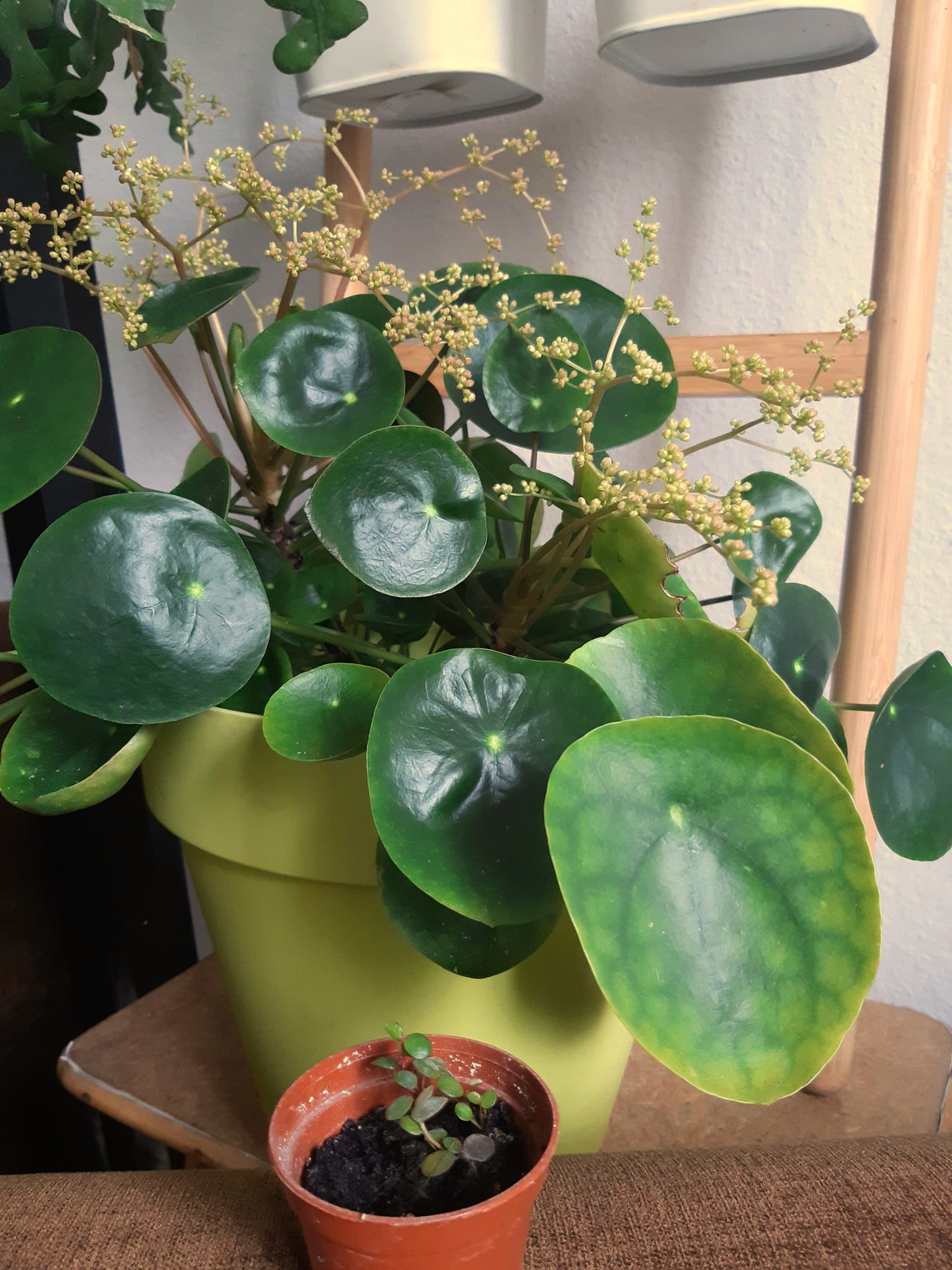
Growth habit. Upright single-stemmed herbaceous perennial. The main stem thickens and lignifies slightly over time; petioles emerge in a loose spiral around it. Mature plants push prolific pups from the underground rhizome — often several per pot — which can be separated to propagate the plant. In low light, the stem leans and bends toward the light source.
Leaves. Round to slightly broader-than-long, 4–10 cm across, with entire (smooth) margins. The petiole attaches to the centre of the underside of the leaf — the peltate arrangement — producing a shield-shaped silhouette unlike almost any other popular houseplant. Leaves are dark glossy green above, slightly paler beneath, semi-succulent, and held on long petioles that angle upward then level out.
Flowers. Small pink-tinged dioecious flowers in loose panicles, each individual flower only 2–3 mm across. The inflorescences emerge from leaf axils on mature plants in spring and summer; they are unobtrusive and often go unnoticed.
- Peltate leaves — the petiole attaches to the centre of the underside, not the edge. No other common houseplant has this arrangement.
- Round, coin-shaped leaves with entire (unlobed, untoothed) margins.
- Upright single stem, not a clumping or vining habit.
- Prolific pups around the base of mature plants.

Commonly confused with
Raindrop peperomia
Often confused because of the round-leaf, upright-stem look, but leaves are teardrop-shaped (pointed at the tip, not round all round) and the petiole attaches at the edge of the leaf, not the centre.
Whorled pennywort
Also has round peltate leaves but is a low-growing bog plant forming mats — not an upright houseplant.
Garden nasturtium
Also peltate, similar-shaped round leaves, but a sprawling annual vine with very different growth habit and bright orange/yellow/red flowers.
Care
Light
Bright indirect light.
Place within 1–2 m of an east, west, or north-bright window. Rotate the pot a quarter turn every week — the main stem leans noticeably toward the light source and, without rotation, the plant develops a permanent lopsided posture. Direct midday sun bleaches and scorches the leaves; deep shade produces spindly growth with widely spaced, pale leaves.
Seasonal: In Nordic latitudes, supplemental grow lights from October to March help maintain an upright, compact habit and keep pup production steady.
Water
When the top 2–3 cm of soil feels dry.
Water thoroughly until it runs from drainage, then empty the saucer. Pilea is moderately drought-tolerant thanks to its slightly succulent leaves but resents waterlogged soil — most Pilea deaths are root rot from soggy conditions. Leaves that curl downward into a dome shape are a sign the soil is too wet; leaves that curl upward into cups suggest underwatering or dry air.
Seasonal: Cut frequency by roughly a third from November to February.
Soil
Well-draining peat-free mix with plenty of perlite.
A mix of ~2 parts peat-free potting soil, 1 part perlite or pumice, and 0.5 part fine orchid bark works well. The key is free drainage — Pilea's rhizome sits just below the soil surface and rots quickly in dense, water-retentive mixes.
Humidity
40–60 %; tolerates average indoor air.
Pilea is more forgiving of dry air than many tropicals. If leaf edges brown uniformly, check water and fertiliser quality before blaming humidity.
Temperature
15–24 °C.
Pilea actually prefers slightly cooler rooms than most tropical houseplants — its native range in Yunnan spans 1,500–3,000 m elevation with cool summers and cold winters. Sustained heat above 27 °C produces pale, floppy foliage.
Fertilizer
Balanced liquid feed monthly in spring and summer, at half strength.
A balanced NPK at half the label rate is ample. Over-fertilising shows up as crispy brown leaf edges and reduced pup production. Apply to already-moist soil.
Seasonal: Skip feeding from late October through February.
Pruning
Remove yellow or damaged leaves; pinch back to encourage bushier growth.
Pilea does not require routine pruning. Cut spent or yellowed leaves off at the petiole base. Pinching out the growing tip forces side-shoots and a bushier habit, though it also slows overall height gain. The cut tip can be rooted in water.
Repotting
Every 1–2 years in spring, or sooner if pups crowd the pot.
Move up by one pot size (2–3 cm wider). Larger jumps hold too much water around the rhizome and invite rot. At repotting, gently separate pups with their roots and pot them individually if you want new plants; otherwise bury them back and they will continue to grow in with the mother.
Separating rooted pups from the rhizome
easy~Immediate — pups carry existing rootsUnpot the mother, identify pups (small plants with their own stem and at least 2 leaves) and trace each back to its attachment on the rhizome. Cut cleanly with a sharp knife, preserving as much root as possible, and pot each pup into a small container of the same mix. This is the classical 'friendship plant' propagation route that rebuilt European cultivation.
Rooting stem-tip cuttings in water
easy~2–4 weeksCut the top 8–10 cm of a leggy stem just below a node, strip the lowest leaf, and place in a jar of room-temperature water. Change the water weekly. Pot up once new roots reach 3–4 cm.
Rooting leaf cuttings
moderate~4–8 weeksSingle-leaf cuttings can produce new plantlets if the petiole is taken with a small slice of parent stem tissue (the 'heel'). Success rate is lower than with pups or stem tips — use only if no pups are available.
Cultivars

'Mojito'
Speckled cream-on-green variegation (a chimeric mutation), reportedly unstable — some leaves revert to solid green and lose the pattern.
'White Splash'
Sectoral white variegation with irregular cream patches. Rare in commerce; propagates from pups that carry the variegated tissue.
'Sugar'
Fine silvery-white speckling across the leaf surface — a subtler look than 'Mojito'. Tissue-cultured forms are more stable than the original chimeric plants.
Common problems
Leaves curling downward into domes
Symptom
Leaves cup outward/downward — the upper surface becomes convex, the edges turn under.
Cause
Almost always overwatering or poor drainage. The rhizome is trying to shed excess water through the leaves.
Fix
Check the soil 3–5 cm down. If wet, let dry fully, reduce watering frequency, and verify drainage is working. If the plant remains affected after a week, unpot and check roots for rot.
Leaves curling upward into cups
Symptom
Leaf edges pull upward, leaves look cup-shaped.
Cause
Usually underwatering, very dry air, or excessive heat — especially near a radiator.
Fix
Water thoroughly until runoff; move away from heat sources; consider a humidifier if indoor air is under 30%. Leaves typically re-flatten within a week.
Leaning stem, lopsided plant
Symptom
Main stem bends distinctly toward the window; leaves face one direction.
Cause
Light is coming from only one side and the plant is tracking it. Pilea is unusually strongly phototropic.
Fix
Rotate the pot a quarter turn every week. For severely bent stems, stake gently and keep rotating. Add supplemental light to even out illumination if rotation alone isn't enough.
Drooping, soft leaves all at once
Symptom
Every leaf simultaneously loses turgor and the whole plant flops.
Cause
Either severely waterlogged roots or a sudden temperature shock (below 10 °C).
Fix
Check soil moisture. If wet, unpot, inspect roots, cut away any brown mushy tissue, and repot in fresh dry mix; water only sparingly until recovery. If cold-shocked, move to a warmer spot and wait — Pilea often recovers fully over 2–3 weeks.
Small flying insects around the pot
Symptom
Tiny black flies hover around the plant and the top of the soil.
Cause
Fungus gnat larvae breeding in wet soil.
Fix
Let the top 3–4 cm of soil dry between waterings; cover the soil with a 1 cm layer of horticultural grit or cinnamon to block egg-laying; use yellow sticky traps for adults. Persistent infestations warrant a Bti (Bacillus thuringiensis israelensis) soil drench.
- Fungus gnats
- Spider mites
- Mealybugs
- Aphids
- Root rot (Pythium, Phytophthora)
- Leaf spot
Toxicity & safety
No known toxic effect on humans.
Pilea peperomioides — Missouri Botanical Garden Plant FinderASPCA lists Pilea peperomioides as non-toxic to cats. No oral irritation, no systemic effects — safe for multi-pet households.
Pilea — ASPCA Toxic and Non-Toxic PlantsASPCA lists Pilea peperomioides as non-toxic to dogs.
Pilea — ASPCA Toxic and Non-Toxic PlantsThe 1946 lineage: from Yunnan to Scandinavia
Pilea peperomioides was first described scientifically in 1912 by the German botanist Friedrich Ludwig Emil Diels from specimens collected in Yunnan, but did not enter European cultivation at that point. A second, small introduction by the Scottish plant hunter George Forrest in the 1910s was cultivated briefly at the Royal Botanic Garden Edinburgh before being lost.
The plant re-entered Europe in 1946 via Norwegian missionary Agnar Espegren, who encountered it in the Cang mountains of Yunnan and brought cuttings back through India and the Soviet Union to Norway. Espegren distributed cuttings among friends; the plant's prolific pups made it easy to share, and over the following decades it spread across Norway, Sweden, and Denmark as a grassroots 'friendship plant' — without ever passing through a commercial nursery.
When Kew Gardens put out a public call for the unidentified species it had been receiving in 2014, the trail led back to Scandinavia. Most of the material that now rebuilds global cultivation — including the cultivars sold in garden centres worldwide — descends, genetically, from the cuttings Espegren carried in 1946.
Why the leaves curl — and what each curl means
Pilea is unusually expressive about its water status through leaf shape, and reading the curls correctly saves most plants that go into decline. Healthy leaves are flat to slightly convex with a mild upward tilt. Leaves that curl downward (edges tucked under, upper surface bulging outward like a shallow dome) signal the root zone is too wet — the plant is attempting to shed water through the leaf surface. Leaves that curl upward (edges raised, forming shallow cups) signal the opposite: underwatering, very dry air, or heat stress.
A third pattern — leaves that droop with their petioles bent downward but the blades still flat — indicates sudden temperature shock or a large watering after a long dry spell. That pattern usually self-corrects within 48 hours.
Pilea peperomioides was effectively unknown to Western horticulture until 2014, when Kew Gardens, struggling to identify specimens being sent in by the public, launched a crowd-sourcing appeal for information. The response came overwhelmingly from Scandinavia — where the plant had been passed quietly from kitchen to kitchen for nearly seventy years as a rootable gift between friends, without ever being formally commercialised.
Frequently asked · 5
Is Pilea peperomioides safe for cats and dogs?+
Yes — ASPCA lists Pilea as non-toxic to both cats and dogs. There is no oral irritation, no systemic toxicity, and no known issues with ingestion. It is one of the safest popular houseplants for pet households.
Why are my Pilea's leaves curling?+
Leaves that curl downward (tucked under, dome-shaped) usually signal overwatering — the soil is too wet and the plant is shedding excess water through the foliage. Leaves that curl upward (cup-shaped, edges raised) usually signal underwatering, very dry air, or heat stress. Check the soil moisture 3 cm down: wet means overwatered, bone-dry means underwatered.
How do I propagate Pilea peperomioides from pups?+
Wait until a pup has 2–3 of its own leaves and at least a small root system. Unpot the mother plant, trace the pup back to its attachment on the rhizome, and slice cleanly through the rhizome with a sharp knife — preserving as much root as you can. Pot the pup into its own small pot of fresh well-draining mix and water lightly. The pup typically establishes within a week.
Why is my Pilea leaning to one side?+
Pilea is unusually strongly phototropic — it tracks the brightest light source. If a pot sits in a fixed position, the stem bends toward the window over weeks. Rotate the pot a quarter turn every week to keep growth vertical. For a stem that is already badly leaning, stake it gently upright and continue rotating; new growth corrects over a few months.
Where does Pilea peperomioides come from?+
Pilea peperomioides is native to the Cang mountains of Yunnan and parts of Sichuan, in southwestern China, at elevations between 1,500 and 3,000 m. It was first described scientifically in 1912, but entered wide European cultivation only in 1946, when Norwegian missionary Agnar Espegren carried cuttings home and distributed them across Scandinavia as a pass-along 'friendship plant'. Most plants in modern Western cultivation trace back to that single introduction.