Why winter leaves burn in spring
A plant leaf is an optimisation problem. In low-light winter conditions, a leaf's priority is to capture every available photon — which means minimising the UV-protective waxes and accessory pigments that partially block the leaf surface. By February, a houseplant that has seen mostly diffuse sky-light for four months has a leaf surface that is 40–60% less UV-tolerant than a leaf grown in summer conditions.
When spring light returns — and it returns quickly: UK daylight roughly doubles in intensity between late February and mid-April — the plant needs a few weeks to rebuild those protective compounds. If direct sun hits the unprotected leaves during the transition, the surface tissue oxidises. The visible damage is bleached or white-to-brown papery patches on the sun-facing leaf surfaces, usually appearing within 24–72 hours of the first sunny spell.
This isn't a watering or heat problem, though plants with inadequate water at the same time get scorched more severely. It is a pure light-physiology issue. See understanding light levels for the background physics.
How spring light actually changes
In the UK (51.5°N) and southern Nordic region (55–60°N), spring light intensifies along three axes simultaneously — which is why the scorch window is so abrupt.
- ·Daily peak intensity doubles: midday lux at a south-facing window goes from roughly 10,000 in January to 25,000+ by early April.
- ·Daylight length doubles: from 8 hours in December to 13+ hours by mid-April — roughly 60% more total photon hours per day.
- ·Sun angle lifts: at noon in January, the sun in London is about 15° above the horizon; by April, ~47°. A plant placed 1 m back from a south window gets hit by direct sunbeams once the angle clears the window frame — a threshold usually crossed in early March.
- ·UV fraction rises: UV-B index over southern Britain goes from near 0 in January to 3–4 in April — real sunburn territory.
Which plants are most at risk
Sensitivity to spring scorch correlates strongly with forest-floor origin. Plants from understory environments evolved under a canopy and never see direct sun — they have the thinnest cuticles and scorch fastest. Plants from drier, sunnier origins (succulents, cacti, Mediterranean species) scorch more slowly but still suffer if the transition is abrupt.
- ·Very high risk: Calatheas, marantas, stromanthes (all prayer plants). Ferns — especially maidenhair and Boston. Anthuriums with dark leaves.
- ·High risk: Fiddle leaf fig, peace lily, philodendron (especially dark-leaved cultivars), young aroids of any species, begonias with dark or velvet leaves.
- ·Moderate risk: Monstera deliciosa (adult leaves tolerate better than juvenile), pothos, rubber plant, rhipsalis, hoya carnosa.
- ·Lower risk but still acclimate: Snake plant, ZZ plant, succulents and cacti (still need 10-day acclimation if they came from a shady winter spot), aloe, jade plant.
- ·Essentially immune: Plants already in south-facing full sun year-round and those currently flowering (which signals active growth and functional UV defences).
What scorch looks like — and what it isn't
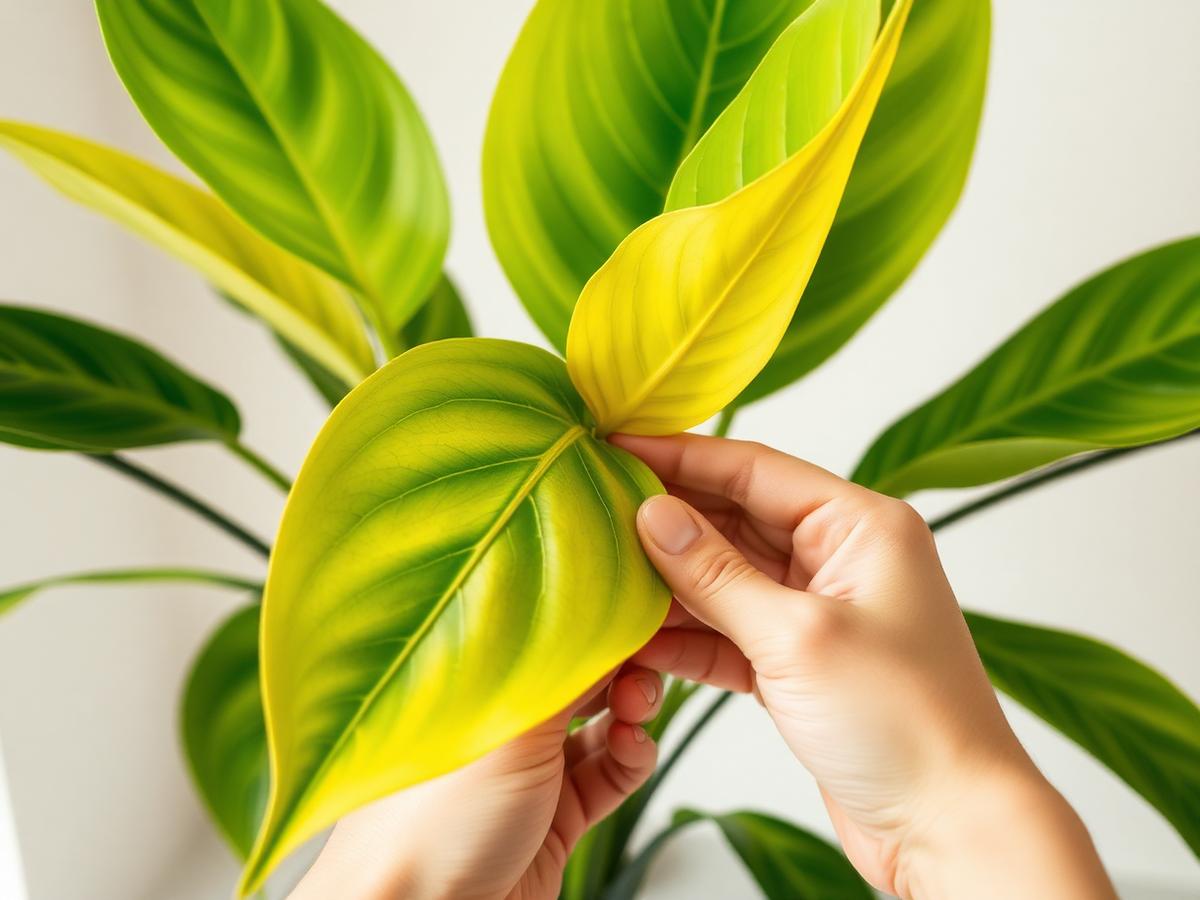
Sun scorch has a very distinctive pattern. It appears only on sun-facing surfaces, usually in the middle or distal portion of the leaf where light strikes most directly. Early damage is a pale or whitish patch, 1–3 cm across, sometimes with a slightly sunken texture. Within days it dries to tan or papery brown. The affected area is always on the upper surface; shaded parts of the same leaf stay green.
Distinguish this from: yellowing lower leaves (overwatering — soft, even colour, not patchy), brown leaf tips (low humidity or mineral buildup — at the margins only), fungal leaf spots (random spots often with yellow haloes, usually on underside too), and frost damage (blackened water-logged patches, not bleached-dry ones). Scorch is dry and sun-facing; almost nothing else matches both criteria.
The 10–14 day acclimation protocol
If your plants spent the winter away from direct sun, and spring is about to (or has just) arrived, work through this protocol before moving them to any brighter spot or letting direct sun hit them for more than a few minutes.
- 1Day 1–3: Move the plant 30 cm closer to the window, but not into direct sun. If it was mid-room, bring it to 1 m from the glass. If it was 1 m away, bring it to 50 cm.
- 2Day 4–6: Continue at the new position. Watch for any pale patches on leaves. If none, proceed. If any, step back 30 cm and add 3 more days at the previous position.
- 3Day 7–9: Allow 30–60 minutes of direct sun per day — typically morning or late afternoon, when UV is weaker. Add a sheer curtain to filter midday sun.
- 4Day 10–12: Extend direct sun to 2–3 hours per day. The leaves should now be developing slightly thicker, more UV-tolerant new tissue.
- 5Day 13–14: The plant is now adapted to the new light level. New leaves grown from this point will be properly adapted; existing leaves are as tolerant as they are going to get.
- 6If scorch appears at any step: Back off immediately. Damaged leaves won't heal, but continued exposure will make it worse. Resume acclimation from the previous safe level.
The pre-emptive move (easier than acclimation)
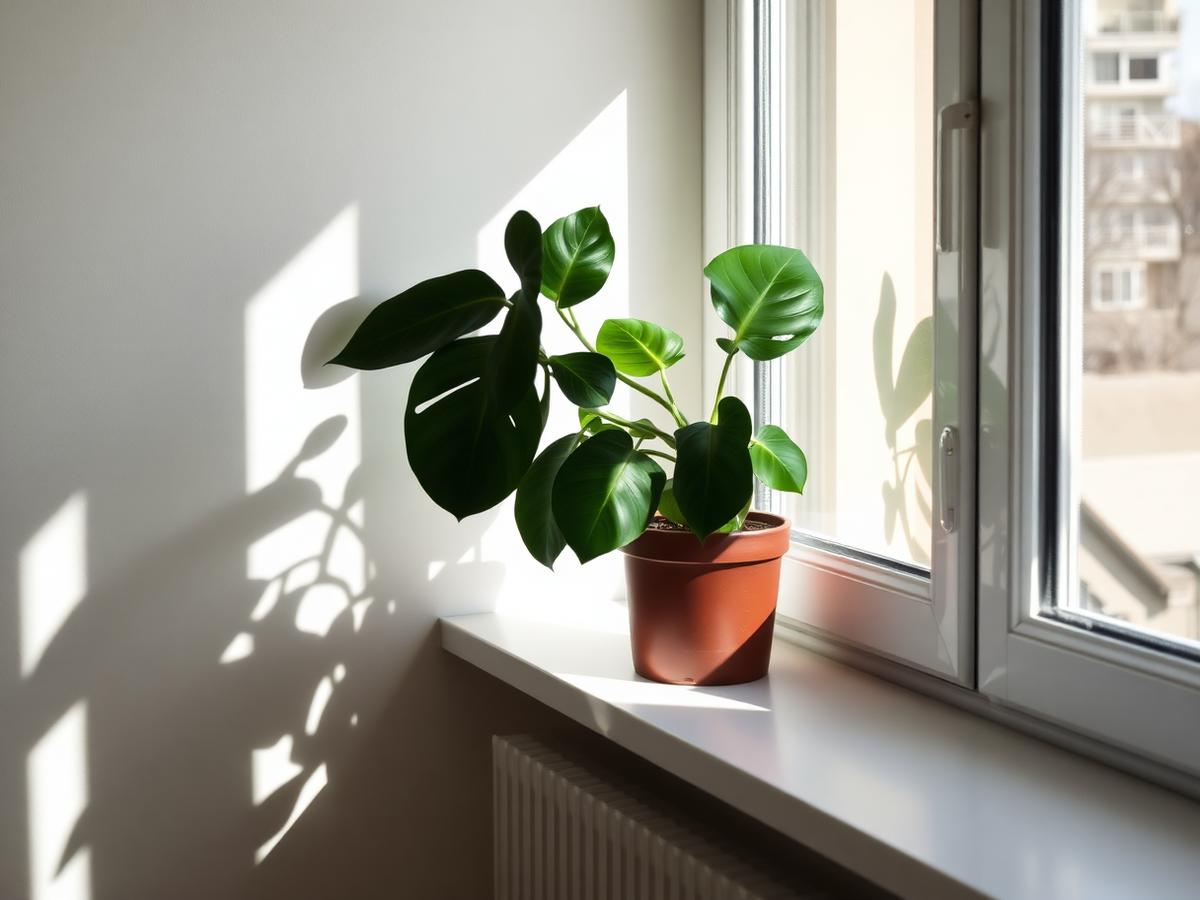
Easier than daily management: in mid-to-late February, before the spring sun arrives, move any scorch-sensitive plants from direct window positions to somewhere 50–100 cm back, or add a sheer curtain between them and the glass. Leave the curtain in place through April. This prevents the problem entirely — the leaves are never exposed to direct sun during the vulnerable transition window.
Once mid-May arrives and new leaves have grown in under the brighter spring regime, you can remove the curtain and move the plant back to its summer position. The newly-grown leaves are adapted to higher light and handle direct sun without scorching. The spring watering reset and light transition usually line up — new growth and water demand both increase at roughly the same point.
If damage is already done
Scorched leaf tissue does not recover. Bleached patches and papery dried patches stay that way forever. The good news is that the rest of the leaf — the undamaged green part — continues to photosynthesise, and most plants can tolerate 20–30% damaged leaf surface without dropping the leaf.
Do not cut off damaged leaves unless they are so badly burned (>50% of surface area) that the plant is likely to drop them anyway. Healthy partial leaves still feed the plant. Instead, focus on preventing further damage: back the plant off from the window, add a filter, and wait for new leaves to come in under the adjusted light. Within 6–10 weeks of active spring growth, most plants will put out enough new, properly-adapted leaves that the damage becomes cosmetically inconsequential.