Why the tips specifically?
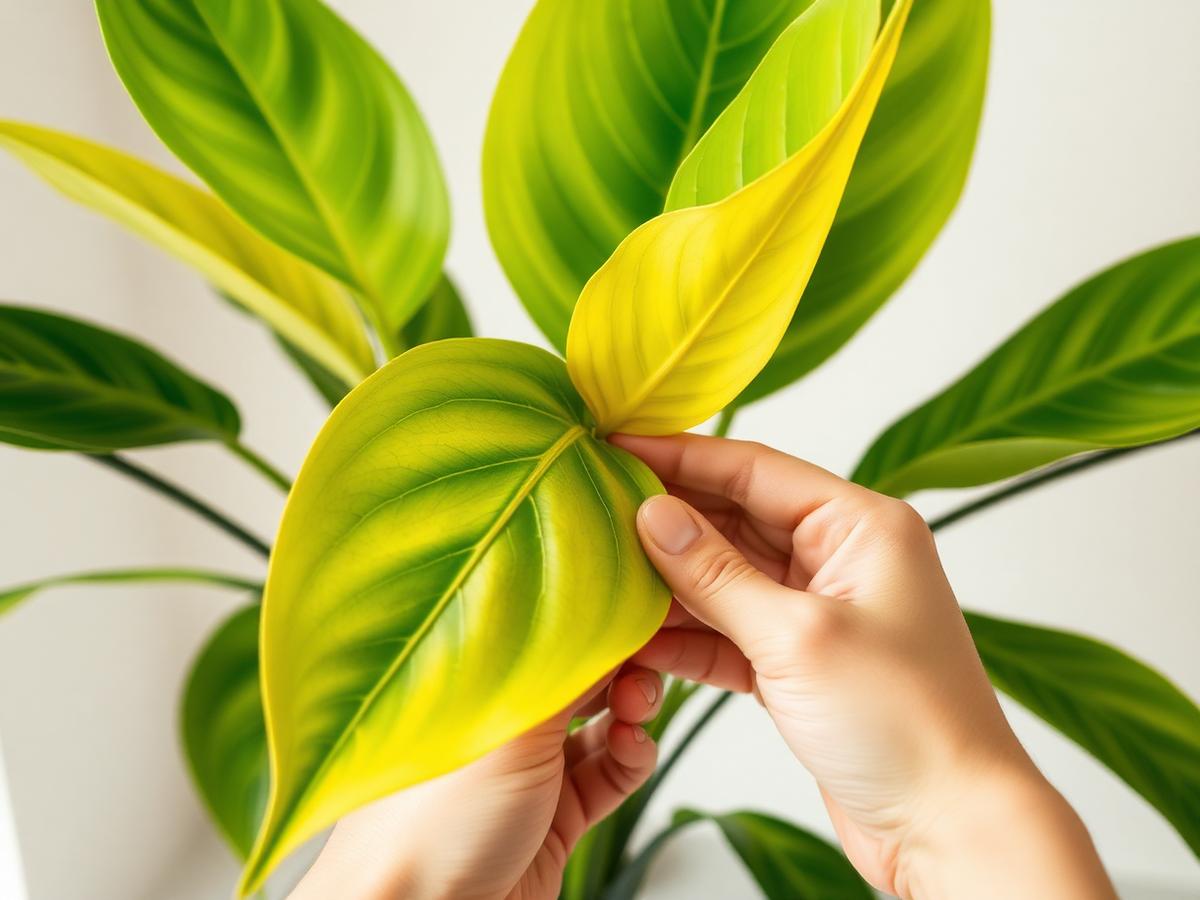
Leaf tips dry out first because they're the furthest point from the root system. Water and dissolved salts reach the tips last, and any shortage — of water, or of unsalted water — concentrates at the tip. That's why tip-browning is the early-warning symptom for a cluster of different stressors: anything that restricts water movement or concentrates salts in the leaf shows up at the tips first.
Once a tip has gone crispy brown, it won't regrow — the tissue is dead. The goal of treatment is to let the next leaves emerge clean. If you fix the cause today, leaves that are half-expanded will still have browning tips when mature; only leaves that emerge after the fix will be fully healthy.
Cause 1 — Low humidity
The most frequent diagnosis, especially in winter. Most tropical foliage plants evolved at 60–80% relative humidity; a heated Nordic apartment in January runs at 25–35%. The water demand from the leaves exceeds what roots can deliver to the distal tips, and they dry and brown.
Tell: the symptom appears or worsens during heating season, affects multiple plants across different waterings, and is worst on sensitive species (calathea, maranta, ferns, anthurium). Room humidity can be measured with a €10 hygrometer — do this before assuming humidity is the cause.
Fix: a cool-mist humidifier near the affected plants (misting the leaves alone has almost no lasting effect — the water evaporates in minutes). Grouping plants together and keeping them away from radiators also helps. For full winter-proofing see winter houseplant care and indoor humidity for houseplants in winter.
Cause 2 — Fluoride or chlorine in tap water
Fluoride is added to tap water in many European and North American cities at 0.7–1.2 mg/L. At those levels it doesn't harm most plants, but a small group of species — dracaena, Chlorophytum (spider plant), Calathea and Maranta family, peace lily — accumulate fluoride in leaf tissue, where it causes exactly the browning-tip pattern people blame on humidity.
Chlorine at typical municipal levels (0.2–0.8 mg/L) is less of an issue because it dissipates if water sits open for 24 hours. Chloramine (used in some utilities — including most of the Thames Valley, see London tap water and houseplants) doesn't dissipate and can irritate roots over time.
Tell: symptom appears only on sensitive species while identical-neighbour plants are unaffected, doesn't correlate with season or humidity, and is worse at the tips of long narrow leaves than in the centre. The fix is water source, not humidity.
- ·Let tap water sit in an open container for 24 hours before watering — removes chlorine.
- ·For fluoride-sensitive species, switch to filtered water (reverse osmosis or carbon-block filter) or collected rainwater.
- ·Boiled water doesn't remove fluoride — boiling concentrates it as water evaporates.
- ·Distilled water works but is flavourless — better paired with occasional fertiliser as distillation removes minerals the plant actually wants.
- ·See tap water for houseplants for the full assessment of what's in tap water and which plants tolerate it.
Cause 3 — Fertiliser salt build-up
Every fertiliser leaves a residue of mineral salts that accumulate in soil over months. Once the soil salt concentration exceeds what roots can osmotically balance, water actually gets pulled out of root tissue rather than in — the same effect as under-watering, visible first at the leaf tips.
Tell: white crust on the soil surface, a crust on the outside of terracotta pots, and browning tips that started gradually after months of regular feeding. Often affects plants that have been in the same soil for more than 18 months.
Fix: leach the pot by running 3× the pot volume of plain water through slowly in the sink — the excess drains out the bottom carrying salts with it. Stop fertilising for 8 weeks. If the crust is heavy, repotting into fresh substrate is the more thorough solution.
Cause 4 — Inconsistent watering
Wild swings between bone-dry and soaking-wet damage the fine feeder roots that deliver water to leaf tips. Each drought cycle kills some roots; each rehydration triggers regrowth but slower than the drying cycle damages them. Over weeks, the plant loses its capacity to push water to the distal edges.
Tell: pot alternates visibly between dry-and-light and soaked-and-heavy, watering is on a calendar ("every Sunday") rather than by soil check, and leaves other than the tips are also sometimes limp.
Fix: adopt the signal-based watering approach — water only when the top 2–3 cm of soil is dry, thoroughly until drainage, then let dry partially before re-watering. Consistency matters more than frequency.
Cause 5 — Cold drafts or hot-air exposure
A plant sitting near a frequently-opened cold door, next to a single-glazed window in winter, or in the direct blast of a radiator or air-con vent will show browning along the leaf edge closest to the source. Distinguishes from humidity (which browns all tips evenly) by the asymmetric pattern.
Fix: move the plant 60 cm or more from the source. Tip damage already present won't heal; new leaves should be normal.
The diagnostic order
Work through causes in the order their symptoms are most distinctive:
- 1Check the plant's position — is it near a draft or radiator? (Cause 5)
- 2Measure room humidity with a hygrometer. Under 40%? (Cause 1)
- 3Is the affected plant on the fluoride-sensitive list (dracaena, spider plant, calathea, maranta)? (Cause 2)
- 4Is there white crust on soil or pot exterior? (Cause 3)
- 5Has watering been inconsistent? (Cause 4)
- 6If multiple apply, treat the most obvious first and observe new growth over 4–6 weeks.