Identity & taxonomy
- Scientific name
- Asplenium nidus L.
- Family
- Aspleniaceae
- Genus
- Asplenium
- Order
- Polypodiales
- Wikidata
- Q156727
- Asplenium ficifolium Goldm.
- Thamnopteris nidus (L.) C.Presl
- Bird's nest fernen
- Nest fernen
- Crow's nest fernen
- Fågelboormbunkesv
- Fuglerede-bregneda
- Fugleredebregneno
- Linnunpesäsaniainenfi
- Nestfarnde
Tropical East Africa · Madagascar · Indomalaya · Tropical Asia (Indonesia, Malaysia, Philippines, Thailand) · Tropical Australia · Polynesia · Hawaii
How to identify it
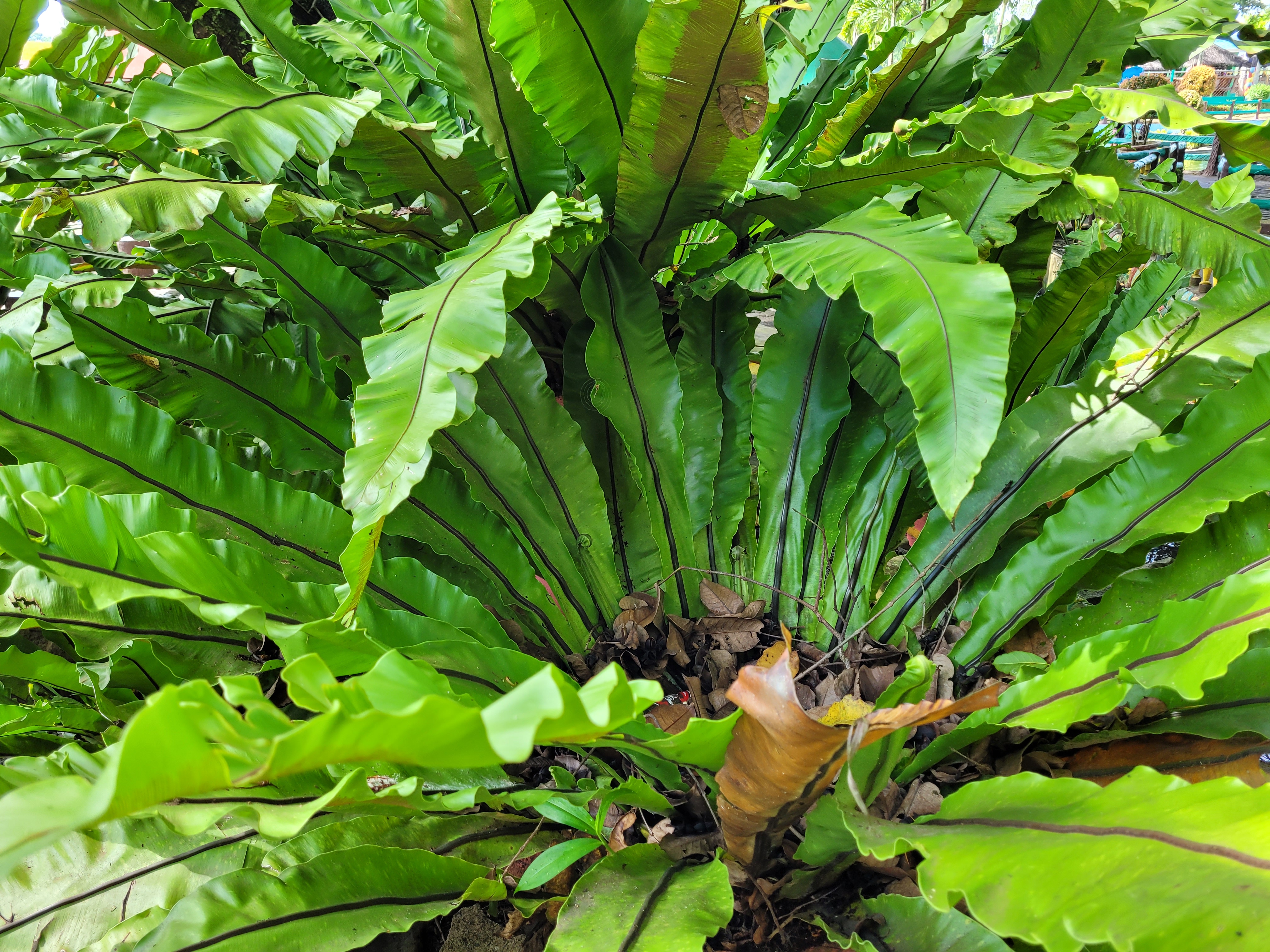
Growth habit. Asplenium nidus produces a single, simple, undivided crown. New fronds unfurl one at a time from a hairy black-brown central nest of scales, emerging tightly coiled before unfolding into broad strap shapes. There are no branching rhizomes, stolons, or offsets — the plant simply gets larger and wider with age. Wild specimens grow as epiphytes anchored to tree branches by a dense mat of wiry black roots, but the species adapts easily to potted soil culture indoors.
Leaves. Simple (undivided), entire-margined fronds 30–120 cm long and 5–20 cm wide, broadly tongue or spoon-shaped. Apple-green to medium-green, glossy, with a prominent dark brown to almost black midrib running the entire length. Margins are smooth in the species; cultivar 'Antiquum' has wavy edges, 'Crissie' has forked tips. Mature fronds develop linear sori (spore-bearing patches) running parallel to the midrib on the underside.
Flowers. None — ferns reproduce by spores, not flowers. Mature plants (>5 years) produce sori on the underside of older fronds.
- Single rosette habit — no offsets, no creeping rhizome.
- Simple undivided spoon-shaped fronds with a prominent dark central midrib.
- Hairy black-brown nest of scales at the centre where new fronds emerge tightly coiled.
- Apple-green colour distinct from the deeper green of most other indoor ferns.
Commonly confused with
Australasian bird's nest fern
Very similar habit but with a more pronounced V-shaped frond cross-section and a more leathery, darker green texture. Often sold interchangeably in Australia.
Toothed bird's nest fern
Frond margins are finely toothed rather than smooth. Native to the Caribbean and tropical Americas. Less common in the European indoor trade.
Hart's tongue fern
Temperate European-Asian relative. Smaller (15–60 cm), with paler more parallel-sided strap fronds. Tolerates frost — usually grown as a garden fern, not indoors.
Care
Light
Medium to low indirect light — no direct sun.
Bird's nest fern grows on shaded tree limbs in tropical-forest understorey. Indoors, place 1–3 m back from a north or east window, or further back from a brighter window. Direct sun bleaches the fronds and crisps the edges within hours. Tolerates lower light better than almost any other common fern, which is why it's a top recommendation for darker bathrooms and inner rooms.
Seasonal: Nordic winters: stays healthy without supplementary lighting; growth pauses but the plant does not decline.
Water
Keep evenly moist — water around the rim, never into the crown.
Water when the top 1–2 cm of soil feels dry, applying water around the edge of the pot or by bottom-watering rather than pouring into the central rosette. Water trapped in the crown for more than a day is the leading cause of crown rot in indoor specimens. Use room-temperature water; cold tap water shocks the roots. Allow the pot to drain fully after each watering.
Seasonal: Winter: reduce frequency by roughly half but never let the soil dry out completely — the species does not tolerate true drought.
Soil
Loose, organic, peat- or coco-based mix with added bark.
A 3:1:1 mix of peat or coir, perlite, and fine orchid bark mimics the loose epiphytic substrate of forest tree branches. Standard indoor potting soil works if amended with 25 % perlite or fine bark for drainage. Avoid heavy garden soil, which compacts and suffocates the surface roots.
Humidity
50–70 % ideal; struggles visibly below 40 %.
Higher humidity produces broader, glossier fronds with smooth edges. Below 40 %, frond edges crisp and brown and the central new growth often emerges deformed. Bathrooms with a window are nearly ideal. A pebble tray, room humidifier, or grouping with other plants raises local humidity reliably; misting the fronds is mostly cosmetic and can encourage fungal spots if water sits in the crown overnight.
Seasonal: Nordic winter heating drops indoor humidity to 20–30 % — a humidifier is the single highest-impact upgrade for this species.
Temperature
18–27 °C; damage below 13 °C.
Tropical species — does not tolerate cold drafts, cold windows, or temperatures below 13 °C. Brief exposure to cold causes blackened patches on fronds within days. Keep clear of unheated entryways and away from glass on cold winter nights.
Fertilizer
Quarter-strength balanced liquid feed monthly in spring and summer.
Asplenium is a light feeder. A balanced liquid fertiliser (e.g. NPK 10-10-10) at quarter the label rate, applied monthly from April through September, is ample. Higher concentrations easily burn frond tips. Skip feeding in winter when growth pauses.
Seasonal: No feeding from October through March.
Pruning
Snip browned outer fronds at the base; never cut into the rosette.
Cut yellowed or browned fronds off flush with the base of the rosette using clean sharp scissors. Never cut into the central crown — the growing point is fragile and any damage permanently disfigures the plant. New fronds always emerge from the centre, so older outer fronds can be removed without affecting future growth.
Repotting
Every 2–3 years in spring; prefers to be slightly pot-bound.
Move up by a single pot size when roots fill the pot or when the rosette overhangs the rim. Bird's nest fern grows roots both into the soil and around the inside of the pot. Take care not to bury the crown — the central nest of black scales must sit at or just above the soil surface. Burying the crown invariably leads to rot.
Spores
difficult~Sporelings emerge in 4–8 weeks; reach saleable size in 1–2 yearsSow ripe spores from sori on the underside of mature fronds onto damp sterilised peat under a transparent cover at 22–25 °C. A two-stage sexual life cycle (gametophyte → sporophyte) means propagation is slow and requires very clean conditions to avoid algal contamination. Most home growers buy young plants instead.
Division
difficult~Not generally possible — single-rosette speciesAsplenium nidus has a single growing point and does not produce offsets, runners, or branching rhizomes. Cutting through the crown to 'divide' the plant kills it. Any specimen at retail was grown from spores or in tissue culture.
Cultivars
'Antiquum'
Compact form with strongly wavy frond margins. The most widely sold ornamental selection — broader and ruffled compared with the species.
'Crissie'
Frond tips fork into 2–4 finger-like lobes ('crested' habit). Slower-growing and slightly more sensitive to direct light than the species.
'Osaka'
Narrower, very wavy strap-like fronds. Holds a tighter rosette than 'Antiquum'.
Common problems
Brown crispy frond edges
Symptom
The outer 1–3 cm of each frond goes brown and papery; the centre stays green.
Cause
Low humidity (most common), tap water with high fluoride/chloride, or salt build-up from over-fertilising.
Fix
Raise humidity to 50–60 % with a humidifier or pebble tray. Switch to filtered, distilled, or rainwater. Flush the soil with plain water once a season to clear salts. Trim browned edges with sharp scissors following the natural curve of the frond — new fronds emerge clean once conditions are corrected.
Full guide: Why Are My Plant's Leaf Tips Turning Brown? Diagnosis GuideBlack, mushy centre
Symptom
The central rosette goes black and soft; new fronds emerge limp or rotten.
Cause
Crown rot from water pooling in the central cup, often combined with cold temperatures.
Fix
Crown rot is usually fatal — once the growing point is lost, the plant cannot recover. Prevent by watering around the rim or by bottom-watering, never by pouring water into the rosette. Move the plant out of cold drafts and keep ambient temperatures above 16 °C in winter.
Full guide: Root Rot in Houseplants: How to Identify, Save, and Prevent ItPale, washed-out fronds
Symptom
Fronds look bleached, pale yellow, or scorched.
Cause
Too much direct sun, or over-fertilising.
Fix
Move the plant 1–2 m further from the window or behind a sheer curtain. Halve the fertiliser rate. Bleached fronds will not recolour but new growth emerges deep apple-green in correct light.
Distorted new fronds
Symptom
New fronds emerge crinkled, stunted, or with a hooked tip.
Cause
Very low humidity during frond development, or scale/mealybug feeding on the developing crown.
Fix
Raise humidity above 50 % during active growth. Inspect the central crown closely with a lens for tiny brown bumps (scale) or white cottony patches (mealybugs); treat with insecticidal soap or 1:1 isopropyl alcohol on a cotton swab, taking care not to wet the crown for more than a few minutes.
- Scale insects
- Mealybugs
- Spider mites (dry air)
- Crown rot (Phytophthora, Pythium)
- Bacterial leaf spot
- Frond-tip browning (low humidity)
Toxicity & safety
No documented toxicity. Young unfurled fronds are eaten cooked as a vegetable in parts of Taiwan and Southeast Asia.
Asplenium nidus — Plants For A FutureListed by ASPCA as non-toxic to cats. Mild GI upset is possible with any plant ingestion but no systemic effects are recorded.
Bird's Nest Fern — ASPCA Toxic and Non-Toxic PlantsListed by ASPCA as non-toxic to dogs. Mild GI upset is possible but no systemic effects are recorded.
Bird's Nest Fern — ASPCA Toxic and Non-Toxic PlantsIn its native range, mature wild Asplenium nidus can hold tens of kilograms of accumulated leaf litter and trapped rainwater in its central rosette — entire micro-ecosystems of frogs, ants, and other invertebrates live exclusively inside these high-canopy 'nests', which are among the largest invertebrate-supporting structures in tropical forests.
Frequently asked · 5
Is bird's nest fern safe for cats and dogs?+
Yes — ASPCA lists Asplenium nidus as non-toxic to cats, dogs, and horses. Pets that nibble the fronds may experience mild GI upset (any non-food plant can cause this) but no systemic toxicity is recorded. It's one of the safest ferns for a pet household and a popular alternative to genuinely toxic options like asparagus fern (Asparagus setaceus).
Why are the edges of my bird's nest fern fronds turning brown?+
Low humidity is the most common cause, especially in Nordic winters when indoor humidity often drops to 20–30 %. Bird's nest fern wants 50–70 % humidity; below 40 %, frond edges crisp and brown within days. Use a humidifier or pebble tray, switch to filtered or rainwater (tap water with fluoride/chloride also browns the edges), and trim crisped tips with sharp scissors following the natural frond curve.
Should I water bird's nest fern into the centre cup?+
No — this is the single most damaging mistake. Water trapped in the central rosette for more than a day routinely causes fatal crown rot indoors. In nature the cup catches and immediately drains rainwater on a warm, well-ventilated tree branch; potting culture provides neither the airflow nor the angle to drain reliably. Water around the rim of the pot, or bottom-water by setting the pot in a saucer of room-temperature water for 15 minutes.
Why are new fronds on my bird's nest fern emerging crinkled?+
Either humidity was too low while the frond was developing inside the central nest, or scale insects / mealybugs are feeding on the developing crown. Inspect the centre with a magnifying lens for tiny brown bumps (scale) or white cotton-like patches (mealybugs) and treat with insecticidal soap. If the centre is clean, raise humidity above 50 % — distortion always reflects conditions during the 4–6 weeks the frond was unfurling, not current conditions.
Can I propagate bird's nest fern by dividing it?+
No. Asplenium nidus has a single growing point and produces no offsets, runners, or branching rhizomes; cutting through the crown kills the plant. The only ways to propagate the species are from spores (slow, finicky home process taking 1–2 years) or by tissue culture (commercial only). All bird's nest ferns at retail were grown from spores or in lab tissue culture.