Identity & taxonomy
- Scientific name
- Nematanthus gregarius D.L.Denham
- Family
- Gesneriaceae
- Genus
- Nematanthus
- Order
- Lamiales
- IUCN status
- Least Concern (LC)
- Wikidata
- Q10646907
- Hypocyrta nummularia (under which name ASPCA still files the entry)
- Hypocyrta radicans
- Nematanthus radicans
- Goldfish planten
- Clog planten
- Candy corn planten
- Gold-fish planten
- Guldfiskblommasv
- Gullfiskplanteno
- Guldfiskplanteda
- Kultakalakukkafi
- Goldfischpflanzede
Brazil — Atlantic coastal rainforest (Mata Atlântica)
How to identify it
Growth habit. Trailing or semi-pendulous epiphytic sub-shrub. Stems are slightly succulent and brittle, branching from the base and arching outward as they lengthen. Best displayed in a hanging basket or on a high shelf where stems can drape. Growth is moderate — adds 15–25 cm of stem length per year in good conditions. Old stems lignify and become brittle; periodic pruning keeps the plant compact and stimulates fresh trailing growth.
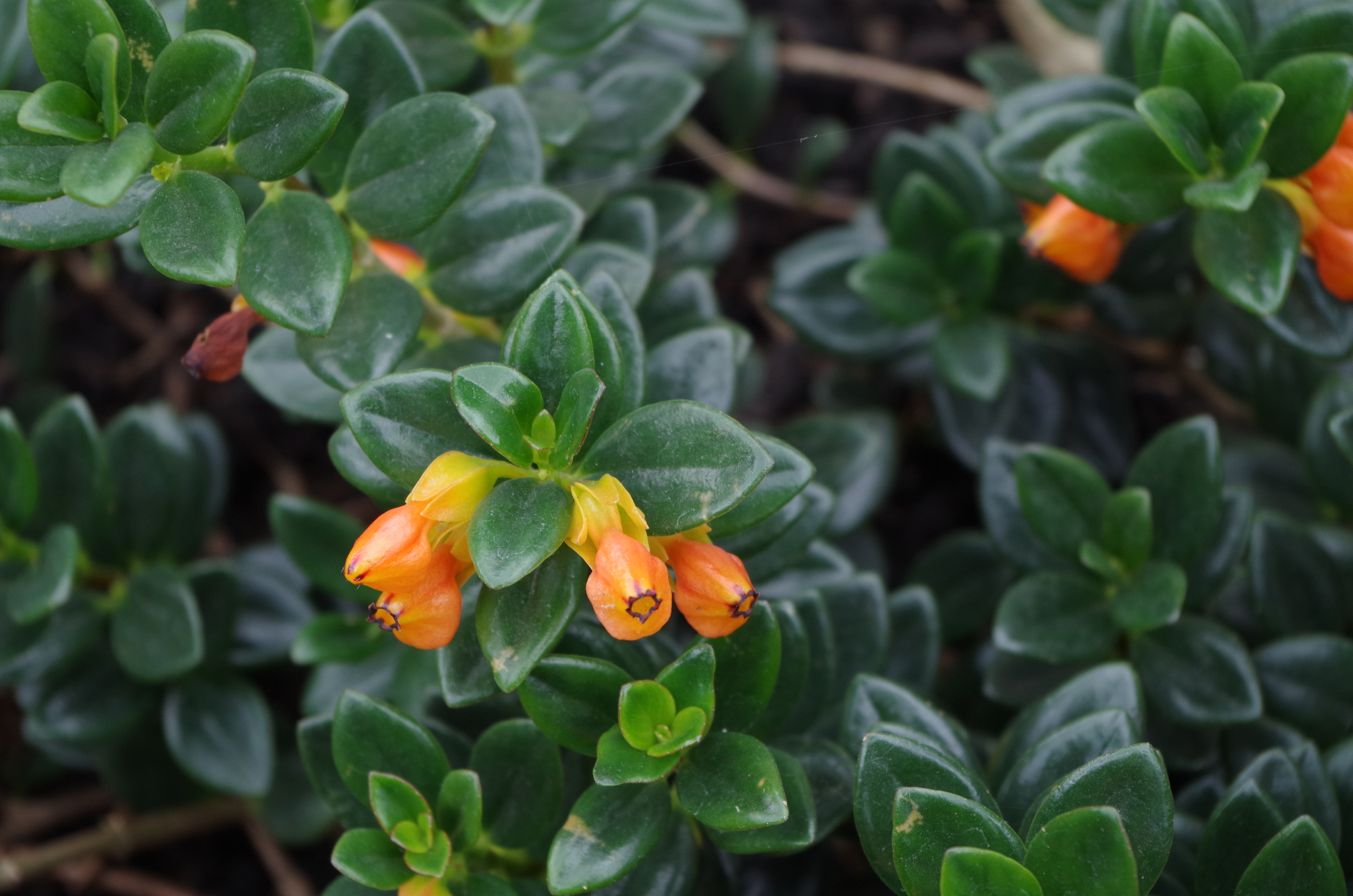
Leaves. Small (2–4 cm) opposite, elliptical leaves with smooth margins, glossy dark green above and slightly paler beneath. The leaves are slightly succulent — thicker than they look — which lets the plant store water for short droughts and is a clue to its epiphytic origin. Some cultivars have yellow-margined or bronzed foliage.
Flowers. Tubular pouched flowers 2–3 cm long, bright orange to red-orange (sometimes yellow), with a constricted throat and a swollen central chamber that gives the flower its 'leaping fish' silhouette. The pouch is formed by fused corolla lobes; nectar collects inside the chamber and is accessible only through the narrow throat. Flowers borne singly along the leaf axils, often heavily on mature plants — a well-grown specimen flowers off-and-on year-round with peaks after the late-winter cool rest.
Fruit. Small round fleshy berries follow successful pollination — uncommon indoors because the plant's natural pollinators (Brazilian hummingbirds) are absent. Hand-pollination by gently squeezing pollen from one flower onto another can produce fruit indoors but is rarely practiced.
- Bright orange-to-red pouched tubular flowers with a swollen central chamber.
- Small (2–4 cm) glossy, slightly succulent dark green leaves in opposite pairs.
- Trailing, pendulous growth habit; brittle slightly succulent stems.
- Flowers borne in leaf axils, often along the entire length of mature stems.
- No leaf joints fused into perfoliate cups (distinguishes from most lipstick plants).

Commonly confused with
Lipstick plant
Same family (Gesneriaceae) and similar trailing habit, but flowers emerge from a dark tubular calyx (the 'lipstick tube') and are straight tubular without the pouched belly. Larger, less glossy leaves. Lipstick plant flowers are typically bright red and emerge in clusters at stem tips; goldfish flowers are orange and borne all along the stems.
Goldfish vine / flying goldfish plant
Often sold under the same 'goldfish' common name. Flowers are similar in colour but typically larger and more flared rather than pouched, and stems trail much longer (1+ m). Same family.
Clog plant
Closely related historical sister genus; many older labels use Hypocyrta names for what is now Nematanthus. Hypocyrta glabra is more upright with smaller pouched flowers; trade plants under either name are essentially interchangeable in care.
Care
Light
Bright indirect light to encourage flowering.
An east window, or a south or west window 1 m back with a sheer curtain. Goldfish plant flowers in response to bright indirect light — in low light it produces lush green growth but no flowers. Direct unfiltered noon sun bleaches the leaves. North-facing windows in Nordic latitudes typically do not produce enough light to flower.
Seasonal: Nordic latitudes above ~55°N: a south or west window through winter is acceptable. A grow light from October to February dramatically improves spring flowering — the plant needs cumulative light energy through winter to set buds.
Water
Keep evenly moist; water when the top 2 cm dries.
Goldfish plant is moderately drought-tolerant thanks to its slightly succulent leaves and stems but flowers best with steady moisture. Water thoroughly until runoff, empty the saucer. Leaves wilt visibly within a day if the soil dries fully — don't let it reach that stage routinely. Use rainwater or filtered water if possible; the species is mildly fluoride-sensitive.
Seasonal: Brief cool-dry winter rest (4–6 weeks at 13–16 °C, watered sparingly) encourages heavier spring flowering. After the rest, return to normal watering as new growth resumes.
Soil
Well-draining peat-free houseplant or African violet mix with extra perlite.
Two parts peat-free houseplant or African violet mix, one part perlite or fine bark. The mix should hold moisture without staying waterlogged. The species is epiphytic in the wild and resents heavy clay-like or moisture-control composts.
Humidity
50 %; tolerates 40 %.
Goldfish plant is more humidity-tolerant than its Atlantic-rainforest origin suggests — it accepts typical home air. Brown crispy leaf tips signal humidity below 35 %. Group with other plants or use a humidifier in dry winter rooms.
Temperature
18–24 °C in growth; 13–16 °C for a 4–6 week winter rest.
A brief cool rest in late winter is the most reliable trigger for heavy flowering. Move to a cool spare room (13–16 °C) for 4–6 weeks in January-February, water sparingly, then return to a warmer bright spot. Avoid sustained cold below 13 °C — cold plus wet soil rots the brittle stems.
Fertilizer
Half-strength African violet or balanced liquid feed every 2 weeks in growth.
An African violet fertiliser at half label rate every 2 weeks during active growth supports flowering well. Stop feeding during the cool winter rest. Resume monthly feeding when growth restarts.
Seasonal: Skip feeding during the late-winter cool rest.
Pruning
Pinch growing tips to keep the plant bushy; prune lightly after each flowering flush.
Pinch the topmost pair of leaves from each stem every 4–6 weeks during active growth to delay legginess. Light pruning after a major flowering flush (cut 5–10 cm off each stem) stimulates a new round of branching and buds. Brittle stems break cleanly under pressure — handle gently when pinching.
Repotting
Every 2 years in spring; the plant flowers best slightly pot-bound.
Move up by one pot size only. Goldfish plant flowers more reliably when slightly pot-bound, so don't oversize. Hanging baskets benefit from refreshing the top 3 cm of soil annually instead of full repotting.
Stem cuttings in water
easy~3–5 weeksCut a 7–10 cm tip below a leaf node. Strip the lowest pair of leaves and stand in a glass of water. Roots emerge from the node within 3–5 weeks; pot up once roots reach 2–3 cm. Several cuttings per pot give a fuller plant faster.
Stem cuttings in soil
easy~4–6 weeksInsert a 7–10 cm cutting into moist propagation mix, optionally dipped in rooting hormone. Cover with a clear plastic bag or propagator dome to maintain humidity for the first 2 weeks. Roots establish within 4–6 weeks.
Leaf cuttings
moderate~8–12 weeksLike other Gesneriaceae (African violets, streptocarpus), goldfish plant can produce plantlets from leaf cuttings. Insert a single leaf with its petiole into damp propagation mix; cover. Slower and less reliable than stem cuttings — use only if no stem material is available.
Common problems
No flowers despite healthy foliage
Symptom
Lush dark green growth but no buds for many months.
Cause
Insufficient light, no winter cool rest, or too much nitrogen fertiliser favouring foliage over flowers.
Fix
Move to a brighter indirect spot. Give the plant a 4–6 week cool dry rest at 13–16 °C in late winter, then return to warmer bright conditions. Switch to an African violet or 'flowering houseplant' fertiliser to lower nitrogen relative to phosphorus and potassium.
Full guide: How to Make a Houseplant Bloom Indoors: The Three Triggers Most Homes Are MissingBrittle stems snap when handled
Symptom
Stems break cleanly off when bent or pinched.
Cause
Normal — goldfish plant has slightly succulent brittle stems by design. Aggravated by very dry conditions which make stems lignify and lose flexibility.
Fix
Handle gently when pinching or pruning. Broken stems root easily as cuttings — never discard, always propagate. Keep humidity above 40 % to delay stem lignification.
Lower stems bare; plant looks scraggly
Symptom
Older parts of stems lose leaves; foliage concentrated at the trailing tips.
Cause
Apical dominance; no pinching; or low light reaching the older basal parts of the plant.
Fix
Pinch every 4–6 weeks during growth. Cut hard back to 10–15 cm in early spring; new growth emerges within 3–4 weeks and the plant rebuilds bushiness.
Buds dropping before opening
Symptom
Flower buds form but yellow and drop without opening.
Cause
Sudden environmental change — relocating the plant, dramatic temperature or humidity shift, or letting the soil dry out fully.
Fix
Stop moving the plant once buds form. Maintain stable temperature and steady soil moisture. Existing dropped buds won't reopen, but the next round usually opens normally.
Stems blackening from the base
Symptom
Lower stems go black and mushy; rapid collapse.
Cause
Stem rot from cold waterlogged soil — most common in winter when watering is not reduced enough.
Fix
Cut healthy tips above the rot and root them as cuttings. Discard the rotted parent. Reduce winter watering and never water during a cool rest unless the soil is bone dry.
- Aphids on flower buds
- Mealybugs in leaf joints
- Spider mites in dry winter air
- Thrips on flowers
- Stem rot in cold waterlogged soil
- Botrytis grey mould on flowers in stagnant air
Toxicity & safety
No reported toxicity. The species has no documented poisoning cases in humans.
Nematanthus gregarius — North Carolina State ExtensionASPCA classifies Nematanthus spp. (and the synonym Hypocyrta nummularia under 'Gold-Fish Plant') as non-toxic to cats. No oral irritation, no systemic toxicity reported. Considered safe for cat households.
Nematanthus spp. — ASPCA Toxic and Non-Toxic PlantsASPCA classifies Nematanthus spp. as non-toxic to dogs. Considered safe for dog households.
Nematanthus spp. — ASPCA Toxic and Non-Toxic PlantsWhy goldfish plant flowers are pouched: the hummingbird-pollination story
The pouched flower shape that makes Nematanthus 'look like a goldfish' to humans is an evolutionary adaptation for hummingbird pollination. Nectar collects inside the swollen chamber, and the constricted throat acts as a filter — only a long thin tongue can reach the nectar reserve. In the species' native Brazilian Atlantic forest, the relevant tongues belong to two small hummingbirds, the festive coquette (Lophornis chalybeus) and the saw-billed hermit (Ramphodon naevius), both of which are documented visitors to Nematanthus flowers in the field.
The orange-to-red coloration and tubular shape are also typical hummingbird-syndrome traits. Hummingbirds see colour with strong sensitivity in the red-orange range and relatively poor blue sensitivity, so red and orange flowers are 'visible' to them in a way that bees, with UV-rich vision, do not register as well. The flower has effectively excluded bees and short-tongued visitors as a way of guaranteeing pollen transfer to other Nematanthus plants — bees that can't reach the nectar don't waste pollen on the wrong species.
Indoors, in the absence of pollinators, the elaborate flower display goes unrewarded — but it doesn't go unnoticed by humans, which is the unintended evolutionary punchline. Goldfish plant has become a globally cultivated houseplant largely because human aesthetics happened to find the same flower shape charming. Hand-pollinating with a small brush between flowers can produce small fleshy berries indoors but is rarely worth the trouble — the species is propagated almost universally from cuttings.
Goldfish plant vs lipstick plant: telling the two trailing Gesneriaceae apart
Goldfish plant (Nematanthus gregarius) and lipstick plant (Aeschynanthus radicans / pulcher) are the two trailing flowering Gesneriaceae most commonly sold as houseplants, and they are confused at the garden centre nearly every week. Both have small glossy dark green leaves, both trail or hang, both flower in red-to-orange shades, and both belong to the same plant family.
The flower shape is the cleanest discriminator. Goldfish plant flowers are pouched — a constricted throat opens into a swollen belly, then closes again at the tip — giving the 'leaping fish' silhouette. Lipstick plant flowers are straight tubular with no swollen middle, and emerge from a contrasting dark calyx (the 'lipstick tube') from which the bright red-orange corolla pushes out 'like a tube of lipstick'. Goldfish flowers are typically borne all along the stems in leaf axils; lipstick flowers cluster at the stem tips.
Foliage is a secondary check. Goldfish plant leaves are smaller (2–4 cm), glossier, and more clearly succulent than the slightly larger, matter-textured leaves of lipstick plant. In Nordic apartment conditions the two are interchangeable in care — both want bright indirect light, steady moisture, and 50 % humidity. We have a separate full care entry for lipstick-plant; cross-reference it if you're choosing between the two for the same hanging hook.
The pouched orange flowers of Nematanthus gregarius are a textbook hummingbird-pollination adaptation. The constricted throat keeps the nectar inaccessible to bees and other short-tongued insects, while the tubular shape and orange-to-red colouration are exactly what hummingbird vision is most sensitive to. In Brazilian Atlantic forest, two endemic hummingbirds — the festive coquette and the saw-billed hermit — are documented visitors. The 'goldfish' silhouette that gives the plant its common name is an entirely human reading of a flower shape that evolved for an entirely different visual system.
Frequently asked · 5
Is goldfish plant safe for cats and dogs?+
Yes. ASPCA classifies Nematanthus spp. as non-toxic to both cats and dogs (the synonym Hypocyrta nummularia under 'Gold-Fish Plant' is also listed non-toxic). It is one of the few brightly flowering houseplants confidently safe for pet households.
Why isn't my goldfish plant flowering?+
Three usual causes. First, light is too low — goldfish plant needs bright indirect light to set buds; move to an east window or 1 m back from a south/west window. Second, no winter cool rest — give it 4–6 weeks at 13–16 °C with sparing watering in late winter, then return to warmer conditions. Third, too much nitrogen fertiliser — switch to an African violet or 'flowering houseplant' formula.
What's the difference between goldfish plant and lipstick plant?+
Flower shape. Goldfish plant flowers are pouched — a swollen belly between a constricted throat and tip — giving the 'leaping fish' silhouette. Lipstick plant flowers are straight tubular and emerge from a contrasting dark calyx like a lipstick from its tube. Goldfish flowers are borne all along the stems; lipstick flowers cluster at stem tips. Both are Gesneriaceae and both are pet-safe trailing houseplants.
Why are my goldfish plant's stems breaking off?+
Normal — the slightly succulent stems are naturally brittle, especially when older. Handle gently when pinching or pruning. Always root broken pieces as cuttings rather than discarding; they take 3–5 weeks in water to produce roots.
How do I propagate goldfish plant?+
Stem cuttings in water are easiest. Cut a 7–10 cm tip below a leaf node, strip the lowest pair of leaves, and stand in a glass of water. Roots emerge within 3–5 weeks; pot up at 2–3 cm root length. Several cuttings per pot make a fuller plant faster than a single cutting.
- Understanding Light Levels for Indoor Plants
- How to Make a Houseplant Bloom Indoors: The Three Triggers Most Homes Are Missing
- Are Houseplants Toxic to Cats and Dogs? A Quick-Scan Safety Guide
- Pet-Safe Houseplants: A Non-Toxic Guide for Cats and Dogs
- How to Propagate Houseplants: The Complete Water vs. Soil Guide