
Identity & taxonomy
- Scientific name
- Oxalis triangularis A.St.-Hil.
- Family
- Oxalidaceae
- Genus
- Oxalis
- Order
- Oxalidales
- IUCN status
- Least Concern (LC)
- Wikidata
- Q935848
- Oxalis regnellii var. triangularis (A.St.-Hil.) Lourteig
- Purple shamrocken
- False shamrocken
- Love planten
- Butterfly planten
- Oxalisen
- Lyckoklöversv
- Lykkekløverno
- Lykkekløverda
- Onnenapilafi
- Glücksklee / Dreieckskleede
Brazil (south) · Argentina (north) · Paraguay · Uruguay
How to identify it
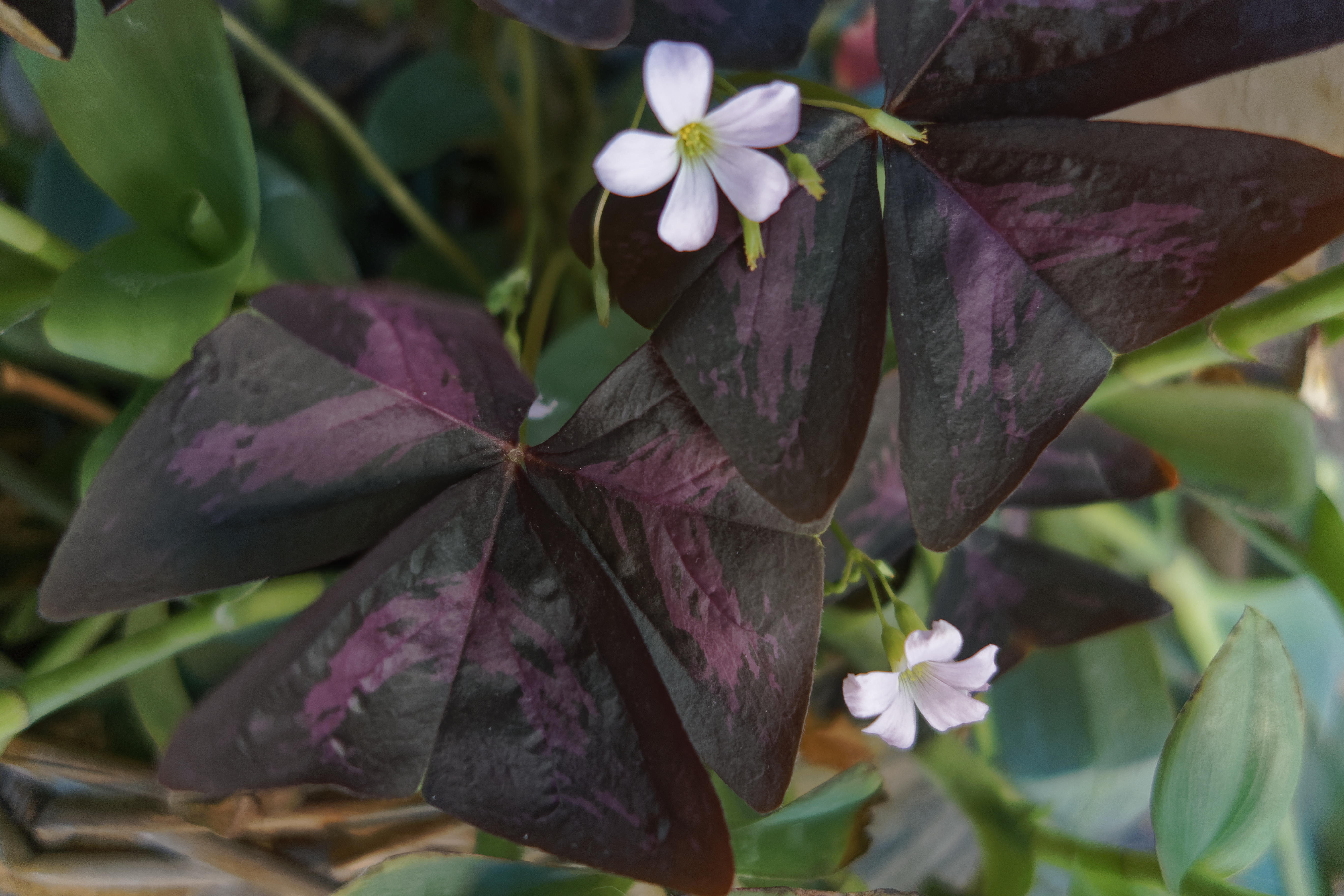
Growth habit. Underground bulb-cluster sends up a dense flush of long-stemmed trifoliate leaves directly from the soil. There is no above-ground stem. Each leaf has three triangular leaflets attached at a central point, like a 3-bladed propeller. Bulbs multiply quickly — a single bulb produces a clump of 6–10 within a year.
Leaves. Trifoliate leaves on slender 10–20 cm petioles. Each of the three leaflets is triangular, 2–4 cm wide, with a slight crease down the middle — the leaflets fold together along this crease at sunset and reopen at dawn (nyctinasty). Leaf colour is the deep saturated purple-burgundy that gives the plant its name; some cultivars edge into nearly black.
Flowers. Pale pink to white five-petalled flowers 1.5–2 cm across, in loose clusters on stems 10–15 cm tall above the leaves. Flowers also fold closed in low light. The species blooms continuously through spring and summer; flowering is heaviest in long days.
- Deep purple-burgundy triangular leaves — diagnostic colour, no other common houseplant has it.
- Three triangular leaflets per leaf, each with a central crease — looks like a small 3-bladed propeller.
- Leaves fold up along the crease at sunset and reopen at dawn — a daily nyctinastic movement.
- Pink five-petalled flowers in loose clusters on slender stems above the foliage.
- Underground bulb cluster — the entire visible plant emerges from soil with no woody stem.
Commonly confused with
Iron cross plant / Lucky shamrock
Four leaflets per leaf, not three; green with a dark cross-shaped marking in the centre. Smaller and harder to grow indoors than O. triangularis.
True clover / shamrock
True clovers have rounder, oval leaflets with smooth edges; the leaves don't fold at night. Real Irish shamrock (Trifolium dubium or T. repens) is rarely sold as a houseplant.
Creeping wood-sorrel
Common garden weed with much smaller green leaves and yellow flowers — frequently mistaken for the houseplant when it self-seeds into pots.
Care
Light
Bright indirect; some direct morning sun deepens the purple.
An east-facing window with morning sun gives the most saturated leaf colour and the most flowers. Bright indirect light through a sheer curtain works in any aspect. Low light produces leggy stems and washed-out leaves that lean toward the window. The plant is photonastic — it physically tracks the sun across the day.
Water
Keep lightly moist while in leaf; allow brief dry-down during dormancy.
Water when the top 1–2 cm of mix feels dry — typically every 5–7 days in active growth. The bulbs rot in soggy mix, so don't water until the soil has begun to dry. Drooping leaves are the plant's wilt signal and recover within hours of watering.
Seasonal: Dormancy (4–6 weeks, usually high summer): if leaves yellow en masse, stop watering, let the bulbs dry, and resume watering in 4–6 weeks. New growth re-emerges from the bulbs.
Soil
Free-draining all-purpose mix.
Standard peat-free potting soil with extra perlite (3:1) is ideal. The bulbs sit close to the surface — plant 2–3 cm deep, no more.
Humidity
Any indoor humidity is fine.
Oxalis tolerates ordinary indoor air at 30–60 % humidity without complaint. No misting or pebble trays needed.
Temperature
13–24 °C ideal; above 27 °C triggers dormancy.
Cool to moderate temperatures suit the plant best — it stays in continuous active growth at 13–24 °C. Above 27 °C the plant interprets the heat as approaching summer drought and starts to die back into dormancy. Cool windowsills above radiators in Nordic apartments are usually fine in winter.
Fertilizer
Half-strength balanced feed every 4 weeks during growth.
Feed at half strength every 4 weeks from spring through autumn while in leaf. Stop entirely during dormancy. Over-fertilising produces lush green growth that fades the purple colour.
Repotting
Every 2 years in early autumn or spring; divide the bulbs.
Lift the bulb cluster, gently separate the bulbs by hand, and replant in fresh mix at the same depth. A pot 12–15 cm wide suits 6–10 bulbs. Each separated bulb makes its own clump within a year — Oxalis multiplies quickly.
Bulb division
easy~Sprouts within 2–4 weeks of replantingThe standard method. Lift the bulb cluster during repotting or after dormancy, gently pull the bulbs apart by hand, and replant at the same depth (2–3 cm) in fresh mix. Each bulb resprouts within 2–4 weeks. A single original bulb can produce 50+ within 2–3 years.
Seed
moderate~Germination in 3–6 weeksPossible but slow and rarely needed. Sow fresh seed onto damp mix in spring, cover lightly, keep at 18–22 °C. Seedlings need 12+ months to reach a flowering size.
Cultivars
subsp. papilionacea (the standard 'purple shamrock')
The deep burgundy-purple leaved form sold worldwide as 'purple shamrock' or 'false shamrock'. Pale pink flowers in clusters above the foliage. By far the most common form.
'Mijke'
Selected dark-leaf cultivar with even deeper purple-black leaves and stronger pink flowering. Slightly more vigorous than the species.
'Charmed Wine'
A Proven Winners trademarked selection — large saturated wine-purple leaves and pink flowers. Marketed as a long-blooming patio plant in milder climates.
Common problems
All leaves yellow at once
Symptom
Healthy plant suddenly has every leaf yellowing simultaneously, often in mid-summer.
Cause
Natural dormancy or heat-induced rest.
Fix
Stop watering, cut yellowed foliage, and store the pot at room temperature with no water for 4–6 weeks. Resume watering and new shoots emerge within 2–4 weeks.
Long, leggy, pale stems
Symptom
New stems emerge thin and stretched, leaves smaller and lighter purple.
Cause
Insufficient light.
Fix
Move to a brighter window — east-facing morning sun is ideal. The purple colour is light-dependent.
Bulb cluster goes mushy
Symptom
Whole plant collapses; bulbs feel soft and smell sour.
Cause
Bulb rot from waterlogged soil — the most common cause of death.
Fix
Lift the bulbs, discard any soft ones, dust the firm survivors with cinnamon, and replant in fresh free-draining mix. Reduce watering frequency.
Leaves don't reopen in the morning
Symptom
Folded leaves at night fail to reopen the next day.
Cause
Dormancy beginning, or severe underwatering.
Fix
Check soil moisture — water if dry. If soil is moist and the leaves still don't open, the plant is entering dormancy; let it rest.
- Spider mites in dry conditions
- Aphids on flower stems
- Fungus gnats in soggy mix
- Bulb rot in waterlogged soil
- Rust (orange leaf spots) in stagnant humid air
- Powdery mildew in still air
Toxicity & safety
Soluble oxalates cause mild GI upset on ingestion in quantity. Sour taste means accidental human ingestion is rare. People with kidney stones or oxalate-sensitive conditions should avoid eating any part.
Mechanism: Soluble oxalates (potassium and sodium oxalate).
Oxalis triangularis — North Carolina State Extension Toxic PlantsDrooling, vomiting, and tremors after ingestion in quantity. Large ingestions can cause kidney damage. Contact a veterinarian if a cat eats more than a leaf or two.
Mechanism: Soluble oxalates.
ASPCA Toxic and Non-Toxic Plants — Shamrock PlantDrooling, vomiting, and tremors after ingestion. Large ingestions (especially of the bulbs) can cause kidney damage. Contact a veterinarian.
Mechanism: Soluble oxalates.
ASPCA Toxic and Non-Toxic Plants — Shamrock PlantWhy your purple shamrock folds up at night — and why that's healthy
First-time owners often panic when they come home in the evening to find their purple shamrock 'collapsed' — leaves folded shut, flowers closed, the whole plant looking smaller than it did at lunch. Almost without exception, this is not a problem. The plant is performing its daily nyctinastic movement: leaves and flowers fold along a central crease at sunset and reopen at dawn.
The folding is driven by changes in turgor pressure in specialised cells (pulvini) at the base of each leaflet. It happens on a circadian rhythm — even in constant light or darkness, the plant continues to fold and unfold for several days before drifting out of sync. There is no horticultural intervention to make. If the plant fails to reopen the next morning, that is the warning sign — usually severe underwatering or the start of dormancy.
The leaf-folding behaviour at sunset is driven by changes in turgor pressure in specialised cells (pulvini) at the base of each leaflet. The folding is reversible and follows the plant's internal circadian clock — Oxalis triangularis kept in constant darkness still folds and unfolds on a roughly 24-hour rhythm for several days, gradually drifting until it can re-sync to a real light cue. It's one of the easiest demonstrations of a plant circadian clock you can run on a windowsill.
Frequently asked · 5
Is purple shamrock toxic to cats and dogs?+
Yes — Oxalis triangularis contains soluble oxalates that are mildly toxic to cats and dogs. Small ingestions cause drooling and vomiting; larger ingestions (especially of the bulbs) can cause kidney damage. Contact a veterinarian if a pet eats more than a leaf or two.
Why does my purple shamrock fold up at night?+
Normal, daily nyctinasty. The leaflets fold along their central crease at sunset and reopen at dawn — a circadian movement driven by the plant's internal clock. It happens every evening regardless of care; the leaves spring open again at sunrise.
Why are all my Oxalis leaves yellow?+
Almost always natural dormancy, not death. Oxalis triangularis goes dormant for 4–6 weeks in summer or after long active growth. Stop watering, cut the yellowed foliage, and let the bulbs rest dry for 4–6 weeks at room temperature. Resume watering and new shoots emerge within 2–4 weeks.
How do I propagate Oxalis triangularis?+
Bulb division is easy and reliable. Lift the bulb cluster during repotting or after dormancy, gently pull the bulbs apart by hand, and replant 2–3 cm deep in fresh mix. Each bulb resprouts within 2–4 weeks. A single bulb multiplies into 50+ within 2–3 years.
Why are the leaves of my shamrock turning green instead of purple?+
Insufficient light. The deep purple anthocyanin pigments are produced in response to bright light. In low light the leaves stay smaller and greener. Move to an east-facing window with some morning sun and the colour will saturate within 2–3 weeks of new growth.