
Identity & taxonomy
- Scientific name
- Aechmea fasciata (Lindl.) Baker
- Family
- Bromeliaceae
- Genus
- Aechmea
- Order
- Poales
- IUCN status
- Least Concern (LC)
- Wikidata
- Q336196
- Billbergia fasciata Lindl.
- Aechmea hystrix E.Morren
- Urn planten
- Silver vase planten
- Silver vase bromeliaden
- Pink-quill planten
- Urnväxtsv
- Urneplanteno
- Urtepalme / urneplanteda
- Maljakaspuolifi
- Lanzenrosettede
Brazil (Atlantic forest, Espírito Santo to Rio de Janeiro)
How to identify it
Growth habit. Stemless rosette of broad strap-shaped leaves arranged in a tight spiral that forms a watertight central cup ('tank') at the base. Naturally epiphytic on tree branches in the wild. After flowering, the parent rosette slowly dies over 1–2 years while 1–4 offsets (pups) develop at the base — the species is monocarpic.
Leaves. Broad strap-shaped leaves 30–60 cm long, 5–8 cm wide, arching outward, grey-green base with pronounced silver-grey transverse bands and small marginal spines. Leaves are leathery and slightly waxy. The silver-grey banding comes from peltate trichomes — the same scales that air plants use to absorb water from the air.
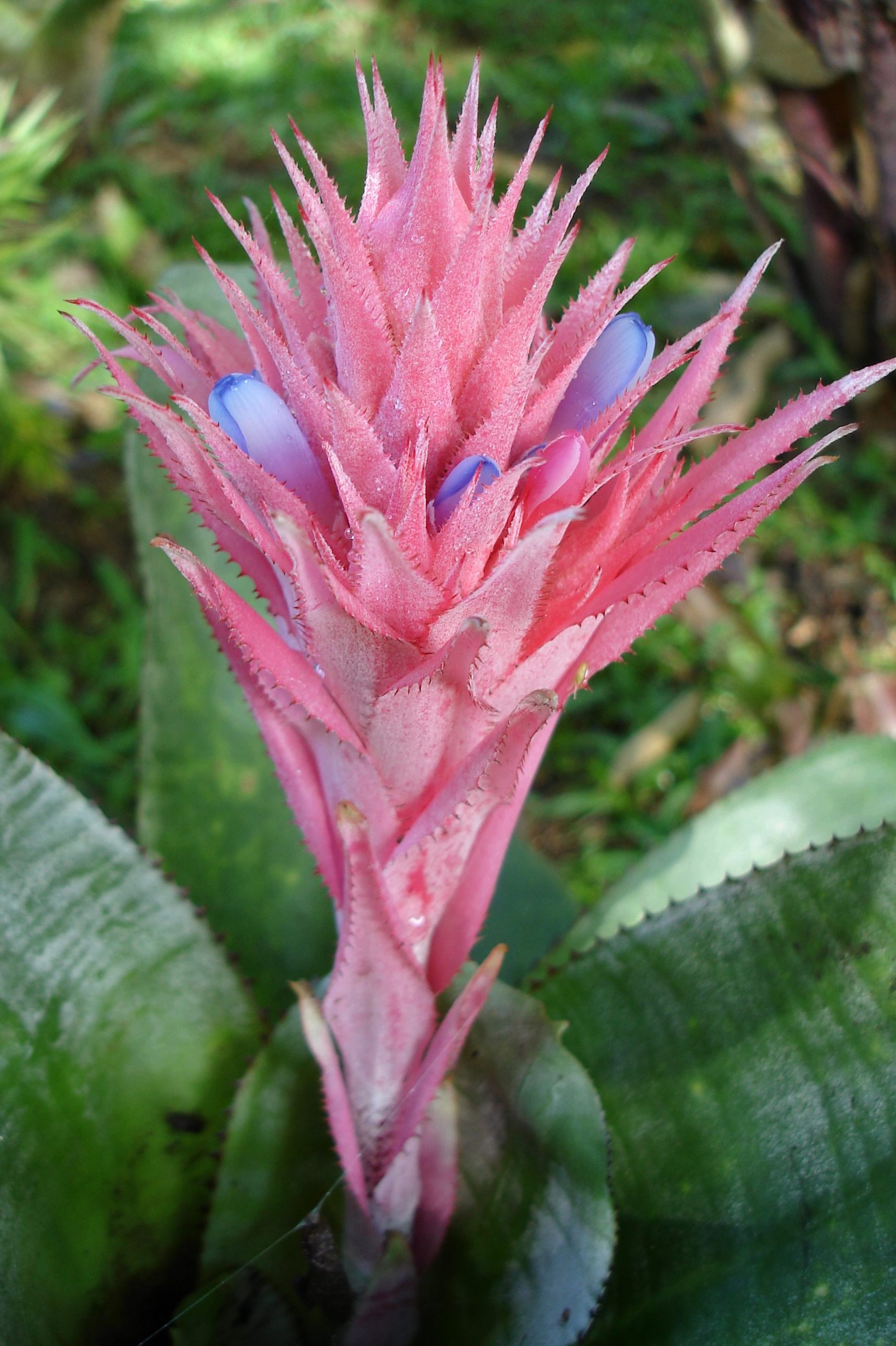
Flowers. A dramatic upright spike emerges from the centre of the rosette, reaching 30–50 cm tall. The spike is densely packed with bright pink, spiny bracts (modified leaves) that persist for 3–6 months. Small purple-blue tubular flowers emerge between the bracts; each flower lasts only 1–2 days but new ones open in succession over weeks. The pink display is the bracts, not the flowers themselves.
- Silver-grey transverse bands on broad strap leaves — diagnostic.
- Watertight central 'tank' cup formed by overlapping leaf bases.
- Bright pink spiny bract spike emerging from the centre at flowering.
- Small marginal spines along leaf edges — sharp enough to scratch when handled carelessly.
- Monocarpic life cycle — parent rosette dies after flowering, replaced by basal pups.
Commonly confused with
Amazonian zebra plant
Chantinii has more dramatic, irregular silver banding on darker leaves and an open, branching inflorescence with red and yellow bracts. Less common in commercial supply than fasciata.
Flaming sword bromeliad
Vriesea has dark-green leaves with horizontal purple bands and produces a flat sword-shaped red-and-yellow flower spike (not a pink urn shape). Different bromeliad genus.
Scarlet star bromeliad
Guzmania has plain green leaves (no silver banding) and a star-shaped red bract cluster at the centre, on a shorter stalk. The most commonly sold supermarket bromeliad worldwide.
Care
Light
Bright indirect; tolerates direct morning sun.
Place near an east, south, or west window with bright filtered light. The species evolved in dappled forest canopy, so direct midday sun through unfiltered glass scorches leaves. A few hours of direct morning sun is fine and intensifies the silver banding. Insufficient light produces dull green leaves with little silver and prevents flowering.
Seasonal: Nordic apartments above ~55°N: a full-spectrum grow light at 30–60 cm distance for 10–12 hours/day from October through March is recommended for flowering specimens. Vegetative growth tolerates standard window light through winter.
Water
Keep the central cup filled with rainwater; soil barely moist.
The unusual rule for tank bromeliads: water primarily INTO the central cup, not the soil. Keep 2–4 cm of clean rainwater (or filtered/distilled, never tap with high mineral content) in the cup at all times. Empty and refresh the cup every 2–3 weeks to prevent stagnation. Water the soil lightly only when the surface dries out — about once every 2–3 weeks. Soggy soil rots the roots; bromeliads in their natural habitat have very small root systems that mainly anchor.
Seasonal: Reduce cup water depth to 1–2 cm in winter and refresh every 3–4 weeks.
Soil
Loose epiphytic mix — orchid bark, perlite, and a small amount of peat-free soil.
A mix of 2 parts orchid bark to 1 part perlite to 1 part peat-free potting soil suits the species' epiphytic origins. Standard potting mix is too dense and waterlogs the small root system. The pot serves more as anchorage than as a nutrient source — bromeliads absorb most nutrients through the cup and trichomes.
Humidity
50–70 % preferred; tolerates 40 %.
Higher humidity supports vigorous growth and flowering. Aechmea tolerates lower humidity better than most bromeliads thanks to its trichomes, but very dry winter heating air below 30 % causes leaf-tip browning. A humidifier in the room helps in heated Nordic apartments.
Temperature
16–28 °C.
Comfortable in normal heated room temperatures. The species comes from Brazilian Atlantic forest at moderate elevations and tolerates a wide range. Brief exposure below 10 °C causes leaf damage; sustained cold below 5 °C kills the plant. Keep away from cold window glass in winter.
Fertilizer
Quarter-strength bromeliad or balanced feed monthly during growth.
Add a quarter-strength balanced or bromeliad-specific liquid fertiliser (urea-free, low salt) to the cup water once a month from April through September. The plant absorbs nutrients directly through the cup and trichomes. Standard urea-based fertilisers can damage trichomes; specialist bromeliad feeds are worth using.
Seasonal: No feeding from October through March.
Repotting
Rarely — only to up-pot pups after flowering.
The parent rosette is monocarpic and dies after flowering, so repotting the parent is wasted effort. Repot only when separating pups — gently lift the entire plant once pups are one-third the parent's size, separate each pup with its own roots, and pot in fresh epiphytic mix.
Pups (offsets)
easy~Immediate; flowering 2–4 years from separationAfter flowering, the parent rosette produces 1–4 pups at its base. When a pup reaches one-third the size of the parent (typically 6–12 months after flowering), gently separate it with a clean knife — keeping any roots attached — and pot in fresh epiphytic mix. Each pup grows to mature flowering size in 2–4 years.
Seed
difficult~8–16 weeks germination; 4–6 years to flowering sizeFresh seed from a fertilised flower spike germinates on damp seed-starting mix in bright indirect light. Slow and used mainly by breeders; home growers always use pups.
Cultivars
'Primera'
Compact selection with stronger silver banding and more reliable flowering — the most common form in commercial supply.
'Morgana'
Variegated cultivar with cream-and-green vertical stripes overlaid on the silver scaling.
'Albo-marginata'
White-edged form with pale margins on each leaf. Striking but slower-growing than the wild type.
Common problems
Brown leaf tips
Symptom
Tips of leaves dry out and turn brown; rest of leaf stays healthy.
Cause
Low humidity, high-mineral tap water, or stagnant cup water unrefreshed for too long.
Fix
Switch to rainwater or filtered water for both cup and soil. Refresh cup water every 2–3 weeks. Raise humidity above 50 %. Trim brown tips diagonally with clean scissors for cosmetic improvement; new growth should be tip-clean.
Full guide: Why Are My Plant's Leaf Tips Turning Brown? Diagnosis GuideParent rosette slowly dying after flowering
Symptom
After the pink bract spike fades, leaves of the parent rosette gradually yellow and die over 6–18 months.
Cause
This is the natural monocarpic life cycle — the parent dies after flowering. Not a problem.
Fix
Continue normal care. Pups will emerge at the base over 6–12 months. When pups are one-third parent size, separate them and discard the spent parent. Each pup grows to flowering size in 2–4 years, and the line continues indefinitely.
Plant refuses to flower despite years of growth
Symptom
Healthy rosette grows steadily for 4+ years but never flowers.
Cause
Insufficient light, immature plant, or no flowering trigger.
Fix
Increase light — bright filtered light or some direct morning sun. Mature plants (3–4 years from a pup) can be triggered with the apple-in-a-bag trick: empty the cup, place the plant in a clear plastic bag with a ripe apple for 7–10 days. Ethylene from the apple triggers flowering; the bract spike emerges 6–14 weeks later.
Stagnant water in cup with mosquito larvae
Symptom
Visible larvae wriggling in the central cup; water smells.
Cause
Cup water unrefreshed for too long.
Fix
Empty cup completely, rinse thoroughly with clean water, and refill with fresh rainwater. Refresh every 1–2 weeks during warm weather. A drop of horticultural soap in the cup deters mosquitoes without harming the plant.
Silver banding fading or disappearing
Symptom
The diagnostic silver-grey transverse bands fade to plain green over months.
Cause
Too much shade — the silver banding intensifies in stronger light. Or trichome damage from high-mineral tap water in the cup.
Fix
Move to a brighter position with bright filtered light or some direct morning sun. Switch to rainwater or filtered water for the cup. New growth should show stronger silver banding within 3–6 months.
- Mealybugs (in leaf axils)
- Scale (rare)
- Mosquitoes breeding in stagnant cup water
- Crown rot from overfilling cup or stagnant water
- Trichome damage from high-mineral tap water
Toxicity & safety
No reported toxicity. Mild skin irritation possible from the marginal leaf spines on contact.
Aechmea fasciata — Missouri Botanical Garden Plant FinderASPCA does not list bromeliads (Bromeliaceae) among toxic plants. Mechanical irritation from the spiny leaf edges possible if chewed.
ASPCA Toxic and Non-Toxic PlantsASPCA does not list bromeliads among toxic plants. Mechanical irritation from spiny leaf edges possible.
ASPCA Toxic and Non-Toxic PlantsHow to actually water a bromeliad — and why the soil isn't the main story
Bromeliads break the standard houseplant watering rules. The plant's central rosette forms a watertight cup ('tank') by overlapping leaf bases, and this cup — not the soil — is the species' primary water and nutrient source. In the Brazilian Atlantic forest where Aechmea fasciata evolved, the plant grows perched on tree branches, its small root system providing only anchorage. Rain falls into the cup and stays there; the plant absorbs water and dissolved nutrients through specialised cells in the leaf bases.
Practical translation indoors: keep 2–4 cm of clean rainwater in the central cup at all times, refreshing every 2–3 weeks to prevent stagnation. Water the soil lightly only when the surface dries out — about once every 2–3 weeks. Treating the bromeliad like a regular houseplant — keeping the soil constantly moist while ignoring the cup — produces root rot and a half-empty cup that signals stress to the plant. Use rainwater or filtered water; standard tap water with high mineral content slowly damages the trichomes that give the leaves their silver banding.
The pink spike, then the death — the bromeliad lifecycle
Aechmea fasciata's most dramatic feature is also its endpoint. The species is monocarpic: each rosette flowers exactly once in its life, then slowly dies over 1–2 years while producing pups (offsets) at its base. The pink-bracted bloom spike that triggers most purchases is the plant's grand finale, not the start of an ornamental career.
First-time owners are often dismayed when, six months after the pink spike fades, the parent rosette begins to yellow and decline. The instinct is to think care has gone wrong and increase watering or move the plant — usually accelerating the decline. The correct response is to leave the parent alone and watch for pups emerging at the base. When pups reach one-third the size of the parent (typically 6–12 months after flowering), separate each pup with a clean knife and pot it in fresh epiphytic mix. Each pup will grow to flowering size in 2–4 years. The parent goes to compost; the line continues. This pattern — flower, die, pup, repeat — is shared by most tank bromeliads (Aechmea, Guzmania, Vriesea, Neoregelia) and is the single most important thing to understand before buying one.
Tank bromeliads like Aechmea fasciata create their own miniature ecosystems in the wild. The watertight central cup collects rainwater, fallen leaves, and dust, decomposing slowly into a nutrient-rich pool that the plant absorbs through specialised cells in the leaf bases. In the Brazilian Atlantic forest, individual Aechmea cups host frog tadpoles, mosquito larvae, predatory damselfly larvae, microscopic protozoa, and unique bacterial communities found nowhere else. A 2010 study identified over 200 species of micro-organisms living exclusively in tank-bromeliad cups in the Atlantic forest — some not yet found anywhere else on Earth.
Frequently asked · 5
How do I water an Aechmea or urn plant bromeliad?+
Water primarily into the central cup, not the soil. Keep 2–4 cm of clean rainwater in the cup at all times, refreshing every 2–3 weeks to prevent stagnation. Water the soil lightly only when the surface dries — about once every 2–3 weeks. Use rainwater or filtered water; tap water minerals slowly damage the silvery trichomes on the leaves. Soggy soil rots the small root system.
Is Aechmea fasciata (urn plant) safe for cats and dogs?+
Yes — ASPCA does not list bromeliads (Bromeliaceae) among toxic plants, and Aechmea fasciata is non-toxic to cats and dogs. The marginal leaf spines can scratch curious pets, but there is no chemical toxicity. A safe choice for pet households.
Why is my urn plant dying after flowering?+
This is the natural monocarpic lifecycle. The parent rosette flowers exactly once and then slowly dies over 1–2 years while producing pups (offsets) at its base. It is not a care failure — it is the species' biology. When pups reach one-third the parent's size, separate them and pot each separately. Each pup will grow to flowering size in 2–4 years and the line continues.
How do I make my bromeliad bloom again?+
The same rosette will not flower again — each rosette is monocarpic. Pups (offsets) at the base of the spent parent will eventually flower, typically 2–4 years after separation. To trigger flowering on a mature pup, empty the central cup and seal the plant in a clear plastic bag with a ripe apple for 7–10 days; ethylene gas from the apple triggers bud formation, with the bract spike emerging 6–14 weeks later.
Why are the silver bands fading on my urn plant leaves?+
Most often insufficient light or trichome damage from tap water. The silver banding intensifies in stronger filtered light (some direct morning sun is ideal). Tap water minerals also slowly damage the trichomes that produce the silver appearance. Move to a brighter spot, switch to rainwater for the central cup, and new growth should show stronger silver banding within 3–6 months.