The short answer
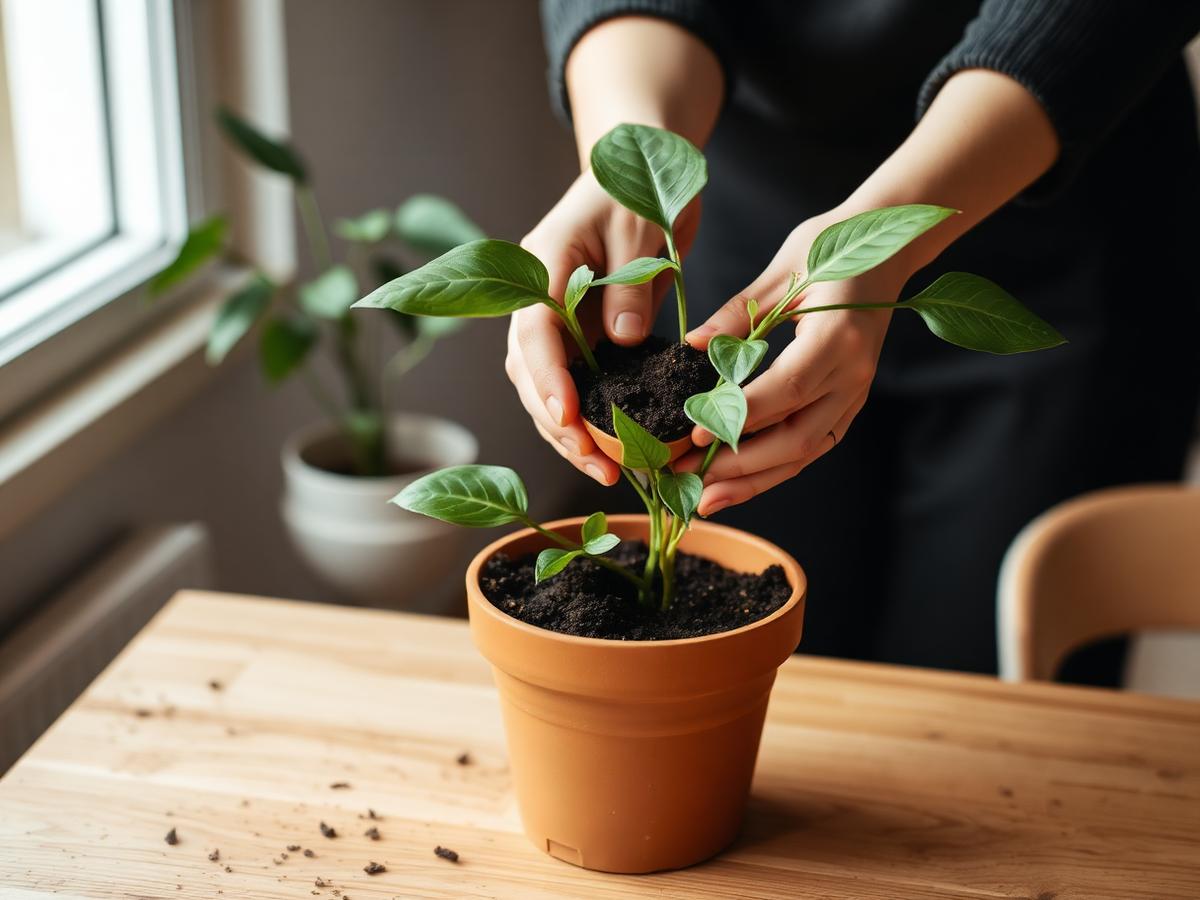
Used coffee grounds should not be sprinkled directly on the soil of a houseplant. They compact into a dense crust that repels water, they stay moist long enough to grow mold, and they release tannins and caffeine that can slow root growth in sensitive species. The nitrogen they contain is real but is not readily available until the grounds have composted for several months.
The advice to use them directly comes from outdoor gardening, where wind, rain, and a huge soil microbiome break down the grounds within weeks. None of those forces are present in a 20 cm pot on a windowsill. In containerised houseplant soil, the grounds behave like a wet cardboard lid.
What coffee grounds actually contain
Used coffee grounds — the wet spent grounds left after brewing — are a 2% nitrogen, 0.3% phosphorus, 0.2% potassium amendment by dry weight. They also contain roughly 0.5% magnesium, trace copper, and measurable caffeine and polyphenols.
Fresh unbrewed grounds are more acidic and far higher in caffeine. Spent grounds, rinsed by hot water, lose most of their acidity and a large fraction of their caffeine in the cup. This is the source of one of the most persistent myths: used grounds are not strongly acidic. Tests by Oregon State University Extension and Sunset Magazine consistently measure used grounds at pH 6.5–6.8 — functionally neutral.
So the promise is real: nitrogen, some micronutrients, and a small amount of organic matter. The problem is not what the grounds contain. It is the physical form they take when you dump them on a pot.
Why fresh grounds on the soil cause problems
Coffee grounds are finely ground — the particle size is in the 200–500 micron range, which is finer than beach sand and about the size of baking flour. When spread on top of potting mix and watered, the grounds form a dense, hydrophobic mat. Water runs off rather than penetrating. The soil below stays dry, while the grounds themselves stay wet.
The wet, nutrient-rich mat is ideal habitat for saprophytic fungi — the harmless white fuzz that appears on pots with poor airflow — and for fungus gnats, which lay eggs in the top 2 cm of damp organic matter. A pot that was gnat-free before the coffee topping gets colonised within a week.
The remaining caffeine and tannins, while low, are allelopathic: they slow the growth of many species, especially succulents and seedlings. Studies at the University of Melbourne found that tomato and cabbage seedlings grew 30–50% less in soil amended with fresh grounds. Mature houseplants are more tolerant, but sensitive species (calathea, maranta, most succulents) show reduced new leaf production for weeks after a heavy application.
The nitrogen lock-up problem
Even setting aside the physical problems, the nitrogen in fresh grounds is not immediately available to plants. Coffee grounds have a carbon-to-nitrogen ratio of around 20:1, which is close to but slightly above the 15:1 threshold where microbes start tying up nitrogen instead of releasing it.
In practice, the first few weeks after a coffee topping, soil microbes digesting the grounds draw free nitrogen out of the soil to process them. The plant temporarily has less nitrogen available, not more. New leaves come in pale and growth slows — the opposite of the intended effect.
This reverses once the grounds have broken down, which in a warm compost takes 2–3 months. At that point the trapped nitrogen is released and becomes plant-available. The solution is obvious: compost the grounds before they go near the plant.
The right way to use coffee grounds, method 1: compost first
The reliable method is to compost the grounds for at least 8 weeks before they touch a houseplant. In a bokashi bin, a worm bin, or a balcony compost, grounds are one of the best green inputs — microbes love them, worms thrive on them, and the finished compost is a rich, dark amendment you can mix into repotting soil at 5–10% by volume.
What to compost them with: paper coffee filters, dry leaves, shredded cardboard, kitchen scraps. The 3:1 brown-to-green ratio that applies to all composting applies here too. Coffee grounds alone will go anaerobic and smell sour within days.
Once composted, grounds are completely safe for every houseplant. The hostile components (caffeine, tannins, allelopathic acids) have broken down, the C:N ratio has dropped below 15:1, and the structure is crumbly rather than compacted.
The right way to use coffee grounds, method 2: brewed coffee water
A low-risk alternative skips the grounds entirely and uses cooled brewed coffee as an occasional dilute feed. Mix 1 part cold black coffee (no milk, no sugar) with 4 parts water. Use this to water a well-fertilised, mature foliage plant once a month at most. It supplies a small amount of nitrogen and micronutrients through solution, without any of the structural or mold problems of the grounds themselves.
Do not use this on succulents, cacti, orchids, or sensitive calatheas. They are intolerant of the trace caffeine and the pH shift, and they do not need the extra nitrogen. Do not use it on seedlings or cuttings in water propagation — caffeine slows root initiation.
The foliage plants that tolerate occasional coffee water well: pothos, philodendron, peace lily (in moderation), spider plant, monstera in large pots. Even for these, it is a once-a-month treatment at the strongest, not a weekly routine.
Which plants should never get coffee, in any form
Some houseplants react badly to coffee even in well-diluted or composted form. Succulents and cacti want low nitrogen and well-draining mineral soil — coffee pushes both the wrong direction. Orchids are watered with fertilisers formulated for their epiphytic biology; coffee is the wrong nutrient profile. Most culinary herbs (basil, rosemary, thyme, oregano) want lean Mediterranean conditions and flower or die back under the nitrogen push.
- ·Succulents (echeveria, haworthia, jade, sedum): no coffee in any form.
- ·Cacti: no coffee.
- ·Orchids: no coffee.
- ·Culinary herbs: no coffee.
- ·Seedlings and cuttings: no coffee — caffeine slows root development.
- ·Sensitive calatheas, marantas, stromanthes: no coffee.
- ·Carnivorous plants (Venus flytrap, sundew, pitcher plant): no coffee.
The myth of acid-loving plants and coffee
The idea that coffee grounds acidify soil comes from a confusion between fresh and used grounds. Fresh unbrewed grounds are mildly acidic (pH 4.8–5.1). Used grounds — what everyone actually has — are close to neutral. Decades of soil testing, including a landmark extension publication from Oregon State, show that applying used grounds does not meaningfully shift pot soil pH in either direction.
This means the standing advice to feed coffee to "acid-loving plants" like azaleas, blueberries, or ferns is based on a chemistry error. If your fern is struggling and the tap water is hard, the problem is the calcium and magnesium in the water, not a lack of acid. A handful of coffee grounds is not going to fix it — filtered or rainwater will.
What a proper fertilising routine looks like instead
If the temptation to put coffee on a plant comes from the desire to feed it something, a proper liquid fertiliser does the job dramatically better. A balanced 10-10-10 or 20-20-20 liquid, diluted to a quarter-strength and applied every 2–4 weeks during active growth, delivers more usable nitrogen than any coffee routine — cleanly, predictably, and without the mold or compaction problems.
For the full protocol, including which plants want which ratios and the winter dormancy schedule, see the fertilising frequency guide. Most houseplants are badly undernourished, not overfed, and a proper feed is usually the single intervention that produces the biggest visible change.
What to do with used grounds if you have them
The best use for spent grounds in a flat without a compost system: collect them in a container with a loose lid, dry them on a baking sheet once a week, and take them to a municipal food-waste collection. Most Nordic cities accept coffee grounds in brown-bag curbside composting.
If you have an outdoor garden or balcony beds, used grounds genuinely are a useful outdoor soil amendment — spread thinly (no more than 1 cm) over beds and raked in, they break down in place. The same handful that would smother a houseplant pot is unnoticeable across a square metre of outdoor soil with rain, wind, worms, and a full soil microbiome. But that is an outdoor technique. Inside, the right answer is still "compost first, or skip".