Five signs your plant needs a new pot
These are the reliable signals — not a calendar reminder, not the plant looking "too big for its pot" cosmetically. If two or three of these are happening together, repot in the next spring.
- 1Roots growing out of the drainage hole at the bottom.
- 2Roots visible circling the bottom or sides when you slide the plant out.
- 3Soil dries out within 1–2 days of thorough watering.
- 4Water runs straight through the pot without absorbing into the soil.
- 5Growth has slowed or stopped despite good light, water, and fertilizer.
- 6The plant tips over because it's top-heavy for the pot.
- 7The pot is visibly bulging or cracking from rhizome pressure (common in snake plants).
- 8Salt or mineral crust on the soil surface despite flushing — old soil is exhausted.
When NOT to repot
Repotting is stressful for a plant — roots are disturbed, fine feeder roots break, and the plant has to reestablish in new soil. A healthy plant tolerates this easily; a stressed one may not. There are several situations where repotting causes more harm than good.
- ·The plant was bought in the last 2–4 weeks. Let it acclimate to your home's light, humidity, and temperature first.
- ·The plant is actively flowering. Most plants drop blooms when disturbed at the roots.
- ·The plant is recovering from pest treatment, leaf damage, or a recent move.
- ·It is the depths of winter (December–January in temperate climates) and the plant is dormant.
- ·Symptoms suggest a watering or light problem, not a root one — repotting won't fix those.
- ·The plant prefers being root-bound (peace lily, spider plant, snake plant, ZZ, hoya, bird of paradise) and isn't actually struggling.
The best time of year to repot
Spring is ideal. The plant is entering active growth, daylight is increasing, and roots regenerate quickly in the warmth. Late February through May covers the window for most houseplants in the Northern hemisphere; the equivalent is August through November in the Southern hemisphere. Repotting in this window means new growth resumes within 2–4 weeks.
Summer is the second-best window — still active growth, just faster water demand to manage. Autumn repotting works for fast growers but recovery slows. Winter repotting should be reserved for emergencies — severely root-bound plants that can't wait, or plants showing signs of root rot where the existing soil has to come off now.
Choosing the right pot
Three things matter: size, drainage, and material. Get any of them wrong and the new pot sets the plant back rather than helping.
- ·Size: Only 2–3 cm wider in diameter than the current pot. Going larger floods the rootless soil with moisture the plant can't use, and the wet pockets rot what roots are there.
- ·Drainage: Non-negotiable. The pot must have a hole at the bottom. Decorative pots without holes are fine as outer covers, but the actual growing pot needs drainage.
- ·Material — terracotta: Porous, wicks moisture, dries fast. Best for plants prone to root rot (succulents, snake plants, cacti, fiddle leaf figs).
- ·Material — plastic: Lightweight, retains moisture, easy to slide plants out for inspection. Best for moisture-loving tropicals.
- ·Material — glazed ceramic: Heavy, retains moisture, looks polished. Treat watering frequency the same as plastic.
- ·Shape: Wide shallow pots dry faster than tall narrow pots. Match to the plant's root structure (most aroids prefer slightly deeper).
Choosing the right soil mix
Generic "houseplant soil" works for many plants but fails for the ones with specific needs. The four common categories cover almost all houseplants — match the plant to the mix.
- ·Standard houseplant mix (peat or coco coir + perlite): Pothos, philodendron, spider plant, dracaena, peace lily, ferns.
- ·Aroid mix (chunky — coco coir + perlite + orchid bark + charcoal): Monstera, anthurium, alocasia, philodendron rare cultivars, syngonium.
- ·Cactus / succulent mix (sand + perlite + minimal organic matter): Snake plant, ZZ plant, succulents, cacti, jade.
- ·Orchid mix (mostly fir bark, minimal soil): Phalaenopsis and most epiphytic orchids.
- ·Avoid: "Garden soil", topsoil from outside, mixes with added wetting agents or moisture-retaining gels (these stay wet too long for indoor pots).
Step-by-step: how to repot
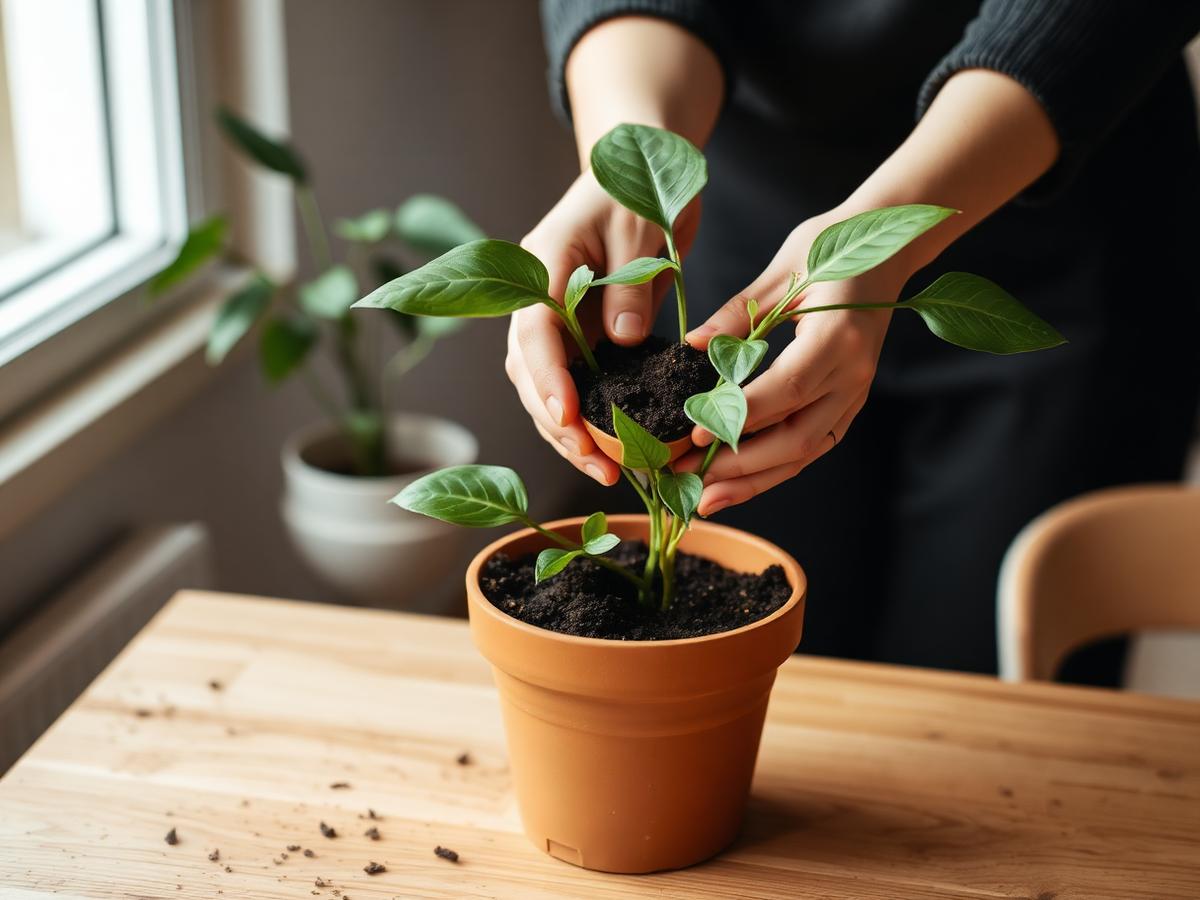
The basic process takes 15–30 minutes per plant. Lay everything out before you start — fresh mix, the new pot, scissors, a tray to catch loose soil, and somewhere to put the dirty old pot.
- 1Water the plant 1–2 days before repotting. The damp root ball releases more cleanly from the pot, and pre-hydrated roots tolerate disturbance better.
- 2Pick a pot 2–3 cm wider than the current one with a drainage hole — never larger.
- 3Add a 2–3 cm layer of fresh mix to the bottom of the new pot.
- 4Gently squeeze the old pot or tip it sideways and slide the plant out. For stuck plants, run a knife around the rim or break a plastic pot rather than pulling the stem.
- 5Tease apart the root ball gently with your fingers. Loosen circling roots; trim any black, mushy, or dead roots with clean scissors. Healthy roots are pale and firm.
- 6Place the plant in the new pot so the top of the root ball sits 1–2 cm below the rim. This leaves room for water to pool and soak in without overflowing.
- 7Fill around the roots with fresh mix, pressing lightly to remove air pockets but not compacting. Tap the pot on the table to settle the mix evenly.
- 8Water thoroughly until water drains from the bottom. Top up any soil that settles low.
- 9Empty the saucer after 10 minutes. Place the plant somewhere bright but out of direct sun for the first week to reduce stress.
Root pruning: keeping a plant the same size
Some houseplants (mature monsteras, fiddle leaf figs, large peace lilies) eventually reach the size you want them to stay at — but they still need fresh soil periodically. Root pruning lets you refresh the mix without upsizing the pot.
Slide the plant out, use clean scissors to trim the outer 2–3 cm of root ball all the way around, and remove any obviously dead or circling roots. Refresh the soil around the trimmed root ball, return to the same pot, and water thoroughly. The plant responds within weeks with vigorous new root growth into the fresh mix. This is also the best moment to take any cuttings for propagation.
Post-repot care: the recovery window
The first 2–4 weeks after repotting are when most repotting damage shows up. Plants that look fine on day one can yellow, drop leaves, or wilt as their disturbed root system catches up.
- ·Bright but indirect light for the first week. Direct sun adds heat stress on top of root stress.
- ·Water only when the soil is dry to the finger test. Fresh mix retains more moisture than old root-bound soil — overwatering after repotting is the most common post-repot killer.
- ·No fertilizer for at least 4 weeks. Fresh mix already contains some nutrients; new feeder roots are easily burned.
- ·Expect some leaf drop or droop. A plant losing 1–2 leaves is normal; losing many means too-large a pot, too-dense soil, or watering errors.
- ·Don't repot again. Resist the urge to "check" the roots within the recovery window — repeated disturbance compounds the stress.
Common mistakes and how to avoid them
Most repotting failures fall into a small set of repeating errors. Knowing them in advance prevents most damage.
- ·Oversizing the pot. The single most common mistake. Wet soil with no roots in it stays wet for weeks, suffocating the limited root system. Always 2–3 cm wider, never more.
- ·Skipping the drainage hole. Plants drown silently in decorative pots without drainage. Use the decorative pot as an outer cover; grow in a plastic nursery pot inside.
- ·Bury the stem. The top of the root ball should sit at the same depth as before. Burying the stem invites stem rot.
- ·Using garden soil. Outdoor soil compacts in pots, drains poorly, and may carry pests or pathogens.
- ·Repotting a stressed plant. Pest-treated, sun-scorched, or newly bought plants need to recover first. Wait at least a month.
- ·Watering before draining out. Always check that water flows from the bottom — if it doesn't, the soil is too dense or the drainage hole is blocked.
- ·Adding rocks at the bottom "for drainage". Decades of research show this actually raises the water table inside the pot and worsens drainage. Use mix all the way down.
- ·Over-pruning roots. Trim only dead, mushy, or aggressively circling roots. Healthy roots should mostly stay intact.
Repotting frequency by species
Generic "every 1–3 years" is the right starting frame. The honest range varies more by species and growth rate.
- ·Annually: Pothos in active growth, fast-growing aroids, herbs, large Monstera, young plants doubling in size.
- ·Every 2 years: Most tropical foliage plants, peace lily, dracaena, ficus, calathea, philodendron, anthurium.
- ·Every 3 years: Slow-growing aroids, mature ficus, palms, established hoyas.
- ·Every 4–5 years: Snake plants, ZZ plants, cast iron plants, cacti, mature succulents, orchids.
- ·Top up only: Mature trees / floor plants over 1.5 m where repotting is impractical — replace the top 2–3 cm of soil annually instead.
Top-dressing as an alternative
For plants that don't need a full repot — large floor plants, slow growers, or plants in a pot you don't want to change — top-dressing refreshes nutrients without disturbing the roots. Scrape off the top 2–3 cm of old soil with your fingers (avoid disturbing surface roots) and replace it with fresh mix. Water thoroughly. This works well as an annual maintenance step in years between full repotting.