
Identity & taxonomy
- Scientific name
- Coffea arabica L.
- Family
- Rubiaceae
- Genus
- Coffea
- Order
- Gentianales
- IUCN status
- Endangered (EN)
- Wikidata
- Q49475
- Coffea laurifolia Salisb.
- Coffea moka Heynh.
- Coffea vulgaris Moench
- Arabica coffeeen
- Coffee planten
- Mountain coffeeen
- Arabian coffeeen
- Kaffeplantasv
- Kaffeplanteno
- Kaffeplanteda
- Kahvipensasfi
- Kaffeestrauchde
Ethiopia (Kaffa, Sidamo, Bale highlands at 1,500–2,000 m elevation) · South Sudan (Boma plateau) · Naturalised in Yemen and across the tropics
How to identify it
Growth habit. Evergreen shrub-tree with a single straight central trunk and opposite-paired horizontal branches. Branching architecture is dimorphic — the central trunk produces vertical orthotropic shoots while side branches grow as horizontal plagiotropic shoots that bear the leaves and flowers. The form is naturally pyramidal in young plants and rounder in mature specimens. Indoor specimens stay in the juvenile phase for years before flowering.
Leaves. Leaves are simple, opposite, glossy dark-green, elliptic to oblong, 10–20 cm long, with a prominent midrib and 6–12 lateral vein pairs. Margins are smooth or slightly wavy. Young leaves often emerge bronze-red and mature to dark green over 2–4 weeks. The leaf surface is leathery and waxy.
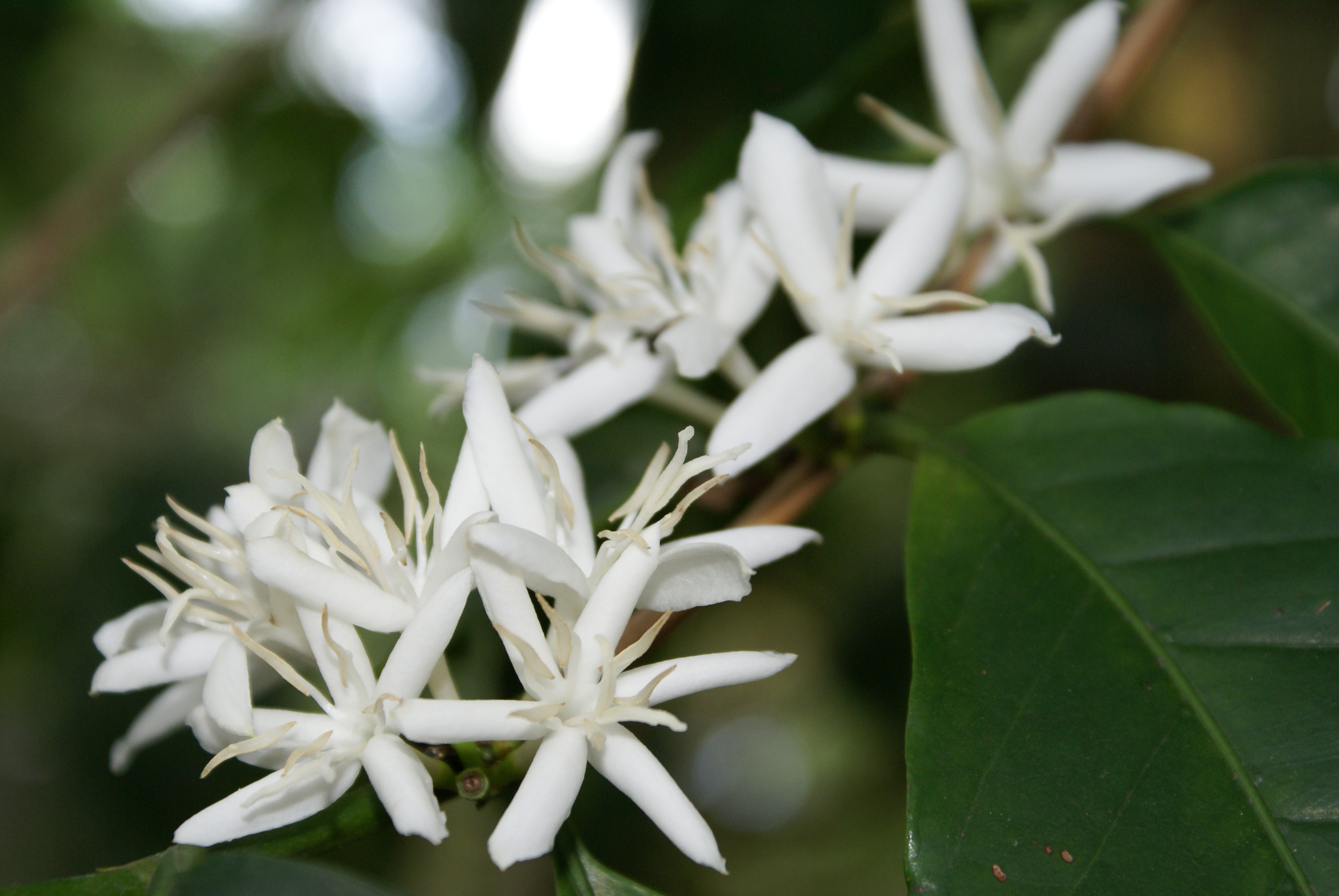
Flowers. Small five-petalled white star-shaped flowers in dense axillary clusters of 5–20 along the branches. Fragrant — described as jasmine-like. Each flower lasts only 2–3 days. Indoor flowering requires bright sustained light, warmth, a mature 4+ year specimen, and a slight dry-then-water trigger that mimics the natural seasonal rainfall pattern.
Fruit. Spherical to ovoid drupes 1–1.5 cm across, ripening from green through yellow to deep red (or rarely yellow at maturity in 'Yellow Bourbon' cultivars). Each fruit contains two seeds (the coffee beans) embedded in sweet pulp. Ripens 7–9 months after flowering. Indoor specimens rarely produce more than a handful of fruits per year.
- Glossy dark-green elliptic leaves arranged in opposite pairs along the stem — diagnostic.
- Pyramidal architecture with a single straight central trunk and horizontal lateral branches.
- New leaves emerge bronze-red and mature to dark green.
- Crushed leaves have a faint bitter scent reminiscent of green coffee.
- Stems are smooth and grey-green when young, becoming brown and slightly fissured with age.

Commonly confused with
Robusta coffee
Canephora has larger, slightly less glossy leaves with more prominent venation, and a more open habit. Almost never sold as a houseplant — arabica is the houseplant species. Genetically tetraploid; arabica is allotetraploid.
Coral berry / Christmas berry
Ardisia has alternate leaves with scalloped margins and persistent red berries; coffee has opposite leaves with smooth margins and red drupes only seasonally.
Weeping fig
Both have glossy leaves on tree-like stems, but ficus has alternate leaves with prominent drip tips, exudes white latex when cut, and has a weeping habit; coffee has opposite leaves arranged in horizontal pairs with no latex.
Care
Light
Bright indirect; tolerates direct morning sun.
Place near a bright east, south, or west window with direct morning sun and filtered afternoon light. The species evolved as an understorey shrub in Ethiopian highland forest at 1,500–2,000 m elevation — strong but dappled light. Direct midday summer sun through unfiltered glass scorches leaves; insufficient light produces leggy growth and prevents flowering.
Seasonal: Nordic apartments above ~55°N: a full-spectrum grow light at 30–50 cm distance for 10–12 hours/day from October through March keeps growth steady through the dark months and is essentially mandatory for any chance of flowering.
Water
Keep evenly moist; let the top 2 cm dry between waterings.
Water thoroughly until runoff and empty the saucer. Coffee plant roots dislike both waterlogging and complete drying — both extremes cause leaf drop. The first sign of underwatering is leaves wilting dramatically; recovery is full if rehydrated within 12–24 hours. Use tepid water; cold water from the tap shocks the roots and triggers leaf drop.
Seasonal: Cut frequency by a third from November to February.
Soil
Slightly acidic, well-drained peat-free potting mix with added perlite.
A mix of 2 parts quality peat-free potting soil to 1 part perlite, with optional addition of leaf mould for organic matter, suits the species. Slightly acidic pH is essential — alkaline tap water in hard-water regions produces slow leaf yellowing (chlorosis) over months. An acid-formula feed designed for camellias or rhododendrons addresses both nutrition and pH together.
Humidity
50–70 % preferred; tolerates 40 %.
Higher humidity reduces leaf-edge browning and supports flowering. The species' native cloud-forest habitat is humid year-round. Dry winter heating below 30 % triggers leaf-tip browning and flower abortion in any buds that have set. A humidifier in the room is highly recommended in centrally heated Nordic apartments.
Temperature
18–26 °C; warmth-loving.
Comfortable in normal heated room temperatures. Brief exposure to 10–12 °C produces leaf drop within a week; sustained cold below 8 °C kills the plant. The species is genuinely tropical — never moves outdoors in a Nordic spring before night temperatures stay above 14 °C. Keep well away from cold window glass in winter and from air-conditioner output in summer.
Fertilizer
Half-strength acidic or balanced feed monthly during active growth.
An acidic-formula liquid feed (designed for azalea, rhododendron, or camellia) at half label rate every 4 weeks from April through September suits the species' pH and nutrient preferences. Balanced (10-10-10) feed also works but produces slower-paced growth. A monthly chelated iron supplement helps in alkaline-water regions to prevent slow leaf yellowing.
Seasonal: No feeding from October through March.
Pruning
Trim leggy growth in spring; avoid over-pruning the central leader.
Cut leggy or weak branches back to a node in spring. Pinch growing tips to encourage branching and a denser form. As with Norfolk Island pine, the central leader should not be cut casually — coffee can recover from leader pruning more easily than Araucaria, but it slows the plant for a season. Commercial coffee plantations 'top' trees at 2 m to keep harvest within reach; the same technique works for indoor specimens.
Repotting
Every 2–3 years in spring; coffee dislikes root disturbance.
Move up by one pot size (3–5 cm wider) in fresh acidic potting mix. Coffee dislikes root disturbance more than most popular houseplants — minimise soil shake-out and keep the rootball intact. Expect 1–2 weeks of slowed growth and possible mild leaf drop after repotting; this is normal.
Seed (fresh green coffee cherry)
moderate~2–8 weeks germination; 18 months to display sizeUse only freshly harvested cherries — dried supermarket coffee beans have been roasted (or at minimum heat-treated) and will not germinate. If a home-grown plant has set fruit, peel the red flesh, rinse the bean, and sow horizontally in damp peat-free mix at 22–25 °C. Germinate readily over 4–8 weeks. Bottom heat speeds germination significantly. The seedling carries the bean on top of its first leaves for several weeks before it falls off — visually distinctive and entirely normal.
Stem cutting
difficult~8–14 weeksTake a 10–15 cm semi-hardwood tip cutting in spring or summer. Dust with strong rooting hormone, plant in damp peat-free mix with extra perlite, bag loosely, and provide bottom heat at 24–27 °C. Success rate 30–50 %. Less reliable than seed.
Cultivars
'Nana' / 'Bourbon'
Compact form of Coffea arabica reaching 1–1.5 m indoors with denser branching than wild type. The cultivar most commonly sold in European garden centres.
'Typica'
Original tall-growing wild-type form. Reaches 2–2.5 m indoors over many years; the historic source of much commercial coffee.
'Caturra'
Naturally compact dwarf cultivar discovered in Brazil. Reaches 1 m with strong branching; flowers and fruits earlier than typical forms.
Common problems
Lower leaves yellowing and dropping
Symptom
Older leaves at the bottom of the plant turn yellow and fall; upper plant looks healthy.
Cause
Most often hard water producing alkaline soil over time, or inconsistent watering. Coffee leaves are slightly acid-loving; alkaline conditions cause magnesium and iron lockout that shows as inter-vein yellowing.
Fix
Switch to rainwater or filtered water if possible. Apply a chelated iron and magnesium supplement (Epsom salt at 1 tsp/L works for magnesium). Repot into fresh acidic potting mix every 2–3 years. Stabilise watering — neither bone-dry nor waterlogged.
Full guide: Hard Water and Houseplants: What It Actually DoesAll leaves wilting dramatically
Symptom
Whole plant looks limp with leaves drooping, but soil may be dry or wet.
Cause
Either underwatering (dry soil) or root rot (wet soil) — both produce identical wilt. The species hates both extremes.
Fix
Check soil moisture first. Bone-dry: water thoroughly with tepid water; recovery within 12–24 hours. Waterlogged: unpot, trim away black mushy roots, repot in fresh mix with extra perlite, and reduce watering frequency. Rotted plants may not recover; underwatered ones almost always do.
Full guide: Overwatered or Underwatered? How to Tell Them Apart on Any HouseplantBrown leaf tips and edges
Symptom
Tips and edges of leaves brown and crispy; leaf interior remains green.
Cause
Low humidity, fluoride or chlorine in tap water, or fertiliser salt buildup.
Fix
Raise humidity above 50 %. Switch to filtered or rainwater in fluoridated/chlorinated areas. Flush the pot with plain water every 2–3 months to clear salt buildup. Reduce fertilising rate.
Full guide: Why Are My Plant's Leaf Tips Turning Brown? Diagnosis GuidePlant refuses to flower despite years of growth
Symptom
Healthy plant grows steadily for 4+ years but never produces flowers.
Cause
Insufficient light is the dominant factor. Coffee needs sustained bright light (8,000+ lux) for years to mature past the juvenile phase, and a slight dry-then-rain stress cycle to trigger bud set in mature plants. Indoor specimens often stay vegetative indefinitely.
Fix
Add a strong full-spectrum grow light running 12 hours/day. Once the plant has reached 80+ cm tall and 4+ years old, try a 'rainfall trigger' — let the soil dry slightly more than usual for 2–3 weeks, then water heavily for several days. This mimics the natural seasonal cue. Even with perfect care, indoor flowering remains uncommon.
Cat or dog ate a leaf or coffee cherry
Symptom
Vomiting, diarrhoea, hyperactivity, restlessness, increased heart rate, tremors — escalating over hours.
Cause
Caffeine and theobromine in the leaves, beans, and cherries — both methylxanthine stimulants that affect the cardiac and central nervous systems. Pets are far more sensitive to caffeine than humans (a cat's tolerance is roughly 15× lower per kilogram).
Fix
Treat as a veterinary emergency. Contact your vet or pet poison control immediately. The toxic dose for a cat is roughly 100 mg/kg of caffeine; for a small cat, this is achievable from a few coffee cherries or a handful of leaves. Take a sample of the plant. Households with pets should keep coffee plants out of reach and pick up any dropped leaves immediately.
Full guide: My Cat or Dog Just Ate a Houseplant — What to Do Right Now- Spider mites (in dry winter air)
- Mealybugs
- Scale (especially soft brown scale)
- Leaf rust (Hemileia vastatrix) — rare indoors
- Root rot from waterlogging
- Cercospora leaf spot
Toxicity & safety
Caffeine in the leaves and beans is the same compound humans drink in coffee, but raw concentrations and ingestion of multiple cherries or leaves can produce caffeine intoxication — restlessness, rapid heartbeat, nausea. Roasted beans are safe at normal coffee-drinking quantities. Children should not chew leaves or unripe cherries.
Mechanism: Methylxanthines (caffeine, theobromine, theophylline).
Coffea arabica — Missouri Botanical Garden Plant FinderRestlessness, rapid breathing, hyperactivity, increased heart rate, vomiting, diarrhoea, tremors. In larger ingestions — seizures, collapse, cardiac arrhythmia. Cats are roughly 15× more sensitive to caffeine per kilogram than humans.
Mechanism: Caffeine and theobromine block adenosine receptors and stimulate the central nervous system and heart.
Coffee Tree — ASPCA Toxic and Non-Toxic PlantsRestlessness, hyperactivity, increased heart rate, vomiting, diarrhoea, tremors. In larger ingestions — seizures, collapse, cardiac arrhythmia. Toxic dose roughly 140 mg caffeine per kg body weight.
Mechanism: Caffeine and theobromine block adenosine receptors and stimulate the central nervous system and heart.
Coffee Tree — ASPCA Toxic and Non-Toxic PlantsWhy a coffee plant rarely flowers indoors — and what would change that
Indoor Coffea arabica often grows steadily for years without ever producing a flower. The species evolved in Ethiopian highland forests at 1,500–2,000 m elevation, where it experiences year-round bright filtered light, consistent humidity around 70 %, cool nights, and a distinct seasonal pulse of dry-then-rainy weather that triggers bud formation. A typical home replicates almost none of those conditions: light is dim by tropical-forest standards, humidity is low, night-day temperature differences are minimal, and watering is steady rather than seasonally pulsed.
The closest a Nordic apartment can come to triggering flowering is: install a strong full-spectrum grow light running 12 hours/day, hold humidity above 60 % year-round with a humidifier, and once the plant is 80+ cm tall and at least 4 years old, attempt a 'rainfall trigger' — let the soil dry slightly more than usual for 2–3 weeks (without crisping the leaves), then water heavily for several consecutive days. This mimics the natural seasonal cue. Some plants flower the first year you try; many never do. The plant remains worth growing for the foliage alone — flowering is a bonus.
Caffeine, pets, and why this is a serious houseplant toxicity
Coffee plants concentrate caffeine and theobromine in their leaves and unripe cherries — the same methylxanthines that make chocolate dangerous to dogs. Caffeine in raw plant material is far more bioavailable than in roasted beans, and pets metabolise it very differently from humans. A cat's caffeine toxicity threshold is roughly 100 mg/kg body weight; a small cat could reach this dose by chewing two or three coffee cherries or a handful of leaves. Dogs are slightly more tolerant per kilogram but still acutely vulnerable.
Practical implication: a coffee plant in a household with curious pets is a meaningful risk, not a theoretical one. Symptoms of caffeine toxicity in pets escalate rapidly — restlessness and rapid heartbeat within an hour, seizures and cardiac arrhythmia within several hours. Treat any ingestion as an immediate veterinary emergency. ASPCA explicitly lists Coffea arabica as toxic. Households with cats or dogs that nibble plants should keep coffee out of reach (high shelves, hanging baskets) or pick a non-toxic alternative — Ardisia crenata has a similar berry-bearing visual story without the caffeine.
Coffea arabica is allotetraploid — it has 44 chromosomes derived from a natural cross between two ancestor species, Coffea canephora (robusta, 22 chromosomes) and Coffea eugenioides (22 chromosomes), that occurred in Ethiopian forests roughly 50,000–600,000 years ago. The hybrid origin is why modern arabica has very low genetic diversity globally — almost all commercial arabica derives from a small number of plants taken to Yemen in the 15th century, then to Java and the Caribbean in the 17th century. The wild Ethiopian populations remain the only significant reservoir of arabica genetic diversity, and they are increasingly threatened by deforestation and climate change.
Frequently asked · 5
Is a coffee plant (Coffea arabica) toxic to cats and dogs?+
Yes — ASPCA lists coffee plant as toxic to cats and dogs. Caffeine and theobromine in the leaves, stems, cherries, and beans cause restlessness, rapid heartbeat, vomiting, tremors, and (in larger ingestions) seizures and cardiac arrhythmia. Cats are roughly 15× more sensitive to caffeine per kilogram than humans. Any ingestion is a veterinary emergency. Households with pets should keep coffee plants out of reach or pick a non-toxic alternative.
Will my indoor coffee plant produce real coffee beans?+
Possibly — but not in significant quantities. Indoor specimens typically need 4+ years of strong light and warm conditions before flowering for the first time, and a single plant produces enough beans for perhaps one or two cups of coffee per year even when fruiting well. Coffea arabica is also self-pollinating, so a single plant can set fruit without a partner. Treat it as a glossy-leaved foliage plant first; flowering and fruiting are a slow novelty bonus, not a viable home-coffee supply.
Why are my coffee plant leaves turning yellow?+
Most often hard water and alkaline soil over time, or inconsistent watering. Coffee plants are slightly acid-loving (pH 5.5–6.5); alkaline tap water gradually raises soil pH and produces inter-vein yellowing as the plant struggles to absorb iron and magnesium. Switch to rainwater or filtered water, apply chelated iron and a magnesium supplement (Epsom salt at 1 tsp/L), and repot into fresh acidic potting mix every 2–3 years.
How fast does a coffee plant grow?+
Moderately — typical indoor specimens add 15–30 cm of new growth per year under good light, reaching 1–2 m over 5–10 years. Growth slows significantly in winter and accelerates in spring/summer. Wild specimens reach 5–9 m at maturity, but indoor plants almost never reach that size due to limited light and pot space. Pinching the growing tips encourages branching at the expense of height.
Can I grow a coffee plant from supermarket beans?+
No — supermarket coffee beans have been roasted (or at minimum heat-treated for shipping) and are no longer viable. Even unroasted 'green' beans sold to home roasters have typically been dried and parchment-removed in ways that kill germination. Fresh seed from a home-grown plant or from a specialist nursery is the only reliable starting material. The fresh bean must be sown horizontally within a few days of harvest — viability drops rapidly with drying.