
Identity & taxonomy
- Scientific name
- Schefflera arboricola (Hayata) Merr.
- Family
- Araliaceae
- Genus
- Schefflera
- Order
- Apiales
- Heptapleurum arboricolum (Hayata) Lowry & G.M.Plunkett (current accepted name in Kew POWO 2020 revision; the trade and nursery industry still universally uses Schefflera)
- Heptapleurum arboricola Hayata (basionym)
- Dwarf umbrella treeen
- Dwarf Scheffleraen
- Hawaiian umbrella treeen
- Parasol planten
- Paraplyträdsv
- Paraplytreno
- Paraplytræda
- Sateenvarjopuufi
- Strahlenaraliede
Taiwan · Hainan (southern China)
How to identify it
Growth habit. Upright woody shrub; in nature an evergreen tree-shrub that branches readily once the apical bud is pinched. Indoors it grows as either a single stem (typically sold as a tall, sparse specimen) or a multi-stemmed bushy plant produced by pinching the tips. Often confused with the much larger Schefflera actinophylla (umbrella tree), which is a different species sold in the same nursery aisle.
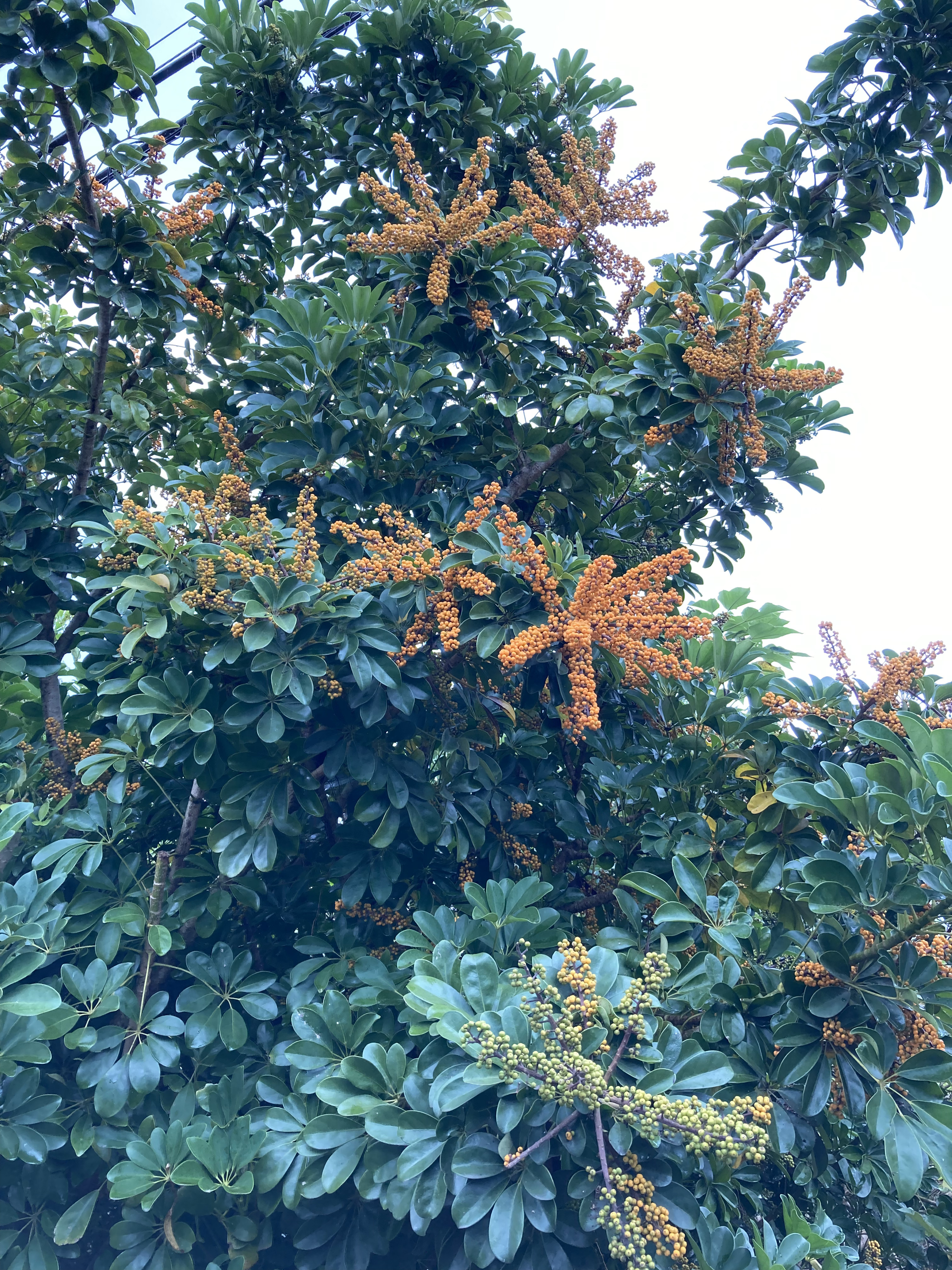
Leaves. Palmately compound leaves with 7–11 (occasionally up to 16) elliptical leaflets arranged like the spokes of an umbrella around a single central petiole. Each leaflet is 7–10 cm long, glossy green, leathery, with a short pointed tip and untoothed margin. Leaflets attach by short petiolules to a small central pad at the top of a long, slender petiole. Variegated cultivars carry yellow, cream, or gold splashes that vary leaflet to leaflet.
Flowers. Compound umbel-of-umbels (panicle) of small greenish-white flowers, produced only on mature outdoor plants. Not seen in normal indoor cultivation.
Fruit. Small drupes 5–6 mm across, ripening from green to orange-yellow to dark red. Decorative outdoors; not produced indoors.
- 7–11 small (≤10 cm) leaflets per leaf, arranged radially — the 'umbrella spoke' pattern is diagnostic.
- Leaflets are smaller and more numerous than its larger cousin Schefflera actinophylla, which has 7–16 leaflets up to 30 cm long.
- Stems are slender, branch readily after pinching, and stay woody but flexible — the plant rarely needs staking.
- No latex sap on cutting (distinguishes it from Ficus species at a glance).

Commonly confused with
Umbrella tree / Australian umbrella tree
Same umbrella-spoke leaf pattern but at much larger scale: leaflets up to 30 cm long, mature plant becomes a small tree. If the leaflets are bigger than your hand, it's S. actinophylla, not S. arboricola.
False aralia
Also Araliaceae and also sold in 'umbrella' style, but leaflets are narrow and sharply toothed (saw-edged) rather than smooth-margined and elliptical.
Cabbage tree
Similar palmate-compound leaf silhouette but each leaflet is much larger and lobed, and the trunk is thick and succulent — a different plant altogether despite a superficial first-glance resemblance.
Care
Light
Bright indirect light preferred; tolerates medium light.
Place within 1–2 m of an east, south, or west window with sheer-curtain filtering. Variegated cultivars (Gold Capella, Trinette) need the bright end of this range to keep their cream and gold patterns; in low light they push plain green new growth and slowly lose their variegation. Direct midday sun through summer glass scorches the glossy leaflets.
Seasonal: Nordic apartments above ~55°N benefit from a full-spectrum LED for 8–10 hours/day from October through March. Without supplemental light, expect slowed growth and elongation toward the brightest source.
Water
When the top 2–3 cm of soil feels dry.
Water thoroughly until runoff, then empty the saucer. Schefflera arboricola is moderately drought-tolerant once established — the woody stems hold reserves — but reacts badly to constantly wet soil, dropping leaves within 1–2 weeks of overwatering. Use tepid water.
Seasonal: Cut frequency by roughly a third from November to February.
Soil
Standard well-drained peat-free potting mix with added perlite.
A mix of 3 parts quality peat-free potting soil to 1 part perlite or pumice gives the drainage Schefflera needs. The fine fibrous root system rots quickly in waterlogged, oxygen-poor soil.
Humidity
40–60 %; tolerates ordinary indoor humidity.
Average indoor levels are sufficient. Schefflera is far less humidity-demanding than Calathea or Stromanthe — a humidifier is not required. Leaves wiped clean with a damp cloth every 1–2 months stay glossy and free of dust-trap allergens.
Temperature
16–24 °C.
Brief exposure to 10–15 °C is tolerated; sustained cold below 10 °C produces leaf yellowing and drop. Keep away from cold window glass in winter and from direct radiator output year-round.
Fertilizer
Balanced liquid feed monthly in spring and summer at half strength.
A balanced NPK (3-1-2 or 20-20-20) at half label rate is plenty. Overfeeding produces dark green oversized leaves on weak elongated stems, which then collapse under their own weight.
Seasonal: No feeding from late October through February.
Pruning
Pinch growing tips in spring to keep the plant bushy; hard prune to restart leggy specimens.
The single most important Schefflera care action is regular tip-pinching. Removing the top 1–2 cm of each growing stem with a clean fingernail in spring breaks apical dominance and pushes 2–3 new side shoots from the leaf axils below. Skipped, the plant elongates upward into a sparse, top-heavy specimen with bare lower stems. Hard pruning back to 30 cm above the soil regenerates a leggy plant; expect 4–8 weeks for new shoots to appear.
Repotting
Every 2–3 years, or when roots circle the pot bottom.
Move up by one pot size (3–5 cm wider). Best done in early spring as new growth resumes. Schefflera tolerates being slightly pot-bound and does not need annual repotting.
Stem cutting in water
easy~4–6 weeksTake a 10–15 cm tip cutting with 3–4 leaves in spring. Strip the lower leaflets, place in tepid water in bright indirect light, and change water weekly. Pot up once roots reach 4–5 cm. Variegated cultivars root reliably as long as the cutting carries variegated tissue.
Stem cutting in soil
easy~5–8 weeksPlant a 10–15 cm cutting directly in damp peat-free mix with added perlite. Cover loosely with a clear bag for the first 2 weeks to raise humidity. Tug gently after 6 weeks to check for root resistance.
Air layering
moderate~6–10 weeksUseful for salvaging a leggy specimen with a long bare stem. Wound the stem below the canopy, wrap in moist sphagnum sealed in plastic, and cut below the new root mass once roots fill the moss.
Cultivars

'Gold Capella'
Bright golden-yellow variegation splashed across each leaflet. The most widely sold variegated cultivar; needs consistently bright indirect light to keep the gold from fading to pale green.
'Trinette'
Cream-and-green variegation with smaller, narrower leaflets than 'Gold Capella'. More compact growth habit, popular for tabletop specimens.
'Variegata'
Generic name covering several cream-edged forms in cultivation. Variegation pattern less stable than 'Gold Capella'; prone to reverting to all-green growth in low light.
'Janine'
Heavily flecked yellow-on-green variegation; slower-growing and more compact than 'Gold Capella'. Less common in mainstream retail.
Common problems
Leaf drop
Symptom
Lower leaflets yellow and drop; sometimes whole compound leaves fall over a few days.
Cause
Most often overwatering. Secondary causes: a sudden move (drop in light, change in humidity, cold draught), or sustained underwatering until the soil pulls away from the pot edges.
Fix
Check soil 4–5 cm down. If wet, withhold water until it dries; if completely dry and the soil has shrunk, soak the pot in tepid water for 20 minutes to rehydrate. Stabilise position and conditions; expect 4–6 weeks before new growth resumes.
Tall, leggy stems with bare lower sections
Symptom
Plant grows upward in a single or few sparse stems; lower parts of the stem hold no leaves.
Cause
Apical dominance combined with insufficient pinching and/or low light. Schefflera will not branch unless its growing tips are removed.
Fix
Pinch the top 1–2 cm of every growing stem in spring. For a badly leggy specimen, hard prune back to 25–30 cm above the soil and keep in bright light. New side shoots emerge within 4–8 weeks.
Full guide: Why Is My Plant Leggy? Causes of Stretching and How to Fix ItReverting to plain green (variegated cultivars)
Symptom
New 'Gold Capella' or 'Trinette' leaves emerge mostly green with little or no variegation.
Cause
Insufficient light. Variegated tissue photosynthesises less efficiently and the plant favours green growth in dim conditions.
Fix
Move to brighter indirect light or add a grow light. Prune off any fully-green shoots back to the last variegated node — green growth out-competes variegated growth and will dominate if left.
Full guide: Why Is My Variegated Plant Losing Its Variegation?Sticky leaves and cotton tufts
Symptom
Sticky residue on leaves and below the plant; small white cottony patches in leaf axils and where leaflets meet the petiole.
Cause
Mealybugs or scale. Schefflera arboricola is one of the most scale-prone houseplants; outbreaks tend to start at the leaflet attachment points.
Fix
Wipe each leaflet front and back with a cotton swab dipped in 70 % isopropyl alcohol. Repeat weekly for 4 weeks. For heavy infestations, follow with insecticidal soap. Inspect new plants carefully before bringing them home — most Schefflera scale infestations come in on retail specimens.
Full guide: Scale Insects on Houseplants: What Those Brown Bumps Actually AreBlack sooty patches on leaves
Symptom
Black powdery coating on the upper leaf surface, often in irregular patches.
Cause
Sooty mould growing on the honeydew secreted by sap-sucking insects (scale, mealybugs, aphids).
Fix
Identify and treat the underlying pest first (the mould lives on insect honeydew, not the plant). Once the pest is controlled, wipe leaves clean with a damp cloth; the mould lifts off easily.
Full guide: Sticky Residue on Houseplant Leaves: The 3 Pests That Cause It- Spider mites
- Scale (the dominant Schefflera pest)
- Mealybugs
- Thrips
- Root rot (Pythium, Phytophthora)
- Bacterial leaf spot (Pseudomonas)
- Alternaria leaf spot
Toxicity & safety
Burning of the lips, tongue, and throat if chewed; mild gastrointestinal irritation. Skin contact with sap can cause dermatitis in sensitive individuals.
Mechanism: Insoluble calcium oxalate raphides plus saponins.
Schefflera arboricola — North Carolina Extension Gardener Plant ToolboxOral irritation, intense burning and swelling of the mouth, tongue, and lips; drooling; vomiting; difficulty swallowing.
Mechanism: Insoluble calcium oxalate raphides
Schefflera — ASPCA Toxic and Non-Toxic PlantsSame oral-irritation syndrome as cats — pawing at the mouth, drooling, vomiting, and reluctance to eat for a day after exposure.
Mechanism: Insoluble calcium oxalate raphides
Schefflera — ASPCA Toxic and Non-Toxic PlantsWhy your Schefflera is leggy and how to fix it
Schefflera arboricola has strong apical dominance — the topmost growing tip suppresses lateral buds via auxin signalling. In nature, mild damage from wind and herbivores constantly removes growing tips, and the plant responds by branching from the leaf axils below. Indoors, where nothing eats the tip, the plant simply keeps growing upward as a single tall stem until it runs out of light or topples under its own weight.
The fix is mechanical, not chemical: pinch the top 1–2 cm of every growing stem in spring with a clean fingernail. Within 4–6 weeks two or three lateral shoots will emerge from the buds below the cut. Repeat the next spring and the plant fills out into the bushy specimen sold in nurseries. Skipping this step is the single most common reason an indoor Schefflera ends up sparse and unattractive after a few years.
Schefflera arboricola vs Schefflera actinophylla
Garden centres often label both species simply 'Schefflera' or 'umbrella tree', and the two are easy to confuse at a glance because both have palmately compound leaves arranged like umbrella spokes. The reliable distinction is leaflet size: S. arboricola leaflets stay 7–10 cm long, while S. actinophylla leaflets reach 15–30 cm. If the leaflets are the size of your hand or larger, it's actinophylla.
S. actinophylla is also a much larger plant in the long run — it is a true tree in subtropical climates and will outgrow most apartments within a decade. S. arboricola stays naturally in the 1–2 m range and tolerates pinching, making it the better choice for Nordic indoor cultivation.
The 2020 taxonomic revision of Araliaceae split the historic genus Schefflera into a dozen smaller genera. The species formerly known as Schefflera arboricola is now technically Heptapleurum arboricolum — but the trade name 'Schefflera' is so entrenched in nurseries, retail tags, and search behaviour that virtually no one outside taxonomic botany has switched. This is the same pattern as Sansevieria → Dracaena: the official name changed years ago and the houseplant world ignored it.
Frequently asked · 5
Is Schefflera arboricola toxic to cats and dogs?+
Yes — ASPCA lists Schefflera as toxic to cats and dogs. All parts contain insoluble calcium oxalate raphides plus saponins, which cause intense oral burning, drooling, and vomiting if chewed. A pet that takes a single bite typically backs off because the burning is immediate, but reactions can be severe. Pet-safe alternatives in a similar visual niche: Areca palm, parlor palm, or Stromanthe Triostar.
Why is my Schefflera leggy and bare at the bottom?+
Apical dominance combined with insufficient pinching. Schefflera arboricola only branches if the growing tip is removed — left alone, it grows as a single tall stem and drops its lower leaves over time as light falls below threshold. The fix: pinch the top 1–2 cm of every stem in spring. New side shoots emerge within 4–8 weeks. For a severely leggy specimen, hard prune back to 25–30 cm above the soil and keep in bright light to regenerate.
Why is my Schefflera dropping leaves?+
Most often overwatering — the species is moderately drought-tolerant and reacts badly to constantly wet soil, dropping leaflets within 1–2 weeks. Other causes: a recent move (sudden change in light, humidity, or temperature), cold draughts (below 10 °C), or sustained underwatering. Check the soil 4–5 cm down: if wet, stop watering and let it dry; if bone-dry and pulling away from the pot, soak to rehydrate. Stabilise conditions and wait 4–6 weeks for recovery.
How do I keep my variegated Schefflera Gold Capella from reverting?+
Variegated cultivars lose their golden-yellow pattern in low light because variegated tissue photosynthesises less efficiently and the plant favours green growth in dim conditions. Move to bright indirect light (an east or south window with sheer filtering) and prune off any fully-green shoots back to the last variegated node — green growth otherwise out-competes variegated growth and will dominate. A grow light helps in Nordic winters.
Can I propagate Schefflera arboricola in water?+
Yes — a 10–15 cm tip cutting taken in spring roots reliably in water within 4–6 weeks. Strip the lower leaflets, place in tepid water in bright indirect light, change water weekly, and pot up once roots reach 4–5 cm. Variegated cultivars root just as well as the species form, as long as the cutting carries variegated tissue.