What 'leggy' actually means
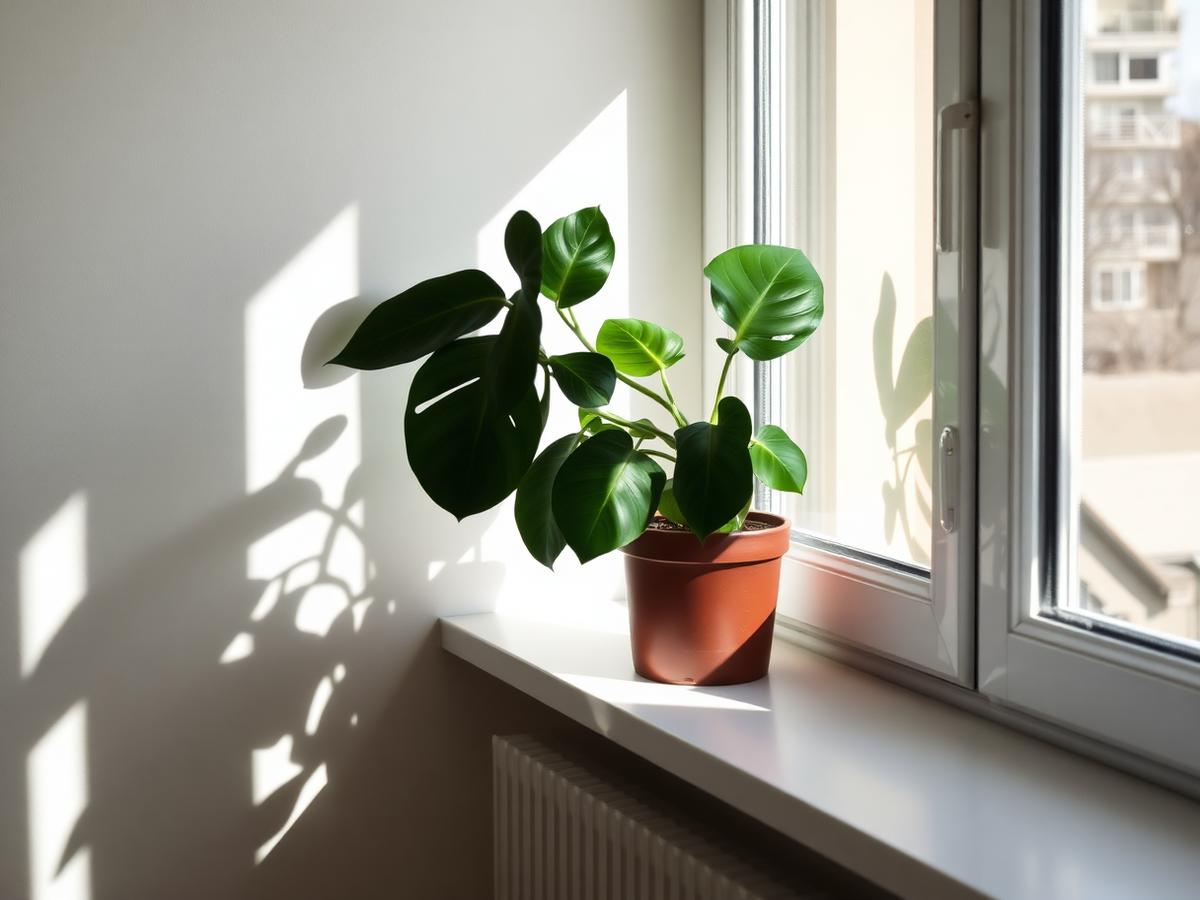
Leggy growth — sometimes called "etiolation" in scientific literature — is when the gaps between leaves (internodes) stretch to two or three times their normal length, the stem becomes thin and pale, and the plant visibly leans toward the nearest light source. Leaves may also come in smaller than the plant used to produce, because the plant is prioritising vertical reach over photosynthesis area.
Compare a leggy pothos to a healthy one: the healthy plant has leaves every 2–4 cm along the stem with thick, deep-green petioles. The leggy version has bare stem for 10–15 cm between leaves, smaller leaves at the tip, and pale colour throughout. Under a light meter, the leggy plant is almost always sitting below 1,000 lux — the lower threshold of medium indoor light.
The 3-minute diagnostic
Before changing anything, confirm the cause. Four quick checks that together take less than three minutes will tell you what you are dealing with.
- 1Shadow test at noon: hold your hand 30 cm above the plant on a clear day. A sharp-edged shadow means bright indirect light; a blurry or barely-visible shadow confirms the plant is in medium-to-low light. Faint shadow + leggy growth = light problem.
- 2Measure two internodes: one from new growth (the last 2–3 leaves), one from older growth. If new internodes are 2× longer, the legginess started recently — match the timing to what changed in the room (shorter days, a furniture move, a new curtain, a bigger plant blocking the window).
- 3Check the lean: if the plant visibly tips toward one direction, it's phototropism — the plant is reaching. The fix is rotation as well as relocation.
- 4Look at the stem base: is the lowest growth still bushy while the top is stretched? That's a recent light drop. Is the whole plant sparse and stretched? That's long-term light starvation, often 2+ months running.
Cause 1: Insufficient light (the usual suspect)
By a wide margin, the most common reason for leggy growth is simply not enough light. Indoor lighting is deceptively dim — a "bright" living room can be under 500 lux, which is less than 3% of outdoor shade on a clear day. Tropical houseplants evolved under 10,000–20,000 lux in forest understories, and in a dim apartment they compensate by stretching toward the brightest spot they can find.
The fix is almost always a better location — moving a plant 1 m closer to a window can double the light it receives. In rooms without a good window, a grow light on a 10–12 hour timer delivers the same effect more reliably than trying to reshuffle furniture twice a year.
- ·Move the plant 1 m closer to the brightest window in the house.
- ·Switch to an unobstructed east or south window (north if you are in the Southern hemisphere).
- ·Clean the window glass — dusty glass blocks up to 30% of visible light.
- ·Take down any sheer curtains for 4 weeks and see whether new growth tightens.
- ·For plants stuck in dim rooms, commit to a grow light; one session with a lux meter app will usually show how big the gap is.
Cause 2: Phototropism (the rotation fix)
Even in bright rooms, plants lean — hard — toward the window. Their growth becomes asymmetric: dense on the window side, sparse and stretched on the dark side. This is not a pathology; it is auxin-driven growth behaviour. The fix is weekly rotation: give the plant a quarter-turn every 7 days so each side gets the bright spot in turn.
This is particularly important for fiddle leaf figs, monsteras, and any upright plant where you care about even shape. Rotation does not fix a plant that has already gone leggy — you will still need to prune or accept the shape — but it prevents future legginess on the same plant.
Cause 3: Seasonal shift (winter legginess)
Plants grown in south or east windows in summer often stretch visibly in winter, even in the same spot. The reason is that sun angle and day length drop sharply — at 60° latitude, a Copenhagen or Stockholm living room receives roughly 20% of the usable light it did in June. Leaves coming in from October to February will be smaller, paler, and more spaced out than the summer growth on the same plant.
The fix is not to do anything dramatic. Either accept that winter growth will be leggy and hard-prune in spring when light returns, or add a supplementary grow light for the dark months. The Nordic winter apartment guide covers the whole-plant strategy.
Cause 4: Over-fertilising (the overlooked one)
High-nitrogen fertiliser pushes rapid soft growth that outpaces the plant's ability to support it with photosynthesis, producing long thin stems and pale leaves. This is most common in people who feed weekly with full-strength fertilizer — the plant responds with sheer mass of weak tissue rather than healthy dense growth.
Stop fertilising entirely for 4–6 weeks, flush the pot with clean water to leach excess salts, and resume at half strength once a month. If the plant has white crust on the soil rim or crispy brown leaf tips alongside legginess, over-fertilising is very likely part of the picture.
Pruning a leggy plant: when and how
Pruning only works if you have fixed the underlying cause. If you cut back a leggy pothos and leave it in the same dim corner, the new growth will be leggy too — often worse, because the plant now has less leaf area to photosynthesise with.
Once the light is sorted, hard-prune in spring when growth is most vigorous. Cut just above a node (the point where a leaf meets the stem), and each cut stem will usually push 1–2 new branches from that point. The old leggy stem stays stretched — but the new branches, growing under better light, will come in compact. For Monstera specifically, how to prune a Monstera walks where exactly to cut, how to root the cutting, and the topping move that turns one leggy plant into a fuller parent and a separate juvenile.
- 1Wait until you have fixed the light cause and 3–4 weeks have passed so you can confirm the plant is growing again.
- 2Use clean, sharp scissors or pruning shears; disinfect with rubbing alcohol between plants.
- 3Cut 3–5 mm above a leaf node, not flush against it.
- 4Propagate the cuttings in water if the plant roots easily — pothos, philodendron, monstera, tradescantia, and coleus all root reliably.
- 5Reduce watering slightly for 2 weeks — less leaf mass means less water uptake.
Plants most prone to legginess
Some species stretch faster than others when light drops. If you keep any of these in average indoor light, expect to manage legginess periodically.
- ·Pothos (Epipremnum aureum) — the classic example; see the pothos care guide.
- ·Philodendron heartleaf — same family, same behaviour.
- ·Succulents and cacti — etiolate dramatically in low light; become almost unrecognisable within weeks.
- ·Basil, mint, and other culinary herbs indoors — always grow leggy unless in a sunny window or under a grow light.
- ·String-of-pearls and string-of-hearts — leaves shrink and space out quickly when light drops.
- ·Spider plant — throws long pale stolons instead of compact babies.
- ·Begonia maculata — upright, so the legginess is especially visible.
- ·Snake plant (Dracaena trifasciata) — rare exception; rarely stretches but will lean slowly in dim rooms. See the snake plant guide.
Prevention: the 5-minute weekly routine
Legginess is almost always preventable if you catch it early. A simple weekly habit — five minutes across your whole collection — keeps plants from drifting into it in the first place.
- ·Rotate each upright plant a quarter-turn every 7 days.
- ·Once a month, compare this month's new growth against last month's — shrinking leaves or longer internodes are an early warning.
- ·In October, move any borderline-light plants 30 cm closer to the window for winter.
- ·Clean window glass twice a year (March and September).
- ·Once a year, check actual light with a meter app — rooms get dimmer as buildings grow up around you, and nobody notices until the plants do.