What an air plant actually is
Tillandsia is a genus in the bromeliad family (Bromeliaceae) — the same family as pineapples — with about 650 accepted species native to a band stretching from the southern United States through Mexico, Central America, and South America to northern Argentina. They are epiphytes, meaning they grow attached to tree branches, rock faces, or telephone wires rather than in soil. The roots, where present, are anchor cables — they do not absorb water or nutrients in any meaningful quantity.
The work happens on the leaves. Tillandsia leaves are covered in microscopic silver-grey scales called trichomes, each one a star-shaped structure that opens to absorb water and dissolved minerals when wet, then closes to retain moisture and reflect sun when dry. The species with the densest, most silvery trichomes (xerographica, tectorum) come from the driest habitats; the greener-leaved species (bulbosa, butzii) come from humid cloud forests. Trichome density is the visual key to drought tolerance — pull a leaf off your plant, hold it up to the light, and decide silver or green. That detail changes how often you water.
Xeric vs mesic — the one distinction that matters
Tillandsia split visually into two camps. Xeric species are silver-grey, often curly or stiff, with thick prominent trichomes — they evolved on dry rock faces and thorn forests with weeks between rains. They tolerate drought, want strong light, and dislike sitting wet. Mesic species are greener, softer, and more flexible, with finer trichomes — they evolved in humid cloud forests and tolerate (and prefer) more frequent watering plus filtered, gentler light. The difference between these two groups is the single biggest care variable, and it overrides any generic "water once a week" advice.
Common xeric species: T. xerographica, T. tectorum, T. ionantha 'Mexican', T. capitata, T. caput-medusae. Common mesic species: T. bulbosa, T. butzii, T. juncea, T. brachycaulos, T. cyanea (which has both habits depending on selection). When in doubt, look at the leaf colour: silvery and stiff = xeric (water every 10–14 days, brighter light); soft and green = mesic (water every 5–7 days, indirect light).
Tillandsia ionantha — the entry-level air plant
Tillandsia ionantha is the air plant most beginners receive as a gift. It is small (3–8 cm), forms a tight rosette of narrow stiff leaves, and turns bright pink or red across the whole plant when it is preparing to flower. The flowers themselves are deep purple-violet on a short spike that emerges from the centre — hence ionantha, "violet flower". After flowering, the plant produces 2–6 offsets ("pups") from the base over the next few months, then the mother plant slowly declines. This is normal — Tillandsia are monocarpic, flowering once and then producing pups before dying. The pups become next year's display.
Several named varieties exist. T. ionantha 'Mexican' is the most xeric (silvery, stiff, drought-tolerant). T. ionantha 'Guatemala' is greener and slightly larger. T. ionantha 'Rubra' has reddish leaves year-round. T. ionantha 'Fuego' goes deep red across the whole rosette before flowering. Care is the same: soak weekly to fortnightly, bright indirect light, dry thoroughly between waterings.
- ·Size: 3–8 cm — among the smallest Tillandsia.
- ·Visual: tight rosette, narrow stiff silvery leaves, turns pink/red before flowering.
- ·Flowering: deep purple spike from centre, lasts 2–4 weeks, then plant pups and declines.
- ·Watering: 20-min soak every 7–14 days; 'Mexican' tolerates the longer interval.
- ·Light: bright indirect; tolerates a few hours of direct morning sun.
Tillandsia xerographica — the queen of air plants
Tillandsia xerographica is the showpiece air plant — large (15–30 cm wide), silvery-grey, with broad strappy leaves that curl into a tight rosette at the centre and unfurl outward. It grows on rocky slopes in Mexico, Guatemala, El Salvador, and Honduras, in a habitat that gets weeks of dry weather between rainstorms. As a result it is the most drought-tolerant common Tillandsia: a healthy xerographica can go 3 weeks without water in cool conditions and recover fully from a 30-minute soak. The dense silvery trichomes give the plant its colour and its drought tolerance simultaneously — they reflect strong sun and slow water loss to a trickle.
Care: a 30–60 minute soak every 10–14 days in summer, every 14–21 days in winter. Bright indirect light to a few hours of direct sun is fine; xerographica handles brighter light than almost any other indoor air plant. The single critical detail is drying — after the soak, shake the plant vigorously to dislodge water from the leaf bases, then place it upside-down on a paper towel for at least 4 hours. Water trapped in the central rosette rots the crown within days, which is the most common way xerographica owners lose theirs.
Listed by CITES Appendix II — international trade is regulated. Buying from a reputable nursery (not pulled from the wild) matters; nursery-propagated xerographica is the only sustainable option.
- ·Size: 15–30 cm; 25 cm is typical for a mature shop specimen.
- ·Visual: silvery-grey, broad strappy curling leaves, tight rosette centre.
- ·Watering: 30–60 min soak every 10–21 days; the most drought-tolerant beginner species.
- ·Light: bright indirect to a few hours of direct sun.
- ·Conservation: CITES Appendix II — buy nursery-propagated only.
Tillandsia caput-medusae — the curling head
Tillandsia caput-medusae ("head of Medusa") is named for its long, twisting, snake-like leaves that emerge from a swollen bulbous base. The plant is 15–25 cm tall, silvery-grey, and looks dramatic on a piece of driftwood or hanging on a wall mount. It is xeric — leaves are stiff, silver, and well-armed with trichomes — and tolerates drought as well as ionantha. The bulbous base is hollow and in the wild houses ant colonies that protect the plant; indoors it is just a striking visual feature.
Care: 30-min soak every 10–14 days, bright indirect light, thorough upside-down drying after watering. The bulbous base is a water trap — dry it deliberately. Caput-medusae blooms a tall pink spike with violet flowers and produces 2–5 pups afterwards. Confused with T. butzii, which has darker mottled leaves and is more mesic.
Tillandsia bulbosa and butzii — the mesic species
Tillandsia bulbosa and Tillandsia butzii are the two mesic species most likely to appear in mixed air-plant displays — both have dark-green to almost-black leaves emerging from a swollen bulbous base, with finer trichomes than the xeric species. They evolved in humid cloud forests in Central and South America and want more frequent watering than xerographica or ionantha. T. bulbosa has shorter, smoother, more uniform tentacle-like leaves; T. butzii has longer, thinner leaves with darker spotted mottling.
Care: 20-min soak every 5–7 days, indirect light (no direct sun), and high humidity if possible (50%+). They will survive in drier flats but lose colour and grow slowly. The bulbous base traps water more than xeric species — invert and dry as thoroughly as for caput-medusae. These are the species most likely to die if treated as drought-tolerant; they do not have the silvery trichome armour to wait three weeks between waterings.
- ·Visual: dark green leaves, swollen bulbous base, finer trichomes than xeric species.
- ·T. bulbosa: shorter, smoother leaves; uniform colour.
- ·T. butzii: longer leaves, mottled darker spotting.
- ·Watering: weekly soak, more frequent than the silvery species.
- ·Light: indirect — no direct sun, which scorches mesic leaves.
Tillandsia cyanea — the air plant with a paddle
Tillandsia cyanea is the visually distinct air plant on the shelf — narrow grass-like green leaves arranged in a fountain rosette, topped with a flat pink-bracted flower paddle that holds violet-blue flowers in succession over weeks. It is the air plant most often grown in pots with a little soil or sphagnum at the base, because it has slightly more developed roots than most Tillandsia. Some growers treat it as a quasi-bromeliad and water like a small bromeliad rather than as an air plant.
Care: weekly soak (or weekly watering through the bracts if mounted), bright indirect light, 50% humidity. It is more forgiving than the bulbous mesic species and produces a flower paddle that lasts 2–3 months — a stronger floral display than any other common Tillandsia. After flowering, expect 1–3 pups from the base.
How to water — the soak method
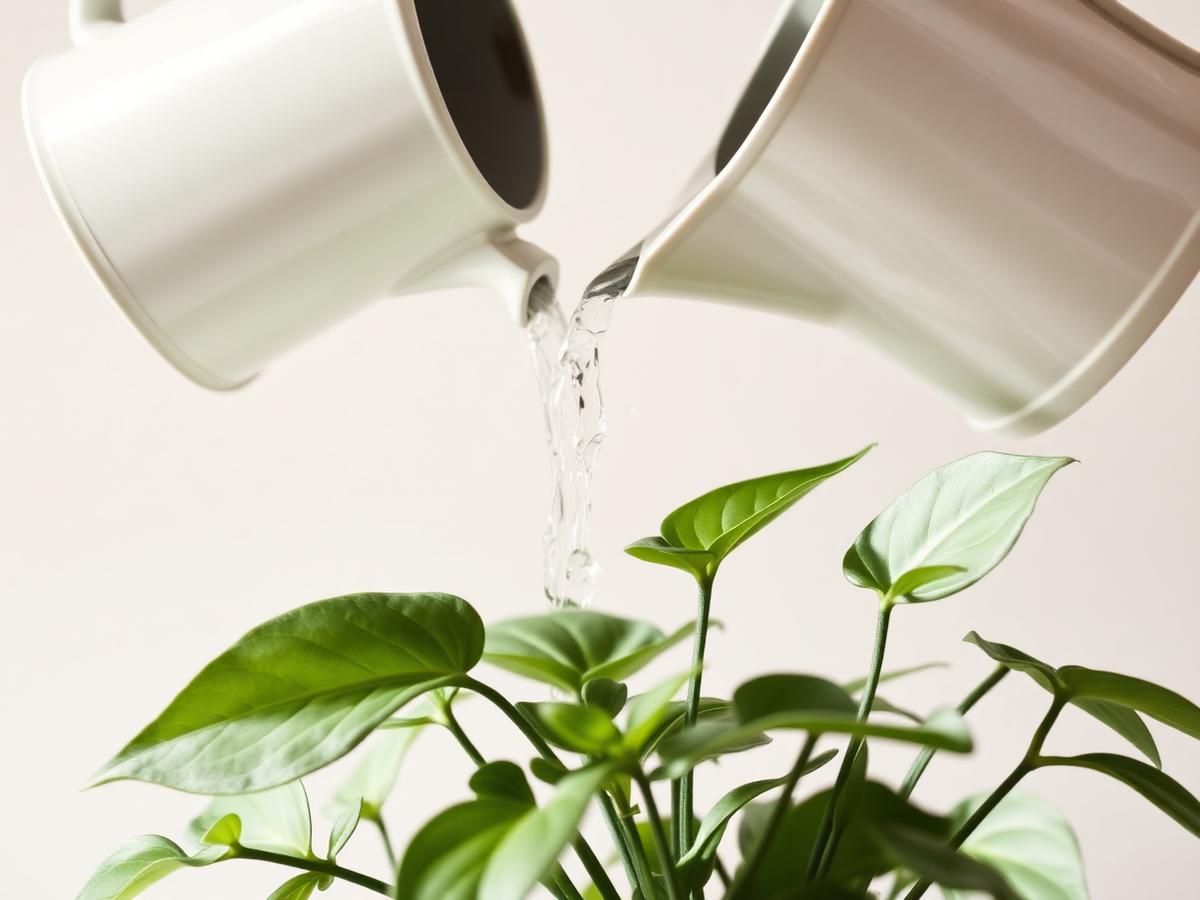
Misting alone does not water an air plant. The trichomes need to be fully saturated to absorb water, and a quick mist barely wets the leaf surface. The reliable method is the soak: submerge the entire plant in pure water for 20–60 minutes, then dry thoroughly. Do this every 7–14 days for most species, adjusting for drought tolerance and climate.
- 1Fill a bowl with pure water at room temperature. Use rainwater, distilled, or filtered tap water — see tap water for houseplants for the calibration. Hard water leaves white mineral spots on leaves over time.
- 2Submerge the entire plant. Hold it down if it floats. The water should cover all leaves; the rosette centre fills naturally.
- 3Soak: 20 minutes for ionantha and small species, 30–60 minutes for xerographica and stressed plants. Longer soaks for plants that have dried out for weeks.
- 4Lift out and shake hard. Inverting the plant briefly and giving it a sharp shake dislodges water trapped between leaf bases — this is what prevents crown rot.
- 5Dry upside-down on a paper towel or grid for at least 4 hours, in good airflow. Ideally finish drying in indirect light. Bulbous and tightly-rosetted species need the full 4 hours; flat ones dry faster.
- 6Return to display. Skip the next watering if leaves still feel cool and damp from the soak.
Light and air — the second half of the equation
Tillandsia want bright indirect light — the same target as a monstera or pothos, about 10,000–20,000 lux. East-facing windows are ideal. Within 1 m of a south or west window works well for xeric species; mesic species prefer the same distance or a little further back. Direct midday sun through south glass scorches even xeric Tillandsia within hours, especially when wet from a recent soak.
Air movement matters more than for soil-grown plants. Tillandsia evolved in environments with constant tree-canopy breeze; stagnant air after a soak is the most common cause of crown rot. A small fan running on its lowest setting in the same room is enough — not aimed directly at the plants, just keeping air moving. This is also the practical fix for mesic species kept in heated dry flats: airflow plus a humidifier nearby raises the local humidity to 50%+ without keeping the plants soaking wet.
Mounting and display
Tillandsia look their best mounted to a backdrop — driftwood, cork bark, slate, or wire — rather than just sitting in a glass orb. Mounting also dries faster after soaking, which reduces rot risk. The mount should be material the plant cannot rot: avoid most softwood (pine, untreated cedar) and avoid any wood that holds moisture; cork, mopani driftwood, and reclaimed grapewood all work well.
To attach: use waterproof glue (E6000, hot-glue, or a marine-grade silicone) on the back of the plant rosette, press onto the mount, and hold for 30–60 seconds. Do not use superglue — the cyanoacrylate vapour damages young leaves. Alternative: tie with monofilament fishing line, copper wire, or plant-mounting wire. Do not stick into terrariums sealed without ventilation; Tillandsia rot in 80%+ humidity without airflow.
Pups, flowering, and the life cycle
Every Tillandsia is monocarpic — it flowers once in its life, then produces pups (offsets from the base) and slowly declines. This is normal and expected. The mother plant typically lasts 6–18 months after flowering, gradually fading as the pups grow. The pups become the next generation: leave them attached to the mother to grow into a 'clump', or detach when they reach about a third the size of the parent and mount separately.
Flowering is triggered by a combination of mature size, season, and a stress signal. Some growers use 1 g/L of ethylene (from a slowly ripening apple in a sealed bag for 5–7 days) to force flowering on mature plants — the apple releases ethylene, which is the hormone Tillandsia use as a flowering trigger in the wild. The trick works best on ionantha and small species. Without forcing, expect mature plants to flower naturally between late winter and early summer.
Identification — confirming what you bought
Most shop air plants are sold without labels. The 30-second visual ID:
- ·Small (3–8 cm), tight silvery rosette, narrow stiff leaves, bright pink/red blush before flowering → Tillandsia ionantha (most common, beginner-friendly).
- ·Large (15–30 cm), silvery-grey, broad strappy curling leaves → Tillandsia xerographica (the queen).
- ·Medium (15–25 cm), bulbous base, long twisting silvery leaves → Tillandsia caput-medusae.
- ·Bulbous base, dark green leaves, smooth uniform shape → Tillandsia bulbosa.
- ·Bulbous base, dark mottled leaves, longer than bulbosa → Tillandsia butzii.
- ·Narrow grass-like green leaves with a flat pink flower paddle → Tillandsia cyanea.
- ·Stiff silvery rosette with thick fuzzy leaves like a snowflake → Tillandsia tectorum (Andean species, very xeric).
- ·Long thin grass-like leaves, no bulbous base, soft pendulous → Tillandsia juncea or T. fasciculata, both mesic.
- ·If completely unsure, photograph the plant and run it through an ID app — Tillandsia ID through apps is improving but still imperfect.
Toxicity — safe for cats and dogs
Tillandsia species are not listed as toxic to cats or dogs by the ASPCA. The bromeliad family contains saponins in some species (mainly Bromelia and pineapple relatives) but Tillandsia leaves cause at most mild stomach upset if chewed by a curious pet. Air plants are one of the few visually distinctive houseplants that are reasonable in pet households, alongside phalaenopsis orchids and most ferns.
The practical caveat: small Tillandsia look like cat toys when displayed loose on a coffee table. Mount them, hang them, or keep them out of reach if you have a cat that bats at small objects. The plant is not poisoned by play, but it does not survive being chewed and dropped behind the radiator.
Common first-year problems
Air plants signal problems on the leaves themselves — colour, posture, and tip condition.
- ·Brown crispy leaf tips: low humidity or under-watering. Soak more frequently, raise local humidity slightly, ensure water is pure.
- ·Leaves curling tightly inward: dehydration. Soak for 30–60 minutes, dry, and shorten the watering interval.
- ·Soft, mushy base, leaves pulling away from the centre: crown rot from water trapped after watering. Often fatal once advanced. Reduce soak duration and improve drying.
- ·Brown patches on the leaves: sunburn from direct sun, especially after a recent soak. Move back from the window.
- ·Whole plant turning red/pink: not necessarily a problem — pre-flowering colour change for ionantha and a few others. If no flower spike appears within 4–8 weeks and colour persists, check light levels.
- ·Leaves pale and elongated: low light. Move closer to the window or add a small grow light.
- ·White spots on the leaves: hard water mineral deposits. Switch to rainwater or distilled.