Identifying your Monstera (and avoiding common mix-ups)
"Monstera" in plant shops often covers several species that look similar when young but behave differently. Knowing what you have matters for scale, spacing, and expectations.
- ·Monstera deliciosa: The "true" Swiss cheese plant. Large leaves (30–90 cm), deep fenestrations and holes, produces edible fruit in the wild. Mature leaves develop geniculum (a flexible joint) on the petiole.
- ·Monstera deliciosa 'Borsigiana': A smaller-leaved, faster-growing variant of the same species often sold as "standard monstera". Slightly smaller internodes and leaves than deliciosa; commonly confused.
- ·Monstera adansonii: Smaller species with oval leaves full of holes but no splits to the leaf edge. Vine-like habit; often sold as "Swiss cheese vine".
- ·Philodendron bipinnatifidum (split-leaf philodendron): Often mislabeled as monstera. Leaves split but have no holes; the plant develops a self-standing trunk rather than climbing.
- ·Rhaphidophora tetrasperma: Sold as "mini monstera". Looks like a miniature deliciosa but is a different genus and stays under 1.5 m with leaves 15–25 cm.
Light — more important than anything else
Bright indirect light is ideal — a spot 1–2 m from an east or south window, or directly against a north window in summer. Monsteras tolerate medium light but pay for it in slower growth, smaller leaves, and fewer fenestrations. They scorch in strong direct afternoon sun (especially west-facing windows in summer).
The fastest way to get dramatic leaves is to move the plant to the brightest spot it can handle without burning. A sheer curtain in front of a south window is often the sweet spot — filtered bright light mimics the dappled rainforest canopy where the species evolved. Rotate a quarter turn weekly so growth stays balanced; monsteras lean hard toward the light.
Water — the thing most new owners get wrong
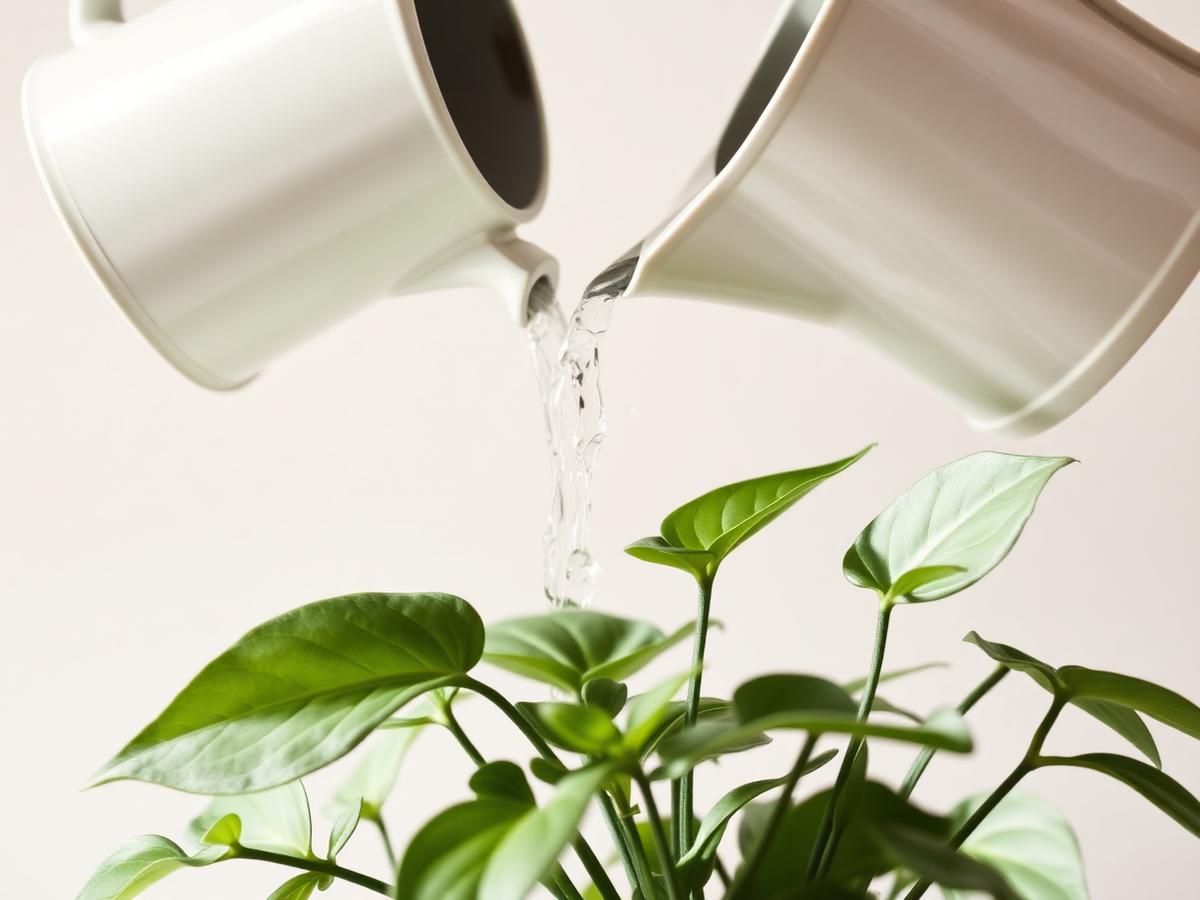
Water when the top 3 cm of soil feels dry — typically every 7–10 days in summer, every 10–14 days in winter. Monsteras are drought-tolerant but not drought-preferring: leaves droop quickly when thirsty and perk up within hours of thorough watering. Overwatering is far more common and far more damaging — symptoms include yellowing lower leaves and a musty smell from the soil.
Water until 10–20% runs from the drainage hole, then empty the saucer. Do not water on a schedule — large pots with chunky mix can hold moisture for two weeks in winter, dry in four days in summer. Use the finger test every time, or a weight-check: a dry pot is visibly lighter.
Humidity and temperature
Monsteras come from humid rainforests but adapt well to typical household humidity (40–60%). Below 30% you may see crispy leaf edges and slower growth; above 60% leaves are noticeably larger and more fenestrated. A humidifier is worth the investment if you are growing a rare variegated form; for a standard deliciosa, a normal living room is fine.
Keep temperatures between 18–27°C. Below 15°C growth stalls; below 13°C leaves may yellow and drop. Avoid cold drafts from single-glazed windows in winter and air-conditioning vents in summer. Monsteras survive a wide range but thrive in a consistent one.
Soil and potting mix
A chunky, well-draining aroid mix is non-negotiable. Straight peat-based houseplant mix holds too much water and causes root rot. The goal is fast drainage with moisture retention at the chunky fibres — mimicking the leaf litter and decomposing bark in the wild.
A reliable recipe: 40% high-quality houseplant mix or coco coir, 30% perlite or pumice, 20% orchid bark, 10% activated charcoal. You can buy premixed "aroid soil" but it is far cheaper to mix your own. Always use a pot with drainage — decorative pots without holes are fine as an outer cover, but never as the growing pot.
Fertilizing
Monsteras are moderately heavy feeders during active growth. A balanced liquid fertilizer (NPK 20-20-20, or similar) at half label strength every 2–4 weeks from March to September is sufficient. Skip fertilizer entirely from October to February, when growth naturally slows — feeding a dormant plant burns roots.
Signs of underfeeding: pale older leaves, very slow growth during peak season, fenestrations disappearing from new leaves. Signs of overfeeding: white salt crust on soil surface, crispy brown leaf tips, sudden leaf drop. Flush the pot every 3–4 months by watering thoroughly with plain water to wash out excess salts.
Support, climbing, and the moss pole
Monsteras are vines. In the wild they climb tree trunks using aerial roots, and their leaves grow progressively larger and more fenestrated the higher they climb. Without support indoors, they sprawl — leaves stay smaller, growth slows, and the plant looks increasingly unhappy as it matures.
Adding a moss pole or coir pole is the single biggest change you can make to a monstera's appearance. Aerial roots latch onto the damp surface and the plant trains itself to climb. Keep the pole damp (mist twice a week, or let it wick from a reservoir at the base). Tie new growth to the pole gently with soft plant ties until the aerial roots attach on their own. See aerial roots on monstera and pothos for the cut-or-train decision tree.
For fast attachment, choose a sphagnum moss pole over coir — roots grip it faster. Start with a 60 cm pole; once the plant reaches the top, stack a second pole or switch to an extendable system. Mature monsteras supported properly can produce 60–90 cm leaves within 2–3 years.
Aerial roots — what to do with them
Aerial roots are the thick, ropy roots that emerge from nodes along the stem. In the wild they attach to tree bark and absorb moisture from the air. Indoors, they confuse new owners — they look alarming but are entirely healthy.
Best practice: if you have a moss pole, guide the aerial roots toward it so they attach. If you don't, they will dangle — you can leave them alone (harmless) or tuck them back into the soil when you repot, where they'll help anchor the plant. Never cut off aerial roots while they're green and active; only remove them once they've turned woody and brown if they are ugly or in the way.
Fenestrations — why do leaves split?
Fenestrations — the splits and holes — are the feature most owners obsess over. Multiple theories exist for their biological purpose (wind tolerance in the canopy, allowing light through to lower leaves, more efficient rainwater capture), but the practical point is this: they are triggered by maturity and light, not age in years.
New monsteras produce solid, heart-shaped juvenile leaves. Fenestrations start appearing after the plant has matured for 1–3 years, but only in adequate light. A monstera in a dim corner may produce unfenestrated leaves indefinitely. Moving the plant to brighter light and giving it a moss pole to climb triggers fenestration in subsequent leaves within 2–4 months.
If you have an established plant that stopped fenestrating, check: is it in brighter light than it used to be, or dimmer? Does it have a support to climb? Has it been fertilized this season? Three yes answers usually bring fenestrations back in the next 1–2 new leaves. For the full diagnostic — light thresholds in lux, the moss-pole effect, and the species-ID step that catches mislabelled plants — see why doesn't my monstera have splits.
Pruning and training
Prune monsteras to control size, remove damaged leaves, or shape growth. Cut with clean sharp secateurs just above a node (the bumpy section of stem where leaves emerge). The plant often responds by producing two new growth points at the node below the cut — a quick way to make a leggy monstera bushier. The full pruning playbook (where exactly to cut, how to root the cutting, and why spring topping triggers the strongest back-budding) is in how to prune a Monstera.
Damaged or yellow leaves can be removed any time at the base of the petiole. Brown leaf tips can be trimmed to a natural curve with scissors — cosmetic only, the damage itself is already done. Save any stem cuttings with at least one node for [propagation](#propagation-below).
Propagation — the reliable method
Monsteras propagate readily from stem cuttings. Take a cutting that includes at least one node (the bump where a leaf emerges) — ideally with an aerial root already present, which speeds rooting dramatically. One leaf per cutting is enough; multi-node cuttings can be divided later.
Place the cutting in a glass of room-temperature water with the node fully submerged and the leaf above the water line. Change the water every 5–7 days. Roots appear within 2–4 weeks; once they are 5 cm long, pot into aroid mix and water well. Keep the new plant in humid conditions (a plastic bag over the pot for the first 2 weeks helps) until you see new leaf growth.
Sphagnum moss propagation works equally well — wrap the node in damp moss, wrap that in plastic, and watch for roots. For very rare variegated cuttings, this method reduces stress compared with water-rooting.
Repotting
Monsteras prefer to be slightly root-bound. Repot every 2 years in spring, going up one pot size (5 cm wider). Signs it's time: roots circling the bottom of the pot, water running straight through without soaking in, new leaves noticeably smaller than older ones.
During repotting, loosen the root ball gently, trim any black or mushy roots, and add fresh aroid mix. If the plant is already large and you want to keep it the same size, root-prune instead: trim the outer third of the root ball, refresh the soil, and return to the same pot.
Variegated varieties
Variegated monsteras are some of the most sought-after houseplants in the world, with individual cuttings selling for hundreds of euros. All are slow-growing, more sensitive to light, and prone to reverting to all-green under poor conditions — the same chimeric instability that affects Pink Princess Philodendron and Marble Queen pothos.
- ·Monstera deliciosa 'Albo Variegata': Sectoral white variegation, unstable — each new leaf can be all white, all green, or half-and-half. Chimeric mutation; cannot be propagated reliably from seed.
- ·Monstera deliciosa 'Thai Constellation': Cream/yellow speckled variegation on every leaf, tissue-cultured for stability. More forgiving than Albo and the best variegated monstera for beginners who can afford it.
- ·Monstera deliciosa 'Aurea' (syn. Marmorata): Yellow variegation rather than white. Extremely rare and unstable.
- ·Monstera deliciosa 'Mint': Pale green variegation on green leaves — subtle, rare, and expensive.
Common problems
Most monstera issues trace back to water, light, or pests. These are the patterns to recognise. For one of the most common — leaf curling — the dedicated monstera leaf curling diagnostic walks through the four curl shapes and the fix for each.
- ·Yellow lower leaves + damp soil = overwatering. Check drainage and let soil dry out.
- ·Brown crispy leaf edges = low humidity, hard water, or fertilizer burn. Flush the pot and increase humidity.
- ·Leaves failing to fenestrate = inadequate light or no climbing support.
- ·Leggy growth with long internodes = light starvation. Move closer to window or add grow light.
- ·Black stem base + leaf drop = advanced root rot. Propagate healthy top cuttings immediately.
- ·Sticky leaves + tiny moving dots = spider mites or thrips. Isolate and treat with insecticidal soap.
- ·White cottony clumps in leaf axils = mealybugs. Wipe with cotton swab dipped in 70% isopropyl alcohol.
- ·Crying leaves (water droplets at leaf tips) = guttation, usually after heavy watering. Harmless but a signal you watered more than the plant can use.
Toxicity
Monstera deliciosa contains insoluble calcium oxalate crystals in all parts of the plant. Chewing or swallowing causes immediate oral irritation, drooling, and in rare cases difficulty swallowing in cats, dogs, and small children. The reaction is unpleasant but rarely dangerous — the crystals discourage further ingestion. Contact a vet or poison control if a pet swallows a significant quantity.
The fruit produced by mature monsteras in the wild (hence deliciosa) is edible when fully ripe — but indoor plants almost never fruit, and unripe fruit contains the same oxalates and should not be eaten.
Growth rate and lifespan
Expect one new leaf every 4–6 weeks during the growing season, with each leaf slightly larger than the last as the plant matures. Young plants may push out two leaves in quick succession, then rest for a month. No new growth for 8+ weeks in spring or summer usually signals a light, water, or root problem.
Indoors, a well-cared-for monstera can live for decades — 20-year-old houseplants are common. Mature size indoors tops out at 2–3 m height and 1.5 m spread with a moss pole. The species can reach 20 m in the wild, climbing tropical trees.
Seasonal care at a glance
Monsteras follow the seasonal rhythm of light even indoors. Adjust water and fertilizer to match.
- ·Spring (Mar–May): Resume fertilizer, increase water as light returns. Best time to repot and propagate.
- ·Summer (Jun–Aug): Peak growth. Water every 5–7 days, feed every 2–3 weeks, rotate weekly.
- ·Autumn (Sep–Oct): Ease off fertilizer as growth slows. Watch for overwatering as evaporation drops.
- ·Winter (Nov–Feb): Skip fertilizer. Water every 10–14 days. Move away from cold glass; supplement with grow lights if natural light drops below 2,500 lux.