How to confirm it's sunburn — not disease, not nutrient burn
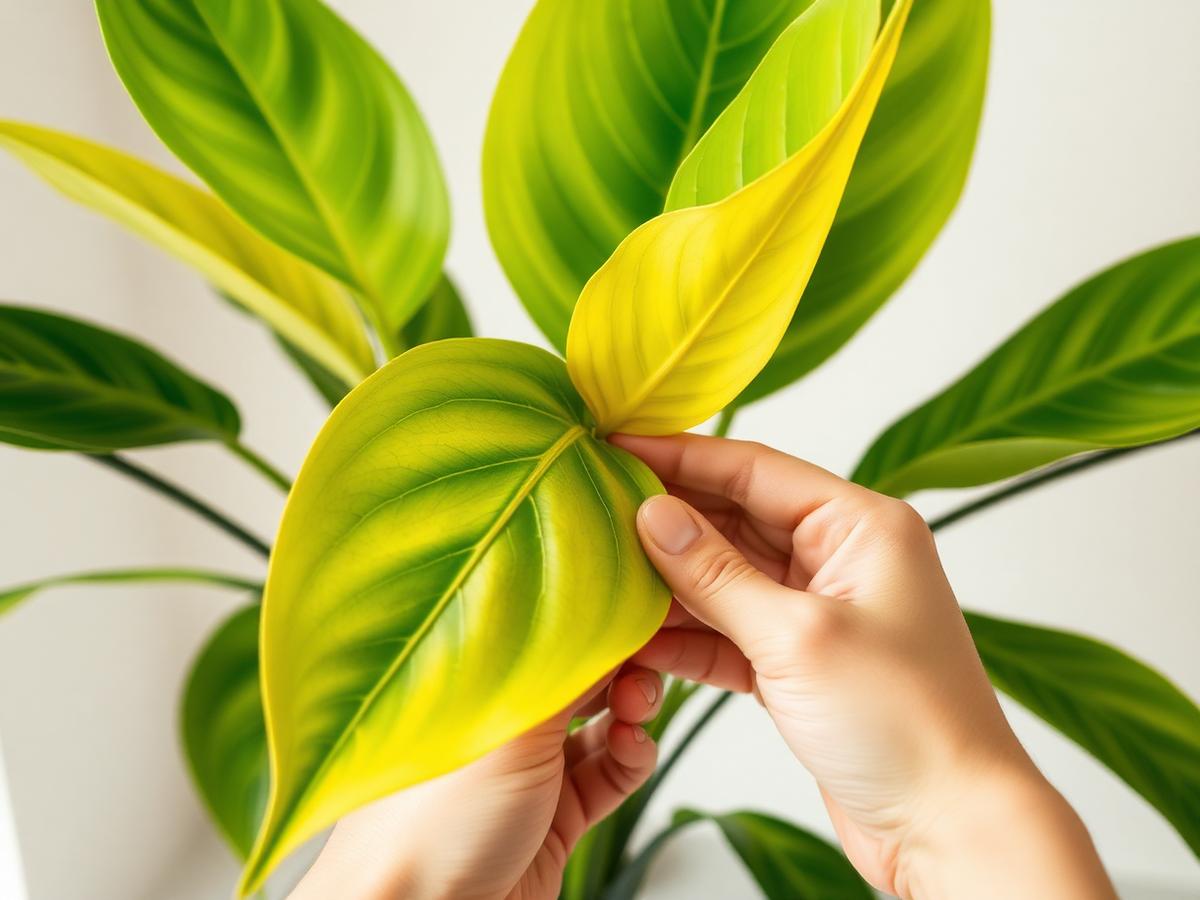
Sunburn has a recognisable signature. The damage is bleached or papery rather than dark, follows the side of the leaf that faces the light source, and has a hard edge between healthy and damaged tissue rather than a gradual fade. The discolouration is usually pale yellow, white, or beige — sometimes brown if the burn is severe — and it does not spread once the light cause is removed.
Compare to similar-looking problems: fungal leaf spot is darker, often with a yellow halo, and spreads over days to other leaves. Nutrient deficiency (chlorosis) yellows the entire leaf or the tissue between veins, not isolated patches. Salt burn hits leaf tips and edges, not the leaf face. Edema produces water-soaked blisters on leaf undersides, not bleaching.
- ·Bleached patches on the side of the leaf facing the window = sunburn.
- ·Brown or black spots with yellow halos, spreading day by day = fungal disease.
- ·Yellowing between green veins across the whole leaf = nutrient deficiency (interveinal chlorosis).
- ·Crispy brown tips and edges only = water quality, fertiliser burn, or low humidity — see brown leaf tips.
- ·Water-soaked blisters underneath = edema (overwatering response), not sunburn.
What's actually happening to the leaf
When sunlight intensity exceeds what the leaf's photosystem II machinery can process, the excess energy generates reactive oxygen species inside the chloroplasts. Those compounds break chlorophyll and damage the proteins that drive photosynthesis. The visible bleaching is chlorophyll loss; the underlying damage is to the leaf cells' photosynthetic apparatus.
Plants have a built-in defence — non-photochemical quenching, which dissipates excess light energy as heat — but the system needs days to weeks to ramp up. A leaf that grew indoors all winter has its photoprotection set for low light. Move it suddenly into a south-facing spring window and the protection lags behind the new light load by 7–14 days. That gap is when most indoor sunburn happens.
Why spring is the worst season for it
In Nordic and northern-European homes the seasonal swing is brutal. In Stockholm, daylight runs about 6 hours in mid-December and ~17 hours by mid-June. Sun angle climbs simultaneously — a south window that received only weak slanting rays through January now hosts intense direct light by mid-April. Plants that were perfectly happy on the same windowsill all winter can scorch within an hour of unfiltered April sun.
The scenario repeats every spring. A monstera or fiddle leaf fig was placed close to a window in November to maximise weak winter light. Nothing was changed in March. By the first warm bright weekend of April, the plant has bleached patches on the window-side leaves and the owner — having changed nothing — assumes the cause must be disease. Our acclimating to spring light guide covers the prevention side; this article is the symptom-side rescue.
Which plants burn first
Burn risk tracks evolutionary origin. Plants from rainforest understories (calathea, anthurium, peace lily, most ferns, maranta, fittonia) evolved under canopy and have low photosystem capacity — they bleach in conditions a desert succulent would find dim. Mid-canopy and gap-tolerant species (monstera, philodendron, fiddle leaf fig, rubber plant) tolerate more but still scorch under direct unfiltered spring sun if the change is sudden. Open-habitat species (succulents, cacti, jade, snake plant, ZZ) tolerate direct light routinely and rarely burn indoors.
Variegated cultivars burn faster than their plain-green parents at every level. White or pale tissue has no chlorophyll and cannot photosynthesise; it heats up faster and damages first. A variegated monstera ('Albo' or 'Thai Constellation') will scorch on a south windowsill in conditions a plain Monstera deliciosa would shrug off — see our monstera guide for the full light tolerance map.
Should you cut bleached leaves off?
Usually no. Bleached tissue does not recolour, but the leaf as a whole still photosynthesises with whatever green tissue remains. Cutting leaves prematurely deprives the plant of energy it needs to push out replacement growth. The rule of thumb: keep any leaf that's still more than 50% green, prune leaves that are mostly bleached or papery, and let the plant decide which damaged leaves to drop on its own.
The exception is leaves that are starting to crisp brown around the bleached patches — those are necrotising and will become entry points for fungal infection. Trim those at the base with clean scissors. Otherwise leave the plant alone for 2–3 weeks while it builds replacement leaves with appropriate photoprotection.
What to do right now (the 5-step recovery)
If you are reading this with a freshly bleached plant in the room, the priority is to stop further damage today and let the plant build photoprotection over the coming weeks. Do not water heavily, do not fertilise, and do not repot — sunburn is a light problem and any other intervention adds stress.
- 1Move the plant 1–2 metres back from the window — out of direct sun, into bright indirect light.
- 2Or add a sheer white curtain to the window to filter direct rays without losing brightness.
- 3Leave watering on its existing rhythm. A burnt plant transpires less, so if anything wait an extra 1–2 days before the next watering.
- 4Skip fertiliser for the next 3–4 weeks. The plant cannot use the extra nutrients while it recovers and excess feed compounds stress.
- 5Check leaf temperature against your hand: a leaf that feels hot to touch on a sunny afternoon is in active stress. Move further from the window or filter the light more.
Preventing it next spring
Two habits prevent almost all indoor sunburn. First, when the days lengthen in late February, walk through the house and reassess every plant near a window: leaves that were comfortably illuminated by weak winter sun are about to be hit with two to three times that intensity. Move sensitive species (calathea, ferns, peace lily) 1–2 metres back, or filter the window with a sheer.
Second, when introducing a new plant — or moving any plant from indoors to a balcony for summer — acclimatise it gradually over 7–14 days. Start with 1–2 hours of brighter light per day and increase incrementally. Plants build photoprotection at roughly 10–15% per day; rushing the transition is the single biggest cause of avoidable burn. The full protocol is in our acclimating to spring light guide. For the deeper light theory, see understanding light levels.