What you need (5 minutes of setup)
Pothos propagation does not need fancy gear. Tap water, a clear jar, and clean scissors are enough. Clear glass matters because it lets you watch the roots grow — and because algae buildup is visible early enough to clean before it harms the cutting.
- ·Sharp, clean scissors or pruners (wipe blades with rubbing alcohol).
- ·A clear glass jar, 200–500 ml — narrow opening helps hold the cutting upright.
- ·Room-temperature tap water (let chlorinated water sit out 24 hours if your municipality uses chloramines).
- ·A bright spot off the window — direct sun cooks roots through glass.
- ·An existing healthy pothos with at least 30 cm of vine.
Where to cut — the node is the only thing that matters
A pothos node is the small bump on the stem where a leaf petiole joins, often with a tiny brown nub of an aerial root. New roots emerge from these nubs, not from the leaf or the cut end. If you submerge a node, you get roots; if you submerge only stem and leaf, you get rot.
Trace back along a healthy vine until you find a stem section with at least one node and one or two leaves above it. Cut 1–2 cm below the node at a slight angle (more cut surface = faster healing). Strip away any leaf or sheath at the lowest node — that section will sit in water and any submerged leaf rots within days.
Multi-node cuttings (3–4 nodes) root faster and produce a fuller potted plant later, but a single-node cutting works perfectly well — it just produces a sparser final plant. To bulk up a finished propagation, see how to make pothos bushier.
The jar setup — light, water, and the algae problem
Place the cutting in the jar with the bare node fully submerged and the leaves clear of the waterline. Top up with tap water that has been sitting out at room temperature for at least an hour — cold water from the tap will shock the cut and slow rooting by a week.
Site the jar in bright indirect light — a spot that gets enough light to read by but no direct sun. A south-facing windowsill in summer will overheat the water and grow algae fast; a position 1–2 m back from the window, or beside a north-facing window, is better. Pothos roots in lower light too but the timeline stretches to 3–4 weeks.
Algae is the most common cosmetic problem — green slime on the glass and stem. It is harmless to the cutting but unsightly, and a heavy bloom can compete with roots for oxygen. Use an opaque jar, change the water more often, or wipe the inside of the glass with a paper towel weekly.
The root timeline — what to expect when
Pothos cuttings follow a predictable schedule when conditions are right. Knowing the milestones tells you whether to wait or troubleshoot.
- 1Days 0–3: cut end calluses; no visible activity.
- 2Days 3–7: aerial root nub at the submerged node swells and begins to push white root tissue.
- 3Days 7–14: 1–3 white roots emerge, each 1–3 cm long.
- 4Weeks 2–4: roots branch and lengthen to 3–8 cm; secondary roots fork from the primaries.
- 5Weeks 4–6: root mass reaches 5–10 cm — the cutting is ready to pot up.
- 6Weeks 6+: if left in water, roots continue to grow but the leaf takes nutrients from water and stalls — pot up before this stage.
When to pot up (and why timing matters)
Pot up when the longest roots reach 5 cm — long enough to anchor the cutting in soil but not so long that the brittle water-grown root structure fails on transition. Water-grown roots are smoother and more fragile than soil-grown roots; if they reach 10 cm or longer, expect 30–50% to break or melt off when potted, and the plant will pause for 2–4 weeks while it regrows soil-adapted roots.
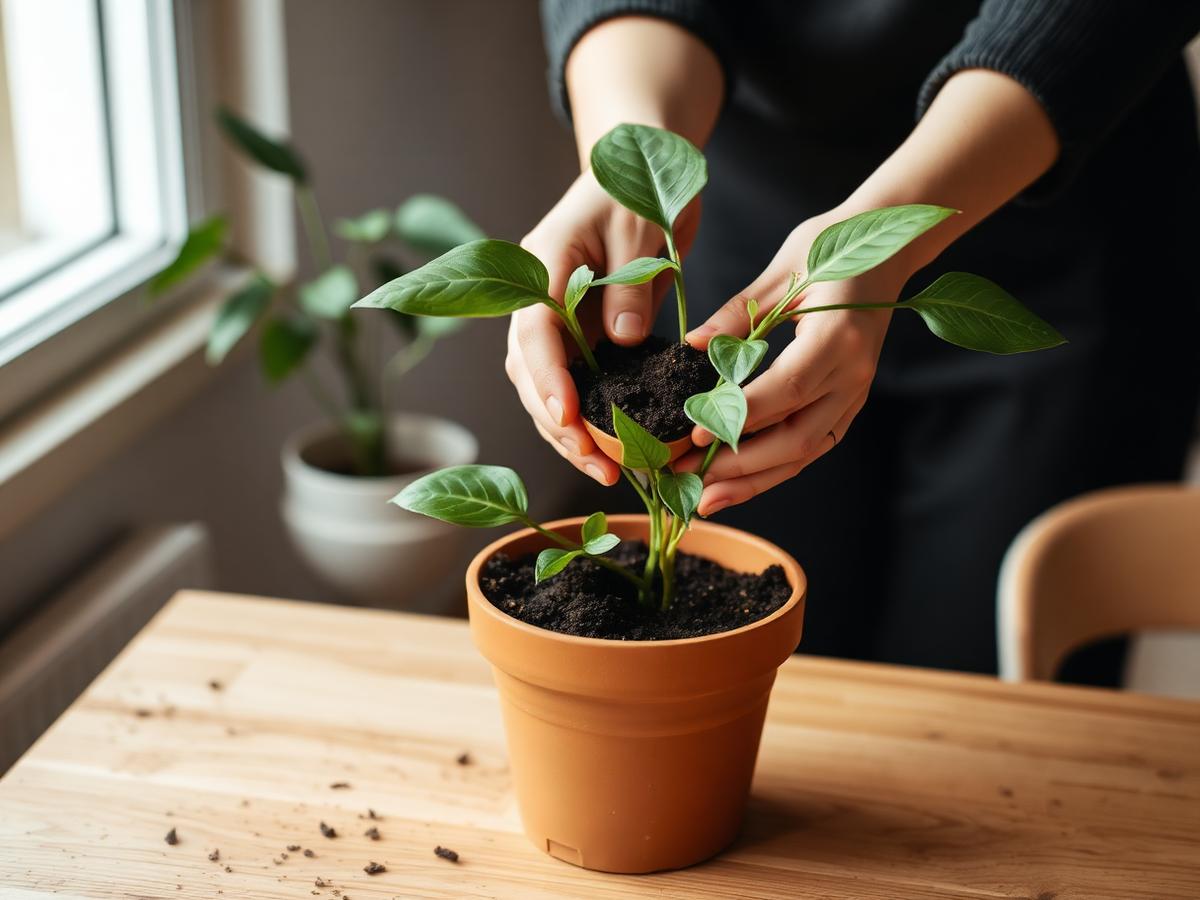
Use a small pot (8–10 cm) with drainage and a standard chunky potting mix (2 parts potting soil, 1 part perlite). Plant the cutting at the same depth the node sat in water, water once thoroughly, and keep the soil consistently damp — not wet — for the first two weeks while the roots adapt. After that, switch to the standard pothos cadence — water when the top 2–3 cm of soil is dry. The full timing rules are in the propagation pillar and the broader cutting timeline.
The three mistakes that fail every cutting
Almost every failed pothos propagation traces to one of three errors. None of them are subtle once you know to look for them.
- 1No node submerged. The most common cause of zero roots after six weeks. A cutting with only stem and leaf in water will not root — it will rot. Recut higher up to expose a node, strip the lowest leaf, and resubmerge.
- 2Stagnant water. Water that has not been changed in 4+ weeks goes anaerobic and the roots blacken at the base. Top up weekly, full change every two weeks.
- 3Direct sun on the jar. Roots cooked at 30 °C+ stop developing and the cutting yellows from the bottom up. Move the jar back from the window or use an opaque container.
Water vs soil propagation — which wins
Water propagation is the easiest and most visible method — you can see the roots and confirm progress without disturbing the cutting. The trade-off is that water-grown roots are weaker than soil-grown roots and the plant pauses 2–4 weeks while it adapts after potting.
Soil propagation skips the transition pause but you cannot see whether anything is happening — many beginners pull cuttings to check, breaking the new roots. For a first attempt, water is the right choice. Once you have done it once, soil-direct (with a humidity dome) gives a stronger final plant. The full comparison sits in the water vs soil propagation guide.