The 10-second visual test
Look at one mature leaf. Ignore juvenile leaves on any of these plants — they all start small and unsplit, and the adult form is what diagnoses the species.
- 1Does the leaf have holes inside the leaf surface (not just at the edge)? → Monstera (deliciosa or adansonii).
- 2Are the splits only at the edge, with no internal holes, and the plant is large with a thick visible trunk? → Split-leaf philodendron (Thaumatophyllum bipinnatifidum).
- 3Are the splits only at the edge, the leaf is small (10–25 cm), and the plant is climbing on a thin vine? → Mini monstera (Rhaphidophora tetrasperma).
- 4Is the plant small, vining, and the leaves have holes but no edge splits? → Monstera adansonii (Swiss cheese plant).
Monstera deliciosa: the real "Swiss cheese plant"
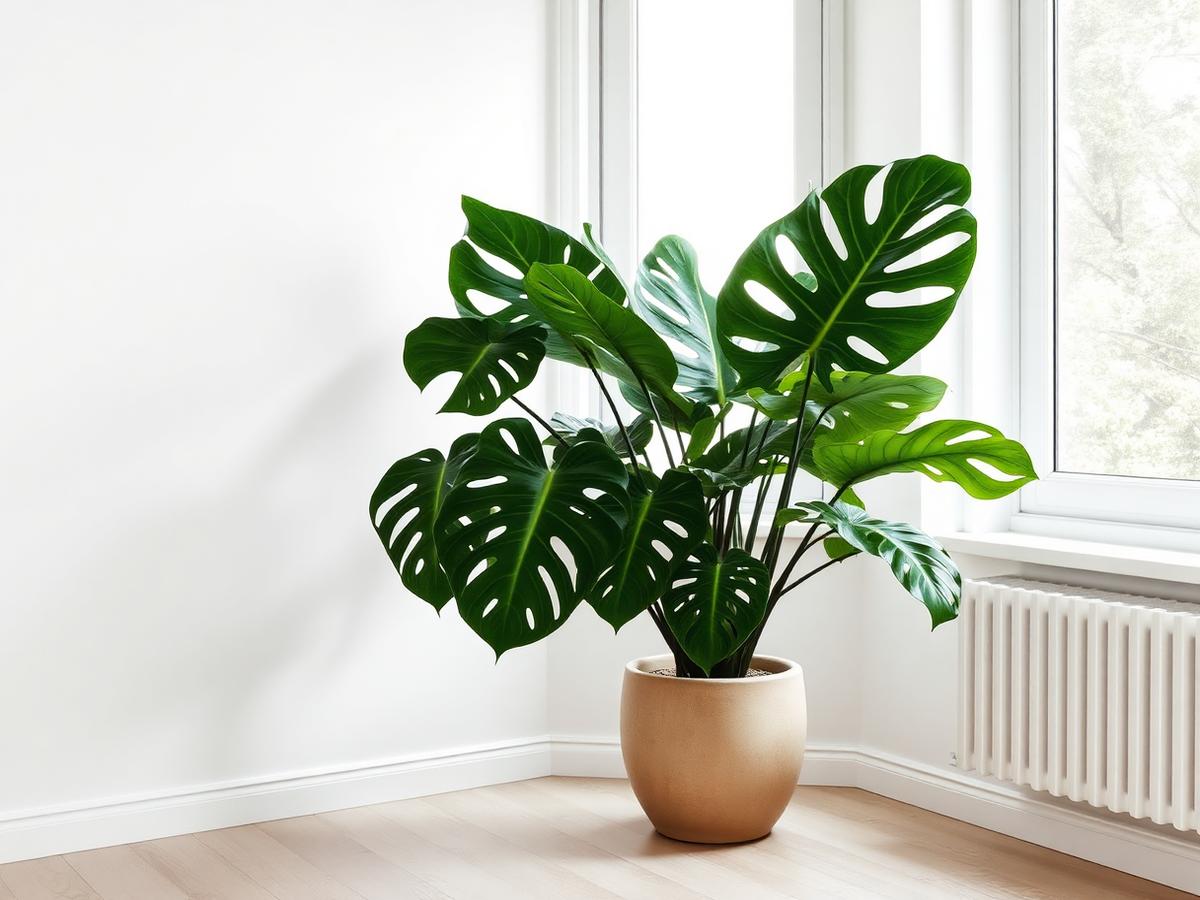
Native to the rainforests of southern Mexico and Central America, Monstera deliciosa is a massive climbing aroid whose mature leaves develop both fenestrations (holes inside the leaf) and deep splits (from the leaf edge toward the centre). The holes are why it's sometimes called "Swiss cheese plant" — though that name is more correctly applied to Monstera adansonii. Juvenile leaves are solid, heart-shaped, and unsplit; fenestrations begin appearing once the plant climbs and reaches brighter light.
Monstera deliciosa is a true climber. In its native range it ascends 20 m+ up tree trunks using aerial roots, and indoors it wants a moss pole or wooden plank to mimic that. On a pole it produces progressively larger, more split, more fenestrated leaves — often 40–60 cm across in a well-lit home, and 60–90 cm in conservatory conditions. The stem becomes thick and woody at the base, with pronounced leaf scars. See our full Monstera deliciosa care guide for watering, light, and support details.
- ·Leaf feature: internal holes (fenestrations) + deep edge splits.
- ·Leaf size at maturity: 40–90 cm.
- ·Growth habit: vining climber, needs a moss pole.
- ·Stem: thick, green-brown, with visible aerial roots and leaf scars.
- ·Mature height indoors: 2–3 m on a pole.
- ·Genus: Monstera — a true member of the 50-species Monstera genus.
Split-leaf philodendron: Thaumatophyllum bipinnatifidum
Historically called Philodendron selloum or Philodendron bipinnatifidum, the split-leaf philodendron was reclassified to the genus Thaumatophyllum in 2018. It's native to Brazil, Bolivia, Paraguay, and northern Argentina, and grows as a "self-heading" plant — meaning it produces new leaves from a central crown on a thick trunk, rather than vining up a support. Mature specimens develop a visible woody trunk covered in oval leaf scars, reaching 2–3 metres tall and 2 metres across.
The leaves look superficially like a Monstera deliciosa: deeply cut, dramatically lobed, glossy green. But a close look reveals the critical difference: the splits only reach in from the edge. There are no holes inside the leaf surface. The leaf is also more feathery and finely divided than a Monstera's, with many shallow secondary splits along each lobe.
- ·Leaf feature: edge splits only — no internal holes.
- ·Leaf size at maturity: 60–90 cm, feathery lobed silhouette.
- ·Growth habit: self-heading rosette — does not climb.
- ·Stem: thick woody trunk, visible leaf scars, no aerial roots to speak of.
- ·Mature size indoors: 2 m+ tall, 2 m+ wide — needs serious floor space.
- ·Genus: Thaumatophyllum (recently separated from Philodendron).
Mini monstera: Rhaphidophora tetrasperma
Despite its common name, mini monstera is neither a Monstera nor a small version of one. Rhaphidophora tetrasperma is a separate genus native to southern Thailand and Malaysia, and its leaves are small (10–25 cm at maturity in typical indoor conditions), thin, and split only from the edge. It climbs on narrow wiry stems, grows quickly, and wraps around a moss pole with small aerial roots.
Because it stays compact, it's often sold as the apartment-friendly alternative to Monstera deliciosa. Care is similar to other climbing aroids — bright indirect light, a moss pole, and the standard aroid watering schedule — but its thinner leaves and faster transpiration mean it prefers slightly more humidity and slightly more frequent watering than a Monstera deliciosa does.
- ·Leaf feature: small edge splits only — no internal holes.
- ·Leaf size at maturity: 10–25 cm indoors.
- ·Growth habit: vining climber on a thin wiry stem.
- ·Stem: thin (1–1.5 cm), light green, with small aerial roots.
- ·Mature height indoors: 1.5–2 m on a pole.
- ·Genus: Rhaphidophora — unrelated to Monstera or Philodendron.
Bonus: Monstera adansonii — the other Swiss cheese
Monstera adansonii is often confused with mini monstera because it's small, vining, and carries Monstera in its name. But adansonii's signature is different: the leaves have holes (fenestrations) across the entire surface, but minimal to no edge splits. Picture a flat green leaf with round or oval perforations scattered across it — that's adansonii.
Rhaphidophora (mini monstera) is the opposite: splits from the edge, no holes. If the leaves are small with obvious round holes, it's Monstera adansonii. If they're small with splits from the edge, it's Rhaphidophora. If they're large with both, it's Monstera deliciosa.
Side-by-side care differences
All three are tropical aroids and share broad care needs — bright indirect light, well-draining aroid mix, monthly feeding in growing season — but each has distinct preferences worth knowing before you buy.
- ·Monstera deliciosa: water when top 3–5 cm dries; needs a moss pole to fenestrate; tolerates medium light but grows slowly.
- ·Split-leaf philodendron: water when top 5 cm dries; does not climb; tolerates brighter light than Monstera; needs a large floor space.
- ·Mini monstera (Rhaphidophora): water when top 2–3 cm dries; climbs quickly on a pole; prefers slightly higher humidity (50%+).
- ·Monstera adansonii: water when top 2–3 cm dries; trails or climbs; prefers moderate humidity; fast grower.
Why these get mislabelled at nurseries
Nursery labels frequently call any split-leaved tropical "philodendron" because the name is catchier and familiar. In North American big-box stores, "split-leaf philodendron" is often used as an umbrella label for all three plants in this guide, which is partly why customers leave unsure what they bought. Botanical names settle this: Monstera deliciosa, Thaumatophyllum bipinnatifidum, Rhaphidophora tetrasperma are three distinct genera.
If your label says only "philodendron" or "split leaf", use the 10-second visual test above. When in doubt, check a mature leaf against our photo identification guide or run it through a dedicated plant ID app — all three of these are in the training set of most major plant ID systems and come back with high confidence scores.
Growing conditions at a glance
If you're choosing between these for a specific spot, the right plant depends more on your available floor space, support, and light than on looks alone.
- ·Small apartment, bright corner with room for a pole: mini monstera (Rhaphidophora).
- ·Medium room with space for a 2 m moss pole: Monstera deliciosa.
- ·Large loft or sunroom with 2 m+ of floor space: split-leaf philodendron.
- ·Shelf or hanging planter, needs a trailer: Monstera adansonii or pothos — see our pothos guide.
Toxicity: all three are toxic to pets
All four plants in this guide — Monstera deliciosa, Thaumatophyllum bipinnatifidum, Rhaphidophora tetrasperma, and Monstera adansonii — contain insoluble calcium oxalate crystals in their leaves and stems. If a cat or dog chews on the plant, it can cause mouth and throat irritation, drooling, and vomiting. Severe reactions are rare but possible. Keep all four out of reach of pets and children. See our full guide to pet-toxic houseplants for safer alternatives.