Light: bright indirect, and stay there
Rubber plants want 1,000–3,000 lux of bright indirect light — roughly the light level 1–2 m back from a large south or west-facing window in Northern Europe. A reading that low on a phone lux-meter app confirms what 'bright indirect' means in practice. See indoor light levels explained for how to measure this accurately with a free phone app.
Direct summer sun through glass scorches the large leaves; less than 500 lux (typical corner of a room) keeps the plant alive but produces leggy, pale new growth and greatly slows the watering window. Variegated cultivars like Ficus elastica 'Tineke' (cream-and-green) and 'Ruby' (pink-red) need at least 1,500 lux to hold their colour — in lower light, new leaves emerge plain green.
The most damaging thing you can do to a rubber plant is move it repeatedly between light conditions. Each relocation triggers a hormonal stress response that results in two to five leaves yellowing and dropping over the following fortnight. Find the right spot first — check with a lux app before committing — and do not move the plant unless the leaves are actively deteriorating.
Watering: drench and let dry
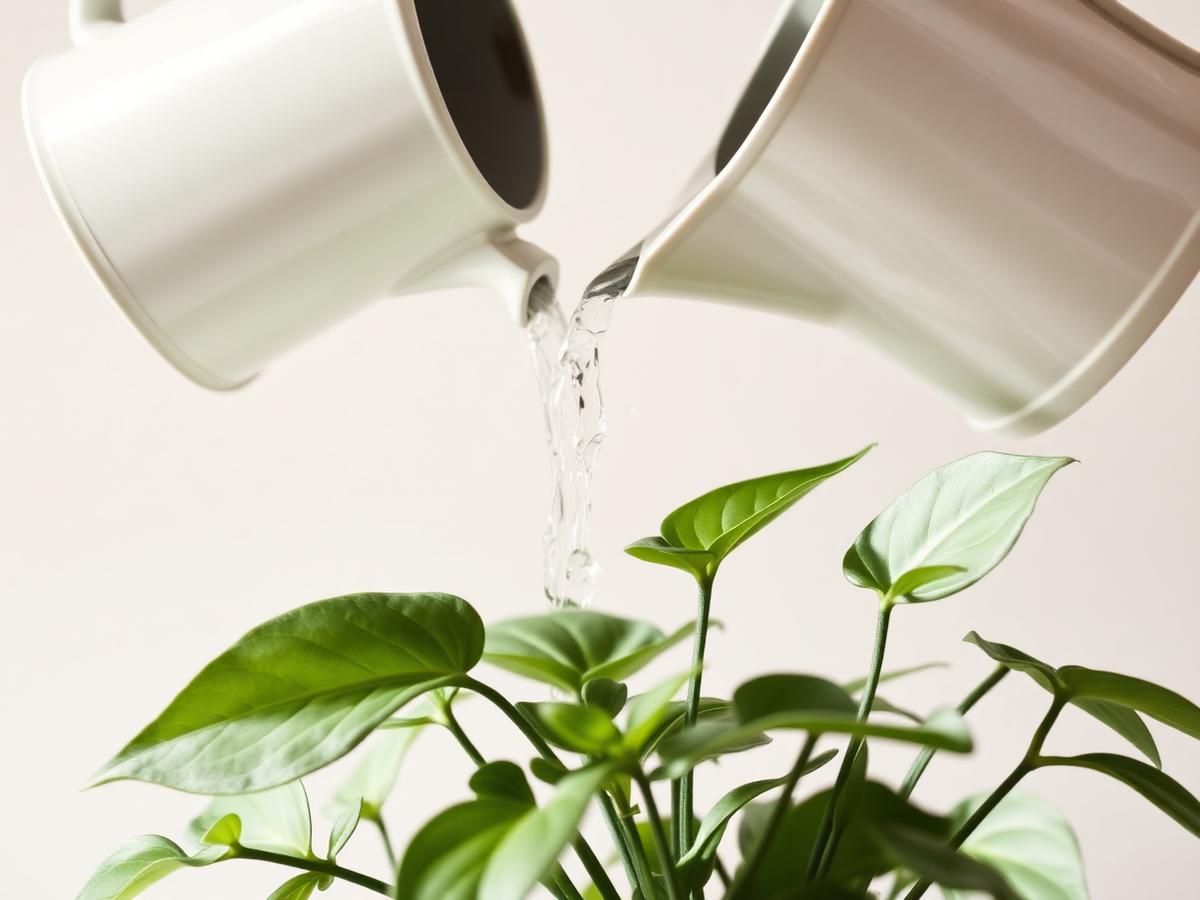
Water a rubber plant thoroughly when the top 3–5 cm of soil feels dry and cool — for a 20 cm pot this is typically every 7–10 days in summer and every 14–21 days in winter. Pour water slowly over the entire soil surface until it runs clearly from the drainage hole, then empty the saucer after 10 minutes. Ficus elastica does not want to sit in water.
The single most reliable way to kill a rubber plant is to give it small amounts of water frequently. This keeps the upper centimetre damp while the lower root zone stays dry, which both starves the roots of oxygen near the surface and fails to hydrate the bottom third of the root ball. Always water to run-off; never splash.
In winter, reduce watering to match the plant's dormancy — most rubber plants in an unheated Nordic room will go three weeks between waterings with no ill effect. If leaves appear soft and the soil is still damp, root rot is likely — unpot and check the roots before watering again.
Why rubber plant leaves fall off (ranked by likelihood)
Leaf drop is the rubber plant's universal stress response, which makes it frustratingly hard to diagnose. These are the causes in order of how often they occur:
- 1Overwatering / root rot — soft yellow lower leaves on damp soil. Stop watering; unpot to check.
- 2Position change — any move triggers 2–5 leaves falling within 10–14 days. Expected, not a crisis.
- 3Cold draughts or cold window glass — leaves touching single-glazed glass in winter brown from the back.
- 4Sudden light reduction — e.g. the plant was near a window all summer and is now 2 m further away.
- 5Underwatering — droopy leaves on bone-dry soil recover within 24 hours of thorough watering.
- 6Low humidity in winter — leaf edges brown and curl before the leaf eventually falls.
- 7Root bound state — a pot-bound plant dries out in 2–3 days and triggers constant leaf stress. Repot.
Soil, pot, and repotting
Rubber plants need fast-draining soil — standard potting mix amended with 20–30% perlite is the reliable recipe. Straight bagged potting soil compacts over 6–12 months, holds too much water, and cuts off the oxygen supply that root cells need for respiration. If the surface of your soil pulls away from the pot edge or has a white mineral crust, it has compacted — repot into fresh mix rather than trying to water through it.
Repot when roots emerge from the drainage holes, when the plant dries out in under 5 days despite normal watering, or when growth has stalled for two full growing seasons. Go up one pot size (2–3 cm wider) — a pot much larger than the root ball holds excess moisture the roots cannot uptake, raising root rot risk. See when to repot a houseplant for the full decision tree.
Spring (March–May) is the ideal repotting window, when days are lengthening and the plant is building new roots. Expect two or three leaves to drop after any repot — this is normal disruption, not a sign of failure.
Temperature and humidity
Rubber plants tolerate most indoor temperatures between 18–30 °C, but anything below 12 °C causes chilling injury — the large leaves develop soft translucent patches that turn brown within days. In a Nordic winter, keep rubber plants away from single-glazed windows (where glass surface temperature can drop to 5–8 °C on cold nights) and away from draughty exterior doors.
Humidity between 40–60% is ideal, and most rubber plants tolerate the low-humidity 30% of a heated Scandinavian winter without visible distress. The exception is the variegated cultivars (Tineke, Ruby, Doescheri) — their thinner-margined leaf cells desiccate faster, showing crispy brown edges by February in a centrally heated flat. A pebble tray adds marginal help; a small humidifier in the same room makes a measurable difference.
Feeding
Feed rubber plants monthly from March through September with a balanced liquid fertiliser (NPK 20-20-20 or similar) diluted to half the label strength. Fresh potting mix contains nutrients for the first 3–4 months — there is no benefit to feeding immediately after a repot.
Do not feed in winter. A dormant plant cannot metabolise the salts, which accumulate in the soil and cause brown leaf tips. If you see a white mineral crust on the soil surface by autumn, flush the pot with a litre of room-temperature water to dilute the salt load before you stop feeding for the season.
Varieties and which to grow
Ficus elastica varieties differ primarily in leaf colour and size. The species (plain green) is the most vigorous and tolerates the widest range of conditions. Key cultivars sold in Northern Europe:
- ·Ficus elastica 'Robusta' — the standard green rubber plant. Most tolerant, fastest growing.
- ·Ficus elastica 'Burgundy' (Black Prince) — deep burgundy-black leaves. Needs at least 1,500 lux to maintain colour.
- ·Ficus elastica 'Tineke' — cream, green, and grey marbling with pink sheaths. Needs 2,000+ lux; drops colour below this.
- ·Ficus elastica 'Ruby' — pink, cream, and green. The most light-hungry; looks poor in anything below 2,000 lux.
- ·Ficus elastica 'Doescheri' — narrow cream-and-green variegation. Less common but more stable than Ruby.
Propagation
Rubber plants propagate via stem cuttings or air layering. Stem cuttings: take a 15–20 cm cutting just below a node, wearing gloves to avoid the latex, and dip the cut end in warm water to stop the sap from setting. Place in water or slightly damp sphagnum moss and expect roots in 4–8 weeks in a warm bright spot.
Air layering is more reliable for thick-stemmed plants: wound the stem 30–40 cm from the tip, pack damp sphagnum moss around the wound, and wrap in clear plastic. Roots appear through the moss in 6–10 weeks, at which point you cut below the root ball and pot it directly. Air layering avoids the transition from water roots to soil roots that causes many cuttings to stall.
Cleaning and the latex sap
Rubber plant leaves attract dust — the large glossy surface area picks up urban particulates within weeks in a city apartment. A dusty leaf can lose 10–20% of its photosynthetic efficiency. Wipe each leaf individually with a damp cloth every 3–4 weeks. Do not use leaf-shine sprays, which block stomata over time.
Ficus elastica produces a milky white latex sap that emerges from any cut or broken surface. The sap causes contact dermatitis in sensitive individuals (wearing gloves when pruning or propagating is good practice) and is toxic to cats and dogs if ingested. The latex belongs to the same general family as rubber-tree latex used in gloves — some people with latex allergies react to it.
Common problems and quick fixes
Most rubber plant problems trace to one of three causes: too much water, too little light, or a position change. Yellow lower leaves on damp soil → stop watering and check roots. Brown leaf tips and edges → low humidity or salt in the soil. Pale new growth with long internodes → not enough light. Leaves dropping after a move → expected, will stabilise in 3–4 weeks.
If leaves are dropping rapidly (more than two per week) despite stable conditions, scale insects and spider mites are worth checking — both settle on the underside of leaves and on the stem nodes. Run a finger along the underside of a few leaves; a sticky residue means honeydew from scale. See scale insects on houseplants for the identification and treatment steps.