First: the taxonomic history that explains the confusion
Snake plants were placed in the genus Sansevieria for over two hundred years, which is why most plant shops, books, and labels still use that name. In 2017, a phylogenetic study based on DNA sequencing showed that Sansevieria sat inside the genus Dracaena rather than alongside it, and the entire genus was folded into Dracaena. The plant most people know as Sansevieria trifasciata is now formally Dracaena trifasciata — but the old name persists everywhere, and you'll see both used interchangeably. We use Dracaena trifasciata in this guide because it's the current accepted name, but every label that says Sansevieria refers to the same plant.
The reclassification matters for ID because it groups plants that look quite different (the tall flat-leaved ones, the cylindrical pencil-leaved ones, the small rosette "bird's nest" forms) under the same genus. Most of the cultivars we'll cover are different selected forms of one species — Dracaena trifasciata. A few, like Cylindrica and Stuckyi, are formally separate species (Dracaena angolensis and Dracaena stuckyi) but are sold under the snake-plant umbrella.
The 10-second variety test
Look at one mature leaf — its colour, its edges, and its shape. Three features sort the most common varieties.
- 1Tall flat leaves with bright yellow edges and dark green centres? → 'Laurentii' (the most common).
- 2Tall flat leaves with horizontal mottled green banding, no yellow edge? → 'Zeylanica' or wild-type Dracaena trifasciata.
- 3Solid silver-green leaves, no banding or edge stripe? → 'Moonshine' (also sold as 'Silver Moon').
- 4Tall leaves with vertical white pinstripes running top to bottom? → 'Bantel's Sensation'.
- 5Very dark green leaves with subtle light-green crossbanding? → 'Black Coral' (sometimes 'Black Gold').
- 6Round tube-shaped leaves like long pencils? → 'Cylindrica' (Dracaena angolensis).
- 7Small rosette, leaves under 25 cm, fanning out from the centre? → 'Hahnii' (bird's nest) or one of its sports.
'Laurentii' — the classic snake plant
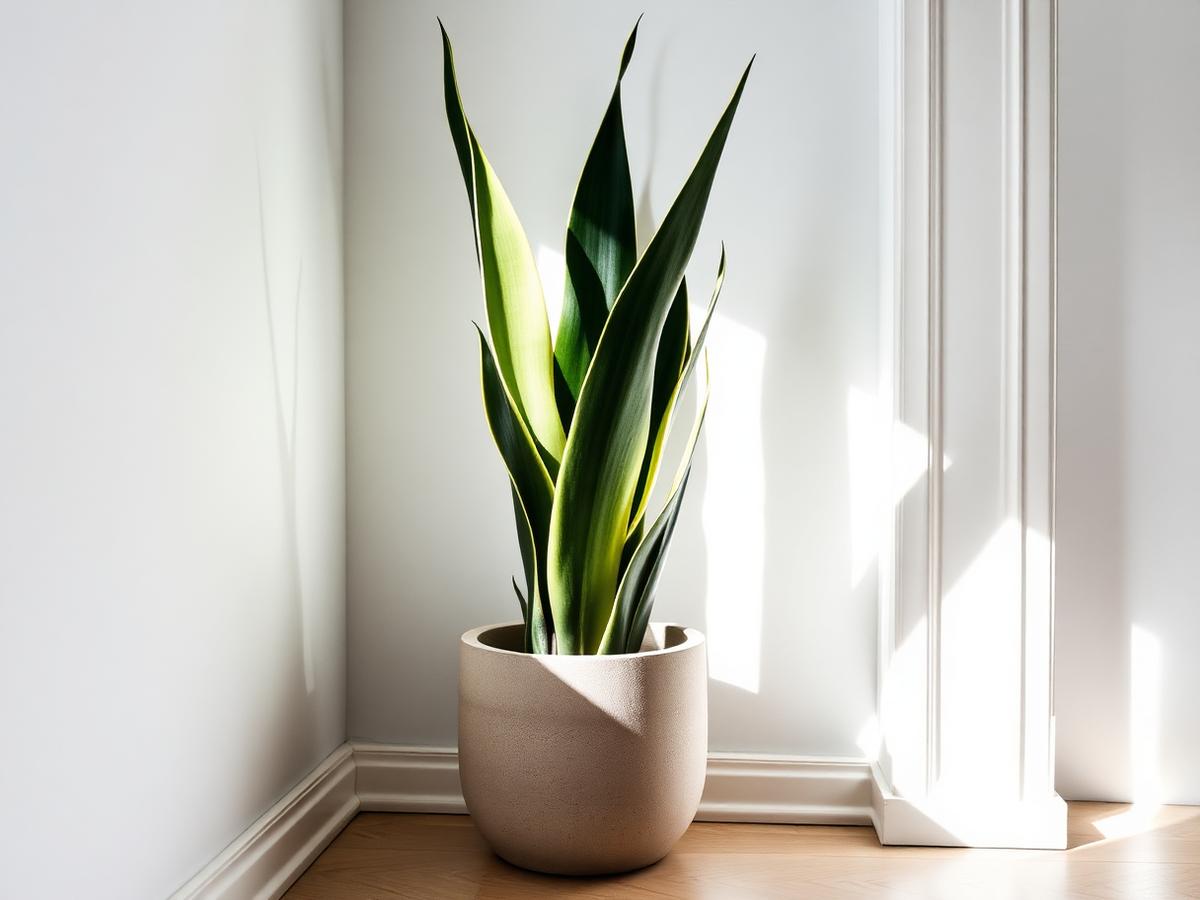
If someone says "snake plant" without specifying, they usually mean 'Laurentii'. It's the variety with tall vertical sword-shaped leaves up to 1.2 m, dark green centres, mottled grey-green horizontal banding, and bright yellow stripes running along both edges. The yellow margin is the diagnostic feature — no other common variety has it.
'Laurentii' is a chimera, meaning the yellow edge is genetically distinct tissue from the green centre. Practically, this means propagating 'Laurentii' from leaf cuttings produces plain green offspring without the yellow edge — to keep the yellow margin you have to divide the rhizome rather than cut a leaf. This catches a lot of new propagators by surprise.
- ·Leaf: tall (60–120 cm), upright sword-shape, dark green with yellow edges.
- ·Pattern: horizontal grey-green banding across the green portion.
- ·Mature size: 1–1.2 m tall in a 25 cm pot.
- ·Propagation note: yellow edge is lost when propagating from leaf cuttings — divide the rhizome instead.
- ·Most widely sold variety worldwide; available at every big-box garden centre.
'Zeylanica' / wild-type — the all-green original
'Zeylanica' is the closest variety to wild Dracaena trifasciata: tall flat leaves with horizontal mottled green-on-grey-green banding and no yellow margin. It's the variety most often sold as just "Sansevieria" or "Mother-in-law's Tongue" without a cultivar name. The leaves can look almost identical to a 'Laurentii' that's lost its yellow edge — but a true 'Zeylanica' was never variegated to begin with.
Because this is the wild-type form, propagation from leaf cuttings produces faithful copies (no chimeral loss). It's the variety to choose if you want to multiply your snake plant stock easily from leaves.
- ·Leaf: tall (60–100 cm), flat, all green with grey-green horizontal banding.
- ·Pattern: mottled cross-banding throughout, no edge stripe.
- ·Mature size: 60–100 cm tall.
- ·Propagation: easy from leaf cuttings — true to type.
- ·Often sold simply as "Sansevieria" or "snake plant" with no cultivar name.
'Moonshine' — the silver-grey one
'Moonshine' (also sold as 'Silver Moon' or 'Moonglow') has wide, flat leaves in a silvery grey-green colour with almost no visible banding. The whole plant has a soft, washed-out appearance compared to other snake plants — almost like it was painted with watercolours. Leaves are typically broader than 'Laurentii' but a bit shorter (40–80 cm).
The silver colour is sensitive to light. In bright indirect light, 'Moonshine' keeps its pale silvery tone; in low light it gradually shifts greener as the plant produces more chlorophyll. Move a fading 'Moonshine' to brighter (still indirect) light and the new leaves emerge with the original silver tone.
- ·Leaf: flat, broad (5–8 cm), silvery grey-green, 40–80 cm tall.
- ·Pattern: minimal banding — almost solid silver-green.
- ·Mature size: 40–80 cm tall.
- ·Light note: silver colour fades to green in low light; brighter light maintains it.
- ·Slightly slower-growing than 'Laurentii'.
'Hahnii' — the bird's nest snake plant
'Hahnii' is a compact mutation that produces a small rosette of short leaves (15–25 cm) fanning outward from a central crown. It looks like a bird's nest, hence the common name. Several sports (mutations) of 'Hahnii' exist with different colours: 'Golden Hahnii' (yellow variegation), 'Silver Hahnii' (silvery-grey), 'Black Hahnii' (very dark green).
Because 'Hahnii' stays small, it's a good fit for desks, shelves, and small windowsills where a tall 'Laurentii' wouldn't suit. Care is identical to other snake plants — bright indirect light, dry between waterings — but the small leaves dry out a bit faster than tall ones, so check soil moisture slightly more often.
- ·Leaf: short (15–25 cm), wide, fanning from central crown.
- ·Form: low rosette — never grows tall.
- ·Sports: 'Golden Hahnii' (yellow), 'Silver Hahnii', 'Black Hahnii'.
- ·Mature size: 25 cm tall, 30 cm wide.
- ·Best fit: desks, shelves, windowsills with little vertical space.
'Cylindrica' — the pencil snake plant (Dracaena angolensis)
Often sold as a snake plant variety, 'Cylindrica' is technically a separate species — Dracaena angolensis, formerly Sansevieria cylindrica. Its leaves are completely round in cross-section, like long firm pencils, and they grow up to 1.5 m tall with a pointed tip. The leaves are usually grey-green with subtle horizontal banding.
'Cylindrica' is often sold with its leaves braided together by the grower, which produces a striking sculptural shape but doesn't reflect how the plant grows naturally — left to its own devices it produces straight upright leaves. Care is identical to flat-leaved snake plants. The cylindrical form makes it slightly more drought-tolerant because the leaves have less surface area to lose water from.
- ·Leaf: round tube shape, 1–1.5 m tall, pointed tip.
- ·Pattern: grey-green with subtle horizontal banding.
- ·Often sold braided — purely cosmetic, leaves grow upright if released.
- ·Species: Dracaena angolensis (formally separate from D. trifasciata).
- ·Slightly more drought-tolerant than flat-leaved varieties.
'Bantel's Sensation' — the vertical white pinstripe
'Bantel's Sensation' is unmistakable: tall narrow leaves with vertical white pinstripes running the full length of each leaf. Some leaves have a wider white panel; others have many fine stripes; the variation between leaves on the same plant is part of its character. The variety is slower-growing than 'Laurentii' and has narrower leaves.
Because of the white striping, 'Bantel's Sensation' has less chlorophyll per leaf than green varieties and grows correspondingly slower. It also wants slightly brighter light — bright indirect rather than tolerating low light — to keep producing new leaves at a reasonable rate.
- ·Leaf: tall (60–90 cm), narrow, dark green with vertical white pinstripes.
- ·Pattern: irregular white stripes, varying widths between leaves.
- ·Slower-growing than 'Laurentii'.
- ·Wants slightly brighter (still indirect) light.
- ·Less common than 'Laurentii' or 'Hahnii' — typically found at specialist plant shops.
'Black Coral' and 'Black Gold' — the dark cultivars
'Black Coral' has very dark green leaves — almost black in low light — with subtle lighter green horizontal banding. 'Black Gold' is similar but with thin yellow-gold edges, a darker version of 'Laurentii'. Both have a dramatic, sculptural look that suits darker rooms and minimalist interiors.
Both are slower-growing than the standard varieties — the dark colour means less reflective surface and slightly less photosynthesis per leaf area. They tolerate low light better than most snake plants because their leaves are already adapted to absorb more of what's available.
- ·'Black Coral': very dark green with subtle light banding, no edge stripe.
- ·'Black Gold': very dark green with thin yellow-gold edges.
- ·Mature size: 60–100 cm tall.
- ·Tolerates lower light than other varieties; growth slows further in dim conditions.
- ·Less commonly sold; check specialist shops.
'Whitney', 'Futura', and other compact varieties
Several shorter, denser varieties exist between full-size 'Laurentii' and the small 'Hahnii' rosette form. 'Whitney' has wide leaves with a light grey-green centre and dark green margins (the inverse of 'Laurentii'), reaching 30–45 cm tall. 'Futura Superba' is a compact 'Laurentii' that maxes out around 60 cm. 'Futura Robusta' is similar without the yellow edge.
These mid-size varieties suit windowsills and small floor pots where 'Laurentii' would be too tall. Care is identical to other snake plants. They're often sold at general garden centres as "compact snake plant" without the cultivar name on the label.
- ·'Whitney': light centre, dark margins, 30–45 cm tall.
- ·'Futura Superba': compact 'Laurentii' (yellow edges), 60 cm max.
- ·'Futura Robusta': compact, no yellow edge, mottled green.
- ·All three are mid-size between 'Hahnii' rosette and full 'Laurentii'.
- ·Often unlabelled at big-box stores; ID by leaf colour and size.
Less common varieties worth knowing
A handful of other varieties show up at specialist nurseries and online sellers. Most are visually distinctive enough to ID on sight.
- ·'Twisted Sister': leaves twist and curl in a corkscrew pattern with yellow edges.
- ·'Starfish' (Dracaena angolensis 'Boncel'): cylindrica with very short fanned leaves arranged in a star shape.
- ·'Samurai' (Dracaena ehrenbergii): thick V-shaped leaves growing flat, fan-like rosette.
- ·'Fernwood' (Dracaena trifasciata × parva hybrid): narrow upright leaves with mottled green banding, more delicate-looking.
- ·'Masoniana' / 'Whale Fin' (Dracaena masoniana): single huge paddle-shaped leaf, sometimes 30 cm wide. Technically separate species.
- ·'Coppertone': bronze-coloured leaves with copper tones, new growth especially.
Care is identical across all varieties
Despite the visual variety, every snake plant in this guide wants the same conditions: bright indirect light (tolerates low light at slower growth), thoroughly drying out between waterings, well-draining cactus or succulent mix, and minimal feeding. Slightly variegated and slow-growing varieties ('Bantel's Sensation', 'Black Coral', 'Moonshine') benefit from the brighter end of "bright indirect" — they have less chlorophyll per leaf and need more light to drive growth.
Watering is the only place to be careful. Snake plants store water in their leaves and rhizomes and are extremely drought-tolerant — they rot fast in wet soil. Wait until the soil is bone dry (the top 5–8 cm crumbles when prodded) before watering thoroughly. In winter, this can mean every 4–6 weeks; in summer, every 2–3 weeks for most varieties. See our watering guide for the technique.
All snake plants are mildly toxic to pets
Every Dracaena trifasciata variety (and its renamed cousins) contains saponins that cause mild gastrointestinal upset in cats and dogs if chewed — drooling, vomiting, diarrhoea. Reactions are usually mild and self-resolving within a day. Snake plants are on the ASPCA's toxic plant list. If you have curious pets, see our pet-toxicity guide for safer alternatives.
The good news is that snake plant leaves are firm, fibrous, and not very interesting to most cats — chewing is uncommon compared to grass-like plants. If pets do bite, the bitter saponin taste usually deters them after one mouthful.
Common nursery mislabels
Snake plants are notoriously poorly labelled at general garden centres — "Sansevieria" or just "snake plant" is often the only label, with no cultivar name. Use the visual chart above to ID what you're actually buying.
- ·Old genus name (Sansevieria) still dominates labels — same plant as Dracaena trifasciata.
- ·'Laurentii' is sometimes mislabelled as just "snake plant" or "variegated snake plant".
- ·Plain green wild-type plants ('Zeylanica') are sometimes mislabelled "Sansevieria laurentii" because the seller doesn't know the difference.
- ·'Cylindrica' is often labelled "African Spear" or "Pencil Snake Plant" — same plant.
- ·'Bantel's Sensation' is sometimes mistaken for an unhealthy 'Laurentii' that's lost its yellow edge — the white pinstripes confirm Bantel.
- ·When in doubt, photograph the leaves and run them through a plant ID app.
Choosing the right snake plant variety for your home
If you want a tall floor plant that will grow to a metre or more in a corner, pick 'Laurentii' (yellow-edged) or 'Bantel's Sensation' (white-striped). If you want a desktop or shelf plant that stays compact, pick 'Hahnii' or 'Whitney'. If you want a sculptural, modern look, 'Cylindrica' or 'Twisted Sister' are unusual enough to be conversation pieces. If you have a darker room, 'Black Coral' tolerates the dim end of "bright indirect" better than the variegated forms.
Whichever you pick, the snake plant is one of the most forgiving houseplants on the market — it survives weeks of neglect, low light, and irregular watering. As an entry plant or as the spine of a larger collection, it's hard to beat.