Light — where snake plants surprise you
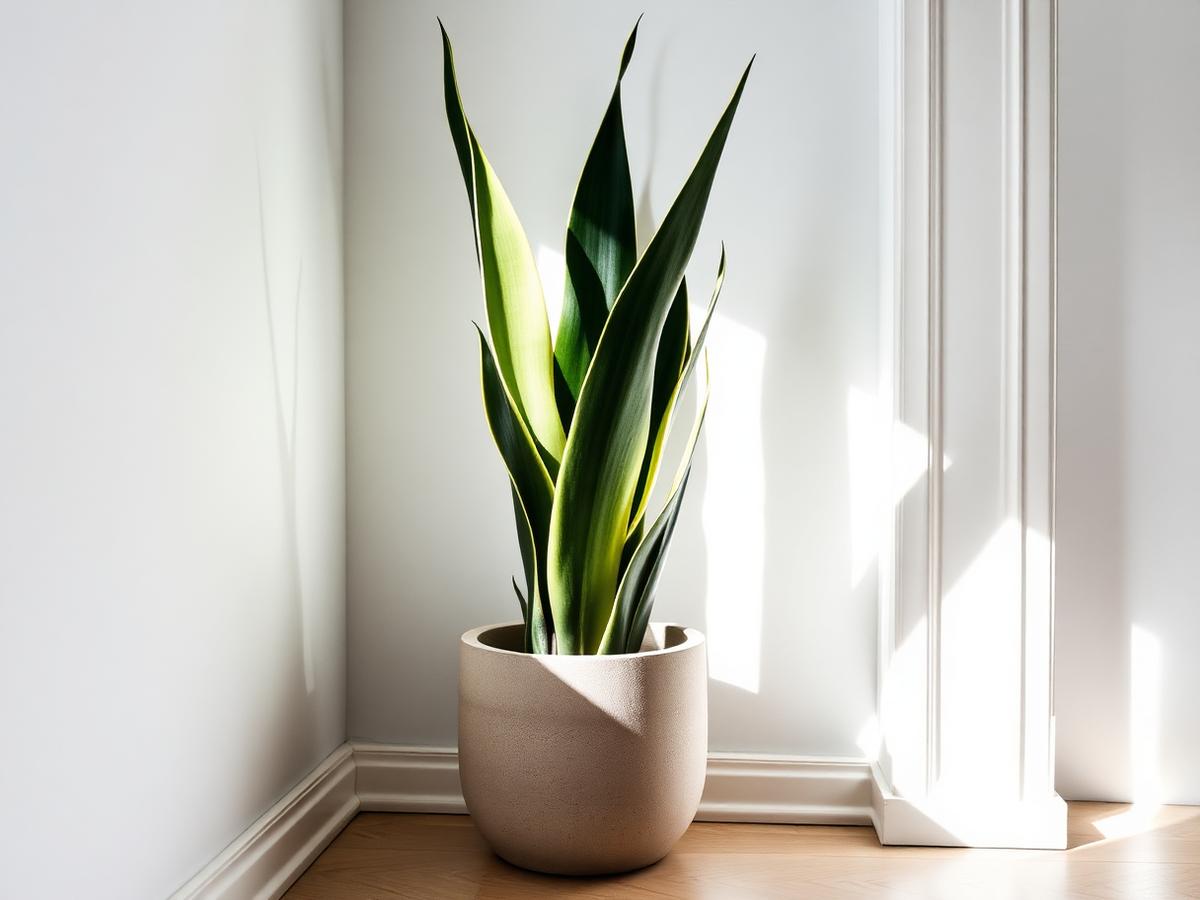
Snake plants are famous for tolerating low light, and they do — a plant in a dim hallway can stay alive for years. But the truth is more nuanced: they thrive in bright indirect light, grow quickly in several hours of direct sun, and merely survive in low light. Brighter light produces faster growth, stronger leaf colour, and more frequent new shoots from the rhizome.
The ideal spot is 1–2 m from an east or south window. A west window works if summer direct sun is filtered through a sheer curtain. Low light is tolerated but growth will slow to almost nothing — not a problem if you value the plant for low maintenance and shape, but worth knowing if you are waiting for new leaves that never arrive.
Water — the only thing you need to get right
Water snake plants only when the soil is completely dry, top to bottom. In summer this typically means every 2–4 weeks; in winter every 4–8 weeks. When in doubt, wait another week. Overwatering is the single leading cause of snake plant death — the symptom is soft, mushy, falling-over leaves and a rotting rhizome.
Water thoroughly when you do water — until 10–20% runs from the drainage hole — then empty the saucer. Small frequent splashes are worse than a thorough soaking every few weeks. Stick a long chopstick or moisture probe to the bottom of the pot if you are unsure — it should come out dry before you water again.
In winter, many experienced growers cut water to almost nothing — every 6–10 weeks — especially for plants in low light or cool rooms. The plant simply doesn't need more. Dormant snake plants can go 3+ months between waterings without stress if the room is cool.
Humidity and temperature
Snake plants tolerate any household humidity from a dry 20% to a humid bathroom at 60%. They are one of the best plants for centrally heated winter apartments where other tropicals struggle. Misting is unnecessary and can actually promote rot in leaf axils if overdone.
Target temperatures are 18–27°C. Below 10°C, leaves suffer cold damage — visible as mushy, blackened areas that don't recover. Above 32°C, growth pauses. Avoid placing snake plants near cold windowsills in winter or directly above heating vents where the airflow dries out the soil unevenly.
Soil and pot choice
Use a fast-draining cactus or succulent mix. A standard houseplant mix retains too much moisture — mix in 30–50% perlite or pumice if that is all you have. Snake plants store water in their leaves and rhizomes; they do not want saturated soil.
Terracotta pots are ideal because they wick moisture away from the root zone and dry the soil faster than plastic or glazed ceramic. If you like glazed pots for aesthetics, water less often to compensate. A drainage hole is non-negotiable — decorative pots without holes are a common killer of snake plants because water collects invisibly at the bottom.
Fertilizing
Snake plants are light feeders. A balanced liquid fertilizer at half strength once every 2–3 months during the growing season (March to September) is enough. Skip fertilizer in winter. Overfeeding causes more problems than underfeeding for this species — symptoms are brown leaf tips, salt crust on the soil surface, and rhizome damage.
A cactus-specific fertilizer works well because it is already formulated for lighter feeding and leaner soil. Flush the pot thoroughly with plain water twice a year to clear accumulated salts.
Varieties worth knowing
The snake plant family is larger than most owners realise — from tall upright sword-leaved forms to low rosettes to cylindrical "sticks". Care is identical across varieties, but form and size vary enormously.
- ·'Laurentii': The classic — dark green leaves with yellow-edged margins. Grows to 90–120 cm.
- ·'Zeylanica' / 'Robusta': Similar to Laurentii but without the yellow edges. Darker, more industrial look.
- ·'Moonshine' / 'Moonglow': Pale silvery-green leaves. Sensitive to low light (reverts darker) and slightly fussier about watering.
- ·'Black Coral' / 'Black Gold': Very dark green with lighter crossbanding. Grows upright to 90 cm.
- ·'Hahnii' / Bird's Nest: Dwarf rosette form, only 15–25 cm tall. Excellent for small spaces.
- ·'Golden Hahnii': Variegated version of the dwarf rosette — yellow edges on short green leaves.
- ·'Bantel's Sensation': Narrow upright leaves with vertical white stripes. Slow-growing, collector favourite.
- ·'Cylindrica' / Dracaena angolensis: Tall, round, pencil-thick leaves. Often sold braided. Technically a related species.
- ·'Whitney' / 'Samurai': Stocky, dark-green leaves with silver mottling. Compact (30–40 cm).
- ·'Twisted Sister': Curly, twisting leaves in gold-green. Dwarf size, unusual shape.
- ·'Futura Superba': Compact Laurentii-like form. Wider leaves, shorter height.
- ·'Starfish' (cylindrica fan): Cylindrical leaves arranged in a flat fan. Striking architectural form.
Propagation — four methods
Snake plants propagate in four reliable ways. The method you choose matters, especially for variegated varieties.
- 1Rhizome division (recommended for variegated plants): Unpot the plant, shake off soil, and use a clean knife to cut the thick underground rhizome into sections, each with at least one leaf and some roots. Repot in dry cactus mix, skip watering for 5–7 days. This is the only method that preserves variegation.
- 2Leaf cuttings in water: Cut a leaf into 5–10 cm sections, note which end was "down" (facing the soil), and place the bottom end in water. Change water weekly. Roots appear in 4–8 weeks, new shoots a few weeks after. Warning: variegated varieties lose their yellow edges and revert to plain green from leaf cuttings.
- 3Leaf cuttings in soil: Same sections as above, but stuck directly into damp cactus mix. Higher success rate than water for some growers; same variegation-loss issue.
- 4Whole-leaf cuttings: An entire detached leaf placed base-down in water or soil. Roots and new pups emerge from the base over 2–4 months.
Repotting — less often than most plants
Snake plants prefer to be root-bound. Repot every 3–5 years, or when the plant visibly cracks its pot from rhizome expansion. They can go longer without complaint than almost any other houseplant. Go up only one pot size when you do repot — oversized pots hold too much water and increase rot risk.
Repot in spring with fresh cactus mix and hold watering for 5–7 days afterwards. This is also the ideal time to divide large plants — healthy rhizome divisions root easily and make quick gifts.
The NASA "clean air" study and what it actually means
Snake plants are frequently cited as "air-purifying" based on a 1989 NASA study that tested houseplants' ability to remove volatile organic compounds (VOCs) in sealed chambers. The study is real, but it is often overstated.
The effect in a normal home is small. Scaling the lab results to a typical room, you would need around 100–1,000 snake plants per room to match the VOC-removal rate of simply opening a window. The plants do produce oxygen at night — interesting for bedrooms in theory — but the difference is too small to measure in human terms. Choose snake plants for being low-maintenance, not for air purification.
Common problems
Snake plants have a short troubleshooting list because they tolerate so much. The issues that do appear are almost always watering-related.
- ·Leaves falling over / floppy = overwatering and rhizome rot. Unpot, trim rotted sections, and repot dry.
- ·Yellow, mushy leaf base = rot at the rhizome. Isolate healthy leaves, propagate them, and start over if the rhizome is mostly lost.
- ·Crispy brown leaf tips = underwatering (rare) or chronic salt/fluoride from tap water. Flush the pot.
- ·Wrinkled or curling leaves = severe underwatering. Water thoroughly; recovery is slow but reliable.
- ·White mealy patches on leaves = mealybugs. Wipe with 70% isopropyl alcohol.
- ·Webbing between leaves = spider mites. Rinse and treat with insecticidal soap.
- ·Leaves split vertically = physical damage or sudden temperature drop. Cosmetic only; the split will not close.
- ·Black areas on leaves after winter = cold damage. Trim damaged tissue; move to a warmer spot.
- ·Slow or no growth = dormancy (normal in winter) or light starvation. Consider a grow light in December–February.
- ·Plant not flowering = flowering is rare indoors and triggered by stress (tight pot, consistent bright light). Not a sign of poor care.
Toxicity
Snake plants are mildly toxic to cats and dogs due to saponins in the leaves. Chewed leaves cause drooling, vomiting, and occasionally diarrhea. The reaction is unpleasant but rarely dangerous. The ASPCA lists snake plant as toxic to both cats and dogs.
Keep plants out of reach of pets that chew. A standing snake plant is usually ignored — cats tend to lose interest in upright, firm leaves quickly — but bored pets and puppies may still chew. Humans ingesting significant amounts may experience nausea; the leaves taste bitter enough that accidental ingestion is uncommon.
Outdoor growth and flowering
In USDA zones 10–12 (southern Florida, coastal California, tropical climates), snake plants grow outdoors as landscape plants, reaching heights of 1–2 m and occasionally flowering. The flower spike emerges from the centre of a mature rosette with small, fragrant greenish-white flowers. Flowering is rare indoors and typically triggered by mild root-bound stress and consistent bright light.
If you live in a temperate climate and want to move a snake plant outdoors in summer, do so only in a shaded spot — direct sun on a plant adapted to indoor light will scorch leaves within days. Acclimate over 10–14 days and bring the plant back inside well before temperatures drop below 13°C.
Why it is the hardest houseplant to kill
Snake plants evolved in semi-arid rocky habitats where water is unpredictable. Their thick waxy leaves store water, their rhizomes store energy, and they use CAM photosynthesis — opening leaf pores at night instead of during the day — which reduces water loss dramatically.
The result: a plant that forgives missed waterings better than almost any other houseplant, shrugs off low humidity, tolerates light levels that kill most tropicals, and doesn't need frequent repotting. The only way to kill one reliably is to love it too much with water. If you are a plant killer, this is where to start.