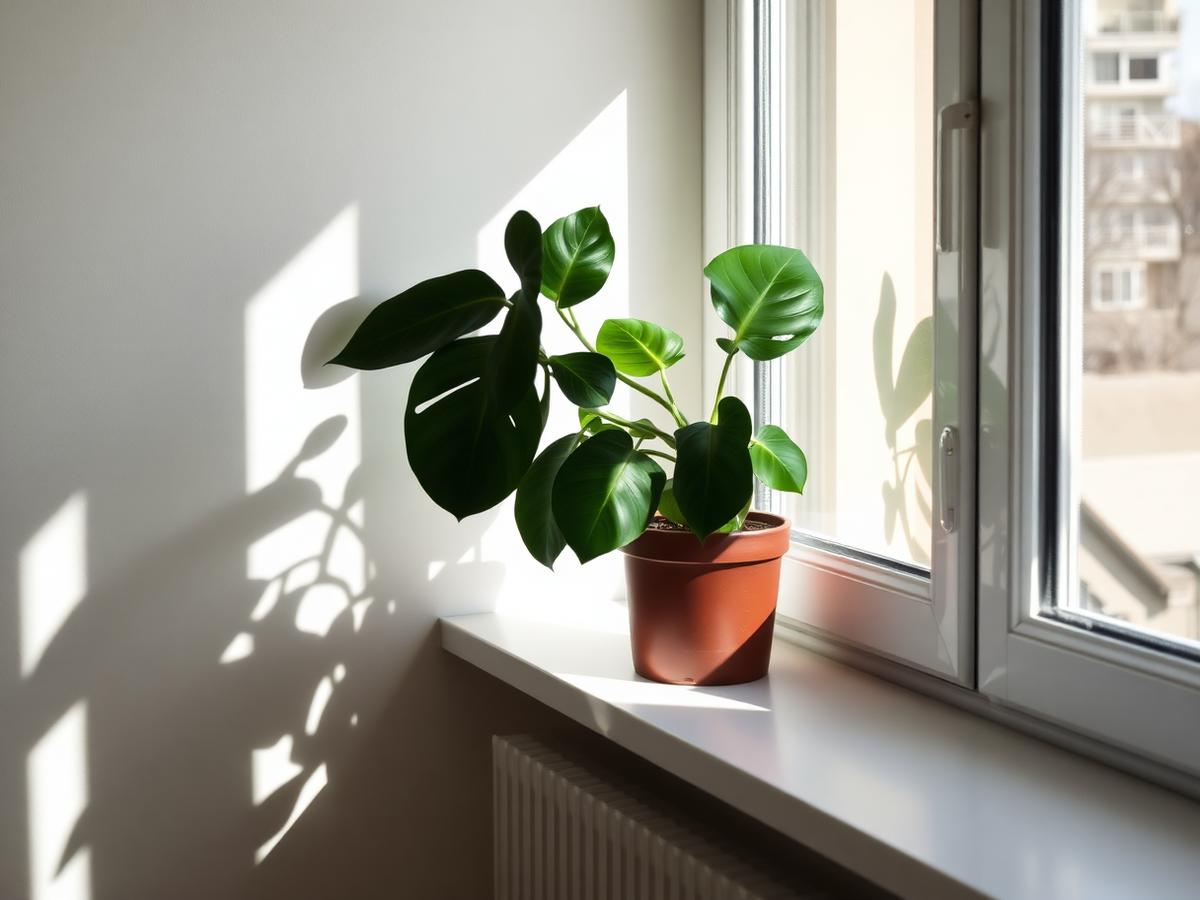
What "north-facing in London" actually means
A north-facing window never receives direct sun. What it gets is diffuse sky-light — the blue of the sky overhead, scattered. In summer at 51.5°N, this is still a usable 4,000–8,000 lux at the glass around midday, which supports most common foliage plants. In mid-winter, the same window at the same hour delivers 800–1,500 lux, and by mid-December it can be under 1,000 lux even on bright days.
Two London-specific factors make it worse than the numbers suggest. First, street-canyon shadow: most Victorian and Edwardian London is built on streets narrow enough that a four-storey terrace opposite shades the opposite pavement for most of the winter day. If you can see only sky by looking upward from your window — not any of the building across — you have full north-light. If you see a wall instead, reduce the published lux numbers by 30–50%.
Second, sash-window geometry. A period sash in a Victorian flat typically has thicker glazing bars, deeper reveals, and more window frame per square metre than modern double-glazing. Usable glazed area is often 70–80% of the total window hole — a real effect once you start counting lux at the sill rather than at the glass.
Month-by-month light in a north-facing London flat
Daylight in London at a north-facing window, measured at the glass at midday on a clear day — approximate values before the canyon deduction:
- ·December–January: 800–1,500 lux. Below the comfort threshold of most foliage plants; marginal for all but the hardiest.
- ·February: 1,500–2,500 lux. The worst month usually feels like December, despite days lengthening.
- ·March: 2,500–4,000 lux. First real recovery — surprise new growth on tolerant plants.
- ·April–May: 4,000–6,000 lux. Good season for almost any "low-light" plant.
- ·June–August: 5,000–8,000 lux. Peak. Can actually be too bright for some shade-lovers pushed up against the glass.
- ·September–October: 3,000–5,000 lux. Gradual decline starts.
- ·November: 1,500–2,500 lux. Growth slows or stops.
The eight plants that reliably hold up
These are picks from a north-facing Stockwell flat and equivalents — species that held onto their leaves through a full London winter cycle without a grow light. Ranked by rough order of tolerance.
- 1ZZ plant (Zamioculcas zamiifolia): The most forgiving. Thrives in 300–1,500 lux. Waters every 3–4 weeks even in summer. Will not grow fast in a north window — accept 2–3 new stems a year.
- 2Snake plant (Dracaena trifasciata): Nearly as tough as ZZ. Tolerates 200–2,000 lux. Over-watering is the only real risk. See the snake plant care guide.
- 3Aglaonema (Chinese evergreen): Evolved on tropical forest floors — effectively what a dim London flat simulates. Silver and green cultivars outperform pink/red ones in low light.
- 4Pothos (Epipremnum aureum): Golden pothos tolerates a north window year-round but growth almost stops November–February. Marble queen and N'Joy need slightly more light.
- 5Cast-iron plant (Aspidistra elatior): The classic Victorian parlour plant for a reason — bred for gas-lit drawing rooms. Handles 200 lux indefinitely.
- 6Parlour palm (Chamaedorea elegans): Genuinely tolerant of low light. Keep evenly moist, not wet. Long-lived.
- 7Peace lily (Spathiphyllum): Will not flower in a north window in winter. Leaves stay green. Wilts dramatically when thirsty — the easiest plant to read.
- 8Chinese money plant (Pilea peperomioides): Does well 1 m from a north window. Rotates weekly to stay symmetrical.
Plants Londoners buy and then lose
The flower-shop pick that kills itself in a north-facing London flat, in rough order of frequency:
- ·Fiddle leaf fig (Ficus lyrata): Needs 2,000+ lux minimum year-round. Drops leaves within a month of a north window in winter.
- ·Calathea / maranta (any prayer plant): Low-light tolerant in theory, but pairs the hard-water sensitivity with high humidity needs that London winter heating actively destroys.
- ·Ficus benjamina (weeping fig): Drops every leaf in response to any change; a move from bright shop to north window reliably triggers full defoliation.
- ·Most ferns (except kimberly queen and bird's nest): Low light plus dry radiator-heated air kills them in weeks.
- ·Bird of paradise: Wants direct sun. A north window gives zero.
- ·Most succulents and cacti: Etiolate (go leggy) badly in under 3,000 lux. Better in an east-facing kitchen window than a north-facing living room.
How far from the window matters more than the window itself
The cruel math of indoor light is that it falls off roughly with the square of distance. A plant 2 metres from a north window receives about a quarter of the light at the sill. 3 metres: a ninth. A living room's "dark corner" is almost never a real plant location, regardless of species — see the full distance-from-window analysis for the numbers.
For a north-facing London flat, the usable growing zone is within about 1 metre of the glass. Beyond that, even the hardiest plants (ZZ, snake) stop making new leaves between October and March. If you must keep a plant further in, either rotate it weekly with a window-adjacent sibling, or add a grow light.
Grow lights — when they earn their keep
In a north-facing London flat, a 20–40 W full-spectrum LED on a 10-hour timer pays for itself in the first winter. The difference between "surviving" and "growing" for plants like pothos, philodendron, and monstera is usually 400–800 extra lux, which a cheap LED provides from 30 cm above the plant.
The honest test: if a plant's noon-day light at its current location is under 400 lux on a January day (measure with a free lux-meter app or a £20 handheld), the plant is running below its minimum. For serious collections, a supplementary light turns a dim London flat into a workable growing environment — see do houseplants need a grow light for the full calculation.
The placement tricks that buy an extra tier
Before buying a grow light, try these — each recovers 200–1,000 lux without any electronics.
- ·Move plants onto the window sill itself: lux roughly doubles between 1 m back and right against the glass.
- ·Paint the wall behind the plant matte white: reflects 70–80% of what hits it back across the plant. Beige or grey walls reflect 40–50%.
- ·Remove net curtains and voile: they cut 20–40% of what reaches the plant.
- ·Clean the windows: grime on a London sash can reduce transmission by 10–20%; it accumulates faster than most people notice.
- ·Add a mirror on the wall opposite the window: doubles the effective light for a plant sitting between them.
- ·Rotate plants 90° weekly: stops leaning, keeps growth symmetrical under directional light.
The three-week test
The quickest way to know if a plant is in the right place in a north-facing London flat is to measure it against itself. Mark the newest leaf with a small piece of thread. Wait three weeks. In the summer (April–September), a thriving plant adds a new leaf or visibly extends the marked one. In the winter (November–February), no growth is expected — but existing leaves should stay firm and the same colour.
If leaves are yellowing, dropping, or getting smaller than old ones during the active season, the spot is not enough light. Move the plant closer to the window, add a grow light, or swap it for one of the reliable species above. A plant declining through summer in a north-facing flat is not a care mistake — it's a light-budget mismatch, and no amount of watering adjustments will fix it.