The 2-second rule: measure in window-widths, not metres
Before the tape measure comes out, try the crude version. Imagine the window turned on its side and laid down on the floor pointing into the room. One window-width from the glass is roughly bright indirect light. Two is medium. Three or more is low. It sounds too simple, and it is approximate, but it scales with the size of the window the way light actually does — a tall floor-to-ceiling pane throws useful light three or four metres; a narrow kitchen window barely a metre.
The rule breaks in two places: very narrow windows in tall rooms (the light fans out less than you'd expect) and any obstruction outside the glass. Use it as a placement starting point, then refine with the centimetre tables below.
Distance tables by window orientation
These are ranges for an unobstructed window at mid-latitudes (roughly 45–60° N — most of Europe, the northern US, Canada) with no sheer curtain. Add 20–30% to every number for a sheer-curtained window, and flip the whole table if you are in the Southern hemisphere.
- ·South window: 0–30 cm direct sun (often too hot for tropicals in summer); 30–120 cm bright indirect; 1.2–2.5 m medium light; beyond 2.5 m low light.
- ·East window: 0–50 cm soft direct morning sun for 2–3 hours; 50–150 cm bright indirect; 1.5–3 m medium; beyond 3 m low. The most forgiving window in the house.
- ·West window: 0–40 cm harsh direct afternoon sun; 40–120 cm bright indirect; 1.2–2.5 m medium; beyond 2.5 m low. Hotter and more scorching than east — acclimate carefully.
- ·North window (Northern hemisphere): 0–60 cm bright indirect cap — this is as bright as it gets; 60 cm–2 m medium; beyond 2 m low. No direct sun is possible unless the window is vast and the sun dips almost to the horizon in summer.
Why "bright indirect" doesn't mean "far from the window"
This is the single most common mistake I see. People read "bright indirect light" and park the plant on a bookshelf across the room from the window because it is not in direct sun. That is not bright indirect — that is medium at best, often low.
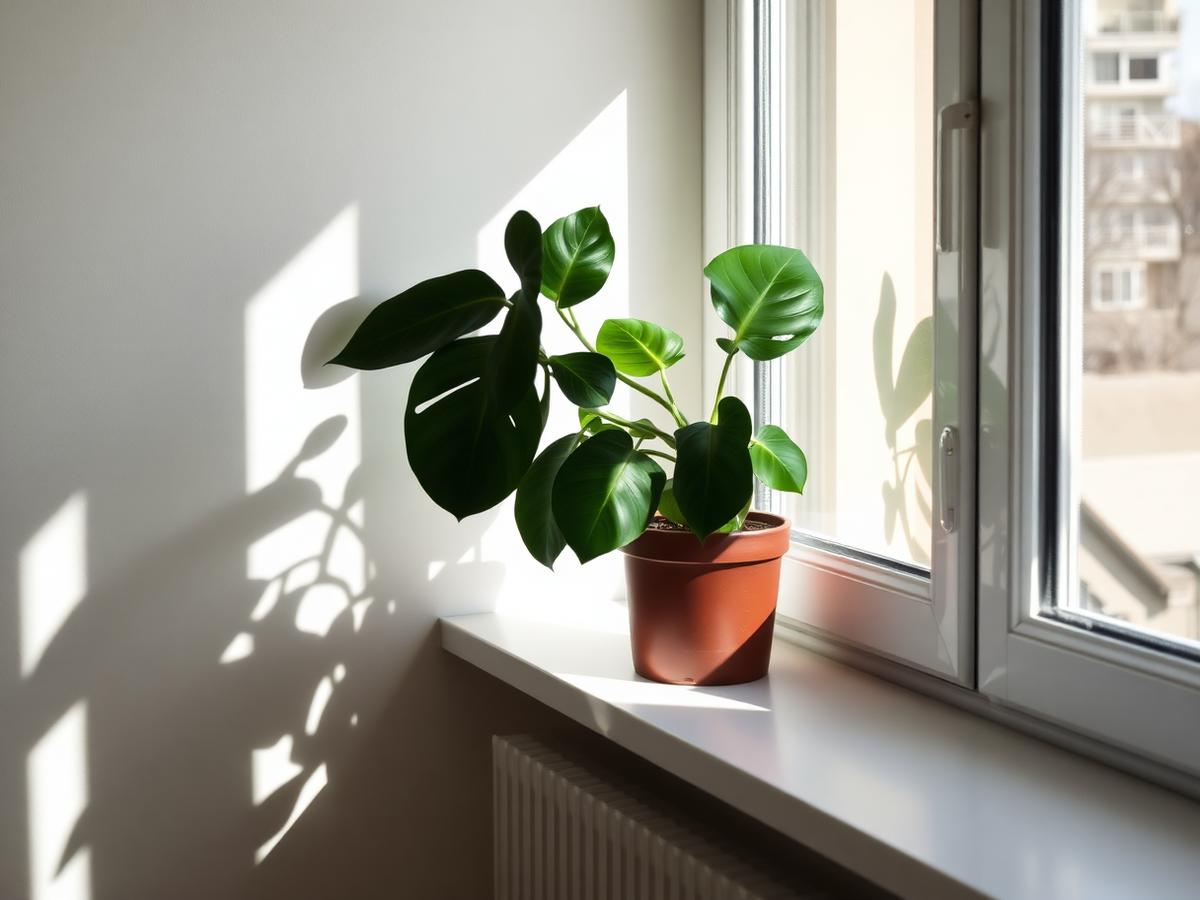
Bright indirect light lives close to the glass. On a south or west window it usually means 30–120 cm back, where the rays no longer touch the leaves but the whole field of view from the plant is still window. On a north window it means pressed against the sill. If you can't see the window from the plant's point of view, the plant can't see it either.
The confusion exists because outdoor "bright shade" — under a tree canopy, say — genuinely is bright. Indoors, there is no sky above the plant, only a ceiling. Light has to come in sideways through one opening, and it dies quickly.
Curtains, sheers, and what they cost you
Treat anything between the plant and the glass as a light tax. Most homes have more of it than they realise — net curtains, frosted film, a radiator cover, condensation, even a dirty window.
- ·Clean single-glazed window: baseline, ~100%.
- ·Double-glazed window: about 85% of the baseline (the coating absorbs some near-infrared and a little visible).
- ·Sheer / voile curtain: cuts usable light by 30–50%. Fine for a south window with tropicals; expensive on a north window.
- ·Venetian blinds half-open: 60–70% blocked depending on slat angle.
- ·Fabric blinds / roller shades fully down: 80–95% blocked — effectively night for the plant.
- ·Closed curtains: 95%+ blocked. A plant behind a closed curtain during the day is on a hunger strike.
The 90° trap: light falls off faster than you think
Indoor light behaves loosely like a point source near the window, which means the inverse-square law is a surprisingly good predictor. Double the distance from the glass and the light roughly quarters. Triple it and you are at about an eighth.
In practice: a pothos at 30 cm from an east window is in ~15,000 lux (bright indirect). Move it to 60 cm and it is at ~4,000 lux (low-medium). At 90 cm it is at ~1,700 lux — below the threshold where most houseplants grow rather than just survive. This is why "just a bit further" ruins placements.
The effect is less extreme when the window is enormous and the plant is close (the window acts more like a wall of light than a point), but the general rule still holds: every 50 cm of extra distance is a real cost.
How to check without a meter
Two free tests get you most of the way to a lux reading.
- 1The shadow test at plant-leaf height: at noon on a clear day, hold your hand 30 cm above the pot. A sharp, dark shadow with crisp edges means direct sun. A soft, defined shadow is bright indirect. A blurry, faint shadow is medium. Almost no shadow means low light. Do this at the leaf, not at head height — the difference between the two can be a full tier.
- 2The phone-app sanity check: free lux apps (Photone, Lux Light Meter, Plant Light Meter) read the ambient sensor and are accurate to ±20%. Hold the phone flat at leaf level, sensor up, and let the reading settle for 5 seconds. Target: 10,000–20,000 lux for bright indirect, 2,500–10,000 for medium, under 2,500 is low. Cross-reference with the shadow test — if they disagree, trust the shadow.
Seasonal distance drift: winter means closer
Indoor winter light at 55° N (Copenhagen, Hamburg, Dublin) is roughly a third of midsummer light at the same window. The sun sits lower, passes through more atmosphere, and is up for fewer hours. A plant that was happy at 2 m from the east window in June is starving by December.
Rule of thumb: move plants 30–50% closer to the brightest window of the house from mid-October to mid-February in Northern Europe. A monstera that lives at 1.5 m in summer wants 80–100 cm in winter. This is also when to consider a supplemental grow light — a single 20–30W full-spectrum LED on a timer for 10–12 hours a day replaces a window for the four darkest months. More on winter placement in a Nordic flat.
Don't forget to move them back in spring. The same south window that is perfect in January will scorch leaves in May.
Plant-by-plant distance cheat sheet
All numbers below assume an unobstructed east window at mid-latitudes with no sheer curtain. Adjust using the orientation table above for your actual window.
- ·Monstera deliciosa: 60–120 cm from an east window. Closer than 60 cm is fine but rotate weekly. Beyond 1.5 m and new leaves stop fenestrating — the classic "why won't my monstera split" problem is almost always distance.
- ·Fiddle leaf fig: 30–90 cm. The hungriest common houseplant for light. If the room only has a north window, the fiddle wants a grow light, not a better spot.
- ·Snake plant: 50 cm to 3 m — it genuinely doesn't care. The only houseplant where "that dark corner" is a real option, though it will grow faster within 1 m of the glass.
- ·Pothos: 50 cm to 2.5 m. Variegated cultivars (Marble Queen, N'Joy) need to be within 1 m or they revert to green; plain green and Neon pothos tolerate deeper placements.
- ·Calathea: 80 cm to 2 m. Direct sun scorches within hours, so keep them well back from south and west windows. An east window at 1 m is the ideal spot.
Obstructions that don't look like obstructions
The window in your plan and the window your plant sees are often different things. Look outside before you measure inside.
- ·A building across the street within 10 m: can cut incoming light by half even without touching the window — the patch of sky your plant draws from is smaller than it looks.
- ·Balcony or overhang above the window: kills direct sun on the upper half of the glass and costs a south window most of its value. A south-facing flat with a deep balcony is often effectively a north-facing one for plants.
- ·Exterior deciduous trees: fine in winter, catastrophic in summer when they leaf out. Worth reassessing placements in May.
- ·Tinted or low-E glass (common in new builds): cuts 20–40% of photosynthetically active light with no visible darkening. A 2026 new-build window is dimmer than a 1970s single-glazed one at the same orientation.
- ·Dirty glass: 10–20% loss. Cleaning the window is the cheapest upgrade in any houseplant setup.
- ·Dark walls or a radiator directly below the sill: both reduce reflected light bouncing back up into the lower leaves.
When to stop measuring and just move the plant
Numbers are a starting point; the plant is the final judge. Give any new spot two full weeks before deciding. In the first week, leaves may droop or yellow slightly from acclimation — this is not the verdict.
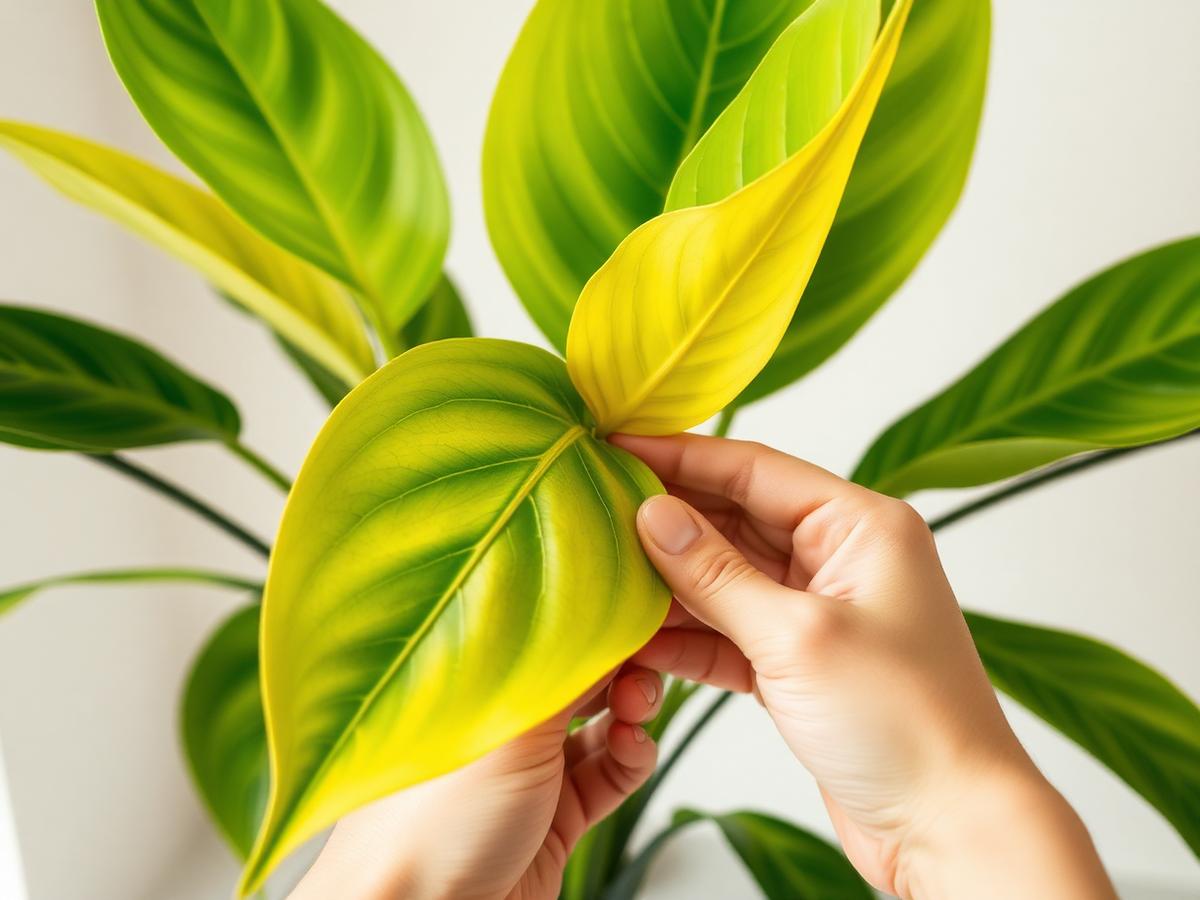
After 14 days, look for the signs. If new leaves are smaller or paler than old ones, or the stems are reaching visibly toward the window, move it closer. If leaf tips are crisping or tips turning brown without a watering change, move it back. If you see unexpected yellowing of lower leaves, that is usually low light, not overwatering.
The best plant-placers I know measure once, watch for a fortnight, and adjust by 20 cm at a time. Everyone else shuffles plants weekly and wonders why nothing thrives. Patience and a tape measure beats intuition every time.