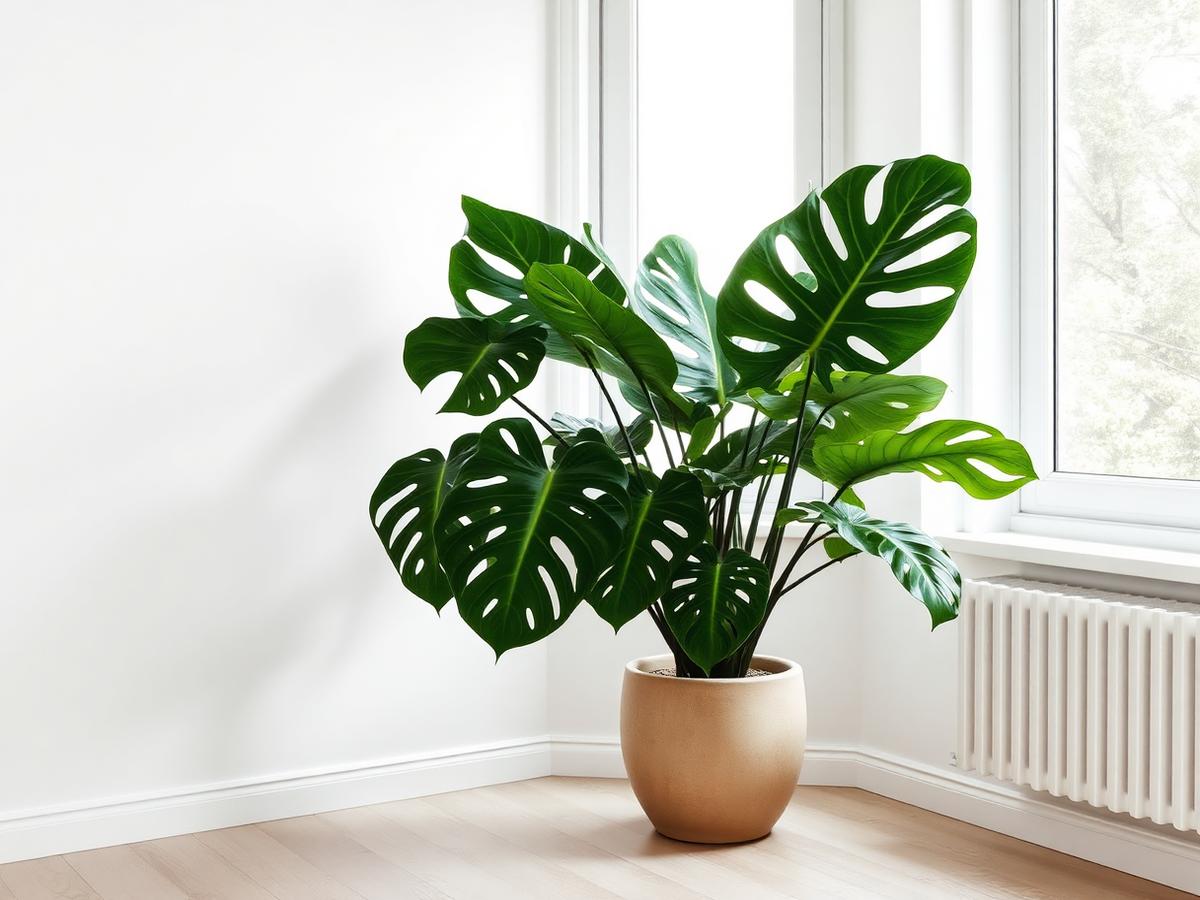
All four are the same species
Monstera deliciosa, Thai Constellation, Monstera Albo Variegata, Monstera Mint Variegata, and Monstera Aurea are all the same species — Monstera deliciosa. The differences are all about the variegation: where the white or cream pigment-free tissue is distributed and how the mutation was selected.
Understanding this is the first scam-prevention step. Sellers sometimes frame these as "different plants" or "rare species" to justify price — they're not. They're one species with four named variegation patterns, each produced by a different underlying biology.
The two kinds of variegation: chimeric vs genetic
All four variegated Monsteras fall into one of two categories. Chimeric variegation means a single plant contains two genetically distinct tissues growing side by side — one with chlorophyll, one without. The pattern depends on how the cells divide and is unstable: a cutting can come out more or less variegated than the parent, and the plant can revert entirely if the green tissue outcompetes the white. Monstera 'Albo Variegata' and 'Mint Variegata' are chimeric.
Genetic (or tissue-cultured) variegation comes from a stable mutation that every cell carries. The pattern is the same across every leaf, every cutting is identical to the parent, and reversion does not happen. Thai Constellation is genetic — it was stabilised through tissue culture in Thailand in the 1990s, which is where the name comes from. This stability is the single biggest practical difference between the cultivars.
Monstera 'Thai Constellation' — stable, tissue-cultured
Thai Constellation has fine cream-yellow speckling and marbling distributed across the leaf blade — think stars across a night sky, not hard-edged sectors. Every leaf looks similar, every cutting matches the parent, and the plant does not revert. It is the most reliable variegated Monstera you can buy: you are paying for a known quantity. It is also the least expensive of the four, typically running a fraction of what 'Albo' costs for a comparable plant, precisely because tissue culture has made production scalable.
Leaves are slightly thicker and more cupped than a standard green Monstera, and new leaves emerge with more yellow-cream speckle that can green up somewhat as they mature. Growth is slightly slower than green Monstera but much faster than 'Albo'. If you want a variegated Monstera and you don't want to play the chimera lottery, this is the answer.
- ·Pattern: fine cream-yellow speckling and marbling across the leaf.
- ·Biology: genetic mutation, stable, does not revert.
- ·Propagation: tissue culture (commercial); cuttings are genetically identical.
- ·Price: lowest of the four variegated cultivars.
- ·Reliability: high — what you see is what you get on every leaf.
Monstera 'Albo Variegata' — chimeric, unstable
'Albo' (short for Albo Variegata, sometimes written Borsigiana Albo) has the most recognisable variegation pattern: hard-edged pure-white sectors adjacent to solid green. A single leaf can be half white and half green, or have a white stripe across it, or emerge almost fully white — the pattern is unpredictable. This is the chimera people pay for: dramatic, one-of-a-kind, and photogenic.
The cost of that drama is instability. Each new leaf is a fresh roll of the dice. A plant can throw a string of highly variegated leaves and then revert to pure green; it can throw an all-white leaf (which will die without chlorophyll); it can grow slowly because white tissue can't photosynthesise. Propagation works only from stem cuttings that include a node with visible variegation — there is no tissue culture for Albo, which is why a single cutting can sell for thousands of euros even in 2026.
- ·Pattern: hard-edged pure-white sectors alongside solid green.
- ·Biology: chimera, unstable, can revert or throw all-white leaves.
- ·Propagation: stem cuttings only, from nodes with visible variegation.
- ·Price: high — chimera × slow growth × hand propagation.
- ·Care: needs to be pruned to balance green vs white tissue; all-white cuttings fail.
Monstera 'Mint Variegata' — the rarest chimera
'Mint' is a chimeric mutation like 'Albo' — hard-edged sectors of pigment-free tissue — but the pigment-free tissue is mint-green rather than pure white. This sounds minor but it dramatically changes the plant's economics: mint tissue contains some chlorophyll and can photosynthesise, which means mint leaves survive where all-white Albo leaves die. The plant grows faster and stays alive more reliably.
Supply is what keeps the price extreme. 'Mint' does not appear in tissue culture, and the original chimeric line has been propagated by cuttings through a small number of collectors for the last several years. A single mint cutting in 2026 sells for the price of a small car, and counterfeit plants — green Monsteras with painted or photoshopped variegation — are an active scam. If you are buying mint, demand video of the parent plant, buy from established collector networks, and assume any "mint" listing for under several thousand euros is fake.
- ·Pattern: hard-edged mint-green sectors alongside solid green.
- ·Biology: chimera (same as Albo) but pigment-free tissue retains some chlorophyll.
- ·Growth: faster and more stable than Albo because mint tissue photosynthesises.
- ·Price: the highest of any mainstream variegated Monstera in 2026.
- ·Scam risk: high — verify parent plant via video, buy from established networks.
Monstera 'Aurea' / 'Marmorata' — the yellow-green chimera
'Aurea' (also sold as 'Marmorata') is a chimeric Monstera with yellow-cream variegation — similar biology to 'Albo' but with yellow rather than pure white tissue. The look sits between Thai Constellation's fine speckle and Albo's hard sectors, leaning closer to Albo in pattern and unpredictability. The yellow tissue, like mint tissue, has some chlorophyll, so the plant grows slightly faster than pure-white Albo but slower than Thai Constellation.
'Aurea' sits at a middle price point — more than Thai Constellation, less than Albo, much less than Mint. It is less hyped than the other three but is a reasonable buy for collectors who want chimeric drama without the extreme economics of Albo. The variegation can revert; propagation is by cutting only.
- ·Pattern: yellow-cream hard-edged sectors alongside green.
- ·Biology: chimera (yellow-tinted pigment-free tissue).
- ·Growth: intermediate — faster than Albo, slower than Thai.
- ·Price: middle — higher than Thai, lower than Albo.
- ·Sometimes labelled Marmorata; both names refer to the same cultivar.
The 30-second ID test
You can separate the four at a glance if you know what to look for.
- 1Fine cream speckling across the entire leaf, no hard edges? → Thai Constellation.
- 2Hard-edged pure-white sectors next to green? → Albo Variegata.
- 3Hard-edged mint-green sectors next to darker green? → Mint Variegata.
- 4Hard-edged yellow-cream sectors next to green? → Aurea / Marmorata.
- 5No variegation, uniform green? → standard Monstera deliciosa.
Reversion and how to prevent it
Thai Constellation cannot revert — every cell carries the mutation. Albo, Mint, and Aurea are all chimeras and all can revert. Reversion happens when the green tissue (which photosynthesises faster) outgrows the pigment-free tissue at a growing point, and subsequent leaves come in fully green.
To reduce reversion risk: give the plant bright indirect light — the pigment-free tissue needs as much light as possible to keep up; prune aggressively back to a variegated node if you see a fully green leaf emerge; propagate variegated sections while the plant is still throwing variegated growth, so you have a backup if the parent reverts. All-white leaves should not be removed immediately — they still contribute to the plant's appearance — but an all-white cutting will not root on its own; it must include a node with at least some green tissue.
Care is identical to standard Monstera deliciosa, with caveats
All four variegated cultivars want the same conditions as the green Monstera deliciosa: bright indirect light, warm temperatures (18–27 °C), chunky aroid mix, moderate humidity (50–60%), and watering when the top 2–3 cm of soil is dry. The only substantive difference is light: variegated plants have less chlorophyll per leaf area, so they need the brighter end of "bright indirect" to keep up with a green plant's growth rate. Direct midday sun burns variegated leaves faster than green leaves.
All four are equally toxic to pets — every Monstera deliciosa contains calcium oxalate raphides, and the variegation does not change the chemistry. See our pet-toxicity guide.
How to not get scammed
The variegated Monstera market is full of fakes and bait-and-switch listings. Protect yourself:
- ·Demand video of the parent plant rooted in soil, not just one cutting photo.
- ·For Albo and Mint: request a timestamped video showing the fresh cut — painted variegation doesn't survive this.
- ·Check sellers against established plant forums and collector groups; prefer traceable names over anonymous marketplaces.
- ·Be suspicious of prices well below the current market — scams are priced to move.
- ·For Mint specifically, expect to spend weeks verifying the source before money changes hands. Never wire-transfer to a first-time seller.
- ·If you're unsure of the plant's identity, run a photo through an ID app — apps usually correctly flag the species, though not always the cultivar.