What fenestration is
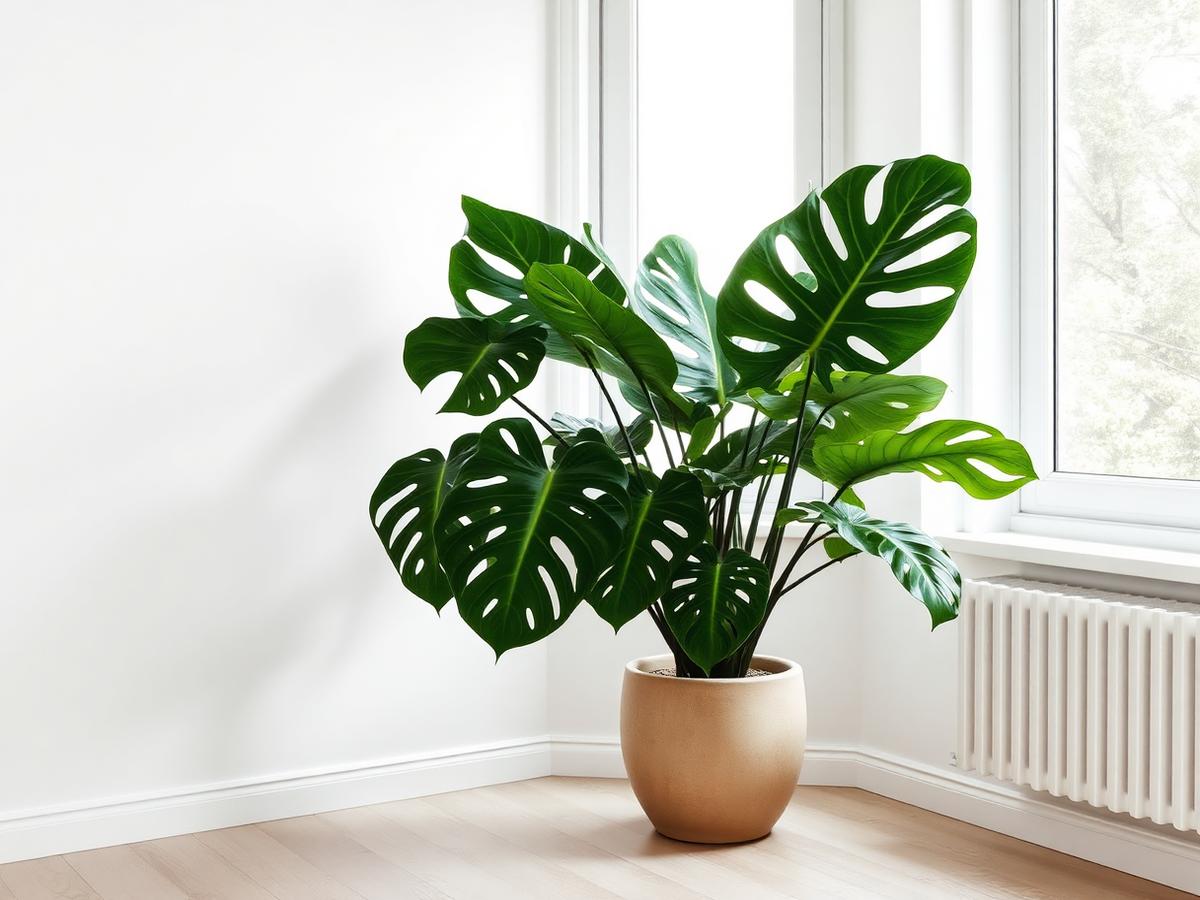
Fenestration is the botanical term for the holes and splits in a Monstera leaf. Monstera deliciosa produces two kinds: edge splits (lobes cut in from the leaf margin) and internal fenestrations (oval or rounded holes in the middle of the leaf that sometimes open to the edge as the leaf ages).
The leading hypothesis for why Monsteras evolved this is light penetration — in the rainforest understorey where Monsteras climb, splits and holes let light through to lower leaves on the same plant rather than shading them out. A secondary hypothesis is wind and rain tolerance: perforated leaves flex rather than tear in storms. Either way, it is a mature-plant trait, and the plant only makes the effort once it has the resources to afford it.
The four factors that control when it starts
All four need to be reasonably met for fenestration. Get one wrong — especially light — and even a 5-year-old plant will produce solid leaves forever.
- 1Age and maturity: Monsteras cannot fenestrate until they are mature. From seed, that's 2–3 years; from a cutting, count from when the original parent was a mature plant. A cutting taken from a mature Monstera's climbing stem can fenestrate within months; a cutting from the same plant's juvenile bottom leaves will revert and produce solid leaves first.
- 2Light: the single biggest controllable factor. Monstera deliciosa wants bright indirect light — more than most other popular houseplants tolerate. As a rough rule, a plant getting less than ~10,000 lux at midday for 6 hours a day will struggle to fenestrate even when mature. See the indoor light levels guide for how to measure this at home.
- 3Climbing support: Monstera is a climber. In the wild it pulls itself up a tree trunk and its leaves enlarge as it climbs. Indoors, a moss pole or coir pole provides the same cue — once the plant's aerial roots grab the pole, leaves typically start enlarging within a few months and splitting shortly after. A tabletop Monstera with no pole often plateaus at juvenile-leaf size regardless of light.
- 4Leaf size: fenestration scales with leaf size. A Monstera whose new leaves are still sub-20 cm has not yet reached the size where fenestration begins — the plant typically produces its first edge splits around 25–30 cm leaf length and its first internal holes at 40+ cm.
What usually fixes it
A Monstera not splitting is almost always an environment problem, not a plant problem. The intervention ladder below is the order to try things — start with the cheapest and most likely.
- 1Move the plant closer to your brightest window that is not direct hot afternoon sun. East-facing or a metre inside a south-facing window is often the sweet spot.
- 2Add a moss pole or coir pole. Anchor it firmly in the pot and tie the main stem to it every 10 cm with soft ties. Spray the pole twice a week so the aerial roots attach.
- 3Repot if the plant is root-bound — a cramped plant pauses leaf-size increases. See when to repot for the cues.
- 4Fertilise lightly during active growth (spring and summer). A balanced liquid fertiliser at half strength every 2–3 waterings is plenty — fertiliser does not trigger fenestration but it fuels the larger leaves that do.
- 5Wait. Even with everything right, the transition takes time. A plant climbing actively on a pole in good light typically shows its first splits within 6–12 months and opens into full fenestration over 1–2 years after that.
Reverting leaves and aerial roots
Two things often scare owners that are actually normal. First, a Monstera that starts fenestrating can still produce an occasional solid leaf — especially after repotting, moving, or any stress. One unsplit leaf in the middle of a split run is not a regression; it's a single slow-growth month. The next leaf is usually back to full split.
Second, aerial roots. Monstera produces thick aerial roots from every node; these are the climbing-anchor roots the plant uses on trees in the wild. They are not a sign of anything wrong and do not need pruning. Direct them into the moss pole (or into the soil) to help the plant climb and support itself.
What your Monstera is not
Two common mix-ups — worth ruling out if your 'Monstera' never splits no matter what.
- ·Monstera adansonii (Swiss cheese vine): smaller leaves with holes but no edge splits. Adansonii fenestrates earlier than deliciosa — holes appear on fairly young leaves — but it never develops the deep edge splits of mature deliciosa. If your plant has only holes and no splits, it may actually be adansonii.
- ·Rhaphidophora tetrasperma (mini Monstera): not a Monstera at all. Small deeply-split leaves on thin climbing stems. If your plant looks like a Monstera but mature leaves are only 10–15 cm across, check the Monstera vs Philodendron vs Mini Monstera ID guide — you probably have Rhaphidophora, which never grows into large fenestrated leaves.