What a fenestration actually is
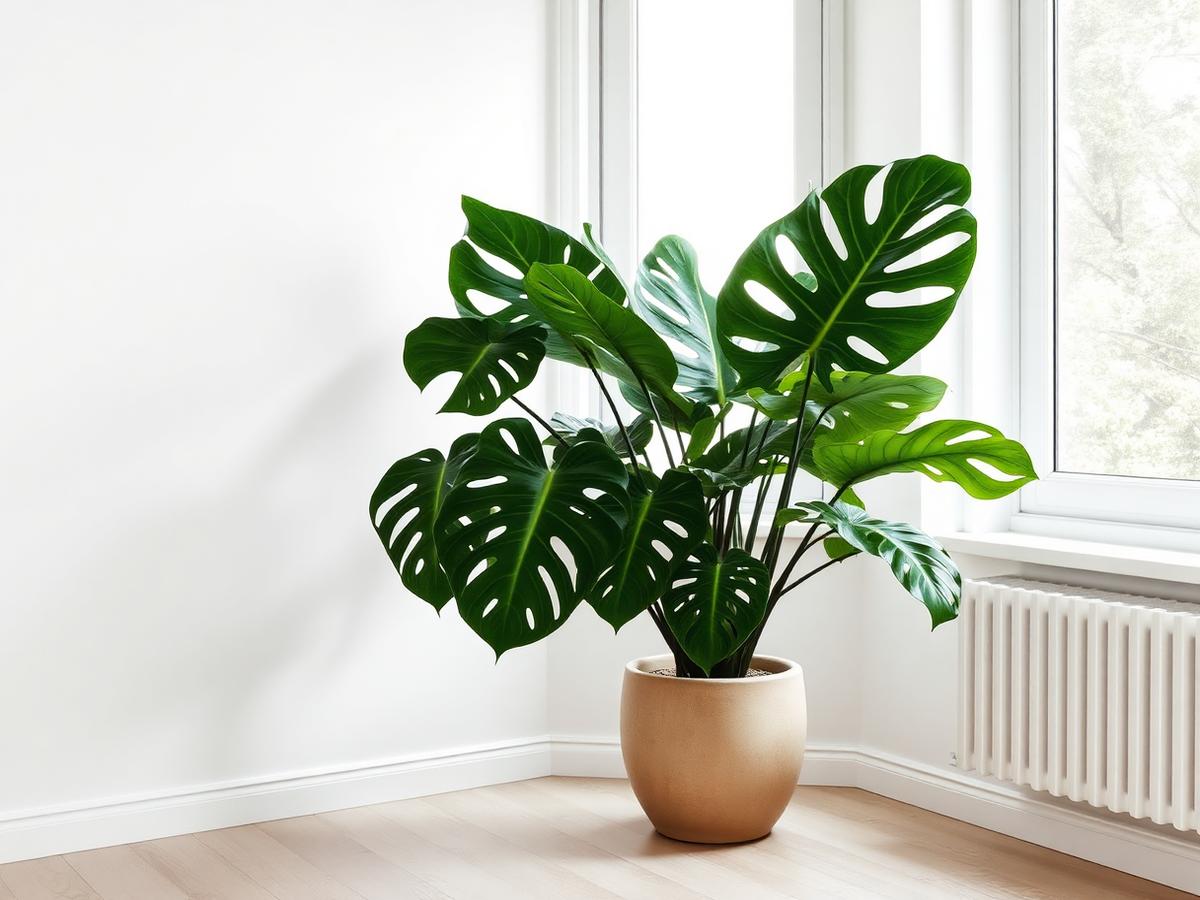
A fenestration is a hole or deep edge-split that develops as a Monstera deliciosa leaf matures — botanists call them lamina perforations. The pattern is genetically programmed but environmentally triggered: even a healthy plant produces solid juvenile leaves first, then transitions to splits and holes once it has enough leaf surface, root mass, and light to support the larger, structurally weaker mature form.
The leading hypothesis is that fenestrations evolved in the rainforest understory to let light reach lower leaves on the same vine, and to reduce wind damage on a leaf that may exceed 60 cm across in the wild. Botanists describe it as a heteroblastic adaptation — the plant produces structurally different leaves at different life stages.
Reason 1: The plant is still juvenile
A monstera grown from seed or a small node cutting produces 2–6 juvenile leaves before it is physiologically capable of splits — solid, heart-shaped, often only 10–15 cm wide. This is normal and unavoidable. A nursery plant sold in a 12 cm pot at a supermarket is almost always still in this juvenile stage, and no amount of light will produce splits before the plant has built the rootmass and stem to support them.
Watch the leaf size, not the calendar. Each new leaf in good conditions should be visibly larger than the previous one — a sign the plant is gaining the resources it needs to fenestrate. If new leaves are the same size or smaller than older ones, see the why is my plant leggy guide; the cause is almost certainly light or rootbound stress.
- ·Leaves 1–3: solid heart shape, no splits — normal juvenile.
- ·Leaves 4–6: first edge notches appear in good light.
- ·Leaves 7–10: deeper splits and the first internal holes.
- ·Mature leaves: full fenestration, often 30–60 cm wide on a climbing plant.
Reason 2: Not enough light (the most common cause indoors)
Monstera deliciosa needs roughly 10,000–20,000 lux at the leaf for 8–10 hours a day to consistently produce fenestrated leaves. Most rooms — even ones that feel bright to a human — fall well under that. A spot one metre back from a north-facing window in winter can deliver under 1,000 lux. A spot directly beside a south-facing window with a sheer curtain is 8,000–15,000 lux on a sunny day. The gap is enormous, and the plant responds in kind.
A handheld lux meter or a free phone-camera lux app makes the difference visible. The full lighting reference is in understanding light levels for indoor plants — read it before moving the plant. If your home cannot deliver bright indirect for that many hours, a 30–40 W full-spectrum LED on a 10–12 hour timer reliably produces the first split — see do houseplants need a grow light for the gear and the math.
- ·Direct sun (south-facing window, no curtain): 30,000–80,000 lux — too much, will scorch.
- ·Bright indirect (1 m from south/west window, sheer curtain): 10,000–20,000 lux — ideal.
- ·Medium indirect (2 m from any window): 2,000–5,000 lux — solid juvenile leaves only.
- ·Low light (north window or 3+ m back): under 1,000 lux — survives, never fenestrates.
- ·Grow light, 30 cm above plant, 30–40 W: 12,000–18,000 lux — reliable fenestration trigger.
Reason 3: No climbing support
Monstera deliciosa is a hemiepiphyte — in the wild it climbs trees, attaching with aerial roots, and its leaves get larger and more fenestrated the higher it climbs. A plant that has nothing to climb stays in a horizontal sprawl, the aerial roots dangle uselessly, and leaf size plateaus. Adding a moss pole, coir pole, or rough wooden plank lets the aerial roots grip and signals the plant to put out larger climbing-form leaves.
The effect is not subtle. A healthy plant given a moss pole typically pushes out a leaf one full size larger than the previous one within two growth cycles, and the next one after that often shows the first deeper split. Keep the moss pole moist (a daily mist or a top-down trickle) so the aerial roots have something to hold onto and absorb from. The full Monstera deliciosa care guide covers pole height, attachment, and when to upgrade.
Reason 4: Rootbound, underfed, or in the wrong soil
A monstera that has filled its pot with roots cannot push out the larger, more demanding fenestrated leaves — it has no nutrient or water reserve to commit to them. Lift the pot: if you see a dense mat of roots circling the bottom, the plant is overdue for a repot, usually one pot size up (2–4 cm wider) into a chunky aroid mix. Compacted "universal" potting soil is the second silent fenestration killer: roots starve for oxygen and the plant defaults to small, safe juvenile leaves.
Feeding matters too, but not as much as light or rooting. A balanced liquid fertiliser at half strength every 2–3 weeks during active growth (March–October in the northern hemisphere) is enough; over-feeding produces lush solid leaves with no fenestration, because the plant is investing in surface area, not structural changes.
Reason 5: It might not be Monstera deliciosa at all
Several plants sold as "Swiss cheese" or "split-leaf" are not Monstera deliciosa, and they fenestrate by a different rule. Monstera adansonii — the smaller, vining "Swiss cheese vine" — has holes in every leaf from very early, including juveniles. Rhaphidophora tetrasperma (the "mini monstera" or Ginny philodendron) is not a monstera at all and only edge-splits, never holes. A young split-leaf philodendron (Thaumatophyllum bipinnatifidum) makes deeply lobed leaves but no internal fenestrations.
If your plant has small leaves with regular holes from leaf one, you almost certainly have Monstera adansonii — see monstera vs philodendron vs mini monstera for the side-by-side ID. Care needs differ subtly, and the fenestration timeline differs entirely.
The 6-step protocol to a first fenestrated leaf
Run all six steps together — they compound. A juvenile Monstera deliciosa given the full treatment typically pushes out its first deeply split leaf within 6–9 months. Skipping any one step (especially light) extends the timeline by months or stops it entirely.
- 1Measure the light at the leaf with a lux app. Move the plant until you read 10,000+ lux for at least 6 hours a day; supplement with a grow light if the room cannot deliver it.
- 2Add a moss pole or coir pole at least 60 cm tall. Tie the main stem loosely against it so aerial roots can grip.
- 3Repot if rootbound. Use a chunky aroid mix (1 part potting soil : 1 part orchid bark : 1 part perlite). Pot one size up, no more.
- 4Water when the top 3–4 cm of soil is dry, until 10–20% drains from the pot. Empty the saucer.
- 5Feed with a balanced liquid fertiliser at half strength every 2–3 weeks from March to October; skip in winter.
- 6Wait two full growth cycles. Each new leaf should be larger than the last; the first split usually appears on the second or third leaf after the routine starts.
What does not cause (or fix) fenestration
The plant internet is full of fenestration myths that waste time and stress healthy plants. None of the items below have any consistent effect on whether a leaf splits.
- ·Cutting holes in leaves with scissors — does not trigger future leaves to split, only damages the existing leaf.
- ·Misting — adds nothing useful; humidity above ~40% is plenty for indoor monsteras.
- ·Talking to or playing music for the plant — placebo for the human.
- ·Specialty "fenestration" fertilisers — no special nutrient triggers splits; light does.
- ·Hormone sprays (GA3, etc.) — promote stretching, not fenestration; can deform leaves.
- ·Burying aerial roots in the pot — no measurable effect; let them either climb the pole or dangle.