Identity & taxonomy
- Scientific name
- Aspidistra elatior Blume
- Family
- Asparagaceae
- Genus
- Aspidistra
- Order
- Asparagales
- IUCN status
- Least Concern (LC)
- Wikidata
- Q156802
- Aspidistra lurida Ker Gawl. (misapplied)
- Aspidistra punctata Lindl. (misapplied)
- Cast iron planten
- Bar room planten
- Iron planten
- Aspidistraen
- Pansarrumssv
- Skomakerbladno
- Skomagerplanteda
- Suutarinpalmufi
- Schusterpalmede
Japan — Kuroshima, Suzushima, Uji, and other islands south of Kyushu · Taiwan · Eastern China (some authors)
How to identify it
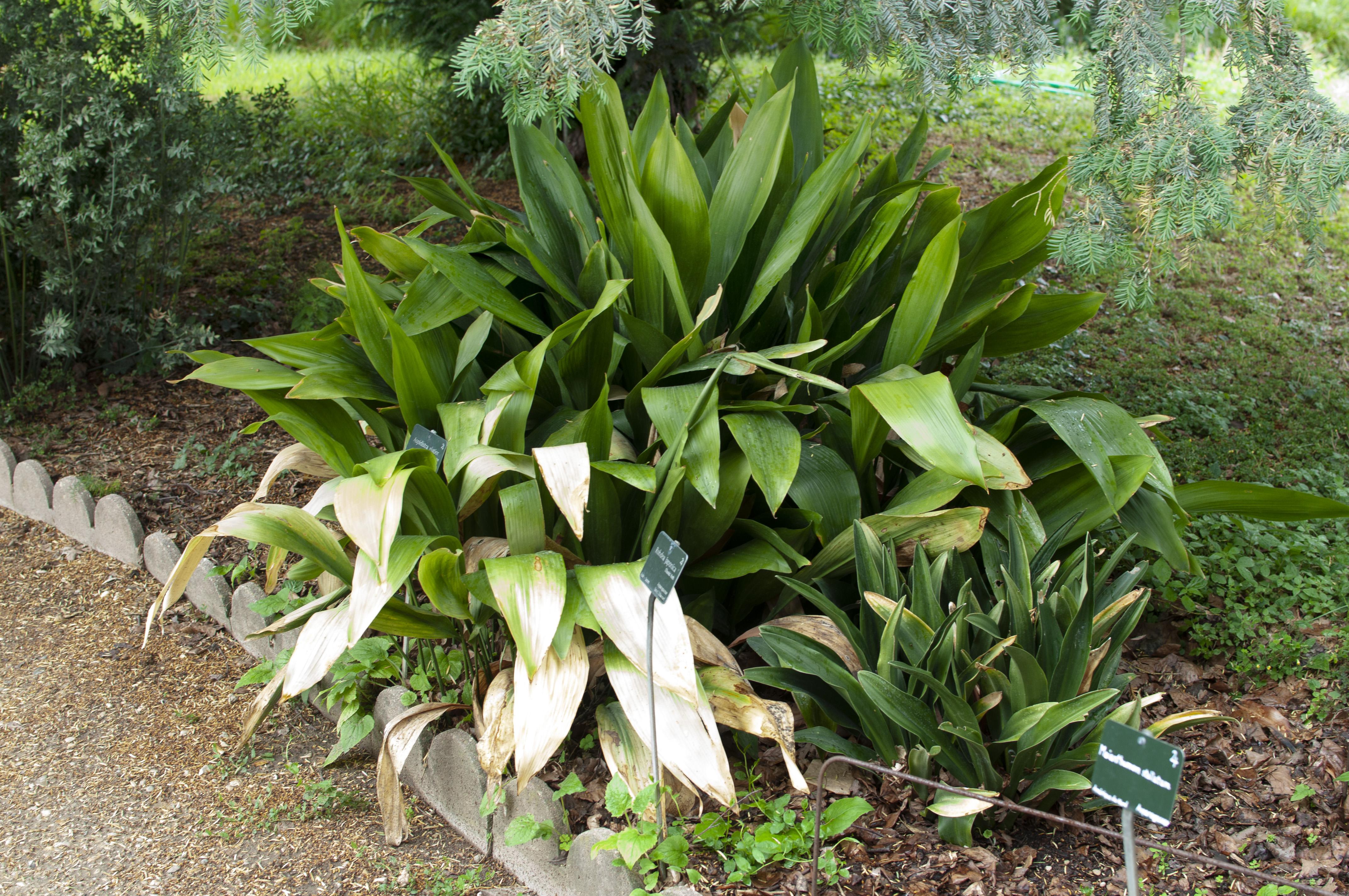
Growth habit. Acaulescent rhizomatous evergreen — there is no above-ground stem. Leaves emerge one at a time from a stout creeping rhizome at the soil surface, each on its own long petiole. Mature clumps build slowly into a dense fountain-like rosette and spread sideways through rhizome growth. Indoors, a plant typically produces 1–3 new leaves per year.
Leaves. Long lanceolate to oblanceolate blades 40–70 cm long and 8–15 cm wide on petioles 15–35 cm long. Leathery texture, deep glossy dark green, with prominent parallel venation running the length of the blade. The base tapers gradually into the petiole. Cultivars add cream stripes ('Variegata'), white flecks ('Milky Way'), or white tips ('Asahi').
Flowers. Strange and easy to miss. Solitary, fleshy, dull-purple to brown bell-shaped flowers 1.5–2 cm wide are produced at ground level on very short stalks, often hidden beneath the leaves. Pollinated in the wild by terrestrial amphipods (sandhoppers) and isopods that crawl across the substrate. Rare indoors but possible on mature plants. The flowers do not produce nectar and have no scent that humans can detect.
- Long lance-shaped leaves emerging directly from the soil — never on a visible stem.
- Prominent parallel veins along the entire leaf blade.
- Thick leathery texture and matt-glossy dark green.
- Extremely slow growth; mature plants are decades old.
- Cryptic ground-level dull-purple flowers (rare indoors but diagnostic).


Commonly confused with
Sacred lily / Nippon lily
Similar leaf shape and very similar growth habit. Distinguished by stiffer, more upright leaves and a prominent central spike of red berries in autumn — Aspidistra never produces a berry spike.
Lilyturf / Big blue lilyturf
Much narrower grass-like leaves and tall purple flower spikes well above the foliage. A garden plant, occasionally confused with young Aspidistra at retail.
Spider plant
Narrower, softer, more strap-like leaves and a tendency to send out long arching stolons with plantlets. Aspidistra never produces stolons.
Peace lily
Glossy lance-shaped leaves but with a clearly raised midrib and pinnate side-veins (not parallel). Produces a white spathe inflorescence well above the leaves.
Care
Light
Low to medium indirect light — tolerates the dimmest spots in the home.
Aspidistra evolved on shaded Japanese island forest floors and is genuinely happy in light levels that would kill any other broadleaf evergreen. North-facing rooms, hallways well away from windows, and bathrooms with frosted glass are all fine. Direct sun bleaches leaves to pale yellow within days and scorches them. Variegated cultivars need slightly more light than the species to maintain pattern but still do well in medium indirect.
Seasonal: Many Nordic apartments have north-facing rooms that drop below 500 lux in mid-winter; Aspidistra is one of the very few houseplants that survives this without supplementary lighting.
Water
When the top half of the soil is dry — every 2–3 weeks.
Water thoroughly until water runs from the drainage holes, then let the soil dry until the top half feels dry. Aspidistra tolerates extended dry periods because the rhizome stores significant water reserves. Overwatering is by far the most common cause of decline indoors — the rhizome rots in soggy soil and the plant collapses without warning. Underwatering causes leaves to brown at the tips slowly over weeks; recovery is reliable after one good soak.
Seasonal: Reduce frequency to once every 4–6 weeks in winter when growth pauses. The plant uses very little water in cool dim conditions.
Soil
Standard well-draining indoor potting mix.
A 3:1 mix of standard indoor potting soil and coarse perlite suits the species. Adaptable to a range of mixes — the priority is good drainage, not specific composition. Avoid pure peat or moisture-retentive 'tropical' mixes.
Humidity
Any — completely indifferent to indoor humidity.
Aspidistra does not require any humidity intervention. Tolerates 25–70 % without complaint. No misting, no humidifier, no pebble tray — wasted effort. The leathery leaf surface resists transpiration loss. This is a major reason it survived the dry, gas-lit, draughty parlours of Victorian Britain.
Temperature
10–24 °C; tolerates brief 5 °C.
Comfortable across the full range of normal indoor temperatures. Tolerates cold draughts, unheated entryways, and brief winter drops to 5 °C without leaf damage — uniquely tough among popular houseplants. Frost will eventually kill the rhizome. Hot dry summer rooms above 28 °C cause leaf-tip browning if not paired with adequate watering.
Fertilizer
Quarter-strength balanced liquid feed every 2 months in growing season.
Aspidistra is a very light feeder. A balanced liquid fertiliser at quarter the label rate every 2 months from April through September is ample. Skipping fertiliser entirely is also fine — the plant simply grows even more slowly. Over-fertilising causes leaf-tip browning and forces weak floppy growth.
Seasonal: No feeding in winter.
Pruning
Cut tatty or yellowed leaves at the soil line.
Prune individual damaged or yellowed leaves with clean scissors at the soil line — the plant does not regrow from a cut leaf, but new leaves emerge from the rhizome. There is no need to top or shape the plant in any way; growth is exclusively from the rhizome.
Repotting
Every 4–5 years in spring; resents disturbance.
Aspidistra dislikes being repotted and may sulk for a year afterwards. Move up by a single pot size only when the rhizome bulges visibly out of the pot or roots come out of the drainage holes en masse. Best done in spring just as new leaves emerge. Use a heavy ceramic or terracotta pot — the plant becomes top-heavy and tips lighter pots over.
Rhizome division
moderate~Established immediately; resumes growth in 6–12 weeksThe only reliable propagation method. Tip a mature plant out in spring and gently work the rhizome apart with your hands — the rhizome usually has natural growing tips that separate cleanly. Each division should have at least 2–3 leaves and a section of healthy rhizome with feeder roots. Pot each division in fresh well-draining mix and water sparingly for the first month. Aspidistra will pause growth for several months after division but recovers reliably.
Cultivars
'Variegata'
Long cream and white longitudinal stripes on the leaves. Slightly less vigorous than the species; needs a touch more light to maintain the variegation.
'Milky Way'
Glossy dark green leaves splattered with small creamy-white flecks like a starfield. The most popular cultivar in modern Nordic trade.
'Asahi'
Each new leaf emerges plain green and then develops a striking white tip as it matures. Slow-growing; collector cultivar.
'Lennon's Song'
Pale yellow longitudinal stripes that fade with age. Less common but distinctive.
Common problems
Plant suddenly collapses, leaves yellow at the base
Symptom
All leaves yellow at the base and pull out with no resistance; the rhizome has gone soft, dark, and watery.
Cause
Rhizome rot from chronic overwatering — the most common (almost only) cause of Aspidistra death.
Fix
Tip the plant out and inspect. If most of the rhizome is rotted, the plant is unsavable. If a healthy section remains, cut off all rotten tissue with a sterile blade, dust the cuts with cinnamon (a mild antifungal), let air-dry for 24 hours, and repot in fresh dry well-draining mix. Do not water for two weeks.
Full guide: Root Rot in Houseplants: How to Identify, Save, and Prevent ItBrown crispy leaf tips
Symptom
Tips of older leaves turn pale brown and crispy, slowly progressing along the leaf edge.
Cause
Almost always tap water mineral buildup, occasionally underwatering. Aspidistra is sensitive to fluoride, chloride, and excess sodium in tap water over years.
Fix
Switch to filtered or rainwater. Flush the soil thoroughly with water once every 3–4 months to leach out mineral buildup — water through with about 3× the pot volume. Trim off browned tips at an angle for cosmetic effect; new leaves emerge clean.
Full guide: Why Are My Plant's Leaf Tips Turning Brown? Diagnosis GuideFaded variegation on cultivars
Symptom
Variegated cultivars ('Variegata', 'Milky Way') lose contrast in cream/white markings; new leaves emerge less variegated.
Cause
Insufficient light. Variegated Aspidistra needs slightly more light than the species to maintain pattern.
Fix
Move closer to a north-facing window or to a brighter spot in the room. Direct sun is still too much — go for medium indirect. New leaves emerging in better light are normally variegated within 3–6 months.
Full guide: Why Is My Variegated Plant Losing Its Variegation?Brown bumpy lumps on leaf surfaces
Symptom
Hard brown or tan oval bumps along the underside or upper surface of leaves; sticky residue below.
Cause
Scale insect infestation — the most common Aspidistra pest, hard to spot until populations build.
Fix
Scrape visible scales off with a soft toothbrush or fingernail. Treat the whole plant weekly with insecticidal soap or 1:1 isopropyl alcohol + water for 4–6 weeks to kill emerging crawlers. Persistent infestations may require systemic treatment. Quarantine until clear.
Full guide: Scale Insects on Houseplants: What Those Brown Bumps Actually AreLeaves bleached pale yellow
Symptom
Leaves rapidly turn pale yellow-green, and newer leaves emerge similarly washed-out.
Cause
Too much light. Aspidistra is genuinely a low-light plant; bright sun bleaches the chlorophyll within days.
Fix
Move further from the window or to a north-facing spot. Bleached leaves do not regreen but new growth in better light is normal. This is one of the few houseplants where 'too much light' is a real problem.
Full guide: Why Are My Houseplant Leaves Bleached or Sunburned?- Spider mites (very dry warm rooms)
- Scale insects (the dominant pest)
- Mealybugs
- Rhizome rot (overwatering)
- Anthracnose leaf spot
- Bacterial soft rot
Toxicity & safety
No documented human toxicity. Aspidistra is widely listed as a safe foliage plant for households with children.
Aspidistra elatior — Plants For A FutureListed by ASPCA as non-toxic to cats. Mild GI upset is possible with any plant ingestion.
Cast Iron Plant — ASPCA Toxic and Non-Toxic PlantsListed by ASPCA as non-toxic to dogs. Mild GI upset is possible.
Cast Iron Plant — ASPCA Toxic and Non-Toxic PlantsAspidistra's pollinator was a long-running botanical mystery. Early hypotheses ranged from slugs to fungus gnats; in 2017, a team led by Kenji Suetsugu confirmed via field cameras in southern Japan that the primary pollinators of A. elatior are terrestrial amphipods (sandhoppers) and isopods crawling along the substrate. The flower's odd ground-level position and dull-purple colour are an adaptation to attract these bottom-dwelling crustaceans. No other widely cultivated houseplant is amphipod-pollinated.
Frequently asked · 5
Is cast iron plant safe for cats and dogs?+
Yes — ASPCA lists Aspidistra elatior as non-toxic to cats, dogs, and horses. It is one of the most reliably pet-safe foliage houseplants you can keep, particularly useful in homes with chewing puppies or young cats. Mild GI upset is possible with any plant ingestion (this is true of any non-food plant), but no systemic toxicity is recorded.
How often should I water a cast iron plant?+
Water when the top half of the soil is dry — typically every 2–3 weeks in summer and every 4–6 weeks in winter. The rhizome stores significant water, and Aspidistra tolerates extended dryness much better than soggy soil. Overwatering is by far the most common cause of decline. When in doubt, water less rather than more — the plant's reputation for being indestructible refers specifically to neglect, not overcare.
Will a cast iron plant really survive in a north-facing room with no direct sun?+
Yes — this is its specialty. Aspidistra elatior tolerates light levels as low as 500 lux, well below the threshold for any other broadleaf foliage plant. North-facing rooms, hallways well away from windows, and even windowless bathrooms with electric light will keep it alive (though slow). It is the single most low-light-tolerant houseplant in cultivation. Variegated cultivars need a touch more light to keep their pattern but still do fine in medium indirect.
Why is my cast iron plant growing so slowly?+
It's not — that is the plant's normal pace. A healthy mature Aspidistra produces only 1–3 new leaves per year, and a small plant stays small for years. Slow growth is not a sign of poor health; it is the species' baseline. If the plant produces no new leaves at all over a full growing season, check that the pot has drainage, water is reaching the rhizome, and you are not over-fertilising. Slow patience is the way with this plant.
How do I propagate a cast iron plant?+
Only by rhizome division — leaf cuttings do not work for Aspidistra. In spring, tip a mature plant out and gently work the rhizome apart with your hands. The rhizome typically has natural growing tips that separate cleanly. Each division should include at least 2–3 leaves and a section of healthy rhizome with feeder roots. Pot each division in fresh well-draining mix and water sparingly for the first month. The plant will pause growth for several months after division but recovers reliably.