
Identity & taxonomy
- Scientific name
- Dracaena sanderiana Sander ex Mast.
- Family
- Asparagaceae
- Genus
- Dracaena
- Order
- Asparagales
- IUCN status
- Least Concern (LC)
- Wikidata
- Q156836
- Dracaena braunii Engl.
- Pleomele braunii (Engl.) N.E.Br.
- Lucky bambooen
- Ribbon planten
- Friendship bambooen
- Curly bambooen
- Ribbon dracaenaen
- Lyckobambusv
- Lykkebambusno
- Lykkebambusda
- Onnenbambufi
- Glücksbambusde
West-central Africa — Cameroon, Gabon, Republic of the Congo, and Democratic Republic of the Congo (despite the 'lucky bamboo' name and feng shui marketing, it is not Asian)
How to identify it
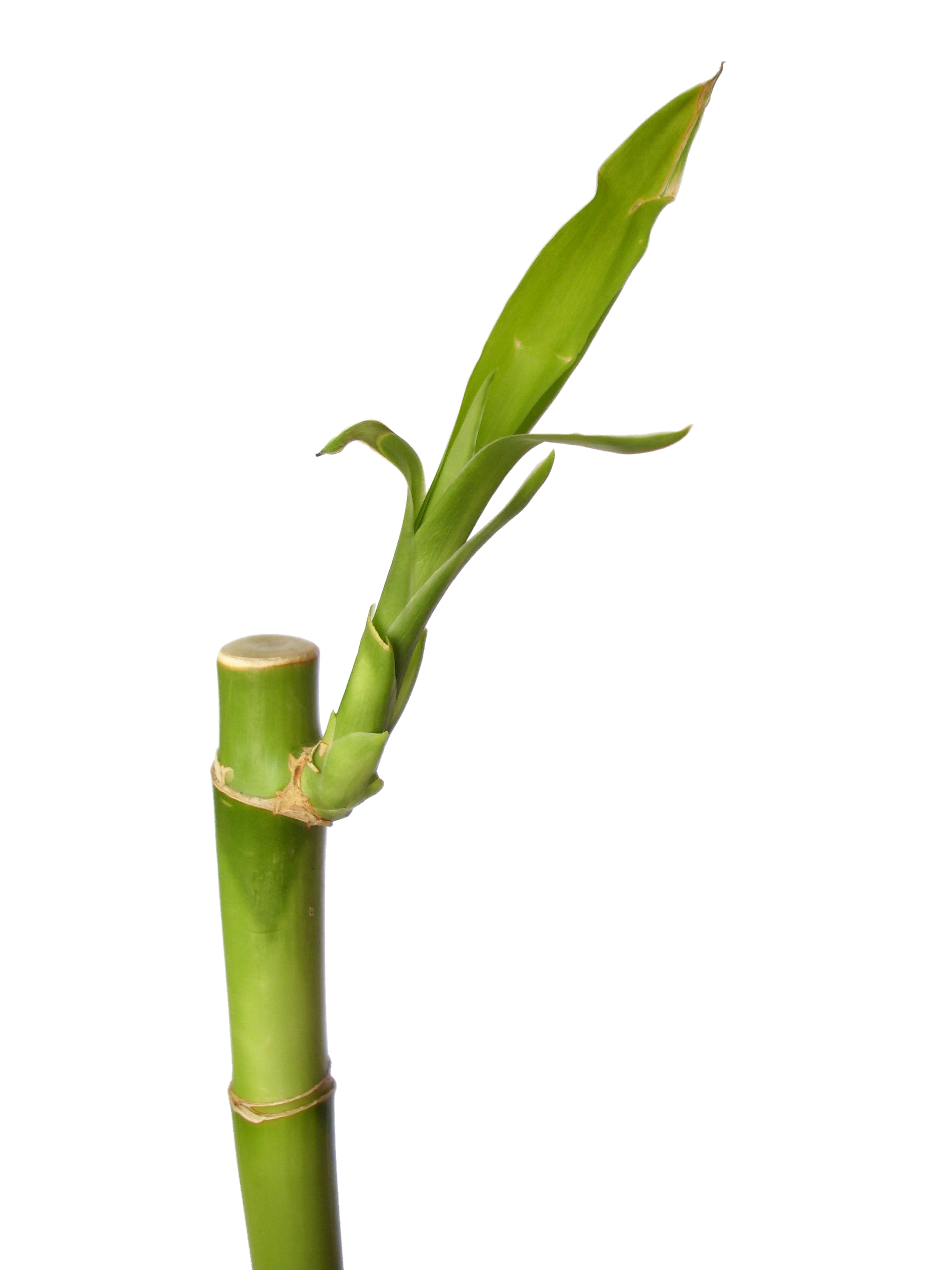
Growth habit. Slow-growing evergreen with thick, segmented, fleshy green stems that look bamboo-like but are not true bamboo (which is a grass). Each cane terminates in a whorl of strap-like leaves. Older canes accumulate leaves in tufts at each node. The plant rarely branches naturally; commercial 'arrangements' are made by bundling multiple separate canes.
Leaves. Strap-like to lanceolate leaves 10–20 cm long and 2–3 cm wide, deep green with a glossy surface. Variegated cultivars add cream or white longitudinal stripes. Leaves emerge as a tight whorl at each stem node and arch outward. Older leaves yellow and drop from the bottom of each tuft, leaving the smooth segmented cane visible.
Flowers. Pendulous panicles of small white-green fragrant flowers — extremely rare in cultivation and almost never seen indoors. Most retail lucky bamboo plants are juveniles that never reach flowering size.
- Segmented bamboo-like canes — but not bamboo (no leaf sheaths around each node).
- Whorls of green strap-shaped leaves only at cane nodes; otherwise smooth bare stem.
- Often sold trained into spirals, hearts, or braided lattices — these shapes are man-made.
- Grows happily in pure water with a few pebbles — almost no other 'shrub' tolerates this.
- Cane is fleshy and snaps cleanly when cut — true bamboo is hollow and woody.
Commonly confused with
True bamboo
Members of grass family (Poaceae) with hollow woody culms, leaf sheaths around each node, and prolific lateral branching. Lucky bamboo is a Dracaena, not a grass — solid fleshy canes, no sheaths.
Corn plant
Same genus, but much larger with broader strap-like leaves and a thicker trunk. Sold as a tall indoor tree; lucky bamboo is sold as a small tabletop arrangement.
Song of India
Variegated Dracaena with shorter, more crowded leaves arranged densely along the stem. No bamboo-like cane segmentation.
Madagascar dragon tree
Same genus and similar segmented growth, but with very thin red-edged leaves clustered at branch tips. Much taller and more tree-like.
Care
Light
Low to medium indirect light; never direct sun.
Dracaena sanderiana evolved as understorey in West African forest and tolerates surprisingly low light indoors. North or east windows are ideal; medium light from further inside the room is also fine. Direct sun bleaches leaves to pale yellow within days and scorches them in hours. Variegated cultivars need a little more light to keep their cream stripes from fading. In Nordic winters, no supplementary lighting is needed for the species but variegated forms benefit from a small grow light.
Seasonal: Avoid south-facing windows in summer. Light sufficient to read by is enough for the species year-round.
Water
Soil: when top 2–3 cm dry. Water culture: top up weekly with filtered water.
In soil, water thoroughly when the top 2–3 cm is dry — typically every 7–14 days. In water culture (the most common retail format), keep the cane bases submerged in 3–5 cm of water above a layer of pebbles; top up as needed and replace fully every 2 weeks to prevent algae and bacterial buildup. The species is highly sensitive to fluoride, chlorine, and chloramine in tap water — use filtered, distilled, or rainwater for both methods. Tap water in Nordic countries varies; if leaves develop brown tips that progress along the edges, switch water sources.
Seasonal: Reduce soil watering to every 2–3 weeks in winter. Water culture frequency stays the same year-round.
Soil
Standard well-draining indoor potting mix (or no soil at all).
If grown in soil, use a 3:1 mix of standard indoor potting soil and perlite. The plant tolerates a wide range of mixes — drainage matters more than composition. In water culture, use clean glass marbles, polished river stones, or aquarium gravel to anchor the canes; do not add sand (it traps debris).
Humidity
40–60 % preferred — tolerates 30 %.
Higher humidity gives slightly fuller leaf tufts but is not critical. In dry Nordic winter air the leaf tips may brown; group with other plants or run a humidifier nearby if this matters cosmetically. Misting is unnecessary and can encourage cane rot at the leaf joints.
Temperature
16–27 °C; damage below 13 °C.
Tropical species — does not tolerate cold draughts or temperatures below 13 °C. Brief cold snaps cause water-soaked patches on leaves and progressive yellowing. Keep clear of unheated entryways and away from glass on cold winter nights. Heating-radiator drafts cause the most year-round problems in Nordic apartments.
Fertilizer
Quarter-strength balanced liquid feed every 6–8 weeks in growing season.
A balanced liquid fertiliser (NPK 10-10-10) at quarter the label rate, every 6–8 weeks from April through September, is plenty. Water-cultured plants need even less — once every 2–3 months at one-eighth strength is typically sufficient. Over-fertilising in water culture is the leading cause of root burn and algae blooms.
Seasonal: No feeding in winter.
Pruning
Cut canes back to a node to promote branching from the cut.
If a cane gets too tall or leggy, cut it cleanly with sterile scissors just above a node. The plant produces 1–2 new shoots from dormant buds at the cut within 4–8 weeks. Do not seal the cut — Dracaena heals cleanly. Cut sections root readily as new plants. Remove yellowed lower leaves at any time to keep the cane appearance clean.
Repotting
Soil: every 2–3 years. Water culture: refresh pebbles and rinse roots every 6–12 months.
In soil, move up by a single pot size every 2–3 years in spring when roots fill the pot. In water culture, every 6–12 months tip the arrangement out, rinse the pebbles in clean water to remove algae and debris, and inspect the cane bases for slime or rot — trim any soft sections back to firm tissue with sterile scissors before re-arranging. Do not transition a long-water-grown plant to soil suddenly; the water-adapted roots typically die back in soil and the plant has to grow fresh roots, which can take months.
Stem cuttings (water or soil)
easy~Roots in 4–8 weeks; established plant in 2–3 monthsCut a healthy section of cane with at least one leaf node using sterile scissors. The cutting can be a top section (with leaves) or a bare midsection (which will resprout new shoots). Place the bottom of the cutting in 3–5 cm of filtered water with the cut end fully submerged. Roots emerge in 4–8 weeks. Transfer to soil or keep in water culture once roots are 5+ cm long.
Cane segments
moderate~Sprouts in 6–12 weeksA bare cane segment with at least one node, laid horizontally on damp moss or substrate, sprouts new shoots from each node. Slower than upright cuttings but produces multiple plants from a single section. Best done in spring with bottom heat at 20–24 °C.
Cultivars
'Victory'
Wide cream-yellow longitudinal stripes on the leaves. The most common variegated form in commerce.
'White Stripe Victory'
Cream-white edge stripes with green centres. Slower-growing than the species.
'Celes'
Mostly white-cream leaves with thin green margins; needs more light to maintain colour.
Common problems
Yellowing canes from the base upward
Symptom
Cane turns yellow-translucent at the base; leaves yellow and drop; cane goes soft and watery.
Cause
Cane rot from stagnant water in water culture, fluoride/chlorine in tap water, or chronic overwatering in soil.
Fix
Tip the arrangement out and cut the cane back to firm green tissue with sterile scissors. Rinse the pebbles thoroughly. Refill with filtered, distilled, or rainwater. Cut sections from the still-healthy upper cane root readily as new plants — propagate as insurance even if you think you've caught it in time.
Full guide: Root Rot in Houseplants: How to Identify, Save, and Prevent ItBrown crispy leaf tips
Symptom
Tips of leaves turn pale brown and crispy, slowly progressing along the leaf edge.
Cause
Tap water mineral buildup. Dracaena sanderiana is highly sensitive to fluoride, chlorine, and chloramine — common at low levels in Nordic municipal water.
Fix
Switch to filtered, distilled, or rainwater immediately. In soil, flush the rootball with clean water once every 3 months to leach minerals. Trim browned tips at an angle for cosmetic effect; new leaves emerge clean.
Full guide: Why Are My Plant's Leaf Tips Turning Brown? Diagnosis GuideGreen algae in the water vessel
Symptom
Visible green or brown slime on pebbles and the inside of the glass; cloudy water.
Cause
Light exposure on the water surface combined with dissolved fertiliser.
Fix
Replace the water completely. Rinse pebbles in clean water (no soap). Move the arrangement to a slightly less bright spot, or use an opaque vessel that blocks light from the root zone. Reduce or skip fertiliser. Algae return if the water is over-fertilised or stays in place too long.
Faded variegation on cultivars
Symptom
Variegated cultivars ('Victory', 'White Stripe Victory') lose contrast in cream/white markings.
Cause
Insufficient light. Variegated lucky bamboo needs a little more light than the species.
Fix
Move closer to a north or east window. Direct sun is still too much — go for medium indirect. New leaves emerging in better light are normally variegated within 6–8 weeks.
Full guide: Why Is My Variegated Plant Losing Its Variegation?Cane rot in water culture
Symptom
One or more canes goes soft, dark, and slimy at the water-line; foul smell.
Cause
Bacterial rot from stagnant or contaminated water; injury at the cut base; or a previously-rotted cane shedding bacteria into the shared water.
Fix
Remove the rotted cane immediately and discard it. Cut all remaining canes back to firm green tissue. Rinse all pebbles and the vessel in clean water (no soap residue). Refill with filtered or distilled water. Avoid mixing canes from unknown sources in a shared vessel.
- Spider mites (very dry rooms)
- Mealybugs
- Scale insects
- Fungus gnats (overwatering in soil)
- Root/cane rot (overwatering or stagnant water culture)
- Algae bloom (water culture)
- Bacterial leaf spot
Toxicity & safety
No documented serious toxicity to humans. Ingestion of large quantities can cause mild GI upset due to saponins, but no systemic effects are recorded for adults.
Dracaena sanderiana — Plants For A FutureVomiting (occasionally with blood), depression, anorexia, hypersalivation, dilated pupils. Caused by saponins in Dracaena. Cats are particularly sensitive — keep out of reach of chewing pets.
Mechanism: Steroidal saponins disrupt cell membranes in the GI tract.
Ribbon Plant (Dracaena sanderiana) — ASPCA Toxic and Non-Toxic PlantsVomiting (occasionally with blood), depression, anorexia, hypersalivation. Less commonly weakness or incoordination. Caused by saponins in Dracaena.
Mechanism: Steroidal saponins disrupt cell membranes in the GI tract.
Ribbon Plant (Dracaena sanderiana) — ASPCA Toxic and Non-Toxic PlantsLucky bamboo isn't bamboo at all — it is Dracaena sanderiana, a member of the asparagus family from West Africa, while true bamboos are grasses (Poaceae) from Asia. The 'lucky bamboo' name was coined in the 1990s by Asian-American horticultural marketers who repackaged the plant for Western feng shui retail. The name stuck so successfully that most buyers and even many shop staff genuinely believe it is a bamboo, though the two plants are not even in the same plant order.
Frequently asked · 5
Is lucky bamboo safe for cats and dogs?+
No — ASPCA lists Dracaena sanderiana as toxic to both cats and dogs. The plant contains steroidal saponins that cause vomiting (sometimes with blood), drooling, depression, anorexia, and dilated pupils in cats. Cats are particularly sensitive. Keep it well out of reach of chewing pets, ideally in a room they don't access. If your pet ingests any part of the plant, contact a vet.
How do I grow lucky bamboo in just water?+
Place the canes upright in a vessel with 3–5 cm of water above a layer of clean pebbles or glass marbles. Use filtered, distilled, or rainwater — never untreated tap water in Nordic municipal areas, as fluoride and chlorine cause progressive leaf-tip browning over weeks. Top up the water as it evaporates and replace it fully every 2 weeks to prevent algae and bacterial slime. Feed at one-eighth standard strength every 2–3 months at most. Keep out of direct sun. With this routine, water-grown lucky bamboo can live 5+ years.
Why are the leaves on my lucky bamboo turning yellow?+
Three common causes. First, fluoride or chlorine in tap water — switch to filtered, distilled, or rainwater. Second, too much direct sun — move out of bright windows to a low-to-medium indirect spot. Third, over-fertilising — flush the soil or fully replace water-culture water and reduce feeding to a quarter strength every 6–8 weeks (or one-eighth in water culture). If the cane itself is going yellow from the base upward, that's cane rot — see the troubleshooting section above; cut back to firm green tissue and propagate the still-healthy upper section.
Why is my lucky bamboo not growing?+
Two main reasons. First, lucky bamboo is genuinely slow — a healthy plant in water culture grows only a few centimetres per year, and most arrangements are sold at near-final size. Second, water culture eventually limits growth as nutrient availability runs out and roots become root-bound to the pebbles. To accelerate growth, transition to a soil pot with regular watering and quarter-strength fertiliser, and provide medium indirect light. The plant can grow 30–50 cm/year in soil under good conditions, versus 5–10 cm in water.
How do I make my lucky bamboo grow into a spiral or curl?+
You can't quickly — the spiral and braided arrangements you see in shops are produced commercially over 1–2 years by laying young canes on their sides and rotating them slowly against a directional light source so they bend toward the light. The technique is hard to replicate at home. Once a cane has been spiral-trained, the shape is permanent, but new growth from the top of the cane comes out straight upward (toward the new light source). To match the original look, you would need to keep training each new section the same way.
- Tap Water for Houseplants: Is It Really Safe?
- LECA vs Soil vs Semi-Hydro: What Actually Works for Monstera, Pothos, and Snake Plant
- Are Houseplants Toxic to Cats and Dogs? A Quick-Scan Safety Guide
- Low-Light Houseplants That Actually Survive in Dim Corners
- How to Propagate Houseplants: The Complete Water vs. Soil Guide