What the ZZ plant actually is
Zamioculcas zamiifolia is the sole species in the genus Zamioculcas, within the aroid family Araceae. Despite looking like a cycad or a zamia palm, it is closely related to monstera and philodendron — the leaf shape is convergent evolution rather than botanical kinship. It comes from East Africa: Tanzania, Kenya, Malawi, Zimbabwe, and surrounding countries, where it grows in rocky, seasonally dry woodland and forest margins.
The plant's adaptations to drought are extensive. The glossy, waxy cuticle on each leaflet reduces transpiration. The stems thicken as water storage tissue. And beneath the soil, each stem base expands into a potato-like rhizome that holds weeks' worth of water. A well-established ZZ plant in a large pot has enough reserve to survive 8–12 weeks without water. This is not an exaggeration — it is why this plant appears on every 'unkillable houseplants' list ever written.
The range of varieties has expanded in recent years. See ZZ plant varieties for the full breakdown — from the classic dark-green standard to the jet-black 'Raven', the compact 'Zenzi', and the variegated 'Lucky'. Care is the same across cultivars, with minor differences in light sensitivity.
Light — flexible but not shade-proof
ZZ plant is frequently sold as a 'no-light' plant, and this is one of the more persistent myths in houseplant marketing. The truth: it tolerates low light — 100–500 lux — but performs best in bright indirect light of 1,000–3,000 lux. In genuinely low light it stays alive but grows at about a quarter of its potential pace, and new stems emerge thin and stretched (etiolated). A ZZ plant in a bright north-facing window in Stockholm will grow faster than one on a dark shelf in the back of a south-facing room.
Direct sun should be avoided — particularly the harsh south or west window in summer. The waxy leaflets handle some morning sun (east-facing windows are fine) but sustained direct midday or afternoon sun bleaches the leaves permanently. A sheer curtain at a bright window solves this completely.
In a Nordic winter — where daylight in Stockholm, Oslo, or Helsinki can be as short as 6 hours and the sun rarely climbs above 15° from the horizon — ZZ plant is one of the better choices. It enters a semi-dormant state in winter, so slow growth in December is normal. Move it as close to the window as possible without direct glass contact. See low-light houseplants that actually survive for a full comparison.
Watering — the rhizome changes everything
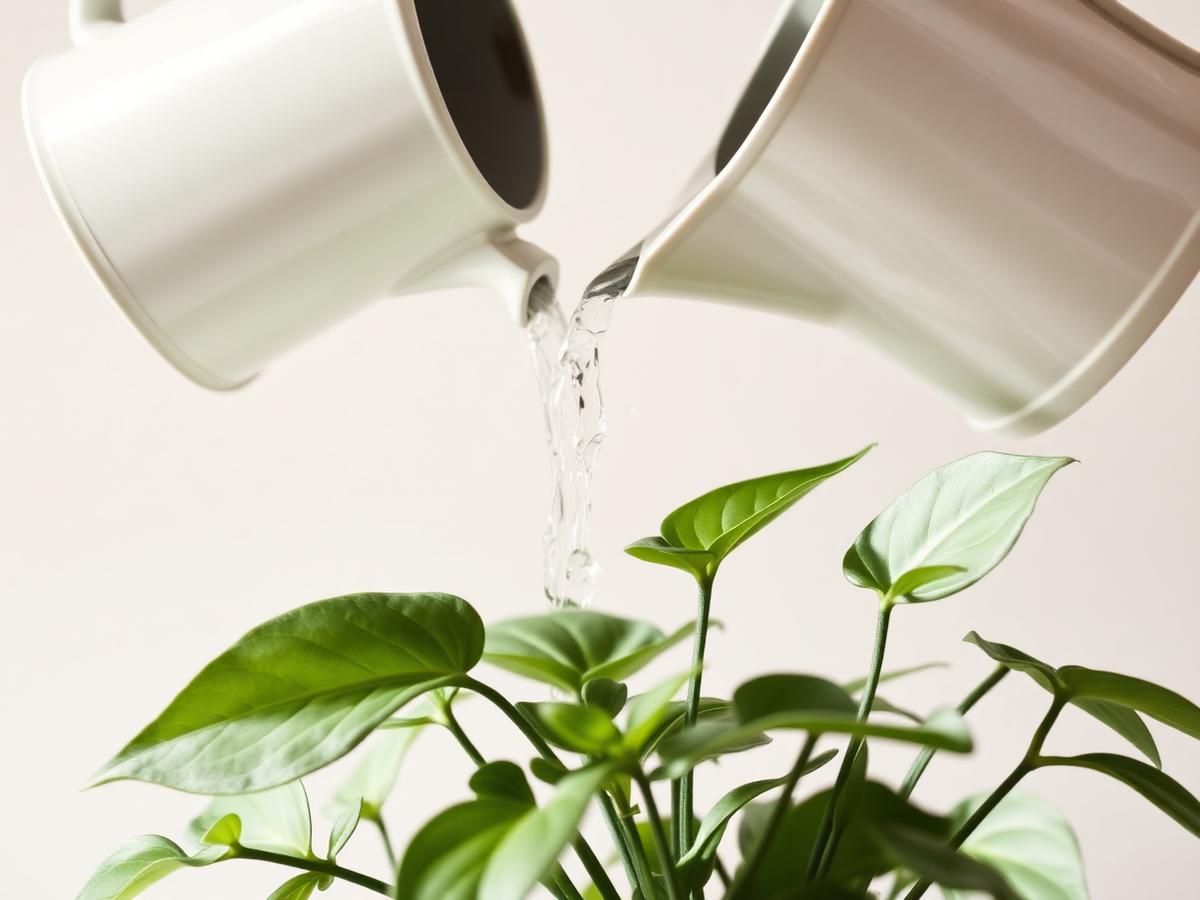
Water ZZ plant only when the top 3–5 cm of soil is completely dry — not slightly dry, not damp to a depth of 1 cm. Push your finger in to the second knuckle. If there is any moisture at all, wait. In practice this means watering every 2–4 weeks in summer in a well-lit spot, and every 4–6 weeks in winter or in low light.
When you do water, water thoroughly. Trickle-watering — a small amount every few days — leads to salt buildup in the top soil and wet-then-dry cycles that stress the rhizome. Instead, soak the pot until water runs freely from the drainage holes, then empty the saucer within 30 minutes and leave the plant completely alone until the soil dries again.
The rhizome is the source of the ZZ plant's famous drought resilience — and also the reason overwatering kills it silently. Unlike plants that show wilt or droop when distressed, a ZZ plant with a rotting rhizome keeps its above-ground appearance almost normal until the rhizome is entirely gone. By the time leaves turn yellow or stems go soft, rot has usually been progressing for weeks. See root rot in houseplants for the diagnosis and recovery protocol.
- ·Push your finger 3–5 cm into the soil. If any moisture remains, wait another week.
- ·Lift the pot. A ZZ plant that needs water is noticeably lighter than one recently watered.
- ·In winter, err on the side of underwatering. The plant is semi-dormant and uses almost no water.
- ·Never let the pot sit in standing water. Empty saucers within 30 minutes of watering.
Soil and potting mix
ZZ plant needs a fast-draining mix that does not hold prolonged moisture around the rhizomes. A standard houseplant compost mixed 1:1 with perlite works well. A proprietary cactus or succulent mix is also appropriate. The goal is a mix that is moist for no more than 7–10 days after a thorough watering.
Clay soil, peat-heavy mixes, and any mix marketed as 'moisture-retentive' are wrong for this plant. These hold water against the rhizomes for too long and create the anaerobic conditions that trigger rot. If your existing mix seems dense or clumping when wet, work in 20–30% perlite at the next repotting.
Drainage holes are non-negotiable. ZZ plants in pots without holes almost always die from root rot within 12–18 months because excess water has nowhere to go.
Humidity and temperature
Unlike most aroids, ZZ plant is not sensitive to low humidity. The waxy leaflet cuticle is thick enough to prevent rapid transpiration, and the rhizome provides a water buffer that protects against air dryness. Household humidity of 30–60% is fine — it will not suffer in a heated Nordic apartment in winter, unlike calathea or peace lily.
Temperature tolerance is broad: 15–30 °C suits any normal home. Below 8 °C the plant shows cold damage — darkened water-soaked patches on leaves, yellowing, eventual stem collapse. Keep it away from cold windowsill drafts in winter; the temperature at a single-glazed window can drop to 5–8 °C at night even when the room is warm.
Feeding and repotting
Feed once a month from March to September with a balanced liquid fertiliser at half the label rate. Skip fertiliser entirely from October to February — the plant is semi-dormant and accumulated salts damage roots.
Repot every 2–3 years, or when rhizomes are visibly pushing out of the drainage holes. ZZ plants tolerate being root- and rhizome-bound well — a slightly snug pot actually slows water uptake and reduces overwatering risk. When you unpot, inspect the rhizomes: healthy ones are firm, cream-coloured, and smell faintly sweet. Soft, dark, foul-smelling rhizomes are rotting — cut away all affected sections with a clean knife and dust cuts with cinnamon. Go one pot size up — 3–5 cm wider in diameter. See when to repot houseplants.
Why are my ZZ plant leaves turning yellow?
Yellow leaves are the most common ZZ plant complaint. Four primary causes, in order of likelihood:
- ·Overwatering (most common): Lower leaves yellow first; stems may soften at the base; soil stays wet for more than 10 days after watering. Let the plant dry out completely, check rhizomes for rot. See why are my plant leaves turning yellow.
- ·Normal senescence: Oldest, lowest leaves occasionally yellow and drop as the plant redirects energy to new growth. One or two leaves yellowing at the bottom over several months is normal.
- ·Root rot: Advanced overwatering. Unpot and check rhizomes — soft, dark, foul-smelling ones must be cut away. Repot in fresh dry cactus mix.
- ·Cold damage or draft: Leaves develop dark water-soaked patches that yellow then blacken. Move away from cold glass and drafts.
Pests and toxicity
ZZ plant is one of the most pest-resistant houseplants. The waxy leaf surface physically impedes most soft-bodied insects. Scale insects and occasional mealybugs are the only pests that appear regularly, and only on stressed plants. Scrape scale off with a toothbrush dipped in soapy water; wipe mealybugs away with 70% isopropyl alcohol on a cotton pad. See scale insects on houseplants.
ZZ plant contains insoluble calcium oxalate raphides in all parts — leaves, stems, and rhizomes. If chewed by a pet or small child, the crystals cause immediate oral irritation: drooling, pawing at the mouth, sometimes vomiting. Symptoms resolve within a few hours. The plant is not carcinogenic — an outdated claim with no toxicological basis. Keep it out of reach of pets that chew; it is not a life-threatening emergency. See are houseplants toxic to cats and dogs.
Seasonal care in a Nordic apartment
ZZ plant is one of the best houseplants for a Nordic apartment because its dormancy aligns naturally with the dark, dry winter months.
- ·Spring (Mar–May): Resume feeding. Move closer to the window as light improves. Water every 2–3 weeks as growth resumes.
- ·Summer (Jun–Aug): Peak growth. New stems emerge from the rhizome — the main flush of the year. Water every 2–4 weeks.
- ·Autumn (Sep–Oct): Taper feeding. Reduce watering frequency to every 3–4 weeks as light drops.
- ·Winter (Nov–Feb): Skip fertiliser. Water every 4–6 weeks. Little or no new growth is normal dormancy, not distress. See winter houseplant care.