Why bagged potting soil fails most houseplants
The compost on the shelf at a supermarket or hardware store is almost always optimised for one job: starting vegetable seedlings. It is fine, dense, holds water for days, and breaks down quickly into a nutrient-rich slurry — exactly what a tomato seedling wants for its first six weeks. None of those properties suit a Monstera deliciosa or a snake plant, both of which evolved with their roots in well-drained leaf litter or rocky scree, not in vegetable beds.
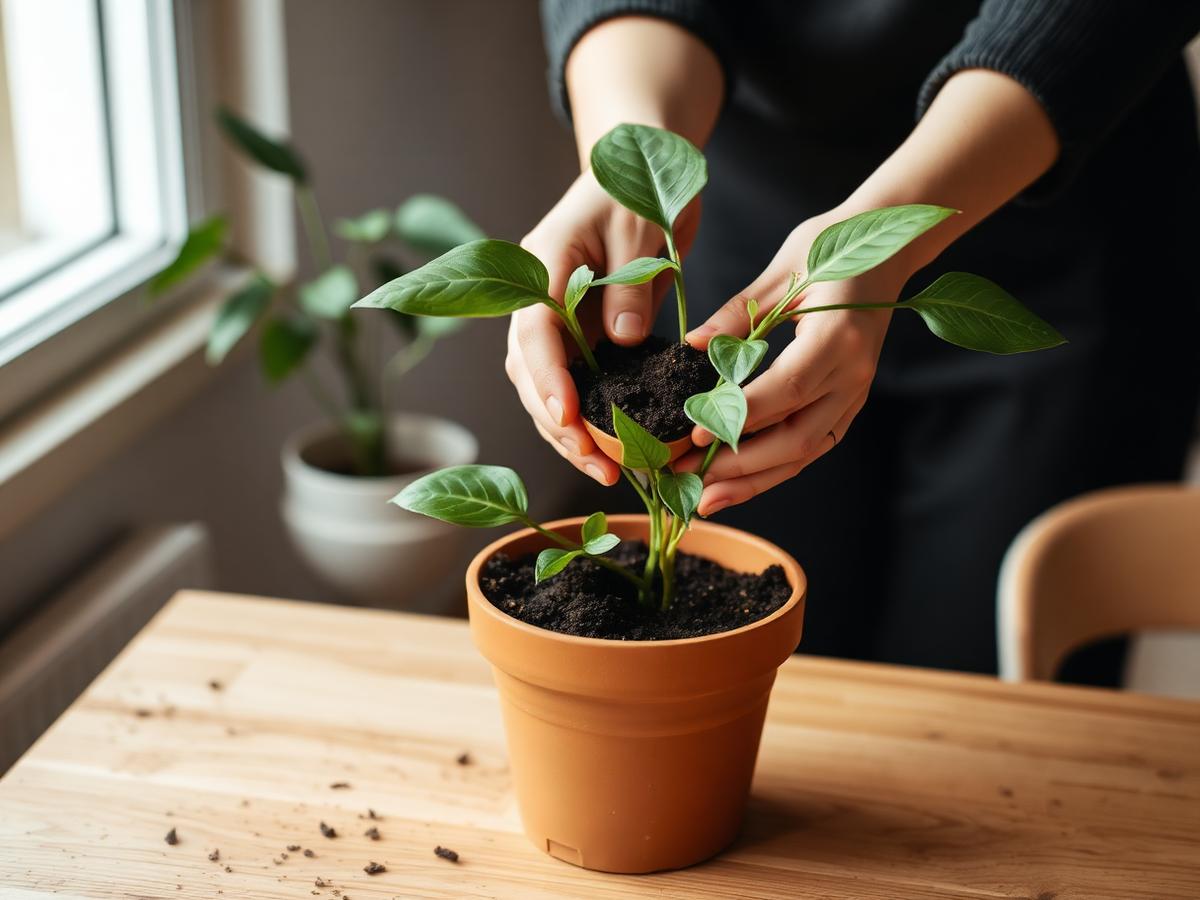
When you pot a tropical aroid or a cactus into pure bagged compost, three things happen over the next 8–12 weeks. The soil compacts as you water it, eliminating the air pockets the roots need for oxygen. The dense organic matter retains water far longer than the plant can use it, creating the wet-feet conditions that cause root rot. And the fine particles work their way into the drainage holes and clog them, so the pot stops draining freely.
The fix is rarely a different bag — it is amending the bag you have. A 70/30 blend of generic potting compost with perlite drains adequately for most foliage plants. A 40/30/20/10 blend of compost, perlite, orchid bark, and charcoal is what aroids actually want. The mixes below are the four that cover every popular houseplant. (One related decision worth flagging up front: what, if anything, to put on the surface of the mix. The honest answer is in top dressing plant soil — pebbles, moss, bark — most cosmetic, only a few functional, and one of them genuinely suppresses fungus gnats.)
The four mixes that cover every houseplant
Almost every common houseplant fits into one of four substrate categories. Once you have the four mixes on hand — or the ingredients to blend them — you do not need to think hard about substrate again.
- ·Standard houseplant mix — 70% peat-free houseplant compost + 30% perlite. For pothos, philodendron heartleaf, dracaena, peace lily, spider plants, Chinese evergreen, ferns, peperomia, baby rubber plant, syngonium.
- ·Aroid mix (chunky) — 40% coco coir or peat-free compost + 30% perlite or pumice + 20% orchid bark + 10% horticultural charcoal. For Monstera deliciosa, Anthurium, Alocasia, rare Philodendron cultivars (Pink Princess, Birkin), Syngonium with chunky roots, climbing aroids on moss poles.
- ·Cactus / succulent mix — 50% houseplant mix + 30% perlite or pumice + 20% coarse sand or fine grit. For snake plant, ZZ plant, jade, echeveria, haworthia, sedum, sempervivum, agave, most cacti.
- ·Orchid bark (mostly bark, no soil) — coarse fir or pine bark + a little sphagnum moss + a handful of perlite. For Phalaenopsis orchids and most epiphytic orchids. Standard potting soil suffocates orchid roots within weeks.
Mix 1 — Standard houseplant mix (the workhorse)
If you only blend one mix, blend this one. Seventy parts of bagged peat-free houseplant compost to thirty parts of perlite covers the majority of foliage houseplants. The perlite increases air-filled porosity and prevents compaction; the compost provides the nutrients and water-holding capacity that fast-growing tropicals need.
I weigh ingredients rather than measuring strictly by volume — a cup of compressed compost and a cup of perlite are not the same physical mass, and a recipe by volume drifts as the bag of compost settles. For a single 2-litre pot's worth of mix, I use about 1.4 litres of fluffed compost and 600 ml of perlite, mixed dry in a deep tub before potting.
Use this mix for any houseplant that does not specifically demand chunky drainage or lean substrate. It is also the right base for citrus, indoor herbs, and most flowering houseplants — see moving houseplants outside for summer for the outdoor version of the same mix with extra grit.
Mix 2 — Aroid mix (the one most worth learning)
Aroids — Monstera, Philodendron, Anthurium, Alocasia, Syngonium — evolved on rainforest floors thick with decomposing bark and leaf litter. Their roots are adapted to a substrate that is mostly air pockets between coarse fibrous lumps. Pot them in dense bagged compost and the roots, deprived of oxygen, sit in moisture and rot within months.
The recipe I use after years of substrate trial-and-error: 40% coco coir or peat-free houseplant compost, 30% perlite or pumice, 20% medium-grade orchid bark, 10% horticultural charcoal. The coir or compost holds enough moisture for weekly watering. The perlite or pumice opens the structure so it stays loose under repeated waterings. The orchid bark provides chunky air pockets that mimic decomposing wood. The charcoal absorbs salts and slows microbial breakdown of the mix.
If you only have one of those amendments and not all four, the order of importance is: perlite > orchid bark > charcoal. A 60/40 blend of compost and perlite is far better for an aroid than straight compost, even if you cannot get bark or charcoal. Substitute pumice for perlite if you can find it cheaply — it is heavier (good for top-heavy monsteras) and breaks down more slowly.
Mix 3 — Cactus / succulent mix (lean and fast)
Succulents and cacti want the opposite of an aroid mix: low organic content, sharp drainage, almost no moisture retention. Half houseplant mix, 30% perlite or pumice, 20% coarse builder's sand or fine grit by volume gives you a substrate that drains in seconds and dries fully within a week even in a deep pot.
Avoid play sand from a children's section — it is too fine and will cement when wet. Look for horticultural sand, builder's sharp sand, or 1–4 mm aquarium gravel. Pumice is better than perlite for top-heavy cacti because it adds weight and stabilises the pot.
This is the right mix for snake plants, ZZ plants, jade plants, echeveria, sempervivum, haworthia, aloe, and most cacti. See also indoor succulent care for the matching watering routine.
Mix 4 — Orchid bark (almost no soil)
Phalaenopsis and most epiphytic orchids must be grown in coarse bark, not soil. Their roots are adapted to bare tree branches and need air around them; standard potting soil suffocates them within weeks. Use medium-grade orchid bark (fir or pine, 1–2 cm chunks) on its own, or add a small amount of sphagnum moss and perlite to slow drying in heated rooms.
Pre-mixed orchid potting bark is widely available and works well for beginners. Avoid "orchid mix" products that are mostly soil with bark chunks added for visual effect — read the ingredient list. A reliable mix at home: 80% coarse fir bark, 10% sphagnum moss, 10% perlite, blended dry. See Phalaenopsis orchid care for beginners for the watering pattern that goes with this substrate.
The DIY aroid mix — measured recipe
This is the recipe I use for every aroid in my flat, scaled to a 5-litre batch — enough to repot 4–6 medium pots. I measure by volume in a kitchen jug and mix dry in a 10-litre tub before potting. Hydrate the coir before mixing if you are using compressed coir bricks.
- 12 litres coco coir or peat-free houseplant compost (40%) — the moisture-holding base.
- 21.5 litres perlite or pumice (30%) — the porosity and drainage backbone.
- 31 litre medium orchid bark, 1–2 cm chunks (20%) — the structural air pockets.
- 40.5 litres horticultural charcoal, 5–10 mm (10%) — the salt absorber.
Why each ingredient is in the mix
Substrate ingredients are not interchangeable; each does something specific. Knowing what each one contributes lets you substitute intelligently when one is out of stock.
- ·Coco coir — the fibrous husk of coconut. Holds water without becoming sodden, has near-neutral pH (5.5–6.8), and is renewable in a way peat is not. Sold as compressed bricks that expand 5–8x in water. The default base for any peat-free mix.
- ·Peat-free houseplant compost — bagged compost made from coir, bark fines, wood fibre, and composted green waste. Holds slightly less water than peat-based compost and drains better. The Royal Horticultural Society has phased out peat for environmental reasons, and most UK suppliers now lead with peat-free.
- ·Perlite — heated volcanic glass that puffs into white pebbles. Adds air pockets, very lightweight, neutral pH, infinite shelf life. Cheapest substrate amendment available; works in every mix.
- ·Pumice — natural volcanic stone, heavier and more porous than perlite. Same drainage benefit but adds weight (good for top-heavy plants) and lasts longer in the mix without breaking down. Costs 2–4x more than perlite.
- ·Orchid bark — coarse fir or pine bark in 1–2 cm chunks. Provides large air pockets between particles; mimics decomposing wood on a forest floor. Sold for orchids but used widely in aroid mixes. Lasts 18–24 months before breaking down to the point of needing repotting.
- ·Horticultural charcoal — activated charcoal in 5–10 mm chunks. Absorbs dissolved salts and excess minerals from irrigation, slows microbial breakdown of organic matter, and discourages anaerobic conditions. Optional but cheap insurance against tap-water build-up.
- ·Sphagnum moss — long-fibre moss harvested from peat bogs. Holds water aggressively (2–4x its dry weight) and is sterile when packaged. Used for orchid mixes, propagation, and aerial-root packing on aroids. Sustainably-harvested New Zealand sphagnum is the standard.
- ·Vermiculite — heated mica that expands into accordion-like flakes. Holds water and nutrients well, but compacts over time and reduces drainage. Better for seed-starting than long-term houseplant pots. Avoid in aroid mixes.
- ·Coarse sand / horticultural grit — sharp 1–4 mm particles for cactus mixes. Adds weight and improves drainage in dry-loving substrates. Avoid play sand (too fine, cements) and beach sand (salty).
Peat vs peat-free — and why it matters
For decades the bagged compost industry was built on peat — partially decomposed sphagnum harvested from peat bogs. Peat holds water beautifully, has near-perfect texture, and is cheap. The problem is environmental: peat bogs are major carbon sinks, and harvesting them releases stored carbon faster than the bog can regenerate. The Royal Horticultural Society banned peat from its gardens and shows in 2019, and the UK government has phased it out for amateur use entirely from 2024.
Peat-free houseplant composts use coir, bark fines, wood fibre, and green-waste compost as the base. The early peat-free products were inconsistent — some held water far less, some far more, and bagged quality varied between batches. The current generation (from RHS-approved suppliers and most major brands) is comparable to peat-based compost in performance, though it is a touch faster-draining and slightly more nutrient-poor, both of which are easily fixed by feeding lightly during the growing season.
If you have an old half-bag of peat-based compost, it is fine to use up — the environmental cost of throwing it away is worse than using it. For new bags, choose peat-free.
Pre-mixed bags vs DIY — when each makes sense
Pre-mixed aroid, cactus, and orchid blends are widely available and worth buying if you have one or two plants and no interest in storing perlite. The cost is roughly 3–5x the DIY equivalent, and quality varies — read the ingredient list rather than the marketing. A premixed bag with "perlite, orchid bark, coco coir" listed is reasonable; one with no ingredient list is suspect.
DIY pays off above about five plants. A 100-litre bag of perlite costs roughly the same as four small pre-mixed aroid bags, and lasts a year or two of repotting. Storage is the only real downside — a flat with a balcony cupboard handles it easily; a one-bedroom flat with no storage may not.
A reasonable middle path: buy pre-mixed cactus and orchid mixes (small quantities, infrequent repotting) and blend your own standard and aroid mixes from compost, perlite, bark, and charcoal stored in lidded bins.
Common soil mistakes
Most substrate problems trace to one of five mistakes. The diagnostic shortcut:
- ·Using bagged compost straight from the bag for aroids — root rot within weeks. Add perlite and bark.
- ·Adding gravel to the bottom of a pot for "drainage" — actually raises the perched water table and makes drainage worse. Use the right mix throughout instead.
- ·Layering different mixes (a layer of cactus mix at the bottom under a layer of regular mix) — water collects at the interface. Use one consistent mix per pot.
- ·Watering a brand-new repot heavily on day one — fresh mix is dusty and dries out in patches, leaving dry pockets. Water lightly the first time; soak thoroughly the second.
- ·Reusing old mix from a dead plant — old substrate is broken down, salt-laden, and may carry pathogens. Compost it; start with fresh mix.
When to refresh the mix
Substrate breaks down over time. Even a well-blended aroid mix slowly compacts as the bark fines settle and the organic matter decomposes — within 18–24 months it has lost most of its drainage benefit. Signs the mix is past its useful life: water draining slowly through the pot, pooling at the surface, persistent fungus gnats, white salt crust around the rim, or growth that has stalled despite normal light and watering.
The full reset is repotting into fresh mix — see when to repot houseplants. A lighter intermediate intervention is to top-dress: scrape off the top 2–3 cm of old mix and replace with fresh, every 12 months. This refreshes the surface zone where most root activity happens and buys time before the next full repot.
If you discover that a plant you bought three years ago is still in its original nursery mix, repot it now regardless of season. Three-year-old mix is unsalvageable — and the plant is almost certainly underperforming because of it. See repotting shock signs and recovery for what to expect after.